

GCSE Religious Studies Grade and Sixth Form
GCSE religious studies grade meaning explained: compare grades 9-1 with typical sixth-form expectations and plan your route to A-level Religious Studies.
A results sheet can make one number feel like a verdict. It is not. If you are wondering about your GCSE Religious Studies grade and sixth form, the useful answer is simple: grades 5 or 6 commonly meet published entry expectations for A-level Religious Studies, but there is no universal national requirement. Some providers accept grade 4, some ask for grade 6 in English, and others do not require GCSE Religious Studies at all.
That variation matters. Your grade is evidence of your current knowledge and writing skills, not a permanent limit on what you can study next.
Your sixth-form checklist
Before choosing a course:
- check the provider's general sixth-form entry requirements;
- check the subject-specific requirement for Religious Studies;
- look for separate English Language or English Literature conditions;
- ask whether GCSE Religious Studies is required or merely preferred;
- compare the A-level specification with what you enjoyed at GCSE;
- contact the admissions team if your result is below the published requirement.
Awarding bodies do not normally impose a single GCSE entry grade for A-level Religious Studies. Schools and colleges decide whom to admit. AQA states that there are no formal previous-learning requirements, although GCSE-level knowledge and skills are recommended. OCR similarly builds on GCSE skills but does not make prior study compulsory.
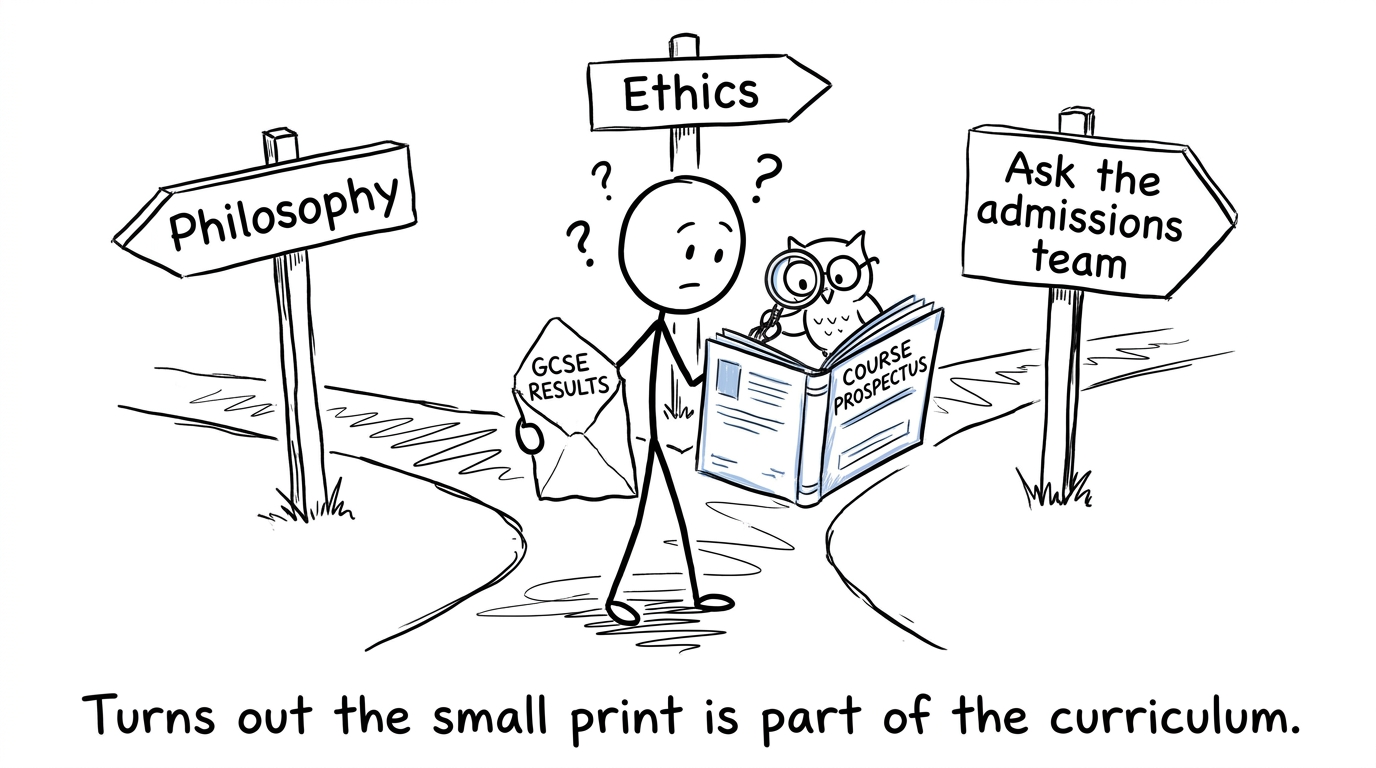 A student discovers that checking the course prospectus is part of choosing sixth-form options
GCSE Religious Studies grade meaning: grade by grade
In England, GCSEs use grades 9 to 1, with 9 as the highest grade. Grade 4 is officially recognised as a standard pass. Grade 5 is commonly described as a strong pass, although individual sixth forms remain free to set higher requirements.
| GCSE grade | What it may mean for sixth-form progression |
|---|---|
| Grade 9 | You have demonstrated exceptional GCSE performance. You should usually be academically well placed for A-level Religious Studies, provided you meet the provider's wider entry conditions. |
| Grade 8 | A very strong result showing secure knowledge, analysis and evaluation. It will normally exceed subject-specific entry requirements. |
| Grade 7 | A strong foundation for the greater reading and essay writing required at A level. It is likely to satisfy most published subject requirements. |
| Grade 6 | Often a comfortable result for progressing to A-level Religious Studies. Some selective providers may also require grade 6 in English Language or Literature. |
| Grade 5 | A common minimum requirement where a provider specifically asks for GCSE Religious Studies. Check whether English and your overall GCSE profile are considered too. |
| Grade 4 | A standard pass. Some colleges accept it, while others set their minimum at grade 5 or 6. A conversation with the subject leader may be worthwhile. |
| Grade 3 | This will fall below many published A-level entry requirements. Progression may still be considered where GCSE Religious Studies is not compulsory and your English grades are stronger. |
| Grades 2 or 1 | Direct entry is less likely where the course has subject-specific conditions. Ask about alternative Level 3 pathways and whether later progression is possible. |
| U | An ungraded result does not automatically define your wider ability, but it is unlikely to support direct entry where GCSE Religious Studies is required. Seek individual advice from the provider. |
These are practical interpretations, not national admission rules. Always treat the course page or prospectus for your chosen sixth form as the deciding source.
Progressing to A-level Religious Studies
A level is not simply a longer version of GCSE. Depending on the exam board, it can include philosophy of religion, ethics and detailed study of religious thought. OCR, for example, assesses philosophy, religion and ethics, and developments in religious thought across three components. AQA uses two assessed components and is linear, so its examinations are taken at the end of the course.
The most important transition skills are often:
- constructing a sustained argument;
- using evidence accurately;
- comparing competing interpretations;
- evaluating rather than merely describing;
- reading demanding material independently;
- writing clearly under timed conditions.
That is why an English requirement sometimes appears even where GCSE Religious Studies is not essential. A-level success depends heavily on literacy, judgement and organised argument.
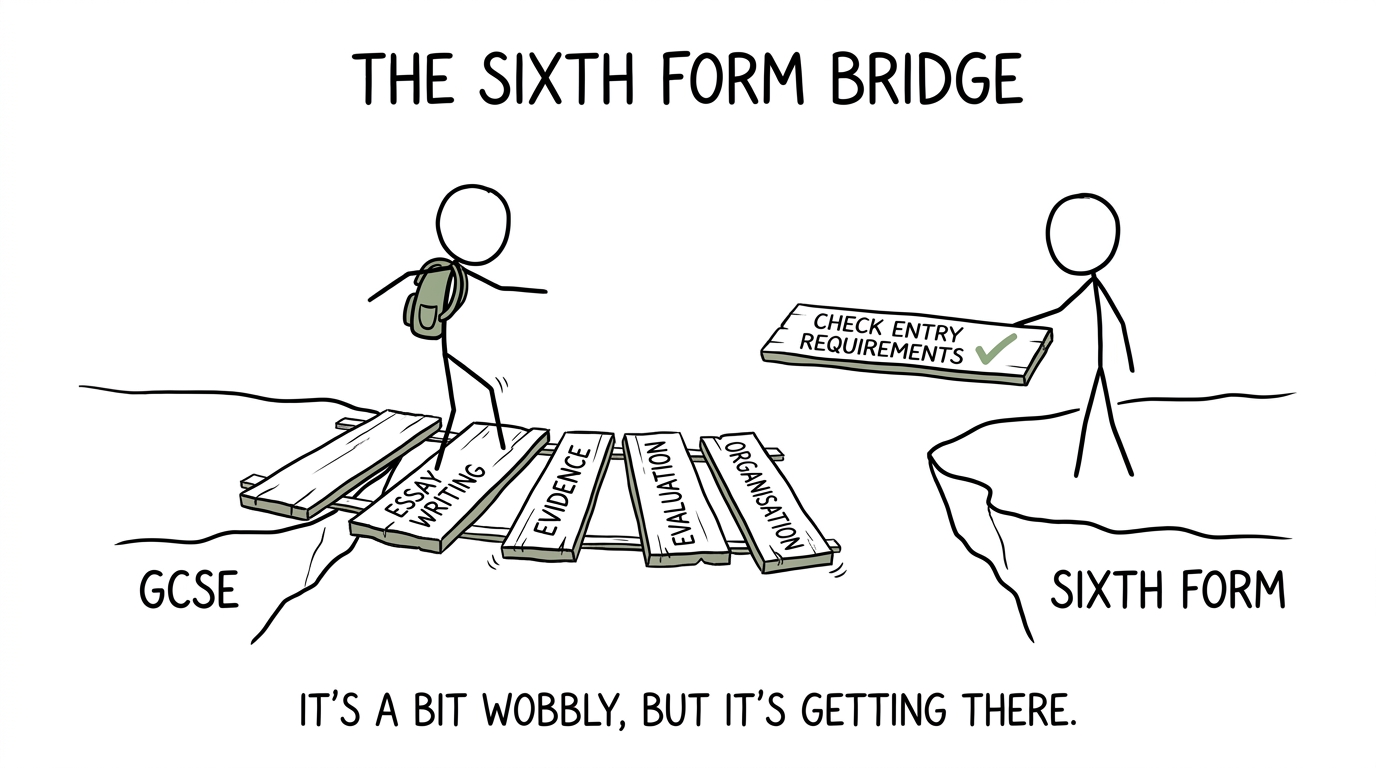 A student builds a bridge from GCSE to sixth form with skills rather than shortcuts
What to do if your grade is below the requirement
Do not reject yourself before the admissions team has considered you. Published requirements guide decisions, but some providers consider the whole application, available places and performance in related subjects.
Ask a precise question: Would you consider me with this Religious Studies grade if my English result and overall GCSE profile meet your requirements?
You can also show readiness by completing transition reading, revisiting ethical arguments and practising structured essays. If entry is not possible, ask which alternative course would preserve your longer-term options. The sensible route is not always the most direct one.
Your other GCSEs still matter. Many sixth forms have general entry conditions covering a minimum number of GCSE passes, while English and maths frequently receive particular attention. If maths is one of the grades you still need to strengthen, begin with the free GCSE Maths revision hub. It covers Edexcel, AQA, OCR, Eduqas and other boards.
Balancing Religious Studies with maths revision
Choosing post-16 subjects can make every GCSE feel urgent at once. The answer is not to abandon one subject for another, but to give each revision session a clear purpose.
For maths, use short feedback loops. Learn one method, answer questions, mark them and repair the mistake. The 20-minute GCSE maths revision routine offers a manageable structure for busy weeks.
You can then target weak areas through the Edexcel GCSE Maths question bank or use the AQA GCSE revision guides if that is your board. Closer to the examinations, move into timed Edexcel GCSE Maths past papers or choose mini tests and predicted papers from the MathsGenie revision resources.
Common mistakes when interpreting your grade
Assuming every sixth form uses the same threshold. Entry criteria are local decisions. Check each provider separately.
Looking only at your Religious Studies result. English grades, your overall GCSE profile and general entry rules may be equally important.
Treating a grade 4 as a failure. It is an official standard pass, although it may not meet every A-level course requirement.
Assuming GCSE success guarantees an easy A level. The depth of reading, evaluation and extended writing increases substantially.
Giving up without asking. If you narrowly miss a condition, request accurate advice rather than relying on rumours or another student's offer.
Your grade is information, not identity
The real meaning of a GCSE Religious Studies grade is the next decision it helps you make. Compare it with the exact sixth-form criteria, examine your English result, and ask what evidence would strengthen your application. If you meet the conditions, prepare for a more philosophical and demanding course. If you do not, ask calmly about alternatives.
Meanwhile, protect the grades that support almost every post-16 route. Use MathsGenie's free revision lessons, practice questions, mark schemes, video solutions, mini tests, past papers and predicted papers to turn maths mistakes into a practical revision plan. If maths is part of your sixth-form future, you can later continue through the A Level Maths revision hub.











