Is Grade 4 GCSE Food and Nutrition Enough?
Grade 4 GCSE Food and Nutrition sixth form entry varies by course. Learn what to check, which grades matter and how to strengthen your application.
Results day can make one number feel larger than it really is. You see a grade 4 beside Food Preparation and Nutrition, then immediately wonder whether a sixth form or college will see potential or a closed door.
The short answer is that grade 4 GCSE Food and Nutrition sixth form entry is possible for some courses, but not guaranteed. A grade 4 may meet the subject requirement for a Level 3 Food Science and Nutrition course at one provider, while another may ask for a grade 5. You must also satisfy the provider's overall entry requirements, which commonly include GCSE English and maths.
So, is a grade 4 good enough? It can be. The only decisive answer, however, is the published requirement for the exact course and institution you want.
The quick sixth-form entry checklist
Before assuming that your grade is either sufficient or insufficient, check:
- the general entry requirements for the sixth form or college;
- the subject-specific requirement for Food Science and Nutrition;
- the required GCSE maths and English grades;
- whether GCSE Food Preparation and Nutrition is essential or merely preferred;
- whether the provider accepts related qualifications, experience or practical evidence;
- whether your offer is conditional on other GCSE results;
- what alternative Level 2 or Level 3 routes are available.
Entry rules are set locally. They can vary between institutions and from one admissions year to the next, so use the current prospectus and admissions policy rather than advice copied from an old discussion.
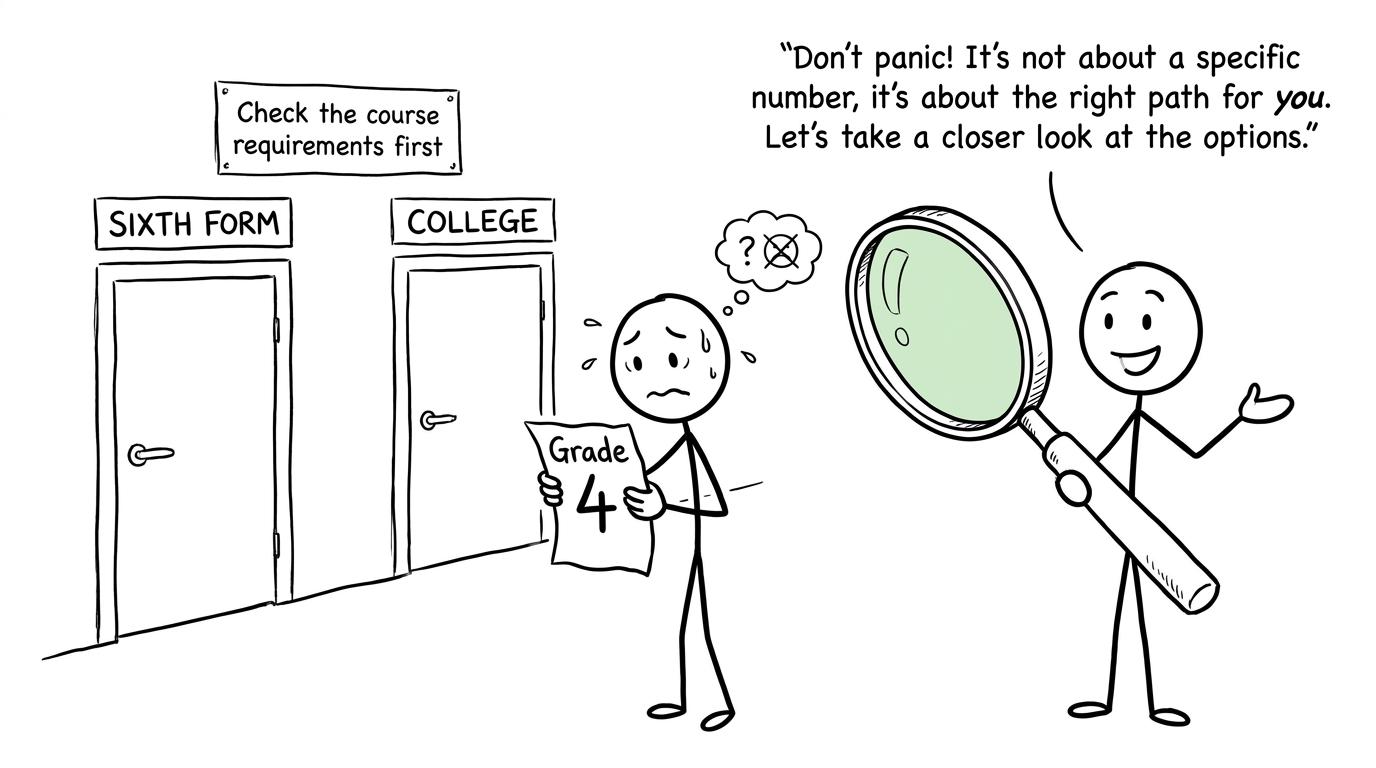 A student checking which sixth-form door matches a grade 4
What does a grade 4 actually mean?
In GCSE qualifications using the 999 to 111 scale, grade 4 is generally described as a standard pass. It is a recognised GCSE outcome, not a failed subject.
That distinction matters emotionally, but admissions decisions are more specific. A standard pass does not automatically satisfy every course requirement. Sixth forms may ask for a collection of GCSE passes at particular grades, while individual subjects can impose an additional threshold.
For example, a provider might accept students onto its wider Level 3 programme with several GCSEs at grade 4, yet require grade 5 in Food Preparation and Nutrition for its food course. Another might accept grade 4 in the subject but ask for a stronger science grade. There is no single nationwide food-course entry rule that every sixth form follows.
You should therefore separate two questions:
- Is grade 4 a GCSE pass? Yes, under the usual description of the grading scale.
- Does it meet my chosen course's conditions? Only the provider can confirm that.
Which sixth-form food course do you want?
The name of the next qualification matters. Students often search for an A Level in food and nutrition, but many post-16 providers instead offer a vocational Level 3 qualification in Food Science and Nutrition or a related hospitality, catering or health pathway.
Level 3 Food Science and Nutrition
This route can include nutritional needs, food safety, food science, practical work, research and assessment completed under different conditions. Its entry requirements vary considerably.
Some providers publish grade 4 in GCSE Food Preparation and Nutrition as the subject threshold. Others ask for grade 5, a related Level 2 qualification, or a particular grade in science. A few may consider students who did not take food at GCSE if they can demonstrate suitable knowledge, interest or practical ability.
Do not rely on the course title alone. Read the full entry requirement and check the qualification type, awarding organisation, assessment model and progression options.
Other college pathways
A grade 4 may also support an application for courses connected with:
- professional cookery;
- hospitality and catering;
- health and social care;
- sport and nutrition;
- applied science;
- public services or childcare where nutrition forms part of the curriculum.
These are not interchangeable qualifications. Compare what is taught, how it is assessed and where successful students can progress. The best route is not automatically the one with the most demanding entry grades. It is the one that fits your interests and future plans.
Why your maths grade may decide the answer
A student can focus so closely on the food grade that they overlook a second admissions condition: GCSE maths.
Many sixth forms and colleges include maths and English within their general entry criteria. If your desired course accepts grade 4 in Food Preparation and Nutrition but the provider requires a higher maths grade for its Level 3 programme, your maths result may become the deciding factor.
Maths also belongs naturally inside food science. You may need to interpret nutritional data, compare quantities, scale recipes, use percentages and understand graphs. These skills are useful before, during and beyond the course.
Relevant GCSE topics include:
- percentages revision and practice;
- fractions, decimals and percentages;
- ratio revision;
- proportion, units, averages and interpreting statistical information.
These are not just exam topics. A percentage describes a part of a whole:
percentage=partwhole×100\text{percentage}=\frac{\text{part}}{\text{whole}}\times 100percentage=wholepart×100A ratio compares quantities, while proportion helps you understand how a change in one amount affects another. Strong number sense can therefore improve both your GCSE maths result and your readiness for a food-related course.
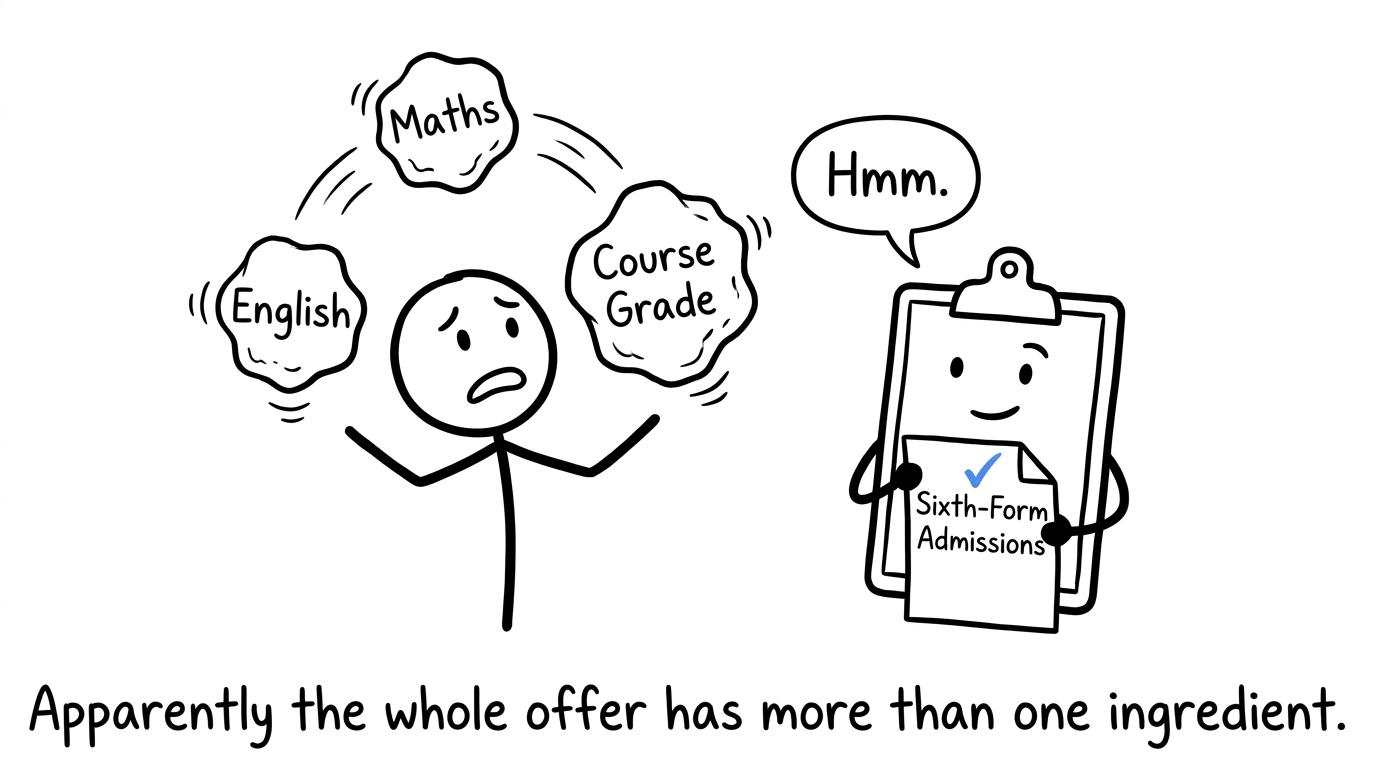 A student juggling several sixth-form entry requirements
How to check whether your grade 4 is enough
Read the current course page
Find the course in the provider's latest prospectus. Look for both the general sixth-form criteria and the subject-specific criteria. A sentence such as “five GCSEs at grade 4 or above” may be followed by a separate requirement for the food course.
Check the intended year of entry. Requirements can change when courses or qualifications change.
Contact admissions directly
If the wording is unclear, email the admissions team or course leader. Ask a precise question: whether grade 4 in GCSE Food Preparation and Nutrition meets the subject requirement, assuming you also achieve the provider's general entry grades.
You can also ask whether applicants are considered individually and whether practical evidence, a related qualification or stronger grades elsewhere can support an application. Individual consideration is never guaranteed, but it is better to ask than to reject yourself prematurely.
Apply to more than one suitable provider
One institution's threshold is not a judgement on your ability. It is an admissions rule shaped by that provider's course, available places and programme structure.
Consider a realistic first choice and at least one alternative. Your backup could be the same subject elsewhere, a related Level 3 course, or a Level 2 route that offers progression. Confirm that each option leads towards the university course, apprenticeship or employment area you may eventually want.
What to do before GCSE results day
You do not need to wait for your final grade before acting.
First, make a small comparison table for your possible destinations. Record the course title, qualification level, general entry rules, food requirement, maths requirement and application deadline. Mark anything that needs confirmation.
Next, protect the grades that appear across many offers. For students preparing for GCSE maths, the MathsGenie GCSE maths revision hub provides free topic resources and exam-board material for Edexcel, AQA, OCR, Eduqas and other specifications.
A useful revision cycle is:
- identify one weak topic;
- use a revision lesson or video to rebuild the method;
- complete practice questions without copying the solution;
- mark the work carefully;
- record the reason for each lost mark;
- retest the topic after a short gap.
If you are unsure where topics should fit, follow the best order for learning GCSE maths topics. Students currently working around grade 4 skills can also use the structured MathsGenie Stage 4 scheme, which combines tests, videos, exam questions and solutions.
Once individual methods are secure, move into mixed and timed work. The guide to GCSE maths topics that commonly appear can help you organise coverage, but no topic list can predict an actual paper. Use it alongside full practice, not instead of it.
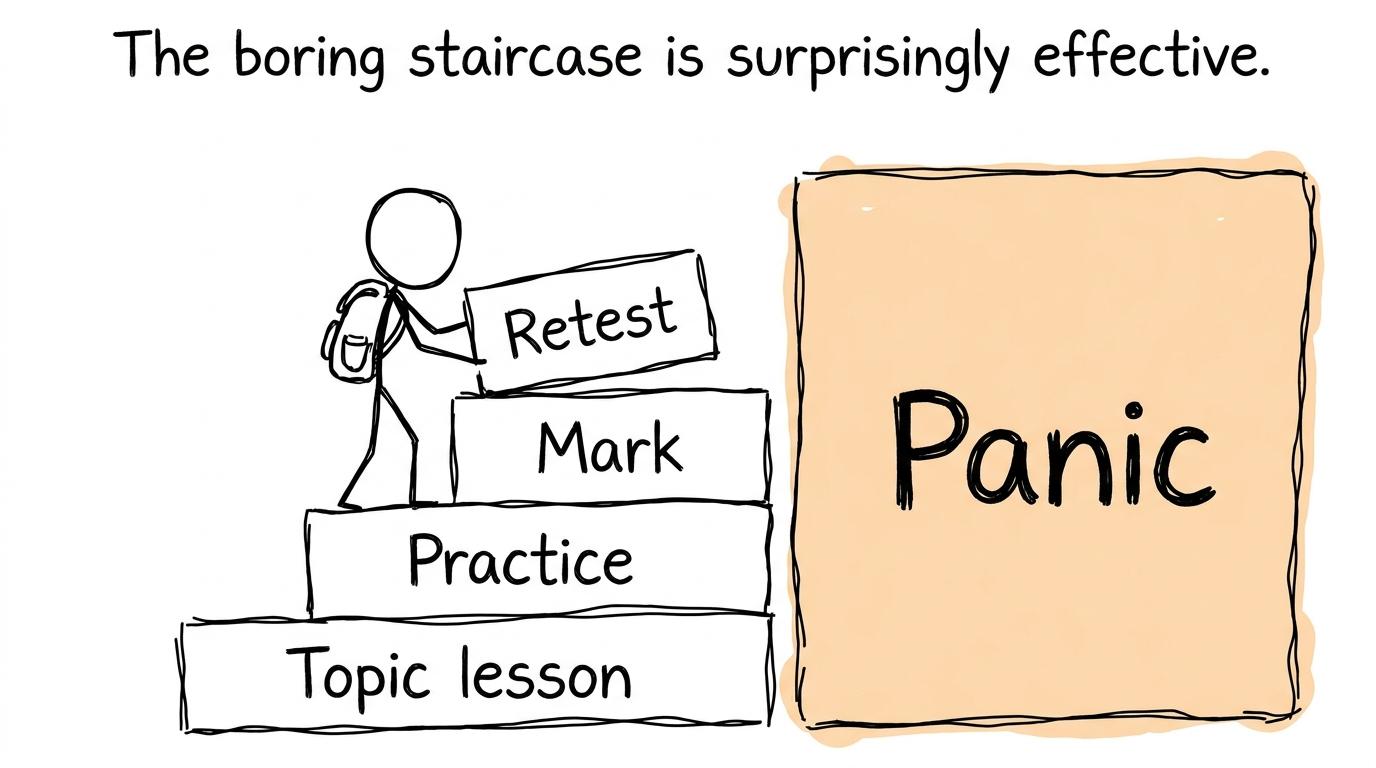 A calm revision staircase beside an unused block of panic
If you receive a grade 4 on results day
Take your results and offer information to the enrolment conversation. If grade 4 meets every published condition, follow the provider's normal enrolment process.
If the course asks for grade 5, still speak to the institution. Ask whether the threshold is firm, whether places remain and whether there is an appropriate alternative route. Do not claim that another provider's lower requirement should apply: each institution controls its own admissions decisions.
If maths or English is below the required threshold, ask how that affects your programme. Post-16 providers have rules concerning continued maths and English participation for eligible students who have not achieved the required GCSE standard, but the exact programme and admissions implications should be confirmed with the college.
A grade 4 can narrow some choices without ending the broader ambition. The useful question is not simply, “Is this grade good?” It is, “Which route remains open, and what does that route allow me to do next?”
Common mistakes when judging sixth-form entry
Treating a standard pass as automatic admission
Grade 4 is a recognised pass, but a course can set a higher threshold. Passing a subject and meeting a particular offer are different things.
Checking only the food grade
General entry requirements may include several GCSEs plus specified maths and English grades. Read the whole offer rather than one line.
Confusing similarly named qualifications
GCSE Food Preparation and Nutrition, Level 2 Hospitality and Catering, and Level 3 Food Science and Nutrition are different qualifications. Confirm exactly what your provider accepts.
Using last year's requirements
Course availability and conditions can change. Check the prospectus for your own entry year and retain written confirmation of any advice from admissions.
Assuming one rejection closes every route
Different sixth forms and colleges set different criteria. Compare suitable providers and related pathways before changing your long-term goal.
Revising maths through passive watching
Videos can explain a method, but improvement depends on attempting questions, checking mark schemes and correcting errors. Reading a solution can feel fluent even when you cannot reproduce the method independently.
Your next step
A grade 4 in GCSE Food Preparation and Nutrition may be enough for the course you want, particularly where the provider explicitly accepts that grade. It may fall short where grade 5, a stronger science result or broader GCSE profile is required. The current course page and admissions team provide the final answer.
While you check those conditions, focus on the part you can still influence. Build the maths grade that may support your application and prepare you for numerical work in food science. Start with the free MathsGenie GCSE revision hub, then move from revision lessons to practice questions, mini tests and full past papers. Mark every attempt carefully and use predicted papers as extra unseen practice rather than a replacement for past papers.
One grade is information, not identity. Use it to choose the next sensible step, and let MathsGenie help you make that step stronger.