GCSE Statistics Exam Season Results: Does Timing Matter?
GCSE statistics exam season results explained: discover whether summer or winter sittings affect grades, boundaries and your best revision strategy.
A difficult paper can make the calendar feel strangely important. If your exam is in summer, you may wonder whether a winter sitting would produce better results, perhaps with fewer candidates, different boundaries or more time to prepare.
The short answer on GCSE statistics exam season results is reassuring: the season itself should not make a grade easier or harder. Exam boards set boundaries for each series to account for differences in paper difficulty, with the aim of maintaining a comparable standard. More importantly, current GCSE Statistics qualifications are generally assessed in the summer series, so most students do not have a standard winter sitting to choose instead.
Where two seasons genuinely are available for a particular qualification, differences in published results usually tell us more about the candidates entering each series than about the weather or month.
The answer at a glance
Before comparing summer and winter, check these facts:
- Your exact qualification, exam board and specification determine which series are available.
- Current Pearson Edexcel GCSE Statistics assessments must be completed in the May/June series in a single year.
- AQA GCSE Statistics is also normally entered in the summer series.
- The familiar November GCSE series in England is primarily for eligible resits in GCSE English language and GCSE mathematics, not GCSE Statistics.
- Grade boundaries can change because papers differ in difficulty.
- A higher boundary does not automatically mean that achieving the grade was harder.
- If another statistics qualification offers both seasons, compare candidate groups before comparing headline pass rates.
- Preparation, subject knowledge and exam technique are far more useful targets than trying to identify a supposedly favourable season.
Start by checking your paperwork or asking your examinations officer. The GCSE Statistics revision hub can then direct you to resources for the correct board.
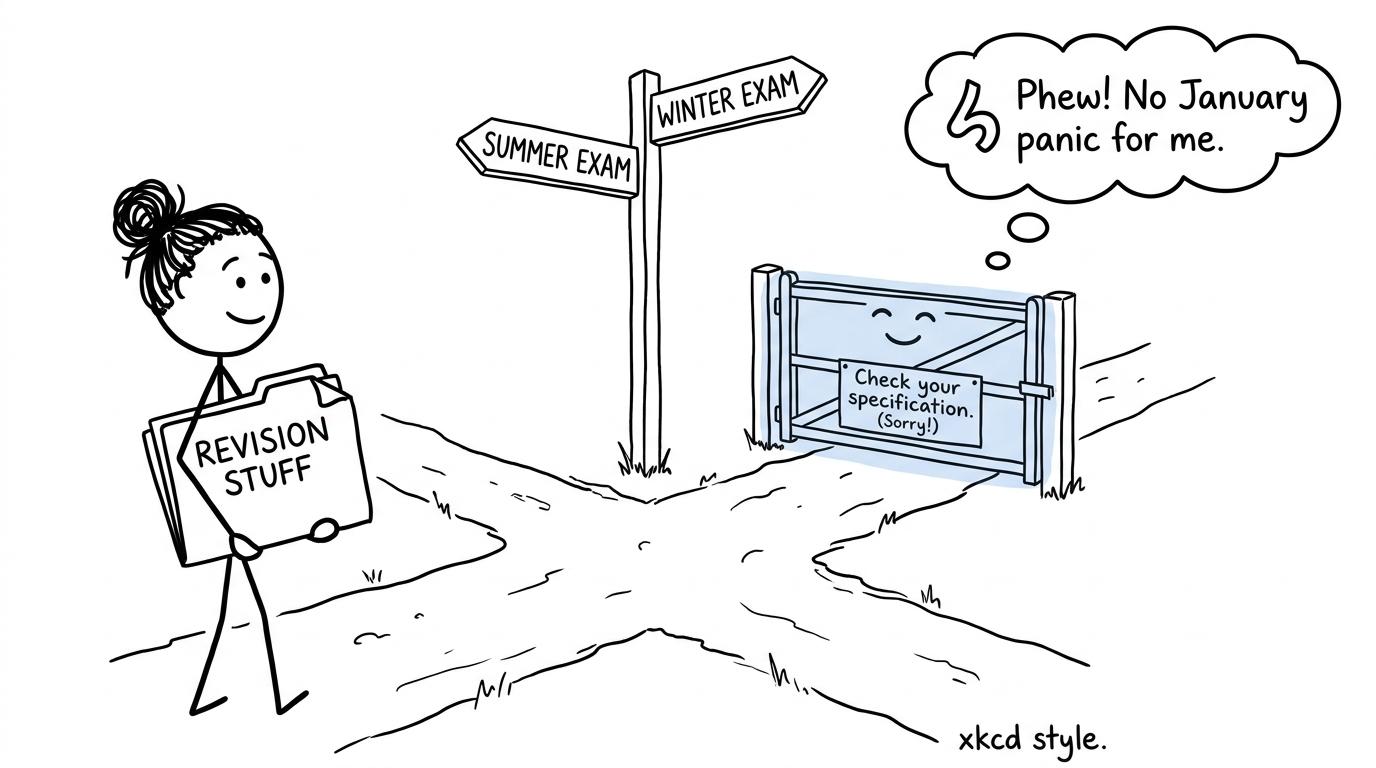 A student discovers that the winter exam path requires checking the specification
Is there a winter GCSE Statistics exam?
For most students taking a current UK GCSE Statistics qualification, no routine winter alternative is available.
Pearson's current Edexcel specification states that both externally examined papers must be completed at the same tier in May/June of a single year. Each paper lasts 111 hour 303030 minutes, carries 808080 marks and contributes 50%50\%50% of the qualification. Foundation and Higher tier candidates therefore complete a total of 160160160 raw marks in the same summer series.
AQA GCSE Statistics is likewise normally scheduled in the summer. Availability must always be confirmed against the current specification and timetable because arrangements can change, and qualifications outside England may operate differently.
This matters because students sometimes confuse three separate qualifications:
- GCSE Mathematics;
- GCSE Statistics;
- International GCSE or other statistics qualifications.
In England, GCSE mathematics has a November opportunity for candidates who meet the age requirement. That rule does not create an equivalent November opportunity for every GCSE subject. Seeing November GCSE maths results online does not mean that GCSE Statistics can be taken in the same series.
Your statistics board may also differ from your maths board. Do not assume that being an OCR or Eduqas maths student tells you which Statistics specification you follow. Check the logo and specification code on your mock paper, then choose the matching AQA GCSE Statistics resources or Edexcel GCSE Statistics resources.
Would summer and winter results be directly comparable?
Suppose two series are available for your exact qualification. A simple comparison of pass percentages would still be unreliable.
Ofqual has explained this problem when discussing November GCSE English language and mathematics. November candidates are commonly resitting, so they are not the same kind of cohort as the much larger summer group. Differences in outcomes can reflect prior attainment, age, entry decisions, teaching time and the reason candidates entered.
This is a classic issue of confounding. Exam season may appear to explain a result while other variables are doing much of the work.
A winter group might contain more resit candidates who narrowly missed their target. Alternatively, it might contain students who received extra teaching after summer. Those two influences could pull outcomes in opposite directions. A headline percentage cannot separate them.
The same caution applies when comparing exam boards. Schools select specifications differently, and their cohorts are not randomly assigned. A higher proportion of top grades on one specification does not prove that its papers are easier.
How grade boundaries protect candidates
Exam boards do not normally fix identical raw grade boundaries every year. They review statistical evidence and the quality of work seen by examiners before setting boundaries for a particular specification and series.
If one paper is more demanding than another, its boundary may be lower. If a paper is more accessible, its boundary may be higher. The intention is that the quality of work needed for a grade remains comparable even though the raw-mark threshold moves.
For instance, the percentage of available marks represented by a boundary can be written as:
Boundary percentage=raw grade boundarytotal available marks×100\text{Boundary percentage}=\frac{\text{raw grade boundary}}{\text{total available marks}}\times 100Boundary percentage=total available marksraw grade boundary×100That calculation describes a particular series. It does not tell you in advance what the next boundary will be, nor does it prove that one season gives candidates an advantage.
This is why practising only until you reach one historical boundary is risky. Boundaries move, question combinations change and performance under timed conditions can vary. The more useful approach is to examine several papers and leave a reasonable margin above your target. MathsGenie's guide to GCSE Statistics grade boundary history explains how to interpret these figures without treating them as predictions.
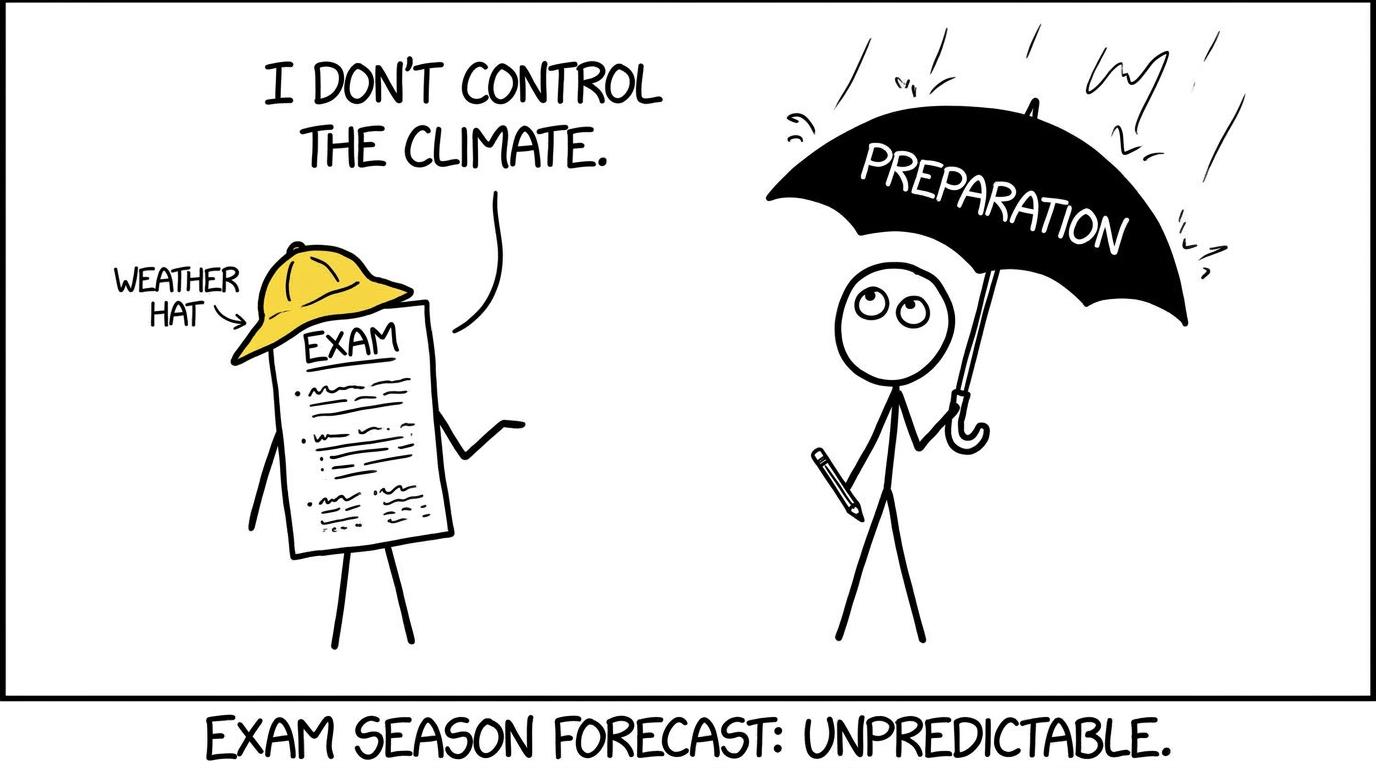 An exam paper explains that weather does not determine its difficulty
What the national results can and cannot tell you
JCQ's summer results data show that GCSE Statistics is a substantial qualification. In summer 2025, there were 34,87934{,}87934,879 UK entries. Approximately 71.1%71.1\%71.1% achieved grade 444 or above, while about 21.0%21.0\%21.0% achieved grade 777 or above.
Those figures describe the candidates who entered that summer. They do not establish what the same students would have achieved in winter. There is no matching experiment in which every candidate sits equivalent summer and winter papers under identical conditions.
The entry total also increased from 31,84431{,}84431,844 in 2024 to 34,87934{,}87934,879 in 2025. A changing cohort can alter an overall grade distribution even when the required grade standard remains stable.
National data are useful for understanding broad participation and outcomes. They are much less useful for forecasting an individual result. Your next mark is more likely to be influenced by whether you can interpret context, select an appropriate statistical method, communicate a conclusion and check the limitations of the data.
What can genuinely make one sitting feel different?
Although the season should not change the grade standard, circumstances surrounding an examination can affect personal performance.
Time available to prepare
A later sitting might provide more revision time, but extra time only helps when it is used deliberately. Repeating complete papers without analysing errors can preserve the same weaknesses for months.
Candidate status
A first-time candidate may have regular lessons and a complete school timetable. A resit candidate may be revising independently alongside college, an apprenticeship or employment. The exam has not necessarily become harder; the preparation environment has changed.
Familiarity with the specification
Statistics rewards more than calculation. Candidates must interpret data, evaluate methods, use precise language and follow the statistical enquiry cycle. Someone who has practised only overlapping GCSE maths content may underestimate these demands.
Pressure and timing
An examination near several other summer papers can create workload pressure. A separate sitting may feel calmer but can also interrupt a new course. Neither effect is automatic. A realistic revision timetable matters more than the season's name. The GCSE maths revision timetable guide offers a structure that can be adapted for Statistics.
A better way to prepare for GCSE Statistics
The strongest response to uncertainty is to replace speculation with evidence from your own work.
Begin with a paper matching your board and tier. Complete it under the correct time limit, using only the equipment permitted in the real examination. Mark it carefully and classify every lost mark as one of the following:
- missing knowledge;
- incorrect method;
- weak interpretation;
- imprecise statistical language;
- calculator or arithmetic error;
- poor timing.
Then repair the largest categories with topic questions and worksheets. Once those weaknesses are smaller, return to timed mixed practice. The guide to starting GCSE past papers can help you sequence topic revision, paper sections and complete examinations.
Past papers are most valuable when they alter what you do next. A score is only a measurement. The improvement comes from studying the mark scheme, correcting the reasoning and testing the same skill again without support.
 A student detective discards exam-season superstition and investigates real sources of lost marks
Common mistakes when comparing exam seasons
Assuming November GCSE maths rules apply to Statistics
Subject availability is qualification-specific. Confirm the series with your school, college or examinations officer rather than relying on a general GCSE timetable.
Treating pass rates as proof of difficulty
Different cohorts can produce different outcomes. Without controlling for prior attainment and candidate circumstances, a comparison cannot isolate the effect of season.
Reading a higher boundary as a harder grade
A higher raw boundary often reflects a more accessible paper. Boundaries are part of the process used to maintain comparable grade standards.
Using the wrong board or tier resources
A paper from another specification can still contain useful mathematics, but it may not reflect your assessment structure or wording. Match your main preparation to your actual board and Foundation or Higher tier.
Predicting a future boundary from one year
Historical boundaries are reference points, not promises. Build a cushion above your target and focus on marks you can control.
Repeating revision without diagnosing errors
If your result was lower than expected, use the GCSE Statistics results review guide to distinguish content gaps from timing, interpretation and examination technique.
Focus on the variables you can change
For current GCSE Statistics students, the summer-versus-winter question is usually settled by the specification: the ordinary assessment opportunity is in summer. Where another qualification genuinely offers both seasons, awarding is designed to maintain standards, while raw outcome differences may reflect very different candidate groups.
The calendar is therefore a weak revision target. Your knowledge, interpretation, accuracy and timing are much stronger ones.
Open the free MathsGenie GCSE Statistics revision centre, select your board and tier, and begin with one diagnostic paper. Use revision lessons and practice questions to repair the gaps, then return to past papers, mark schemes, predicted papers, video solutions and mini tests. Add each task to your revision planner.
You cannot control the season. You can control what your next marked paper teaches you.