

GCSE Statistics Lower Grade Than Expected?
GCSE Statistics lower grade than expected? Check your marks, consider a review, plan a resit and rebuild confidence with free revision resources.
A results sheet can make months of work feel as though they have been compressed into one small number. If you received a GCSE Statistics lower grade than expected, pause before deciding what it means. Your result may affect a course choice, but it does not erase what you learnt or define your ability.
Your immediate next steps are practical: check your marks, speak to your teacher, find out whether the grade affects your plans, and consider either a review of marking or a resit. Do not make the decision from disappointment alone. Make it from evidence.
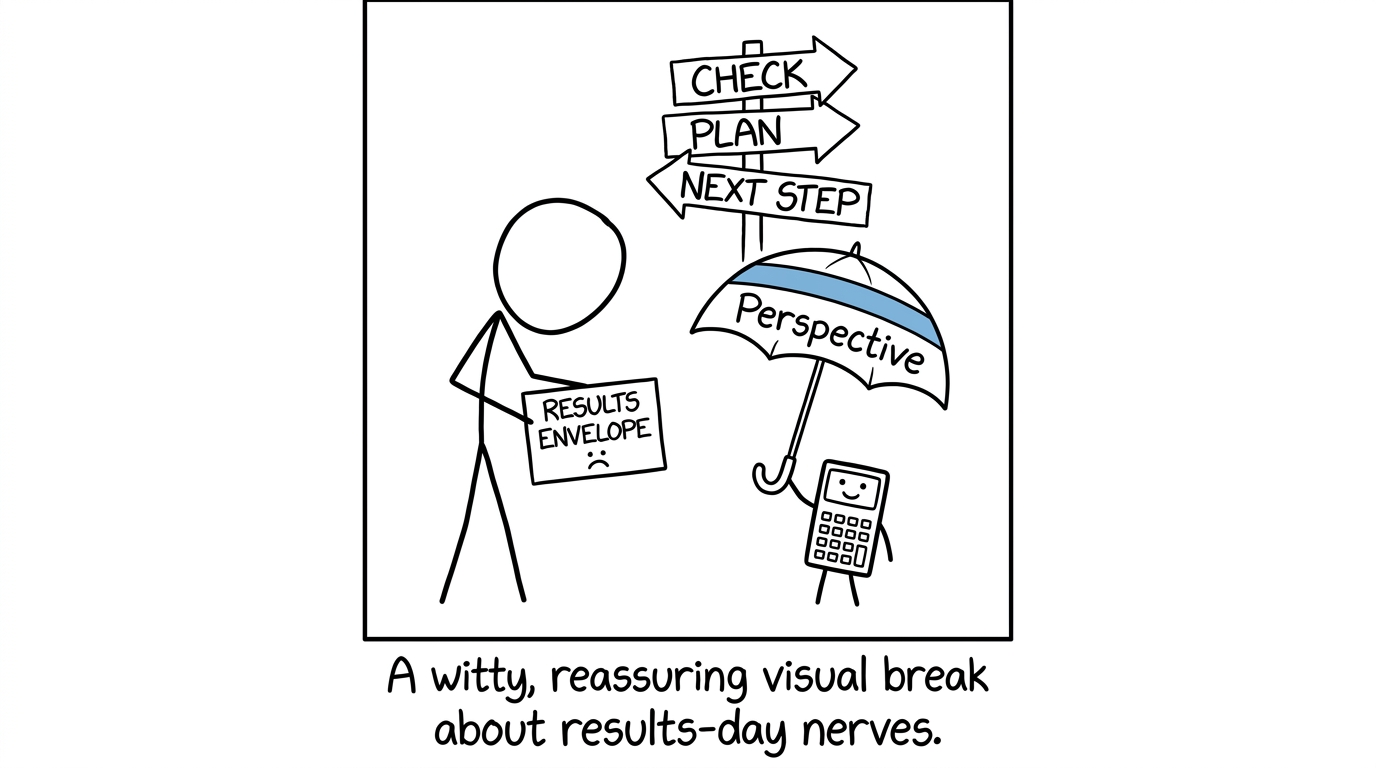 A student finding perspective after an unexpected GCSE result
Your results-day checklist
If your GCSE Statistics result was disappointing, work through this list:
- Confirm the grade and marks for each paper.
- Check the published grade boundaries for your exam board and series.
- Ask your teacher whether the result matches the standard of your written work.
- Find out whether the grade affects sixth-form, college or apprenticeship entry.
- Request access to your marked scripts if a marking error seems possible.
- Compare the risks, cost and deadline for a review of marking.
- If necessary, ask when and where you could resit the qualification.
- Begin a focused revision plan rather than repeating your old approach.
Start by identifying your board. MathsGenie has separate free hubs for AQA GCSE Statistics revision and Edexcel GCSE Statistics revision, including topic questions, past papers and mark schemes.
Check what the grade actually changes
A lower grade can feel urgent without being practically important. Before requesting a review or planning months of revision, ask what requirement you need to meet.
GCSE Statistics is a separate qualification from GCSE Maths. A disappointing Statistics result does not change your GCSE Maths grade. Sixth forms, colleges and employers also set their own entry requirements, so contact the institution directly rather than relying on assumptions.
If you have already met the conditions for your next course, accepting the grade may be reasonable. If the grade blocks a confirmed opportunity or matters strongly to your future subject choices, investigate further.
Also remember that a predicted grade is not a guaranteed result. Exam boards award grades from the work submitted in the examination series, not from predictions, mock results or how close a mark is to a boundary.
Ask for your marks and marked scripts
Speak to your school or college exams officer promptly. Ask for:
- your total qualification mark;
- the mark awarded on each paper;
- the relevant grade boundaries;
- information about access to scripts;
- your centre's post-results deadline and fees.
Schools and colleges can obtain marked GCSE scripts to help decide whether a review is sensible. A teacher can then compare your responses with the mark scheme and look for specific issues, such as an unmarked page, an incorrect total or an answer that may not have been credited correctly.
This is more useful than saying, “I was expecting one grade higher.” A review needs a plausible marking error, not simply a painful result.
Decide whether to request a review of marking
For most students, a review must be submitted through the school or college. Private candidates may usually approach the awarding organisation directly. Written consent is required because the mark can rise, stay unchanged or fall, and the final qualification grade could also go down.
A review of marking is not a fresh attempt at the paper. A reviewer checks whether the original marking contained an administrative or marking error and whether the mark scheme was applied properly. Being close to a boundary does not automatically justify extra marks.
Ask these questions before consenting:
- Has a teacher examined the script?
- Can they identify a credible missed mark or marking issue?
- How far is the result from the grade boundary?
- Could a lower mark create a problem?
- What fee applies if the grade does not change?
- What is the exact deadline?
Deadlines and charges vary by exam board and series, so use the information supplied by your centre rather than an old social-media post.
Consider whether a GCSE Statistics resit is worthwhile
Most GCSE subjects are assessed in the summer. The November resit opportunity commonly discussed for GCSEs applies to GCSE Maths and English language under specific eligibility rules, not automatically to GCSE Statistics. Ask your centre or a prospective private-candidate centre about the next available Statistics series.
A GCSE resit normally requires you to take all examination components again. Confirm the current entry arrangements, tier and fees before committing.
A resit may be worthwhile when:
- a particular grade is required for your next step;
- you want to continue with a statistics-heavy subject;
- your scripts show fixable gaps rather than broad misunderstanding;
- you can prepare without damaging progress in your new courses.
It may be better to move on when the grade does not affect your plans and a resit would consume time needed for A Levels, college work or an apprenticeship.
Turn the result into a focused revision plan
The best resit preparation begins with diagnosis. Do not just repeat every worksheet from Year 11.
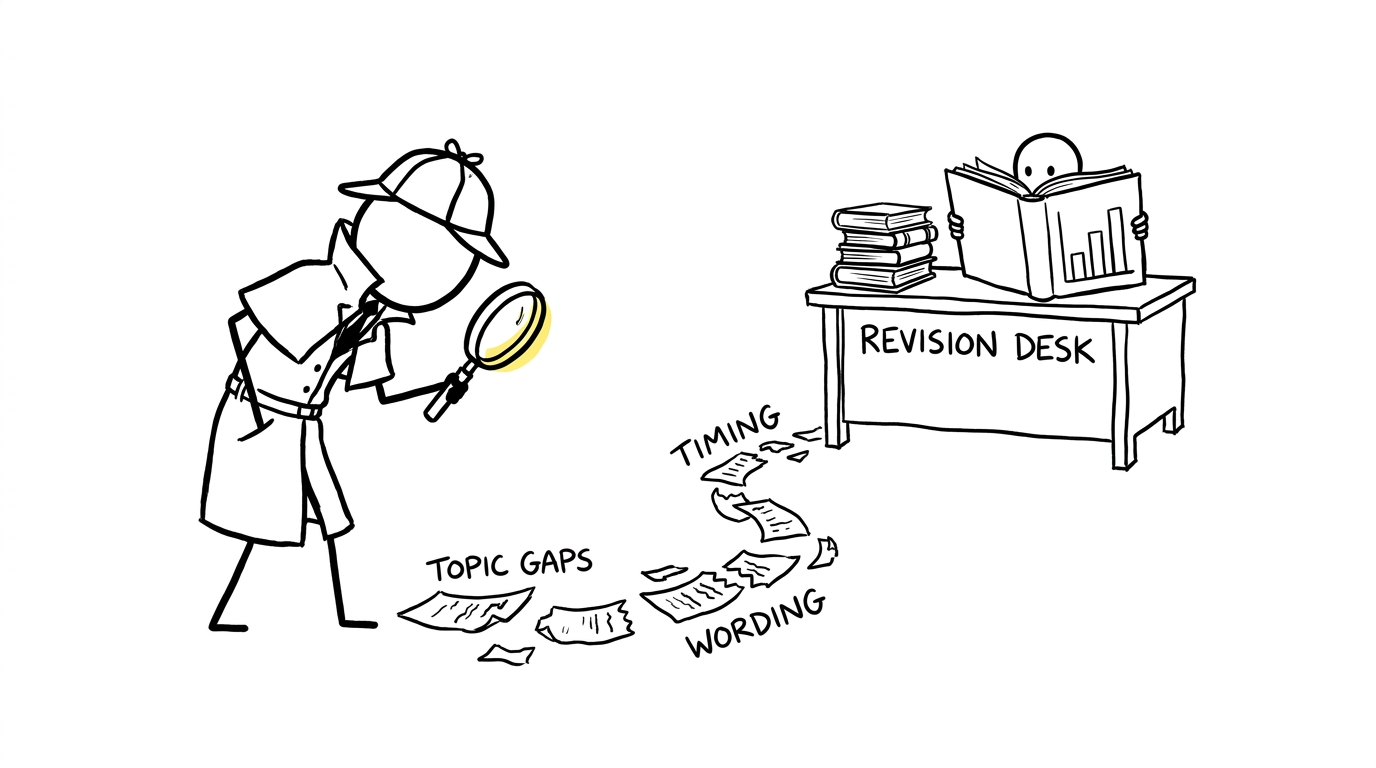 A student detective tracking down hidden revision weaknesses
Label every lost mark by cause:
- missing statistical knowledge;
- misreading or weak interpretation;
- inaccurate calculator work;
- poor use of statistical language;
- incomplete comparison or conclusion;
- timing and unanswered questions.
Then use the GCSE Statistics revision hub to rebuild individual topics with exam questions and worksheets. The wider GCSE Maths revision hub can strengthen overlapping skills such as probability, averages, graphs and cumulative frequency.
Follow a simple cycle: revise one topic, complete exam-style questions, mark them, record why marks were lost, and test the topic again later. For a harder area, resources such as the standard deviation practice questions show how marks are awarded. AQA students can also revisit overlapping material through the AQA GCSE Maths revision guides.
Once topic gaps are smaller, move to timed past papers and mark them strictly. MathsGenie's predicted papers and mini-test resources can support mixed practice, but predicted papers should complement the specification and past papers rather than replace them.
Common mistakes after a disappointing result
Requesting a review without seeing the evidence
A near-boundary mark is not proof of an error. Ask a teacher to inspect the script first.
Missing the post-results deadline
Access-to-script and review deadlines are time-sensitive. Contact your exams officer as soon as possible.
Assuming a review can only improve the mark
A reviewed mark can increase, decrease or remain unchanged. Understand that risk before giving consent.
Resitting with the same revision method
More hours will not solve an unidentified problem. Use mark schemes to separate topic gaps from interpretation, accuracy and timing errors.
Letting one grade rewrite the whole story
A GCSE Statistics disappointing result is information about one assessment series. It is not a permanent judgement on whether you can succeed in maths, A Level subjects or future study.
Make the next decision calmly
Results day feels final because the number is printed. In reality, it is a decision point. Check whether the grade affects your route, gather evidence from your papers, and choose between a review, a resit or moving forward.
If a resit is the right GCSE Statistics next step, begin with MathsGenie's free GCSE Statistics resit resources. Use revision lessons and practice questions to repair weak topics, then test your progress with past papers, mark schemes, predicted papers, mini tests and available solutions. The aim is not to prove that the first result was unfair. It is to make the next performance stronger.











