GCSE Statistics Christmas Holiday Revision Plan
GCSE statistics Christmas holiday revision made manageable: build a focused plan, practise weak topics and protect time for rest over the festive break.
The Christmas break creates a strange kind of pressure. The exams are still months away, yet January feels close enough to make doing nothing uncomfortable. At the same time, nobody wants to spend the whole holiday bent over a statistics textbook.
A reasonable amount of GCSE statistics Christmas holiday revision is around six focused sessions of 303030 to 404040 minutes across the break, plus one optional mixed test. That is roughly three to four hours in total. It is enough to diagnose weaknesses, repair a few important topics and return to school with momentum, without turning Christmas into an early exam season.
This is a starting point, not a rule. If mocks begin immediately after the holiday, you may need more. If you are already secure or have many subjects competing for attention, you may need less. The useful question is not simply, “How many hours?” It is, “What will be different when those hours are finished?”
Your Christmas revision checklist
Keep the plan small enough to complete:
- Confirm whether you are taking the separate GCSE Statistics qualification or revising the statistics content within GCSE Maths.
- Check your exam board and tier rather than revising from a generic list.
- Use one short diagnostic task to identify weak areas.
- Choose no more than three priority topics.
- Complete questions actively instead of only reading notes.
- Mark every task and record why marks were lost.
- Revisit mistakes after a gap.
- Protect several completely revision-free days.
The MathsGenie GCSE Statistics revision hub is the simplest starting point for finding board-specific resources, past papers, worksheets and exam questions.
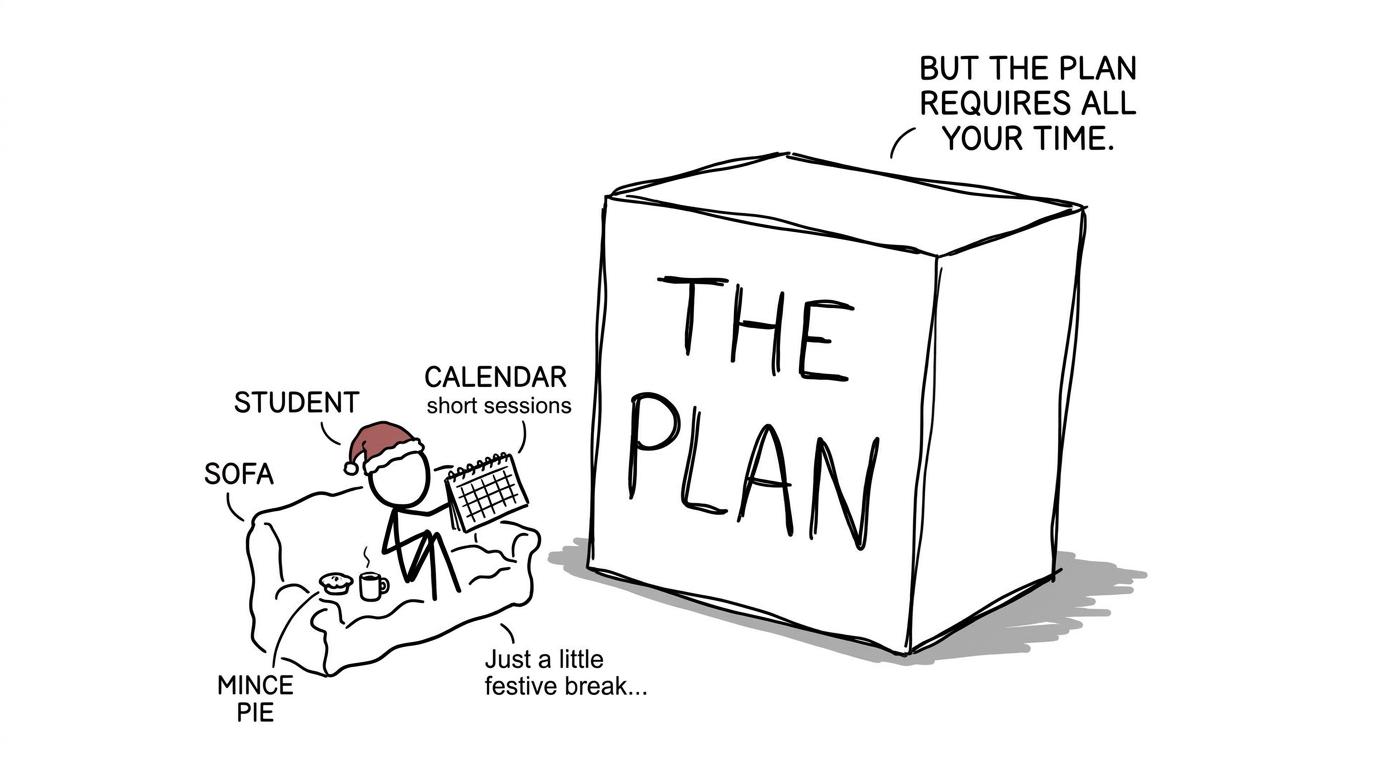 A student defending Christmas from an enormous revision timetable
First, check which statistics course you mean
There are two related but distinct possibilities.
You may be taking a separate GCSE in Statistics, offered by boards including AQA and Pearson Edexcel. Its content is built around the statistical enquiry cycle: collecting data, processing and representing it, analysing results, using probability and evaluating conclusions. Official subject requirements also place substantial emphasis on interpretation and assessing whether statistical methods are appropriate.
Alternatively, you may mean the statistics strand inside GCSE Maths. Edexcel, AQA, OCR and Eduqas all assess statistics and probability within their GCSE Maths specifications, although the organisation and wording vary. The GCSE Maths topics by exam board and tier guide can help you distinguish common content from Higher-tier material.
This matters because a separate Statistics GCSE goes further than the statistics found in a standard GCSE Maths paper. Do not build your holiday plan from somebody else’s topic list. Ask your teacher, check the specification and look at the front of a recent school paper if you are uncertain.
How much revision is reasonable at Christmas?
For most students, a sensible target is six short sessions spread across ten to fourteen days. Each session should have one clear purpose and a definite stopping point.
| Session | Suggested focus | Time |
|---|---|---|
| Diagnostic | Mixed questions followed by careful marking | 353535 to 454545 minutes |
| Repair one | Weak topic and focused questions | 303030 to 404040 minutes |
| Repair two | Second weak topic and focused questions | 303030 to 404040 minutes |
| Interpretation | Conclusions, comparisons and evaluation | 303030 to 404040 minutes |
| Repair three | Third weak topic or probability | 303030 to 404040 minutes |
| Retest | Questions previously answered incorrectly | 252525 to 353535 minutes |
| Optional | Mini test or timed paper section | 303030 to 454545 minutes |
The compulsory part totals approximately:
6×35=210 minutes=3.5 hours.6 \times 35 = 210\text{ minutes} = 3.5\text{ hours}.6×35=210 minutes=3.5 hours.That total is modest, but its value depends on concentration. Three deliberate hours containing questions, feedback and corrections will usually reveal more than a vague promise to “do statistics” every day.
A student with a January mock might add two timed sections. A student balancing ten subjects might complete four sessions instead. Your plan is reasonable when it is demanding enough to create progress but realistic enough that you will actually follow it.
Choose topics from evidence, not anxiety
Revision often begins with the topic that feels most familiar. That is comforting, but comfort is not diagnosis.
Start with a short mixed set or part of a past paper. Use the correct tier and exam board where possible. The Edexcel GCSE Statistics revision page brings together topic resources, questions, worksheets and papers for Foundation and Higher tier.
When marking, sort each lost mark into one of four categories:
- Knowledge: you did not know the fact, definition or method.
- Application: you knew the method but could not adapt it to the context.
- Interpretation: your calculation was acceptable, but your conclusion was incomplete or unsupported.
- Accuracy: you misread a scale, rounded incorrectly or made a calculator slip.
Your priority list should be specific. “Data” is too broad. “Choosing a representative sample” or “comparing distributions using an average and a measure of spread” gives you an action.
Three priorities are enough for Christmas. A short list focuses attention. A list of twenty topics merely records that the course exists.
Build each revision session around feedback
A productive session can follow the same quiet rhythm every time.
Recall before reopening your notes
Spend five minutes writing what you remember about the topic. For measures of spread, that might include:
range=largest value−smallest value\text{range}=\text{largest value}-\text{smallest value}range=largest value−smallest valueand
interquartile range=Q3−Q1.\text{interquartile range}=Q_3-Q_1.interquartile range=Q3−Q1.This brief recall tells you whether the idea is available without support. If it is not, use a revision lesson or guide rather than guessing.
Practise one connected set of questions
Move into exam-style questions while the method is fresh. For foundational data skills, the averages revision guide reviews the mean, median, mode and range. If relationships between paired variables are weaker, use the scatter graphs revision guide.
Higher-tier GCSE Maths students may also need cumulative frequency revision and histogram practice. Separate GCSE Statistics specifications can contain additional techniques, so follow your own board’s checklist.
Mark immediately and write one correction
Do not leave marking until “later”. The useful moment is when you can still remember what you were thinking.
For every lost mark, write a short correction such as:
- compare both centre and spread;
- state the conclusion in context;
- distinguish correlation from causation;
- check whether the data are continuous;
- use bar area, not bar height alone, in a histogram.
Then schedule the question for another day. Seeing a solution can create recognition; answering again without the solution tests whether the learning has lasted.
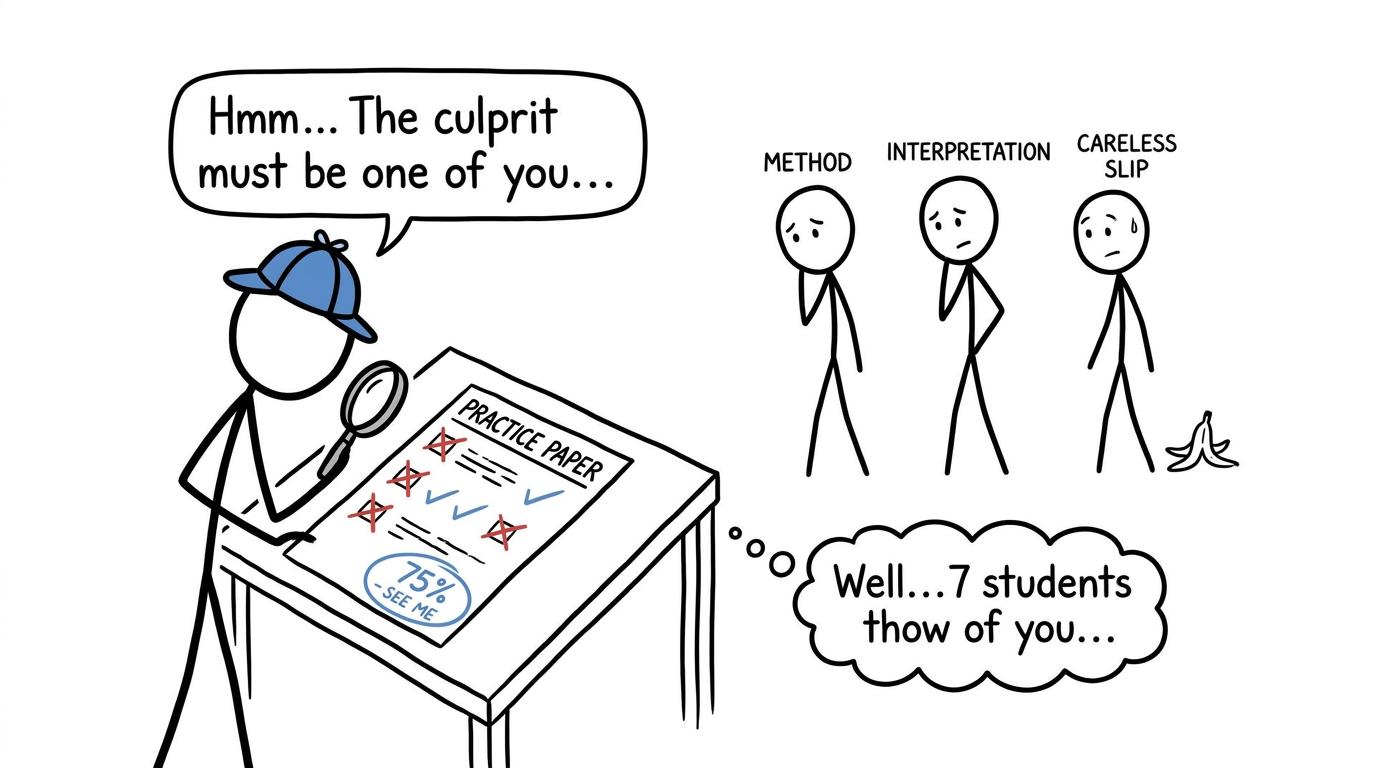 A revision detective investigating method, interpretation and careless slips
Give interpretation its own session
Statistics is not only calculation. Official GCSE Statistics assessment objectives include interpreting information in context, reasoning statistically and evaluating methodology. That is why a student can calculate an average correctly and still lose marks on the conclusion.
Dedicate one Christmas session to written responses. Practise explaining:
- whether a sample is representative;
- how bias may have entered the data collection;
- why one average is more suitable than another;
- what a graph supports and what it cannot establish;
- whether an estimate is interpolation or extrapolation;
- how sample size and methodology affect reliability;
- why correlation does not establish causation.
Use the mark scheme as a guide to precision. Notice whether it expects a comparison, contextual reference or limitation. Do not memorise isolated sentences; learn what makes a conclusion statistically justified.
Keep the holiday feeling like a holiday
A sustainable plan includes limits. Choose revision times in advance, place them in your MathsGenie revision planner and stop when the session ends. You should not spend the rest of the day feeling that revision is still hovering unfinished in the background.
A workable pattern might be:
- two sessions before Christmas;
- several days with no statistics revision;
- three sessions between Christmas and New Year;
- one retest before returning to school.
Avoid assigning heavy work to family events or travel days. Keep at least two consecutive days completely free if your circumstances allow. Rest is not a reward issued only after perfect productivity; it is part of making January’s work sustainable.
The GCSE maths revision timetable guide offers a broader structure if statistics must fit alongside algebra, geometry and your other subjects.
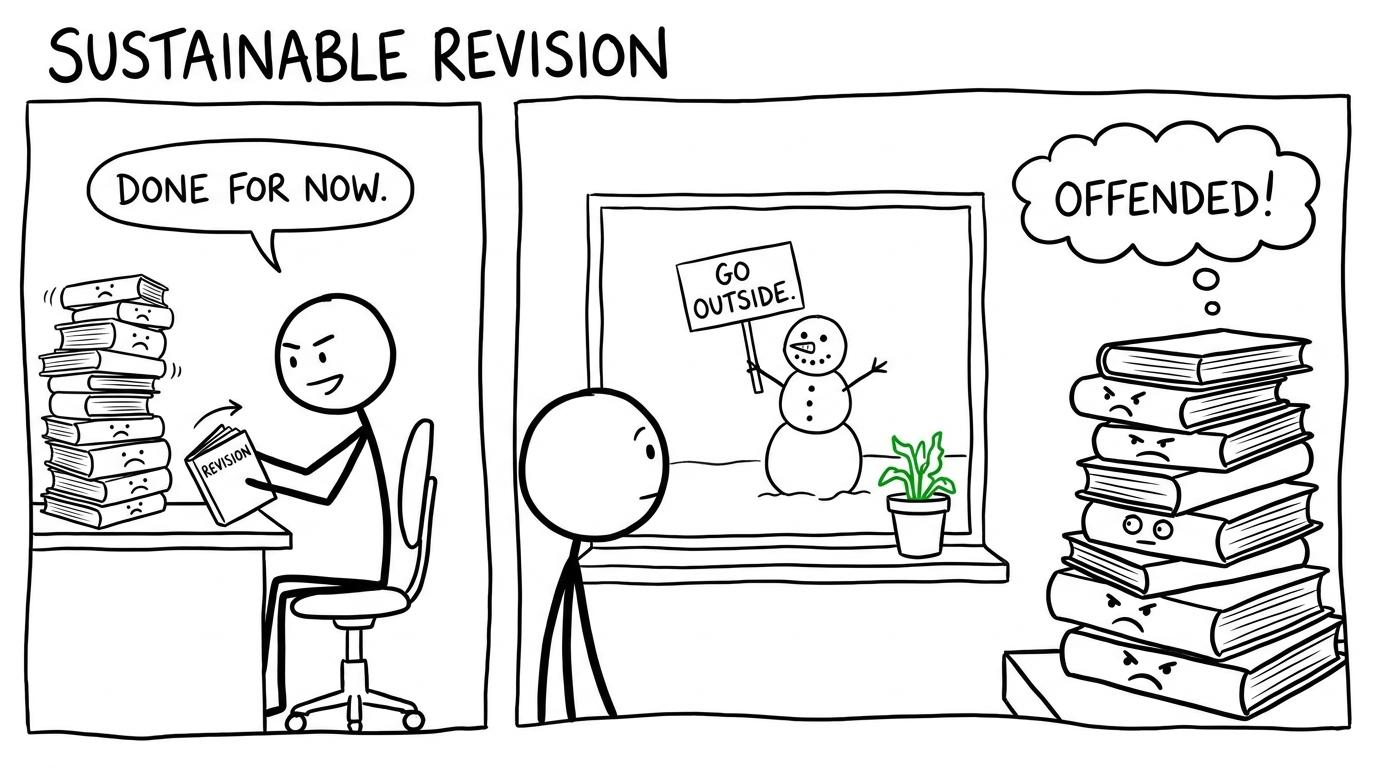 A snowman reminding a student to finish revision and go outside
Common Christmas revision mistakes
Planning every day of the holiday
An intensive timetable looks impressive before Christmas and oppressive afterwards. Leave blank days and one catch-up slot. A plan needs room for real life.
Revising only comfortable topics
Repeatedly calculating simple averages may feel productive while sampling, probability distributions or statistical evaluation remain untouched. Let diagnostic questions choose your priorities.
Completing a whole paper too early
A full paper can be useful, especially before a January mock, but it may consume a large part of your available time. A short diagnostic section often gives enough information to plan targeted repair. Save unseen full papers for occasions when you genuinely want to test timing and stamina.
Counting questions instead of learning from them
Twenty unmarked questions provide less useful feedback than eight questions that are marked, corrected and attempted again. Completion is not the same as improvement.
Treating every mistake as careless
“Careless” is often too vague to fix. Identify whether you misread the axis, omitted units, used an unsuitable statistic or failed to connect the conclusion to the context.
Ignoring board and tier
A Higher-tier histogram task is not a sensible priority for every Foundation student. Equally, students taking the separate Statistics GCSE should not assume an ordinary GCSE Maths topic list covers their full specification.
Finish the break with a small piece of evidence
On your final session, return to questions you previously answered incorrectly. Do them without notes, then mark them again. Record what is now secure and what should become January’s first priority.
That final check matters because revision is not measured by time spent near a workbook. It is measured by what you can now retrieve, apply and explain independently.
Christmas does not need to transform your grade in a fortnight. Its quieter purpose is to prevent drift: discover where marks are leaking, repair a few important gaps and make the return to school less abrupt.
Start at the MathsGenie GCSE Statistics revision hub, choose the resources matching your board and tier, and add six manageable sessions to your revision planner. Use revision lessons to rebuild understanding, practice questions to test it, and mark schemes or video solutions to correct it. Later, mini tests, past papers and predicted papers can build exam readiness. For now, make the plan small, focused and finishable, then enjoy the holiday you protected.