

GCSE Spanish Time Pressure Mistakes to Avoid
GCSE Spanish time pressure mistakes can cost easy marks. Learn how to pace listening, reading, writing and speaking, then check every answer with purpose.
The final minutes of a GCSE Spanish paper can make familiar language feel strangely distant. You know the vocabulary, but rush past a negative. You understand the writing task, but miss one bullet point. You hear the right answer, doubt yourself and replace it with the wrong one.
These GCSE Spanish time pressure mistakes are rarely caused by knowing nothing. More often, the clock changes how you use what you know. The solution is not simply to work faster. It is to recognise the small decisions that protect marks: reading instructions precisely, answering every required detail, moving on when stuck and checking the features most likely to fail under pressure.
This guide explains where easy marks disappear across listening, reading, writing and speaking, and how to stop that happening.
Your time-pressure checklist
Before looking at each paper, remember six rules:
- Read the instruction and identify the required response language.
- Underline negatives, time phrases, question words and every writing bullet point.
- Match the length of your answer to the marks and task.
- Leave no accessible question blank.
- Move on before one difficult item consumes the paper.
- Check for omissions before polishing individual words.
The exact format and timing depend on your exam board, tier and specification. Check the materials supplied by your school rather than relying on a routine learned from somebody taking a different paper. AQA, Pearson Edexcel and Eduqas assessments do not necessarily organise every task in the same way.
For specifications introduced for first teaching in England from September 2024, first assessed in summer 2026, listening, speaking, reading and writing remain central to GCSE Spanish. Current specifications also place explicit emphasis on accurate vocabulary and grammar. That makes calm accuracy valuable, but accuracy begins with completing the task.
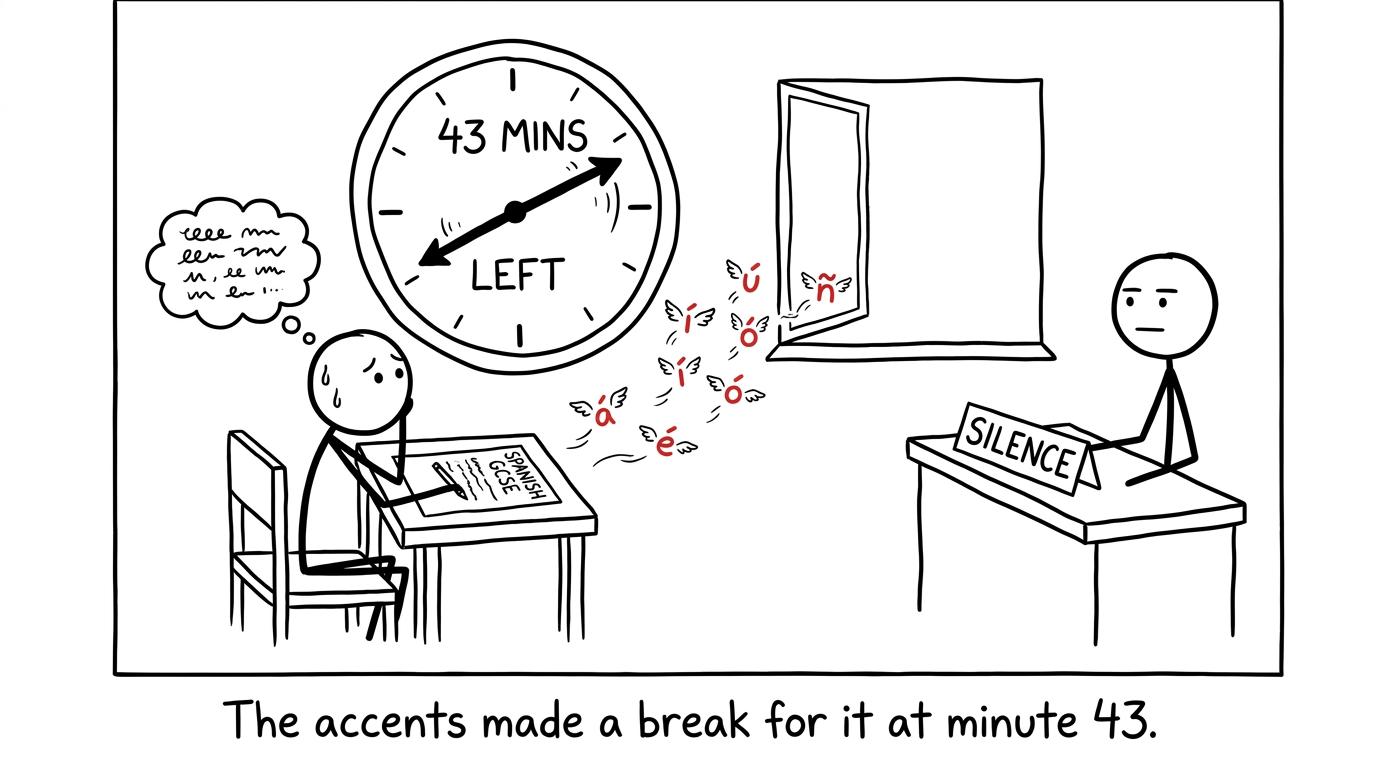 A student watches accent marks escape from a Spanish exam as the clock ticks
Listening mistakes when there is no rewind button
Listening pressure feels different because the recording controls the pace. You cannot pause to reconstruct every sentence, so preparation and recovery matter.
Wasting the reading time
Where reading time is provided, use it to predict what information you need. Look for whether the answer is likely to be a person, place, opinion, reason, time or activity. Mark contrasts and negatives in the question.
Do not attempt to translate every printed word. Your purpose is to create targets for your attention. If the question asks why somebody dislikes a journey, listening only for a transport word will not be enough.
Writing too much during the recording
Long notes can make you miss the next piece of information. Record only what is needed to secure the answer. If the question requires a brief response, a brief and unambiguous response is safer than a hurried sentence containing extra claims.
This matters particularly when two details are close together. Students sometimes hear the first answer, keep writing and lose the second.
Treating the first familiar word as the answer
Recordings often contain distractors, corrections and changes of opinion. A familiar word may introduce an idea that is rejected moments later. Listen through contrast words and notice negatives, tense changes and speakers correcting themselves.
If you miss something, do not mentally replay it while the recording continues. Mark the question, reset your attention and catch the next available detail.
Neglecting dictation accuracy
Current specifications may include dictation or transcription-style demands. Under pressure, students can capture the general sound but lose marks through missing word endings, agreements, accents or small grammatical words.
Use any checking time to read the completed phrase as language, not as a collection of sounds. Ask whether the spelling and grammar fit the sentence you heard.
Reading mistakes that hide in familiar vocabulary
Reading can feel more controllable because the text stays on the page. That often creates a different danger: spending too long proving that you understand one difficult paragraph.
Translating everything before answering
Most comprehension questions do not require a complete translation. Read the question first, identify the information being tested and search for the relevant part of the text.
Unknown vocabulary does not automatically prevent an answer. Surrounding words, grammatical clues and the overall context may reveal enough. Time pressure becomes worse when one unfamiliar word is treated as a locked door rather than a gap you may be able to walk around.
Missing negatives and time frames
Words meaning never, no longer, before, currently or next year can reverse an otherwise plausible answer. Circle or underline these signals. Also notice whether the question asks about the past, present or future.
A response containing the right activity but the wrong time frame is not the same meaning.
Answering in the wrong language
Some sections require answers in English; others may require Spanish or a non-verbal selection. The instruction decides. A linguistically correct answer can still fail to meet the task if it is given in the wrong language.
Build a simple habit: before reading the passage, identify the response language and expected answer form.
Leaving translation gaps
In translation, omissions are dangerous because every skipped idea reduces how completely meaning is conveyed. If one phrase is difficult, translate the surrounding material and return to it. A sensible attempt informed by context is usually better than an empty space.
Check pronouns, negatives, possession and tense. These small features often carry more meaning than the longest noun in the sentence.
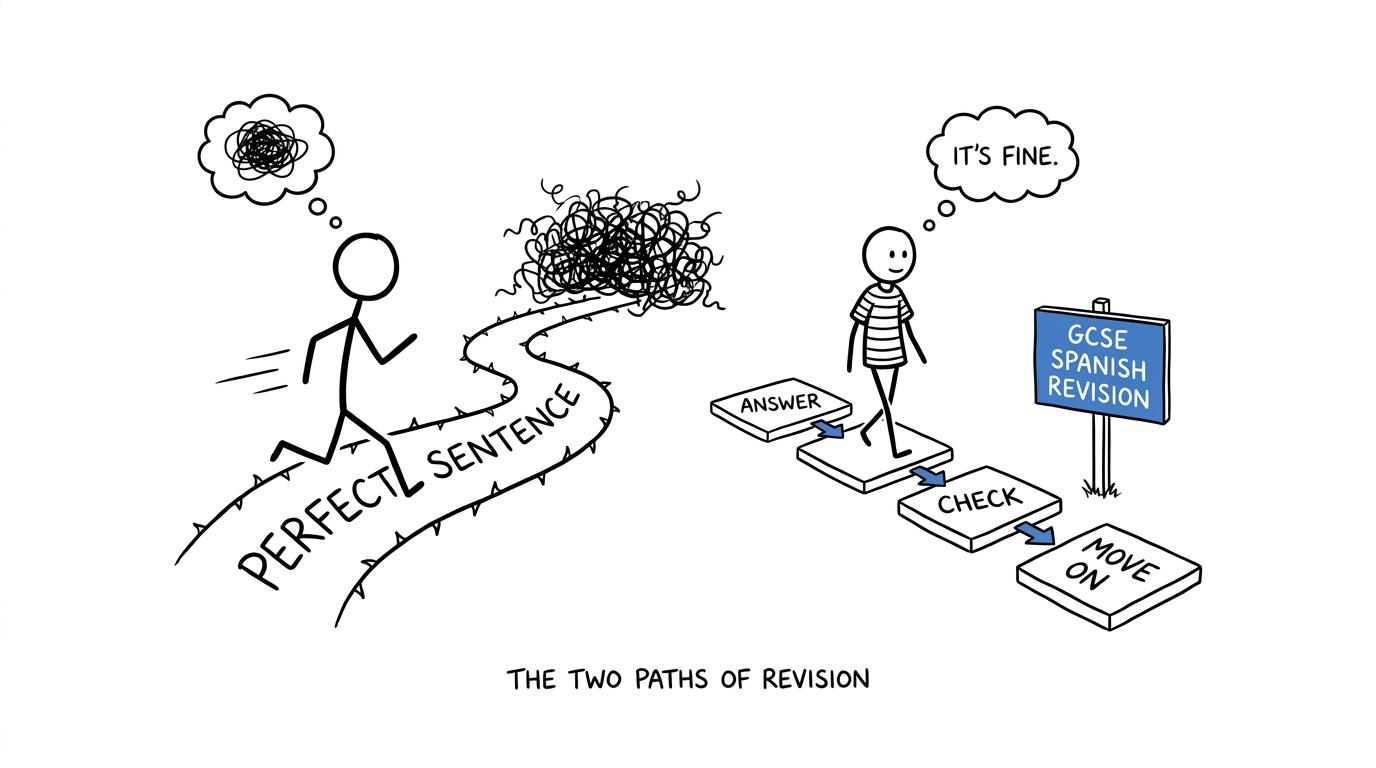 One student chases perfection while another follows a calm answer-check-move-on path
Writing mistakes that cost easy marks
Writing is where perfectionism becomes expensive. A student may spend several minutes improving an opening sentence while leaving the final bullet point rushed or unanswered.
Ignoring part of the task
Before writing, turn each bullet point into a small checklist. Covering all required content is more important than producing an elegant paragraph that answers only half the question.
When finished, check the response against the task itself. Do not rely on memory. It is surprisingly easy to discuss a related topic without supplying the requested opinion, reason or future plan.
Attempting language you cannot control
Ambition is useful, but complexity earns nothing if the meaning collapses. Under time pressure, secure language with a clear verb is stronger than an overextended sentence copied from memory but adapted incorrectly.
Aim for controlled variety: relevant vocabulary, justified opinions, accurate verbs and appropriate links between ideas. Choose structures you have practised enough to reproduce reliably.
Forgetting verb ownership and time
A memorised verb may be correct in isolation but wrong for the person performing the action. During the final check, identify the subject of each key verb and confirm that the ending matches. Then check whether the tense fits the time phrase.
Do this selectively. A purposeful grammar scan is better than rereading the whole answer while vaguely hoping to spot something.
Counting words instead of answering well
Follow the task guidance from your board, but do not let constant word counting interrupt your writing. Plan the content, write the response and make one sensible length check. Repetition added merely to make an answer longer can introduce new errors without adding communication.
Speaking mistakes caused by rushing
Speaking pressure can make silence feel much longer than it is. Students then speak too quickly, abandon accurate language or give such short answers that they create little evidence of their ability.
Starting before forming the sentence
A brief pause to organise the verb and key idea is not failure. It is often faster than beginning immediately, getting trapped and restarting several times.
Giving unsupported one-word opinions
Where the task allows development, add a reason or relevant detail. However, do not force a long rehearsed answer into a question it does not address. Listening to the question remains more important than displaying a prepared paragraph.
Forgetting the required interaction
Role-play tasks may ask you to request information or ask a question. Under pressure, students can answer the teacher’s prompts yet forget their own required question. Use preparation time to identify every action in the task, not just the vocabulary topics.
Treating one mistake as the end
If a word comes out incorrectly, correct it briefly when possible and continue. Spending the next answer worrying about the previous one turns a small slip into a larger time-management problem.
Common GCSE Spanish time pressure mistakes
Across all four skills, the most damaging habits are remarkably consistent:
- Misreading the command: answering the topic rather than the precise question.
- Missing a negative: selecting an answer that states the opposite meaning.
- Over-answering: adding unsupported information that makes a correct response ambiguous.
- Under-answering: giving one detail when the marks or wording require more.
- Getting stuck: sacrificing several accessible questions for one difficult item.
- Changing answers without evidence: replacing a sensible first response because anxiety demands activity.
- Checking cosmetically: correcting handwriting or accents while an entire bullet point remains unanswered.
- Using memorised material inflexibly: forcing prepared language into the wrong person, tense or context.
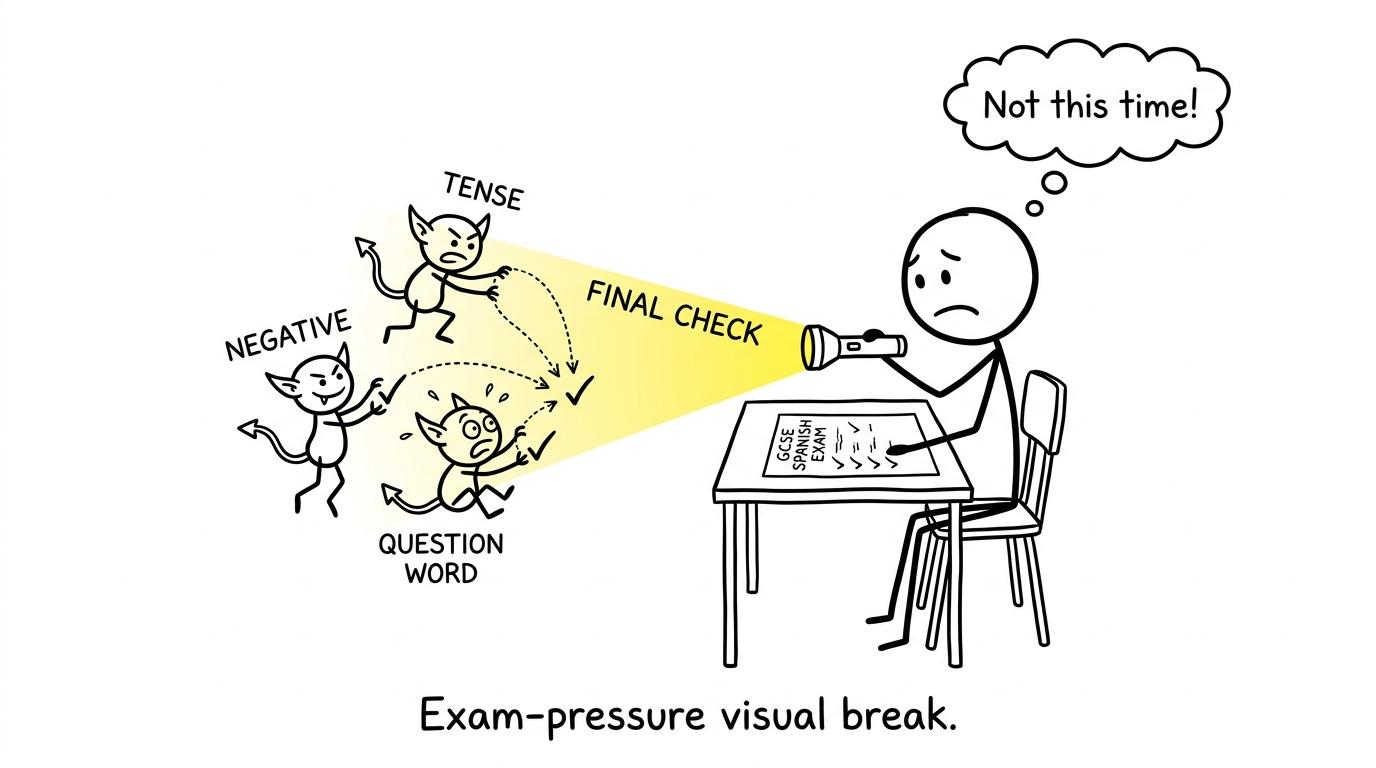 Three tiny exam gremlins are caught by a final-check torch
How to practise performing under pressure
Time management is not a speech you give yourself on exam morning. It is a routine built through timed practice.
Complete short sections first, then progress to full papers. After each attempt, classify every lost mark: knowledge gap, misread instruction, omission, grammar error, spelling problem or poor time decision. This is more useful than recording only a total.
The same process works when Spanish revision must fit alongside maths. MathsGenie’s guide to finding your weakest GCSE topics explains how to turn lost marks into specific next steps. Its advice on when to begin GCSE past papers also shows why timed papers work best when followed by careful review.
For your maths preparation, use the GCSE maths revision hub to choose the correct exam board and tier. Short practice can build consistency, while full papers develop stamina. If revision feels difficult to start, the simple GCSE revision loop keeps the process focused: attempt, mark, repair and repeat.
Near the examination period, avoid replacing broad preparation with guesses about likely content. The guide to using predicted topics responsibly explains how predictions should support rather than narrow revision. Edexcel maths students can then practise with GCSE maths predicted papers, using the mark schemes and solutions to locate recurring errors.
Turn the final minutes into useful minutes
The clock does not usually create a new weakness. It exposes an old habit: rushing instructions, chasing perfection, failing to move on or checking without a plan.
Your best defence is a repeatable sequence: understand the task, bank the accessible marks, return to harder material and finish with a targeted check. In Spanish, search for omissions, negatives, response language, verbs and uncovered bullet points. In maths, search for misread values, missing working and answers that do not fit the question.
Make MathsGenie your free home for the maths side of that preparation. Start with revision lessons and practice questions, test yourself with mini tests, then build exam stamina through past papers and predicted papers. Use the mark schemes and video solutions to understand every lost mark. Calm exam performance is rarely improvised; it is the result of practising the right decisions until they become familiar.











