GCSE Spanish 4 to 6: A Practical Grade Plan
GCSE Spanish 4 to 6 revision explained: improve vocabulary, grammar, speaking and exam technique with a focused plan for reaching grade 6.
Moving from a grade 4 to a grade 6 in GCSE Spanish is not mainly about memorising longer answers or collecting impressive phrases. It is about becoming more reliable: understanding messages accurately, communicating across different time frames, responding fully and making fewer avoidable mistakes.
That is the heart of a successful GCSE Spanish 4 to 6 plan. A grade 4 performance often shows enough language to communicate familiar ideas, but with gaps, repetition or inconsistent accuracy. A grade 6 response tends to be more developed, better controlled and more adaptable when the question changes.
One important detail comes first: Foundation tier normally offers grades 1-5, while Higher tier offers grades 4-9. You therefore need to be entered for Higher tier to achieve grade 6. Discuss tier entry with your Spanish teacher rather than deciding from one mock result.
Your grade 4 to grade 6 checklist
Focus on these changes:
- learn vocabulary for recognition as well as production;
- control present, past and future time frames;
- extend answers with reasons and relevant detail;
- improve verb endings, agreements and word order;
- practise listening and reading without translating every word;
- speak clearly rather than rushing;
- answer every bullet point in writing tasks;
- use official papers and mark schemes for your specification;
- record recurring errors and revisit them regularly.
The jump is rarely caused by one spectacular answer. It usually comes from small improvements appearing across listening, speaking, reading and writing.
What separates a grade 4 from a grade 6 in GCSE Spanish?
There is no universal number of sophisticated phrases that guarantees grade 6. Your final grade is based on your total performance, and grade boundaries are set for each exam series. Individual exam boards also use their own task-specific assessment criteria.
However, several differences regularly matter.
| Grade 4 performance often shows | Grade 6 performance more often shows |
|---|---|
| Basic messages are communicated | Ideas are communicated and developed clearly |
| Vocabulary is familiar but repetitive | Vocabulary is selected to suit the task |
| One time frame is secure | Different time frames are used with reasonable control |
| Errors sometimes obscure meaning | Errors occur, but the overall message remains clear |
| Answers address part of the task | Bullet points and follow-up questions are covered fully |
| Responses depend on memorised material | Learned language is adapted to the question |
| Listening relies on individual familiar words | Meaning is built from context, verbs and key details |
The distinction is not perfection. A grade 6 student can still make mistakes. The difference is that mistakes are less disruptive, while the amount of successfully communicated Spanish is greater.
Know the assessment you are preparing for
GCSE Spanish assesses listening, speaking, reading and writing. On current AQA and Pearson Edexcel specifications for first assessment from summer 2026, each of these four components contributes one quarter of the qualification. The revised qualifications also include dictation, reading aloud and translation.
Students taking the updated specifications must be entered for the same tier across all components. The precise task order, timings and mark criteria depend on the board, so check whether you take AQA, Edexcel or Eduqas and use the correct specification materials. Students following an older or Wales-specific course should follow the information supplied by their school.
The broader lesson is simple: a writing-only revision plan cannot carry the whole qualification. Your weekly routine must touch all four skills.
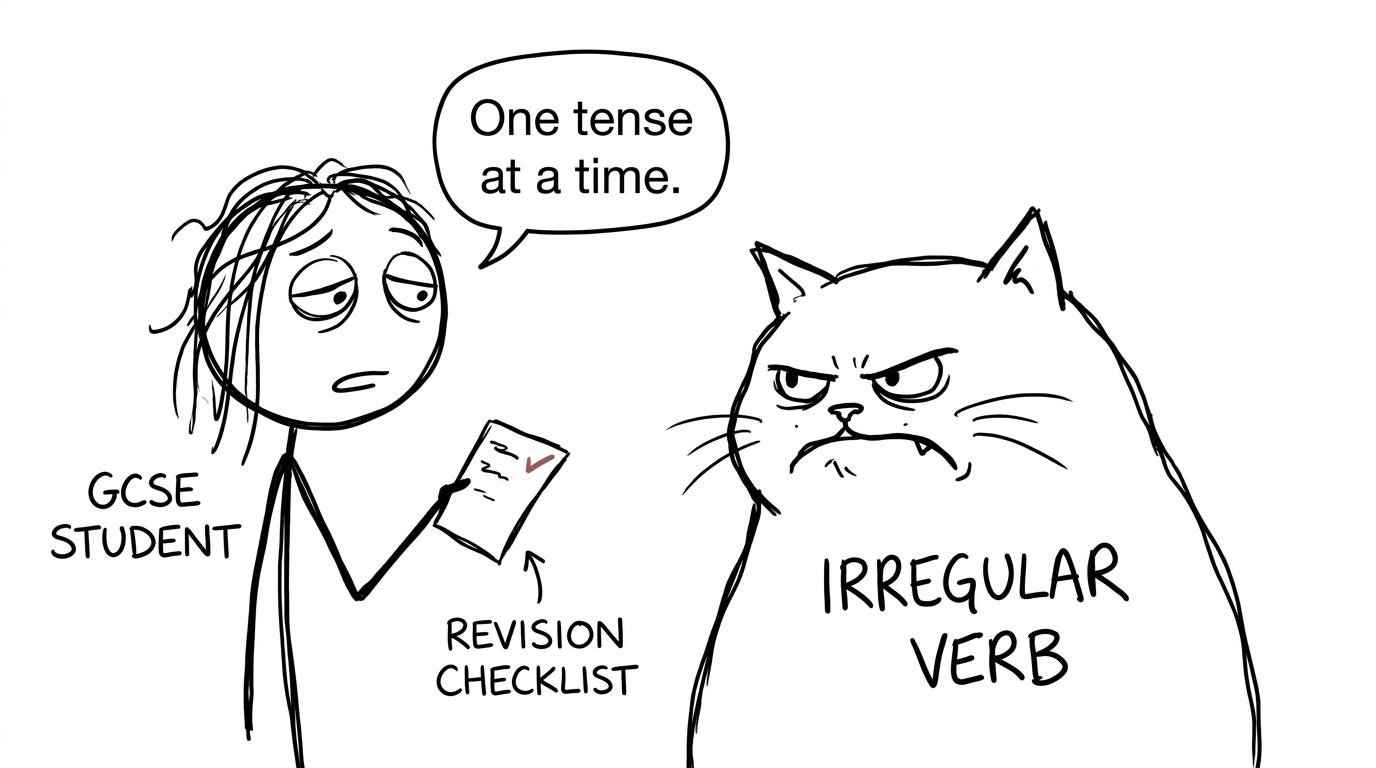 A student calmly confronting an irregular verb one tense at a time
Build vocabulary that works under pressure
A grade 4 student may recognise a word on a classroom list but fail to retrieve it in an exam. To reach grade 6, vocabulary needs to work in several directions:
- Spanish to English for reading;
- spoken Spanish to meaning for listening;
- English idea to Spanish for writing;
- immediate spoken recall for conversation.
Use the vocabulary list for your own specification. The revised GCSEs in England define vocabulary by tier, although some unfamiliar language can still appear in controlled contexts such as inference and dictation tasks.
Do not revise twenty isolated nouns and call the topic complete. Link vocabulary to verbs, opinions, connectives, negatives and time markers. Learn whether a noun is masculine or feminine, and notice the preposition or infinitive construction that commonly follows a verb.
Short retrieval sessions are more revealing than rereading. Cover the answers, recall aloud, check, then return to missed words on another day. MathsGenie's guide to remembering GCSE content through spaced practice is written for maths students, but its learn, retrieve and revisit cycle transfers neatly to language vocabulary.
Make grammar dependable, not decorative
Students sometimes chase rare expressions while common verb forms remain unstable. That is like decorating a house before checking whether the floor is level.
Prioritise grammar that affects many tasks:
- present-tense verbs, including frequent irregular forms;
- a secure way to communicate past events;
- a secure way to communicate future intentions;
- adjective and noun agreement;
- negatives;
- question formation;
- infinitive constructions;
- pronouns and word order required by your tier.
Higher-tier grammar extends beyond Foundation content, but range only helps when meaning remains clear. One accurate past-tense sentence is more useful than an ambitious construction that collapses halfway through.
Create a grammar error log. Instead of writing “grammar bad”, record the precise pattern: incorrect person ending, missing agreement, wrong auxiliary or confusion between an infinitive and a conjugated verb. Specific errors can be repaired. Vague judgements cannot.
Turn short answers into developed communication
At grade 4, students often answer the question and stop. At grade 6, they are more likely to add a reason, detail, contrast, consequence or time reference.
A useful answer-building pattern is:
- direct response;
- opinion or judgement;
- reason;
- supporting detail;
- another relevant time frame, where natural.
This is not a script to force into every sentence. It is a check against underdeveloped answers. In speaking, it helps prevent conversations from becoming a chain of one-line replies. In writing, it helps you cover the task rather than merely mentioning its topic.
Adaptability matters too. Memorising whole paragraphs can feel safe, but a changed bullet point may make them irrelevant. Memorise flexible building blocks and practise recombining them.
Improve each Spanish paper deliberately
Listening
Before an extract begins, read the question and predict what kind of information is needed: an opinion, reason, activity, person, place or time. During the recording, listen carefully for negatives, changes of opinion and contrasts.
Do not panic when one word is unfamiliar. Keep following the sentence. In dictation, use your knowledge of Spanish sound / spelling relationships, articles and verb endings to reconstruct what you hear. Regular reading aloud can support this skill because it connects spelling with sound.
Speaking
Clear, comprehensible Spanish matters more than speed. Practise reading aloud, responding without a script and asking questions where the task requires it. Record short responses and listen for swallowed endings, hesitation and unclear pronunciation.
Prepare themes, but vary the questions and their order. If you can only answer in one rehearsed sequence, you have memorised a performance rather than developed control of the language.
Reading
Read for the overall message before chasing individual words. Then locate evidence for each answer. Pay attention to who performed an action, when it happened and whether the writer is positive, negative or undecided.
For translation into English, preserve meaning rather than copying Spanish word order mechanically. Check small words, negatives and tense after completing the first draft.
Writing
Underline every bullet point and check it off only when you have answered it. Plan the time frames and content before writing, then leave time to check high-frequency errors.
A longer response is not automatically better. Relevant, varied and reasonably accurate language is more valuable than extra sentences that introduce avoidable mistakes.
Use a revision loop instead of vague effort
The most effective improvement cycle is straightforward:
- attempt a short task without notes;
- mark it using the correct criteria or feedback;
- identify one precise weakness;
- practise that weakness separately;
- attempt a fresh task;
- check whether the problem has actually improved.
This resembles the system in MathsGenie's guide to finding weak GCSE topics quickly. Although MathsGenie specialises in free GCSE and A Level maths revision, diagnosis, immediate feedback and retesting work across subjects.
A balanced week could contain short vocabulary retrieval, one grammar focus, a listening or reading task, a recorded speaking response and one piece of timed writing. Keep sessions focused enough to mark properly. The structure in the GCSE one-month revision plan can help students organise Spanish alongside maths and other subjects without allowing one subject to consume the timetable.
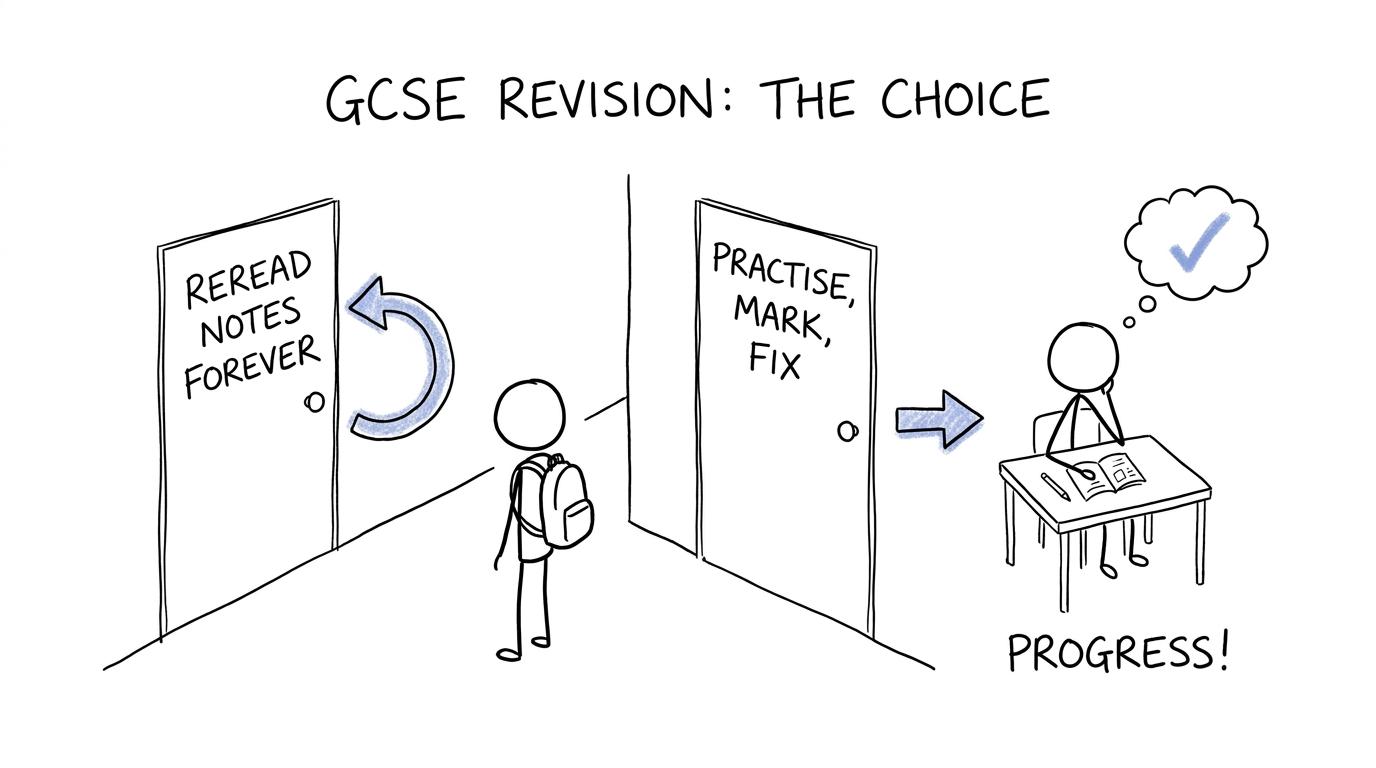 Two revision routes showing why practice and feedback beat endless rereading
Treat papers as evidence, not judgement
Past-paper tasks tell you where marks are leaking. They are most useful when followed by correction.
After each task, classify the problem:
- vocabulary was unknown;
- grammar knowledge was missing;
- the question was misread;
- the answer lacked development;
- pronunciation or spelling weakened communication;
- time pressure caused an unfinished response.
Use official Spanish materials from your exam board and ask your teacher to apply the relevant speaking or writing criteria. Do not use predicted papers as promises about what will appear. They are fresh practice, not forecasts with certainty.
The same principle explains why MathsGenie's guide to using past papers properly emphasises the cycle of attempt, mark, fix and retest. For your maths preparation, the GCSE past-paper library, Edexcel GCSE Maths predicted papers and 45-minute maths tests let you apply that cycle without losing your Spanish revision time.
Common mistakes that keep students near grade 4
Revising only writing
Written preparation may improve vocabulary, but it does not replace listening under time pressure or spontaneous speaking. Train every assessed skill.
Learning impressive phrases without control
Complex language is useful only when it is relevant and understandable. Secure frequent verbs and adaptable structures first.
Ignoring the exact question
A polished paragraph can earn limited credit if it misses a bullet point. Build each response around the task in front of you.
Translating word by word
Spanish and English do not always organise ideas in the same way. Translate meaning, then check tense, negatives and detail.
Counting revision time instead of corrected errors
An hour of highlighting can feel productive without changing performance. Track words retrieved, tasks completed and recurring mistakes fixed.
Assuming grade boundaries never change
Grade boundaries vary by exam series. Use marks to monitor progress, but judge individual responses against the published assessment criteria and your teacher's feedback.
Make the next improvement visible
A grade 6 is built when familiar vocabulary becomes retrievable, grammar becomes dependable and answers become fuller without losing clarity. You do not need flawless Spanish. You need more successful communication across all four components, repeated often enough that it survives exam pressure.
Start by taking one recent task from your exam board. Mark it carefully, choose the single weakness that cost the most marks and repair it this week.
Then protect the rest of your revision timetable. MathsGenie remains your go-to free resource for GCSE and A Level maths, with GCSE maths revision lessons and practice questions, past papers, predicted papers, mark schemes, video solutions and mini tests. Use the same calm loop in both subjects: diagnose, practise, check and return stronger.