GCSE Sociology Discord Server: Is It Worth Joining?
GCSE sociology Discord server advice: explore revision benefits, misinformation risks, safety checks and how to avoid replacing proper exam practice.

Revision can feel strangely solitary. You may understand most of a sociology topic, yet still have one question about social stratification, research methods or an essay plan that your notes do not answer. A GCSE sociology Discord server can help at moments like these, but only if it is well moderated, matched to your exam board and treated as a supplement rather than your main source of revision.
The short answer is that subject servers can provide useful discussion, accountability and shared resources. They can also consume time, circulate inaccurate information and expose you to strangers. The value comes less from joining and more from how carefully you use the community after you arrive.
A quick checklist before joining
A GCSE Sociology community is more likely to be useful if it has:
- separate channels for AQA and Eduqas specifications;
- clear rules and active, visible moderation;
- focused channels for families, education, crime and deviance, social stratification and research methods;
- source labels on notes and resources;
- no promises of leaked papers or guaranteed questions;
- sensible privacy expectations;
- regular question discussion rather than endless general chat;
- an easy way to report inappropriate messages or behaviour.
If you cannot identify the moderators, rules or exam-board structure within a few minutes, leaving is usually the sensible choice.
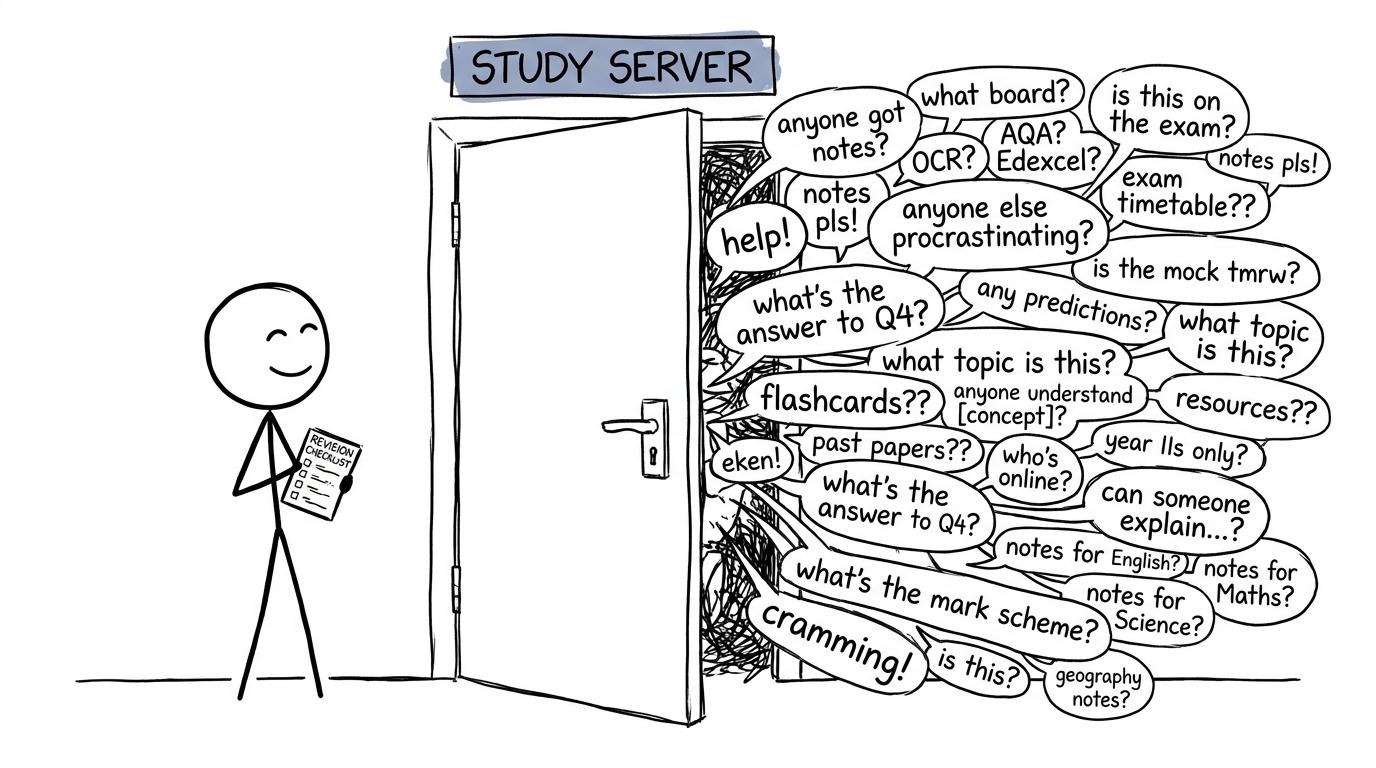 A student discovers that a study server contains rather more conversation than expected
What you can realistically gain from a GCSE Sociology server
The word community can create unrealistic expectations. A server cannot revise for you, know precisely what will appear or replace feedback from your teacher. Its genuine benefits are smaller, but still valuable.
Faster answers to specific questions
A focused question such as “Does this evidence support a functionalist or Marxist view?” may produce several explanations. Seeing how other students distinguish knowledge, application and evaluation can reveal where your own understanding is vague.
This matters because official GCSE Sociology assessment is not based on recall alone. In both AQA and Eduqas, the assessment objectives cover knowledge and understanding, application, and analysis and evaluation. Their overall weightings are 40%40\%40%, 40%40\%40% and 20%20\%20% respectively. A useful server therefore discusses how evidence is used and evaluated, rather than merely sharing long lists of definitions.
The danger is that quick answers can sound authoritative without being correct. Treat a response as a suggestion to check, not a replacement for checking.
Exposure to alternative arguments
Sociology asks students to compare perspectives and build reasoned judgements. A discussion can help you notice an objection you had missed or see how the same evidence might be interpreted differently.
For example, one student may approach a topic through functionalism while another notices a feminist criticism. That contrast can sharpen your thinking. It should not become a copied paragraph. Your task in the examination is to select relevant knowledge and construct your own coherent answer.
Accountability without formal teaching
A quiet revision channel, shared goal or scheduled question session can make starting easier. This is particularly helpful when you are balancing Sociology with Maths, English and Science.
Keep the accountability concrete. “Revise tonight” is vague. “Complete one research-methods question, mark it and record one weakness” creates an observable result. MathsGenie’s 20-minute GCSE maths revision routine uses the same principle: choose a small task, attempt questions and review the result.
Shared resources and signposting
Good communities may help members locate official specifications, publicly available past papers or helpful topic prompts. Yet the number of files in a channel says little about their quality. A folder containing hundreds of pages can create the feeling of progress while making revision harder to organise.
Prefer resources that identify the exam board, specification topic and source. Do not download unknown programs or open suspicious links sent by strangers. A document should also be checked against the specification and your teacher’s guidance before it enters your revision notes.
The limits of relying on Discord for revision
Discord is designed for communication, not for building a complete GCSE course. Conversation moves quickly, old answers disappear up the screen and popular claims can seem true simply because several people repeat them.
Your exam board may not match
AQA and Eduqas both assess GCSE Sociology, but their paper structures and specification wording are not interchangeable. AQA divides its assessment between families and education on Paper 1, then crime and deviance and social stratification on Paper 2. Eduqas organises the qualification into Understanding Social Processes and Understanding Social Structures.
There is substantial overlap, but advice about a named study, question structure or required content may not apply to your course. Put your exam board and specification at the top of your notes. If a server mixes boards without labels, it creates avoidable confusion.
Confidence is not evidence
Online, certainty often travels faster than accuracy. Someone may state that a topic “always comes up”, that a particular theorist is compulsory or that an essay must contain a fixed number of paragraphs. Unless the claim can be checked against an official specification, paper or mark scheme, it remains an unverified opinion.
This is especially important when predictions appear. Predicted content can guide additional practice, but it should never narrow your revision to a few guessed topics. The same principle applies in maths: GCSE predicted papers work best after broad topic revision, not instead of it.
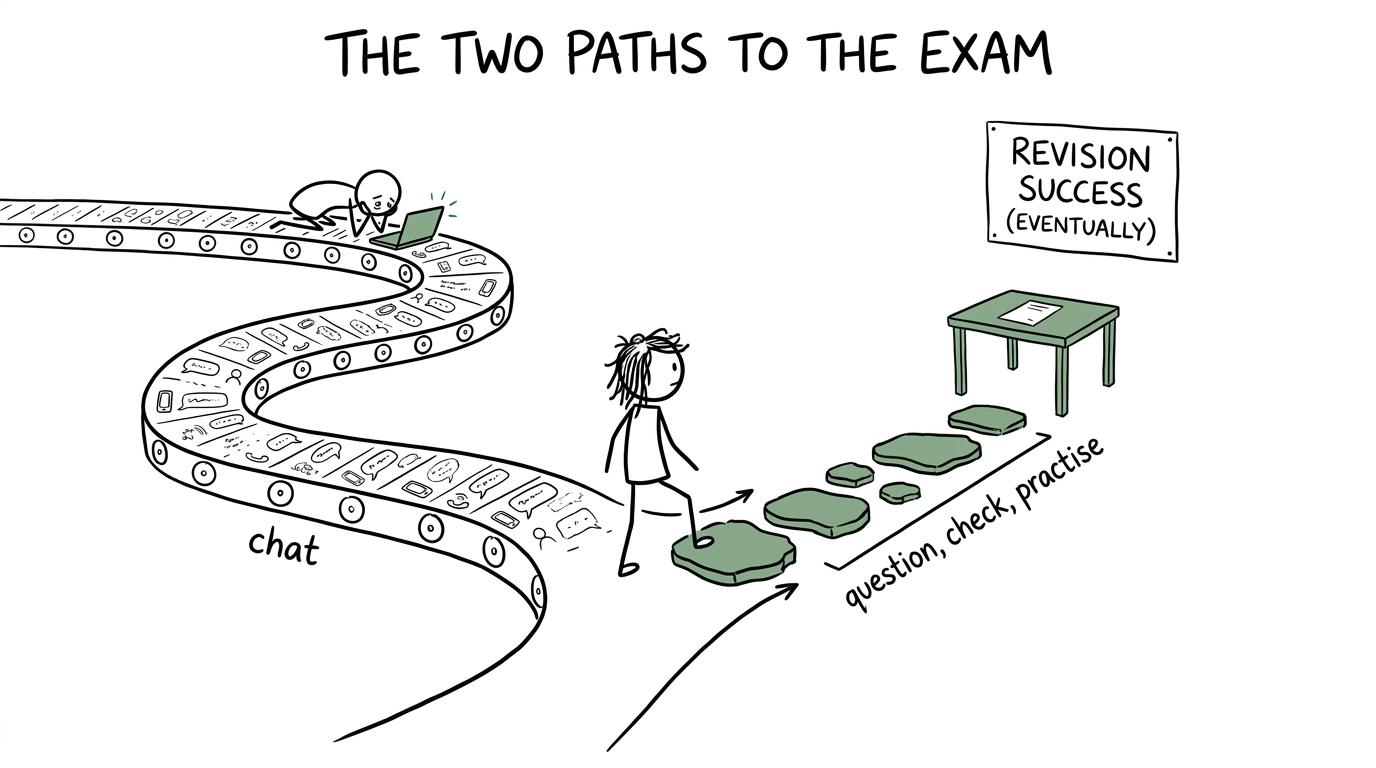 A student leaves the endless chat conveyor belt for focused practice
Reading discussion can imitate learning
Chat feels active because messages keep moving. But following somebody else’s debate is not the same as recalling knowledge or writing under time pressure.
Use a simple rule: every useful discussion must lead to an action away from Discord. Close the app, write the explanation from memory, answer a relevant question and check the result. If you spend 303030 minutes chatting and complete no independent retrieval or practice, the server probably displaced revision rather than supporting it.
This attempt, check, fix cycle also underpins effective maths revision. The GCSE Maths revision hub brings together lessons, exam questions, mini tests and papers so that reading turns into measurable practice.
How to use a subject server without letting it take over
Enter with one purpose
Before opening Discord, write down what you need. It might be clarification of a concept, feedback on whether an argument is relevant or a short accountability session. When that task is complete, leave.
Muting non-essential channels and setting a timer can prevent one useful question from becoming an hour of scrolling. For a broader structure across your subjects, adapt the rhythm in MathsGenie’s one-month GCSE revision plan: diagnose weaknesses, practise actively, mark carefully and revisit gaps.
Verify before saving anything
Use a three-level check:
- Primary check: Does it match your official exam-board specification or published assessment material?
- Teaching check: Does it agree with your teacher’s guidance and class resources?
- Performance check: Can you apply it successfully to an exam question and understand why it earns marks?
Screenshots of notes, model paragraphs and revision grids can all contain mistakes. Verification is not distrustful. It is part of becoming an independent student.
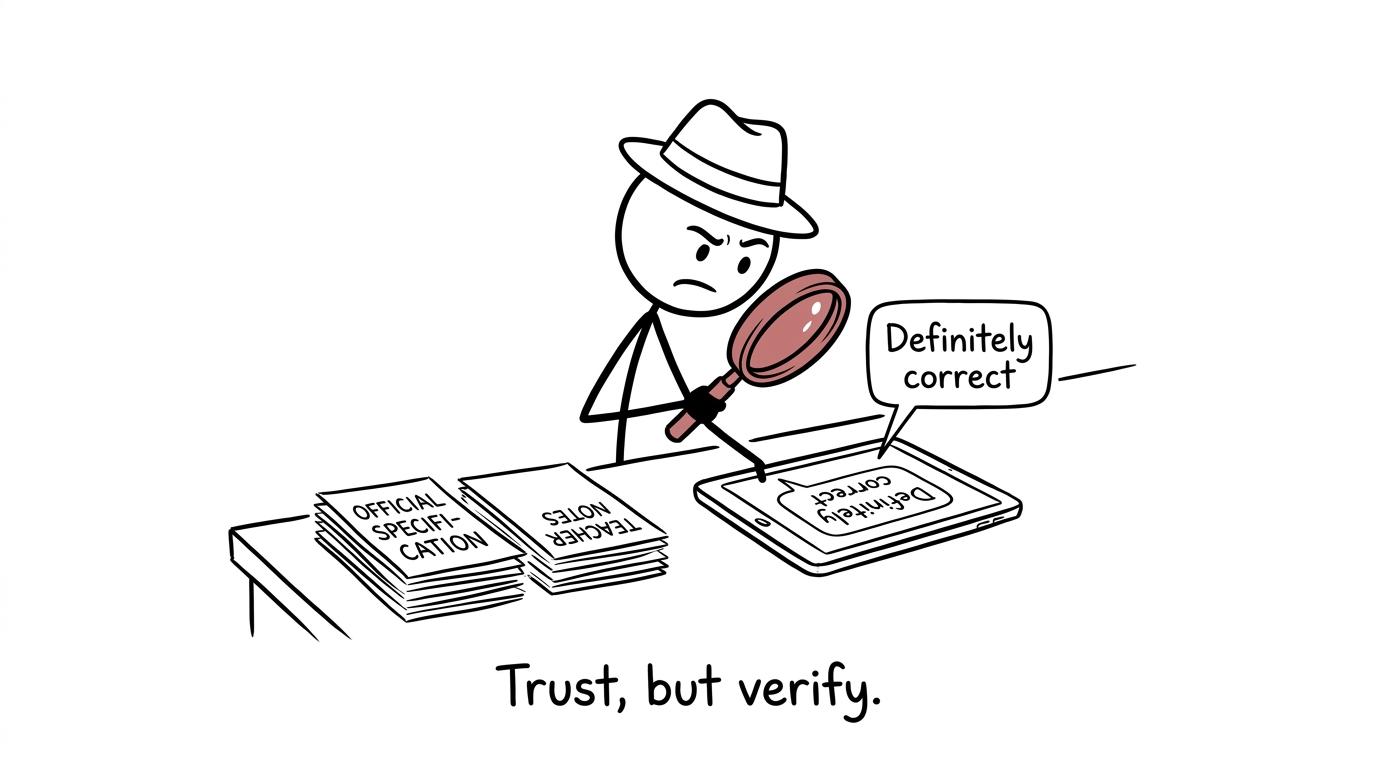 A revision detective checks an online claim against trusted material
Keep your core revision outside the server
Your main system should survive even if the server disappears tomorrow. Keep your specification checklist, notes, completed questions, teacher feedback and mistake log somewhere you control.
For maths, that dependable core can begin with a self-assessment and the free GCSE Maths resources. Build understanding through revision lessons, then use practice questions and mini tests before moving to full papers. Edexcel students can use the GCSE Maths past paper collection with mark schemes and available solutions.
Protect your privacy and safety
Discord’s terms require users to meet its minimum age requirement, which is generally 131313, although local rules may require an older age. UK users also receive age-appropriate protections and restrictions around sensitive or age-gated content. These platform measures reduce some risks, but they do not make every server or user trustworthy.
Use a nickname that does not reveal your full identity. Do not share your school, location, timetable, phone number, personal email address or examination candidate details. Restrict direct messages and friend requests, use a unique password, and enable available account-security features. Never send money, identification or private images to someone claiming to be a tutor or moderator.
If a message is sexual, threatening, manipulative or simply makes you uncomfortable, stop responding. Block and report the account, save relevant evidence where safe, leave the server and tell a trusted adult. Follow your school’s online-safety rules and involve a parent or carer when deciding whether a public community is appropriate.
Common mistakes students make
Joining too many communities
Several servers usually mean repeated information and more notifications, not better revision. One carefully chosen community is enough. Leave servers that consistently add distraction rather than value.
Treating shared notes as complete
A polished document can still omit specification content or use the wrong board. Audit every resource against your own course before relying on it.
Copying essay plans
Copying gives you somebody else’s structure without building the judgement needed to reproduce it independently. Read an idea, close the message and reconstruct the argument in your own words.
Debating instead of practising
Discussion may improve understanding, but examination performance also requires retrieval, selection, timing and clear writing. Set a firm point at which conversation becomes independent question practice.
Believing predictions are promises
No ordinary server member knows the secure content of a future paper. Avoid communities promoting leaks, guaranteed topics or dishonest access to assessment material. Prepare across the specification.
Letting one subject consume the timetable
An active Sociology chat can quietly take time from Maths and other GCSEs. Use a realistic weekly plan and protect subject-specific sessions. MathsGenie’s guide to finding your weakest GCSE topics can help you direct maths time towards the skills actually losing marks.
So, is joining worth it?
A GCSE Sociology Discord server is worth considering when it is safe, well moderated and used for precise questions, thoughtful discussion and light accountability. It is not worth relying on as your syllabus, teacher, mark scheme or main revision environment.
Think of it as a study-room noticeboard. Useful ideas may appear there, but the marks are earned elsewhere, by checking the specification, retrieving knowledge, planning arguments, completing questions and learning from feedback.
Keep that same discipline across your GCSEs. For maths, start with MathsGenie’s free revision lessons and practice questions, test yourself with mini tests, and then build exam readiness through past papers, predicted papers, mark schemes and video solutions. If you need a practical timetable, use the GCSE Maths revision timetable guide and make online communities serve the plan rather than replace it.