GCSE Sociology and GCSE Psychology Together?
GCSE sociology and GCSE psychology together: learn if schools allow both, where the subjects overlap, and how to manage them alongside GCSE maths.
Choosing GCSE options can feel strangely permanent. A timetable arrives, several interesting subjects occupy the same column, and suddenly a decision made at fourteen appears to determine everything that follows.
The practical answer is reassuring: you can take GCSE sociology and GCSE psychology together, provided your school offers both subjects and places them in compatible option blocks. They are separate GCSE qualifications, so there is no general rule preventing you from choosing both. The real questions are whether your school can timetable them and whether two content-heavy, written subjects suit your strengths and overall workload.
There is some useful overlap, especially in research methods, evidence and evaluation. But they are not versions of the same course. Sociology mainly examines society, groups and institutions; psychology concentrates more closely on behaviour, thought and the individual.
The quick decision checklist
Taking both is realistic if you can answer yes to most of these questions:
- Does your school offer both GCSEs in your year?
- Are they in different option blocks?
- Do you enjoy explaining evidence rather than simply memorising facts?
- Are you comfortable with regular reading and extended written answers?
- Can you distinguish similar research-methods terminology between subjects?
- Will your complete timetable still leave enough time for English, science and GCSE maths revision?
- Have you checked the exact exam boards and specifications with your teachers?
That final point matters. AQA offers GCSE specifications in both sociology and psychology, while Pearson Edexcel offers GCSE Psychology and Eduqas offers GCSE Sociology. Schools select which qualifications to teach, and availability varies. Do not assume that a subject shown on another school’s website will be available at yours.
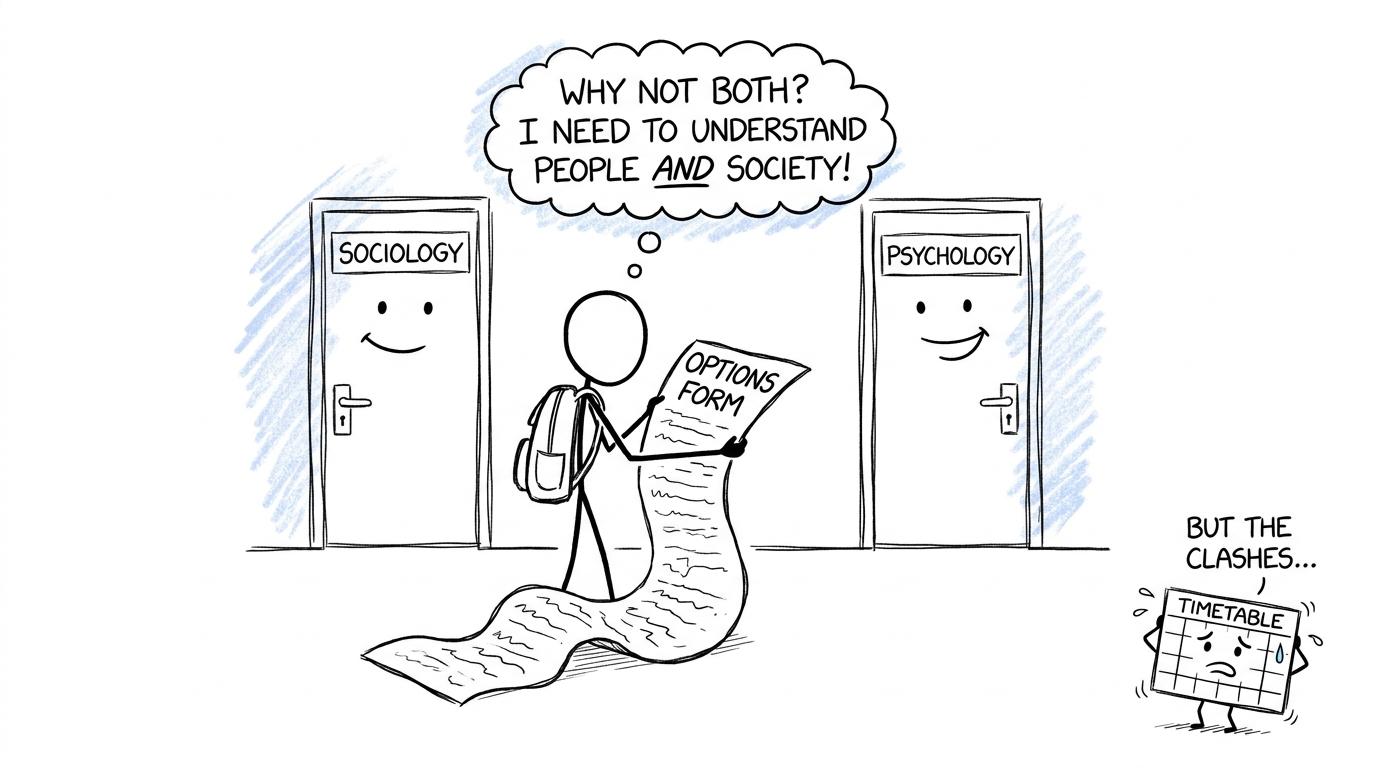 A student choosing between sociology and psychology while a nervous timetable watches
Is it realistic to take both subjects?
For many students, yes. The combination is academically coherent because both subjects investigate human life through evidence, theories and reasoned conclusions. They can also support later study in areas such as psychology, sociology, criminology, education, health and social sciences.
However, a sensible subject combination is not just a collection of things you find interesting. It is a workload you can sustain on an ordinary Wednesday in February, when homework from every department arrives at once.
Both courses require accurate terminology, knowledge of theories or studies, application to unfamiliar material and evaluation. Neither should be treated as an easy option. You may have definitions to retrieve, evidence to compare and longer answers to plan across both subjects.
This does not make the combination unmanageable. It means organisation matters. A student who revises through short, repeated sessions is likely to find the pairing more manageable than someone who leaves both subjects until the final weeks. The same principle applies to maths: a realistic GCSE maths revision timetable protects every subject from last-minute panic.
Your school’s timetable is the first obstacle
The most common practical barrier is not an examination rule. It is the school timetable.
Schools arrange optional subjects into blocks according to staffing, rooms and likely demand. If sociology and psychology appear in the same block, you may initially be unable to select both. Ask the options coordinator whether movement is possible, but understand that schools cannot always rebuild a timetable around one combination.
If one subject is not offered, taking it independently can involve finding teaching, arranging entry through an examination centre and checking that the specification can be prepared properly. That is a much larger commitment than choosing two subjects through school, so discuss it with a parent or carer, teachers and the prospective examination centre before making plans.
How much overlap is there really?
The overlap is meaningful but limited. Think of the courses as two neighbouring houses. Some tools are shared, but the rooms are different.
Research methods are the clearest connection
Current official specifications for both subjects include research methods. Depending on the board, students may meet ideas such as:
- questionnaires, interviews and observations;
- experiments and case studies;
- samples and sampling methods;
- primary and secondary data;
- quantitative and qualitative evidence;
- reliability, validity and bias;
- ethical issues;
- drawing conclusions from findings.
Learning to ask whether evidence is trustworthy helps in both classrooms. If a sample is unrepresentative or a question is leading, that weakness matters whether the investigation concerns memory, education or attitudes towards crime.
The terminology is not always used in precisely the same way, however. Psychology generally places greater emphasis on controlled scientific investigation, variables and the analysis of behavioural data. Sociology is more likely to connect a method to the practical and ethical challenges of researching social groups and institutions. Always answer in the language of the specification named on the paper.
Data skills provide another connection with maths. Interpreting tables, graphs, averages and relationships becomes easier when your statistical foundations are secure. MathsGenie’s GCSE Statistics revision hub and Edexcel GCSE Statistics resources can strengthen those underlying skills, even if you are not taking GCSE Statistics as a separate qualification.
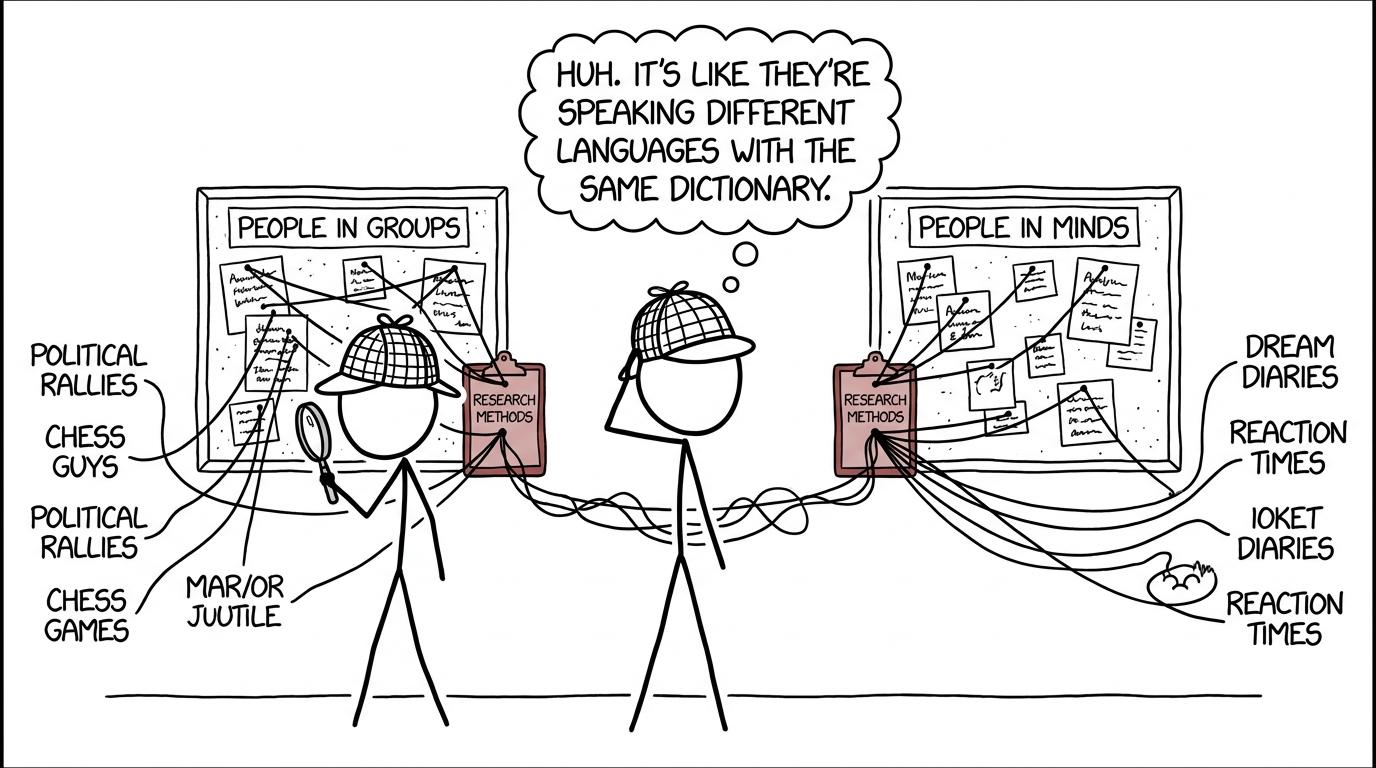 A student detective compares two evidence boards connected by research methods
Evaluation and argument also transfer
Both subjects reward more than description. You need to apply knowledge, analyse material, evaluate explanations and reach supported conclusions.
A strong habit in one subject can therefore improve the other. You learn to separate a claim from its evidence, identify limitations and avoid making a judgement without explaining why it follows. Those habits also support English essays and the reasoning demanded by multi-step maths questions.
Yet shared assessment skills do not mean shared content. Knowing how to evaluate a psychological study will not automatically give you sociological knowledge about social stratification. Transferable technique reduces some friction, but it does not halve the revision.
Where sociology and psychology differ
The distinction becomes clearer when you ask what each subject is trying to explain.
Sociology looks outward towards society
GCSE Sociology studies social structures, processes and issues. In the AQA course, for example, content includes families, education, crime and deviance, social stratification and sociological research methods. Students examine how institutions and social factors can influence people’s opportunities, experiences and behaviour.
The course involves perspectives, concepts, evidence and debates. You may consider how different sociologists explain the same social pattern and why their conclusions differ.
Psychology looks towards behaviour and mental processes
GCSE Psychology examines topics connected to thought and behaviour. AQA’s current course includes memory, perception, development, social influence, language, the brain and neuropsychology, psychological problems and research methods. Pearson Edexcel organises its course differently but also includes compulsory psychological topics, research methods and optional content.
Psychology can feel more scientific because students study investigations, variables, the brain and data analysis. Sociology can feel broader because it asks how society and institutions shape experience. Both descriptions are simplifications, but they reveal why taking one does not replace taking the other.
The apparent overlap can be deceptive
Crime might appear in both courses, for example, but the questions are different. Sociology may examine patterns of crime, social control or explanations linked to social structures. Psychology may consider individual, learning or biological explanations for criminal behaviour where that optional topic is taught.
Similarly, social influence appears in psychology, while socialisation and culture appear in sociology. Both concern other people’s effects on us, but they use different frameworks and evidence. The overlap can help ideas feel familiar; it cannot substitute for subject-specific revision.
Managing both alongside GCSE maths
The hidden cost of taking two essay-based subjects is not only lesson time. It is the number of small facts, studies, theories and evaluation points competing for retrieval.
A workable weekly pattern is:
- one short sociology retrieval session;
- one short psychology retrieval session;
- one session that compares research-methods terminology;
- regular maths practice based on your actual weak topics;
- one flexible catch-up block rather than filling every evening.
Do not give every subject identical revision time. Allocate time according to upcoming assessments and the marks you are currently losing. Use a diagnostic approach for maths: complete a mini test or timed section, mark it, and revise the topics revealed by the result. MathsGenie’s guide to the best order for learning GCSE maths topics can help you decide what should come next.
As examinations approach, gradually move from topic revision to timed practice. The guide on when to start GCSE past papers explains how to build that transition without exhausting your newest papers too early.
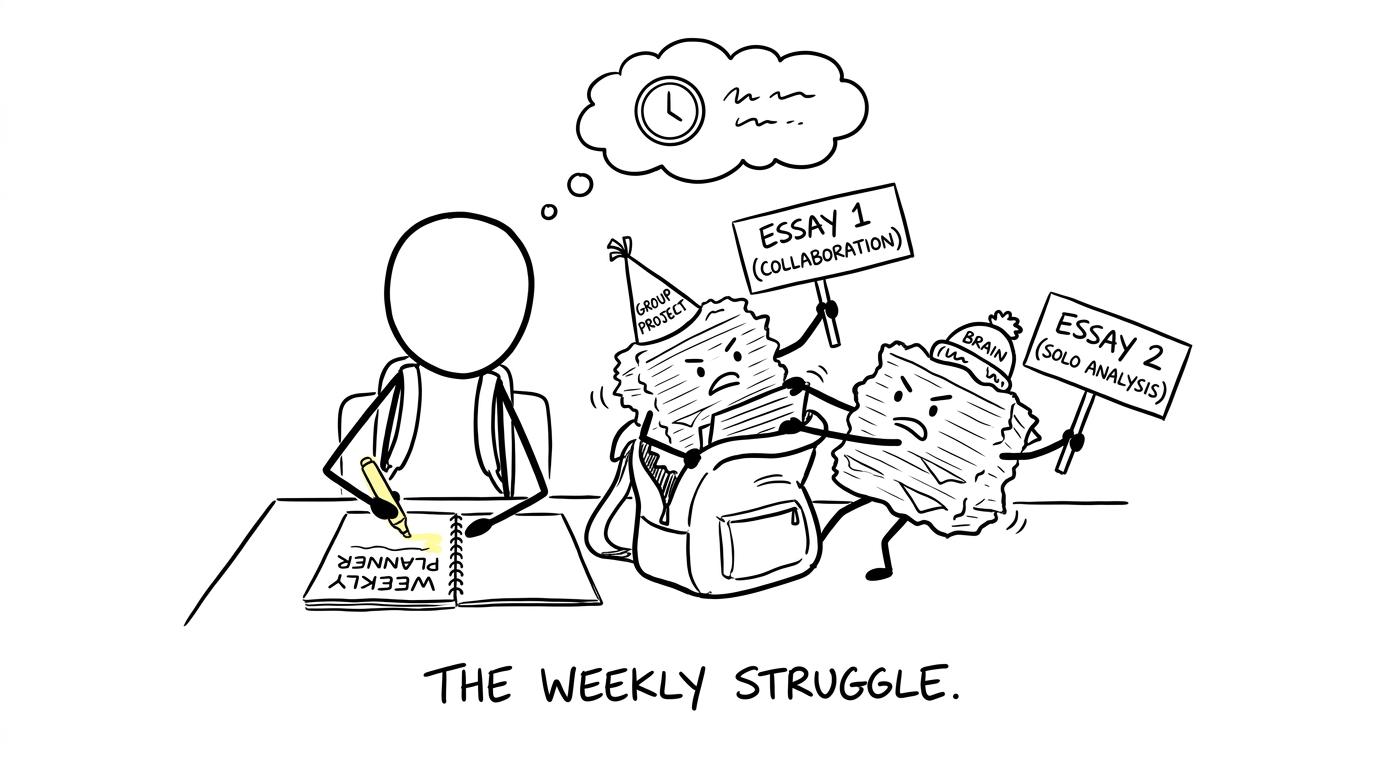 Two revision-card piles attempt to fit into one carefully planned backpack
Common mistakes when choosing both
Assuming the subjects are almost identical
Research methods and evaluation overlap, but most specification content remains distinct. Choose both because you genuinely want to learn both disciplines, not because you expect one set of notes to cover two GCSEs.
Choosing before checking the option blocks
A combination can be academically sensible and still be impossible within your school’s timetable. Check the published blocks and speak to the options team early.
Ignoring the amount of extended writing
Students sometimes focus on the interesting topics and overlook the assessment style. Look at specimen or past papers for your exact boards. Notice how often you must explain, apply, compare and evaluate.
Mixing up subject terminology
A research-methods term may sound familiar while being applied in a different context. Keep separate glossaries and use the wording expected by each specification and mark scheme.
Letting option subjects displace core revision
Interesting subjects naturally attract attention. Maths gaps are easier to postpone because they can feel less comfortable. Keep a protected slot for maths and use the GCSE maths topics by exam board and tier guide to make sure your practice matches Edexcel, AQA, OCR or Eduqas and your foundation or higher tier entry.
Treating interest as the only criterion
Interest is essential, but also consider workload, assessment style, teaching availability and your wider option balance. Ask teachers what lessons and homework typically involve rather than relying on the subject title.
Make the choice with evidence
Taking GCSE Sociology and GCSE Psychology together is realistic when your school offers both, the timetable allows it and you are prepared for substantial reading, terminology and written evaluation. Their strongest overlap lies in research methods and critical thinking. Their central content remains different: sociology studies society and institutions, while psychology focuses more closely on behaviour and mental processes.
Before submitting your options, read the specifications for the boards used by your school, inspect sample papers and ask current teachers how each course is taught. Then test the decision against your whole timetable, not just your enthusiasm for two subjects.
Whatever options you choose, keep maths revision steady. Start with the free MathsGenie GCSE maths hub, use revision lessons and practice questions to repair weak skills, then add mini tests, past papers, predicted papers, mark schemes and video solutions. A good option choice creates possibility. A repeatable revision routine turns that possibility into marks.