GCSE Russian vs GCSE Polish: Which Should You Choose?
GCSE Russian vs GCSE Polish explained: compare scripts, grammar, exam formats and revision demands to choose the language that best matches your strengths.
Choosing a language GCSE can feel strangely permanent. Russian may appeal because you already understand conversations at home, while Polish may feel more readable because it uses the Latin alphabet. Then someone calls one language “easier”, and a useful decision becomes a contest of opinions.
The clearest answer to GCSE Russian vs GCSE Polish is this: choose the language in which you can most confidently listen, speak, read and write under exam conditions. Existing fluency, access to teaching and familiarity with formal grammar matter far more than claims that one language is universally easier.
Both qualifications assess the same four broad skills, each worth 25%25\%25%. However, they use different exam boards and differ in script, grammar, vocabulary and individual task formats. Your choice should reflect your whole skill profile, not simply which language you can speak at home.
The quick decision checklist
Before choosing, ask:
- Which language do I hear and use most often?
- Can I read it accurately, not just recognise familiar words?
- Can I write extended answers with correct spelling and grammar?
- Do I have a teacher or tutor who understands the specification?
- Can my school arrange the speaking assessment and exam entry?
- Which option requires less improvement across all four skills?
- How will the extra preparation fit around GCSE maths and other subjects?
If one language wins clearly on most of these questions, it is probably the stronger choice.
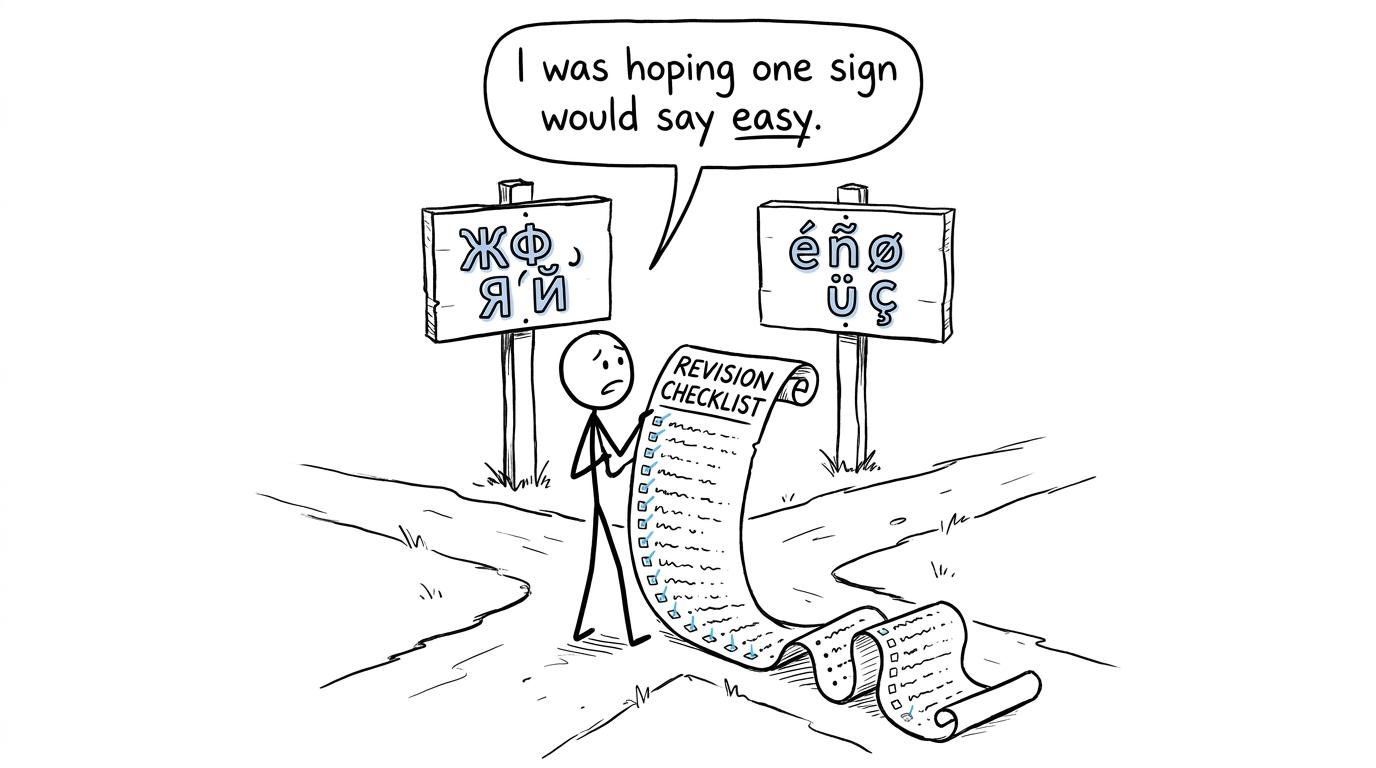 A student discovers that neither language choice is labelled easy
GCSE Russian vs GCSE Polish at a glance
As of the 2026 exam series, GCSE Russian is offered by Pearson Edexcel under specification 1RU01\text{RU}01RU0. GCSE Polish is offered by AQA under specification 868886888688. Check the latest specification and entry arrangements with your school before making a final decision.
| Feature | GCSE Russian | GCSE Polish |
|---|---|---|
| Current exam board | Pearson Edexcel | AQA |
| Writing system | Cyrillic alphabet | Latin alphabet with Polish diacritics |
| Main assessed skills | Listening, speaking, reading and writing | Listening, speaking, reading and writing |
| Weighting | Each skill is worth 25%25\%25% | Each skill is worth 25%25\%25% |
| Tiers | Foundation and Higher | Foundation and Higher |
| Foundation grade range | Grades 111 to 555 | Grades 111 to 555 |
| Higher grade range | Grades 444 to 999 | Grades 444 to 999 |
| Dictionary in assessments | Not permitted | Not permitted |
| Translation | Russian to English and English to Russian | Polish to English and English to Polish |
Students must take all four components at the same tier. Russian and Polish are therefore similar in overall assessment balance: neither lets strong speaking completely compensate for neglected reading or writing.
How the exam formats actually compare
The broad structure is reassuringly familiar. You face listening, speaking, reading and writing in both qualifications, and each component contributes one quarter of the final result.
There are still practical differences. Edexcel Russian speaking includes a role-play, a picture-based task and a conversation. AQA Polish speaking uses a role-play, a photo card and a general conversation. The labels sound similar, but the prompts, timings and mark schemes are board-specific.
Both reading papers include translation into English, while both writing papers assess translation from English into the target language. AQA Polish Higher writing includes structured tasks of approximately 909090 and 150150150 words. Edexcel Russian uses its own task lengths and prompt structure. You should therefore practise with material for the correct board rather than treating every language GCSE paper as interchangeable.
The theme organisation also differs. Edexcel Russian is arranged around identity and culture; local area, holidays and travel; school; future aspirations, study and work; and the international and global dimension. AQA Polish groups content into three wider themes covering identity and culture; local, national, international and global interests; and current and future study and employment.
The everyday territory overlaps. The way each board packages and tests it does not.
Which language matches your strengths?
Choose Russian if Cyrillic is already comfortable
Russian uses Cyrillic. If you can already read and write it fluently, that is a meaningful advantage. If you only speak Russian, however, the alphabet becomes an additional skill that must become automatic before you can handle timed reading and writing confidently.
Russian also requires control of features such as grammatical case, gender, adjective agreement, verb conjugation and aspect. Those ideas may feel natural in conversation without being easy to explain or apply accurately in writing.
Russian may suit you better if you:
- regularly speak and hear Russian;
- can read Cyrillic without slowly decoding each letter;
- have experience writing complete sentences;
- can distinguish informal speech from accurate exam language;
- have reliable support for grammar and speaking preparation.
Choose Polish if reading and spelling are stronger
Polish uses the Latin alphabet, but that does not make its written form identical to English. Diacritics and letter combinations matter, and familiar spoken words still need accurate spelling.
Polish grammar includes cases, gender, agreement, verb conjugation and aspect. Consonant changes and inflected word endings can make formal writing demanding even for confident speakers. A student who chats naturally with family may still need focused work on spelling, grammatical terminology and extended responses.
Polish may suit you better if you:
- use Polish regularly in real conversations;
- can read authentic Polish at a useful speed;
- already write with reasonable spelling accuracy;
- can express opinions and justify them;
- have access to someone who understands AQA assessment requirements.
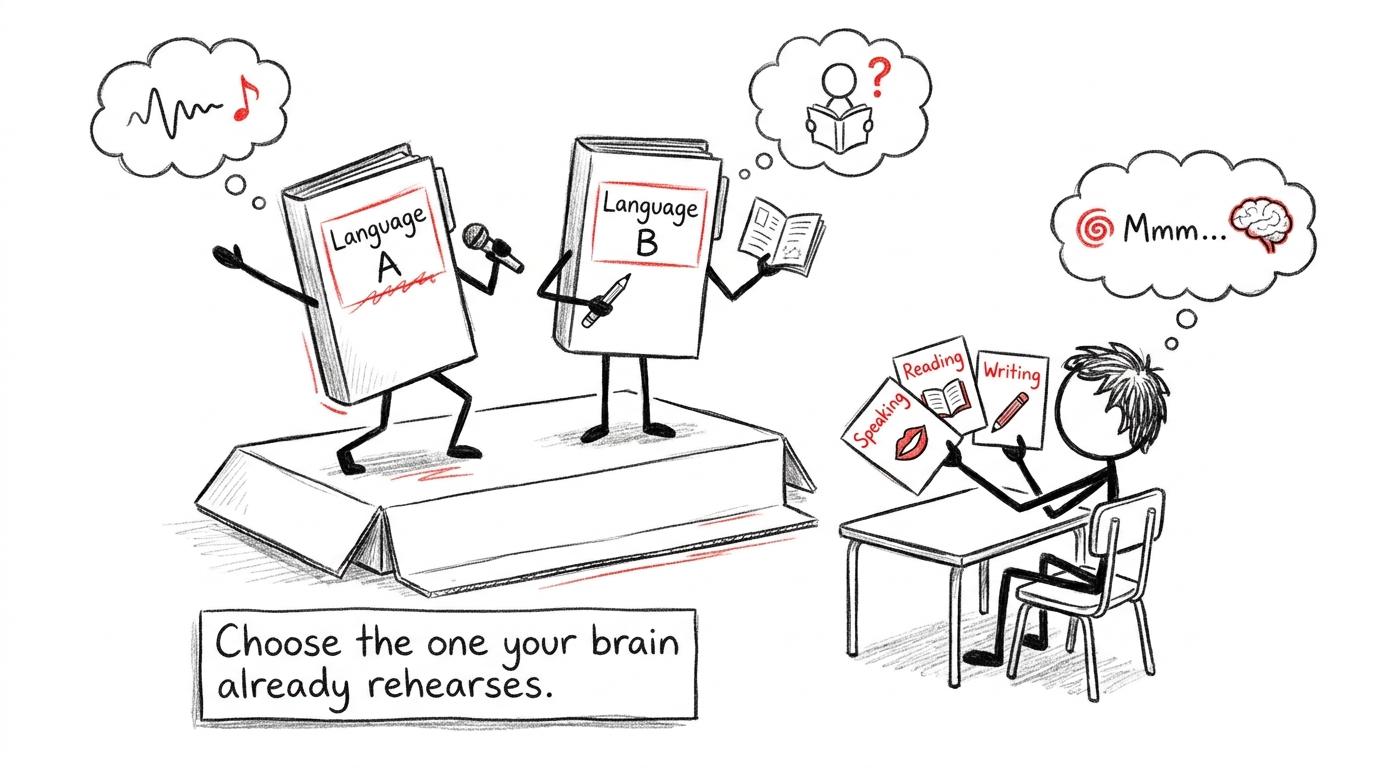 Language folders compete in a four-skill talent show
Being a heritage speaker is an advantage, not a guarantee
Home-language experience can give you a valuable head start in listening, pronunciation and spontaneous conversation. But a GCSE tests more than everyday fluency.
You may rarely discuss environmental issues, future employment or school rules at home. You may understand a relative perfectly while finding a recorded extract difficult because the voice, pace or context is unfamiliar. You may also speak naturally but write phonetically, miss endings or rely on vocabulary from one family or region.
A useful diagnostic is to try one listening section, one reading section and one writing task in each language without help. Ask a qualified teacher to assess the speaking element. Compare the gaps rather than comparing only the marks: an unfamiliar topic is easier to repair than weak literacy across an entire writing system.
This is the same principle that makes a GCSE maths diagnostic paper useful. The result is not a verdict. It tells you what the next stage of revision would cost.
Consider teaching and exam access before difficulty
The theoretically perfect language is not a practical option if you cannot receive suitable teaching or complete the speaking assessment.
Ask your school or exam centre:
- whether it accepts entries for the qualification;
- whether it can conduct and record the speaking assessment correctly;
- who will teach or supervise your preparation;
- which tier is appropriate;
- what internal deadlines apply;
- whether there are fees or additional arrangements for an external entry.
Do this early. Smaller-entry language subjects may not be taught on your normal timetable, and private-candidate arrangements vary between centres. Never assume that speaking fluently is enough for a school to enter you automatically.
Protecting your GCSE maths revision time
A language choice has an opportunity cost. Every hour spent learning a new alphabet or repairing formal grammar is an hour unavailable for algebra, geometry or science. That does not mean you should avoid the challenge. It means you should measure it honestly.
Start with the free GCSE maths revision hub and identify how much maths preparation you already need. If your timetable is crowded, use GCSE mini tests to find weak areas without committing to a full paper.
A balanced weekly routine might include separate sessions for language vocabulary, writing, listening and speaking, alongside protected maths sessions. MathsGenie's one-month GCSE revision plan shows how short retrieval tasks, targeted practice and timed papers can fit into a repeatable structure.
Do not revise whichever subject feels most comfortable. Give time to the skill that currently loses marks. In maths, that may mean repairing simultaneous equations. In Russian or Polish, it may mean writing accurate opinions across several time frames.
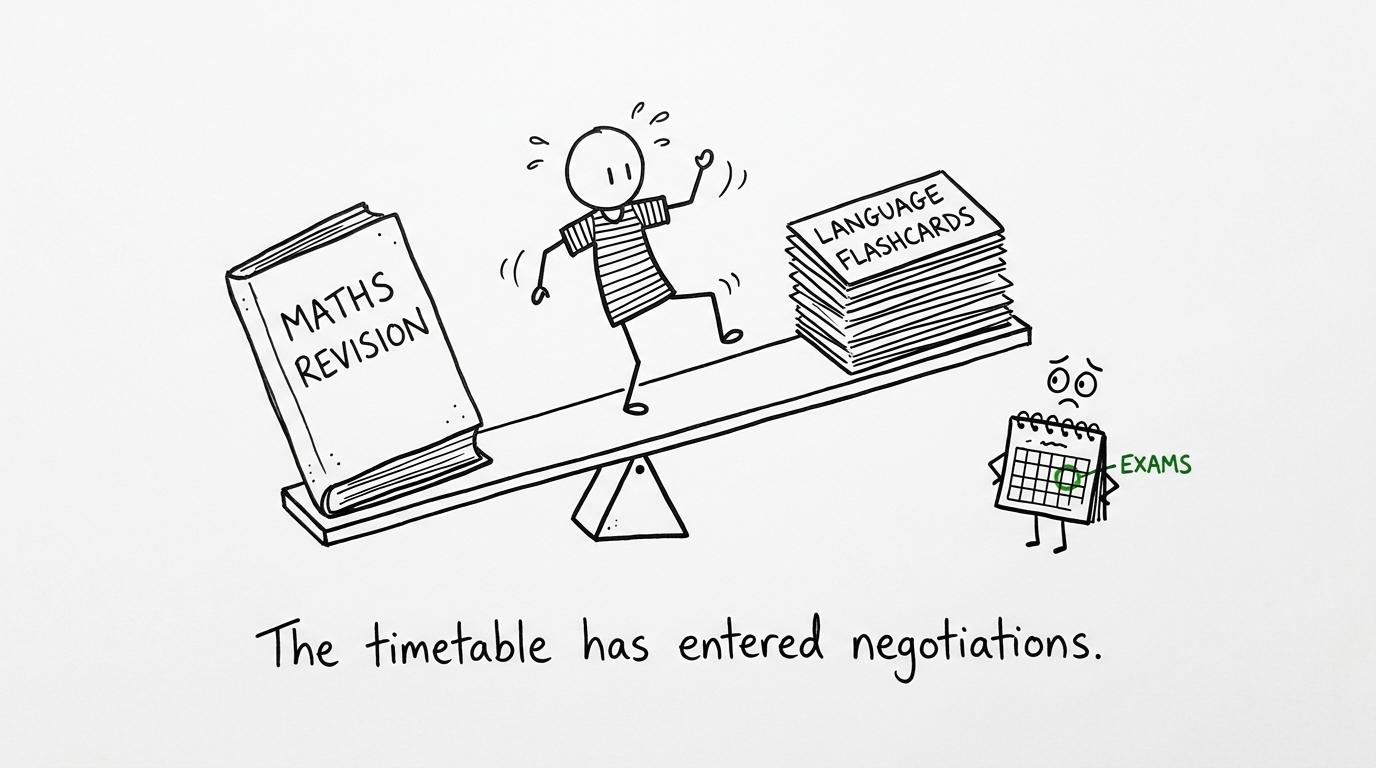 A revision timetable begins negotiations with maths and language folders
A sensible way to make the final decision
Score each language against five areas: listening, speaking, reading, writing and access to support. Use a simple scale from 000 to 444, where 000 means no current confidence and 444 means strong exam-ready confidence.
Do not treat the total as an automatic answer. Look at its shape. Four strong Russian skills and one repairable weakness may be safer than uneven Polish knowledge supported only by fluent conversation. Equally, strong Polish literacy and accessible teaching may outweigh a casual familiarity with Russian.
Then estimate the weekly preparation each option requires. Keep enough room for timed maths practice using GCSE predicted papers, while remembering that predicted papers should supplement rather than replace official past papers. If full papers feel too large, the Edexcel GCSE maths 45-minute tests can help build stamina in smaller steps.
Common mistakes when choosing between Russian and Polish
Choosing the language that sounds easier
Neither qualification is universally easier. Your prior knowledge, literacy and support determine the real workload.
Judging ability only by conversation
Informal speaking does not test extended writing, translation, unfamiliar listening extracts or specification vocabulary. Check all four skills.
Ignoring the exam board
Russian and Polish use different boards. Task formats, themes and mark schemes are not identical, so revision must match the correct specification.
Leaving speaking arrangements too late
A centre must be able to administer the assessment properly. Confirm this before building a revision plan around the subject.
Allowing one GCSE to consume the timetable
An ambitious language entry should not quietly displace maths. Use a structured approach to start GCSE past papers at the right time, then turn every lost mark into targeted revision.
Make the choice that reduces avoidable difficulty
The best answer to GCSE Russian vs GCSE Polish is rarely hidden in a league table or someone else's opinion. It is visible in your present skills.
Choose Russian if Cyrillic, Russian grammar and formal communication are already the stronger foundation. Choose Polish if your Polish literacy, vocabulary and exam support are more developed. If the decision remains close, complete specimen tasks in both and ask an experienced teacher to assess them.
Once you have chosen, protect the rest of your GCSE preparation. MathsGenie gives you free revision lessons, practice questions, mini tests, past papers, predicted papers, mark schemes and video solutions. Begin with the GCSE maths topics by exam board and tier, build a realistic revision plan and let evidence, not guesswork, decide what you practise next.