GCSE Russian Paper 3 Exam Date 2026: Key Guide
GCSE Russian Paper 3 exam date 2026 was 2 June. Check the afternoon session, paper length, required equipment and a calm plan for nearby GCSE maths exams.
An exam date can look like a small detail until it sits beside several other papers in the same week. Then it becomes the detail around which sleep, travel and revision all have to turn.
The GCSE Russian Paper 3 exam date 2026 was Tuesday 2 June 2026, in the afternoon session, according to Pearson Edexcel's final summer timetable. Paper 3 was Reading and Understanding in Russian. Foundation tier lasted 50 minutes, while Higher tier lasted 1 hour 5 minutes.
Your school's individual timetable remained the document to follow for the precise arrival time, room and seating arrangements. Russian Paper 1 was also timetabled for the afternoon of 2 June, so candidates needed to check how their centre arranged the two papers.
GCSE Russian Paper 3 date at a glance
| Detail | Official information |
|---|---|
| Exam board | Pearson Edexcel |
| Specification | GCSE Russian (1RU0)(1RU0)(1RU0) |
| Paper | Paper 3: Reading and Understanding in Russian |
| Date | Tuesday 2 June 2026 |
| Session | Afternoon |
| Foundation code | 1RU0/3F1RU0/3F1RU0/3F |
| Foundation duration | 50 minutes |
| Higher code | 1RU0/3H1RU0/3H1RU0/3H |
| Higher duration | 1 hour 5 minutes |
| Available marks | 505050 marks |
| Qualification weighting | 25%25\%25% |
| Dictionary | Not permitted |
Before the exam, confirm five things:
- whether you are entered for foundation or higher tier;
- the arrival time printed on your centre timetable;
- where the exam will take place;
- how your school will organise Russian Papers 1 and 3 that afternoon;
- whether you have any approved access arrangements.
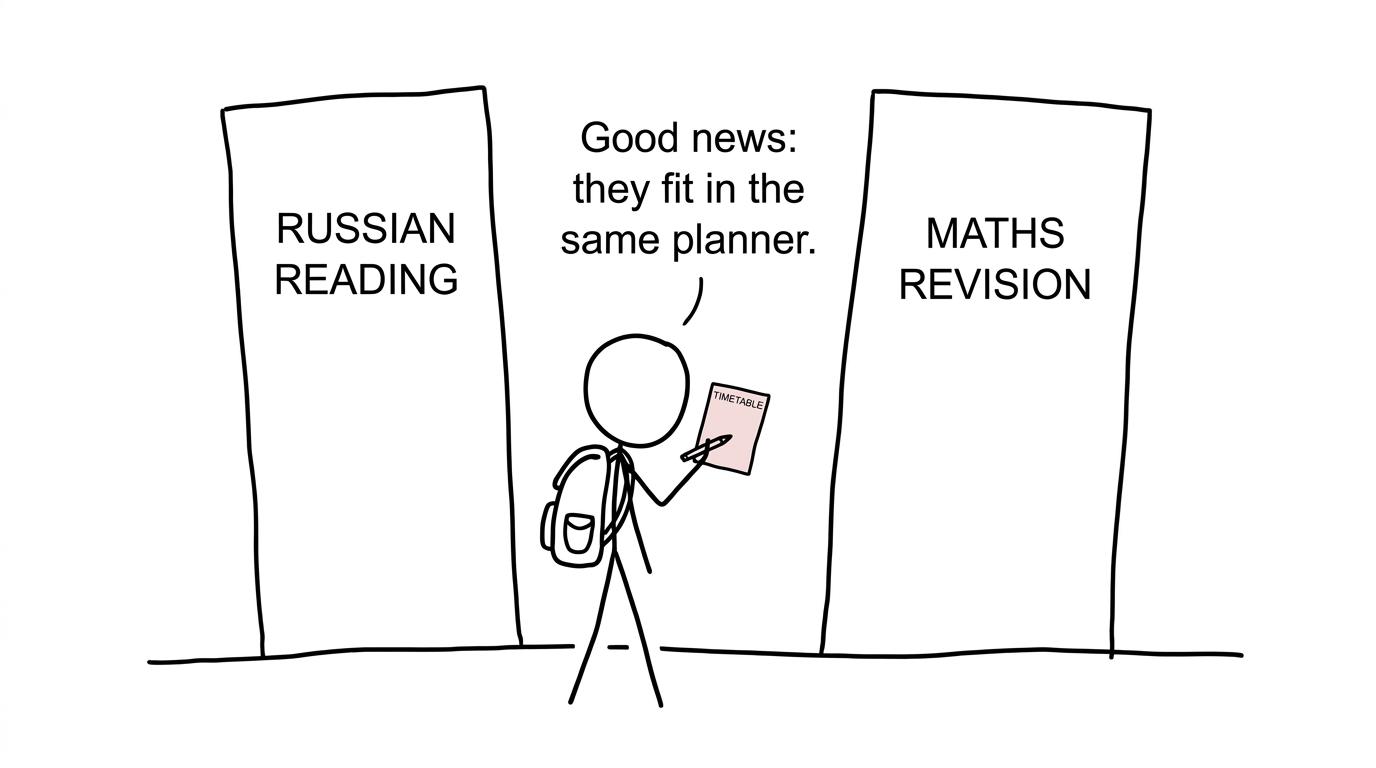 A student calmly fitting Russian and maths into one revision planner
What GCSE Russian Paper 3 assesses
Paper 3 is a reading examination. It draws on vocabulary and language structures from across the specification's themes rather than focusing on one isolated topic.
The paper contains three sections. Questions in Sections A and C are set in English, while questions in Section B are set in Russian. Candidates must answer all sections. The final section includes translation from Russian into English, and Pearson's paper guidance suggests spending approximately 15 minutes on that translation task.
This matters for preparation. Reading revision should not become a long attempt to memorise every possible word. A more useful approach is to develop several connected skills:
- identifying the main message of a passage;
- noticing details that change meaning, such as negatives and time references;
- recognising familiar words in unfamiliar forms;
- distinguishing past, present and future events;
- answering in the language requested by the question;
- translating meaning naturally rather than replacing words mechanically.
Foundation and higher candidates sit different papers and have different time allowances. Students must be entered for the same tier across the qualification, so do not decide which practice paper to use by difficulty alone. Match every paper to the tier confirmed by your school.
What to have ready before the exam
The best exam kit is deliberately uninteresting. It works, it follows the rules and it removes decisions from the afternoon.
Essential equipment
Have at least two working black ink pens in a clear pencil case. JCQ instructions for the 2025-26 examination year required candidates to write clearly in black ink. Gel pens, erasable pens and correction fluid or tape were not permitted for answers.
You may also want a clear, label-free water bottle if your centre allows one. Your school may ask you to bring candidate identification, although arrangements differ between centres. Check rather than assume.
You do not need a calculator, ruler or other mathematical equipment for this reading paper. More importantly, you must not use a dictionary. The instruction appears on the question paper, so leave Russian dictionaries and vocabulary sheets outside the exam room.
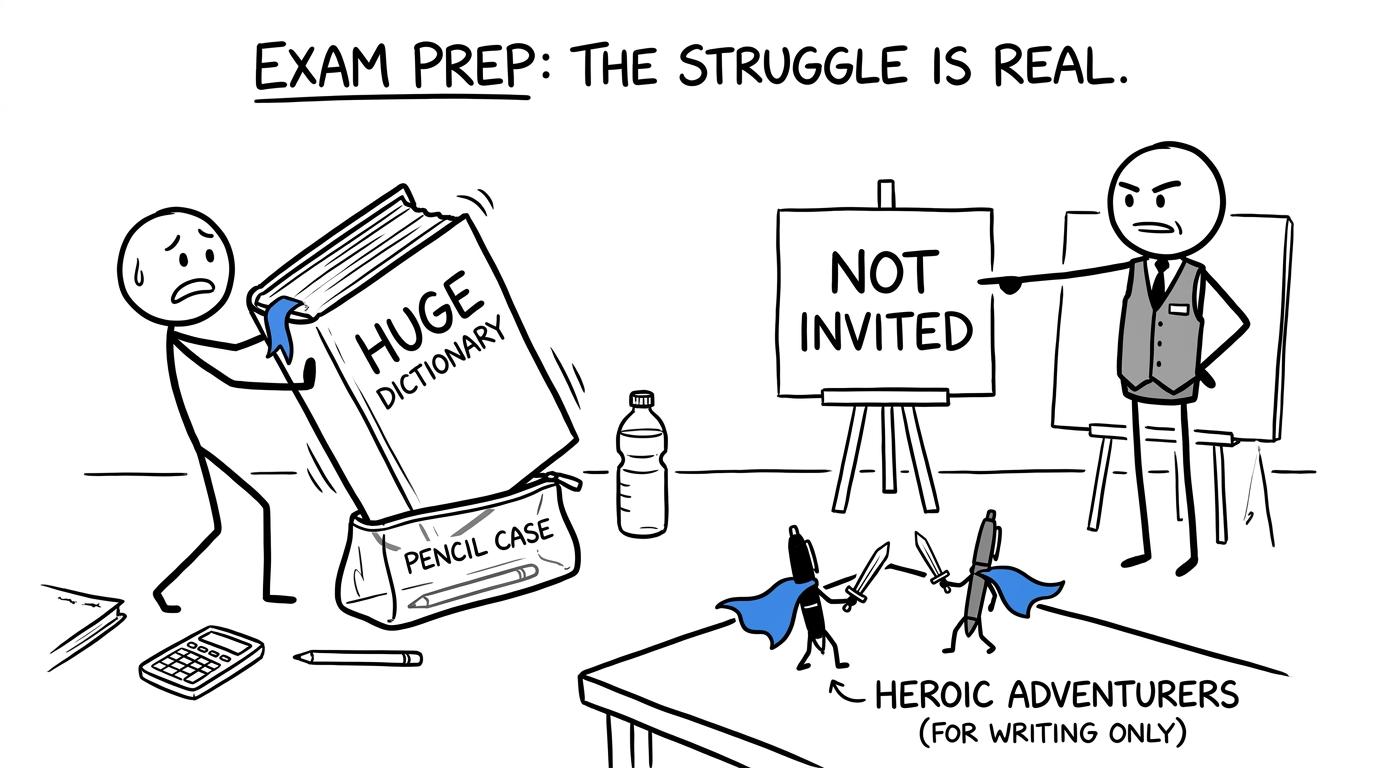 Two heroic black pens watch an oversized dictionary being turned away from an exam
Information to check in advance
Write down or save your school's instructions for:
- your required arrival time;
- the exam room and seat number;
- your candidate and centre numbers;
- the handling of any timetable clash;
- the arrangements between Russian Paper 1 and Paper 3;
- who to contact if illness or travel disruption makes you late.
The published timetable identifies an afternoon session, but it does not replace the personal timetable issued by your school. Centres manage arrival and start arrangements within examination regulations. If two documents appear to disagree, contact your exams officer immediately.
Items to leave outside
JCQ rules prohibited candidates from possessing unauthorised materials in the exam room, even when there was no intention to use them. That includes:
- mobile phones;
- watches, including analogue and smart watches;
- earphones or earbuds;
- smart glasses and other smart devices;
- revision notes and vocabulary lists;
- opaque pencil cases;
- dictionaries unless expressly permitted.
Do not rely on switching a device off. Follow your centre's procedure for handing it in or leaving it securely outside.
Planning Russian alongside GCSE maths
The difficult part of a mixed exam week is rarely one paper by itself. It is the switching cost. Russian asks you to read closely and interpret language; maths asks you to select methods, calculate accurately and show clear working. Both become harder when revision is improvised late at night.
Start by placing every official paper and school arrival time into one calendar. Then work backwards. The MathsGenie GCSE maths revision hub lets you choose your exam board and find suitable lessons, worksheets and exam questions for Edexcel, AQA, OCR, Eduqas, WJEC or CCEA.
Keep the final Russian session focused on recognition and retrieval: vocabulary families, question instructions, tense clues and short reading passages. Keep the nearby maths session equally selective. Choose one or two recurring weaknesses rather than opening an entire specification.
If you are unsure what deserves attention, the GCSE maths topics by board and tier guide provides a structured checklist. The best order for learning GCSE maths topics can also help if your revision still feels fragmented.
Use a short feedback loop
A reliable maths revision cycle is:
- choose one weak skill;
- revisit the method through a revision lesson;
- complete exam-style practice questions;
- mark the work immediately;
- record why each mark was lost;
- retest the skill on another day.
MathsGenie GCSE mini tests are useful during a crowded week because they test recall without consuming the time and energy of a full paper. When you have a longer session available, use past papers under timed conditions. The guide to when to start GCSE past papers explains how to move from short sections to complete papers.
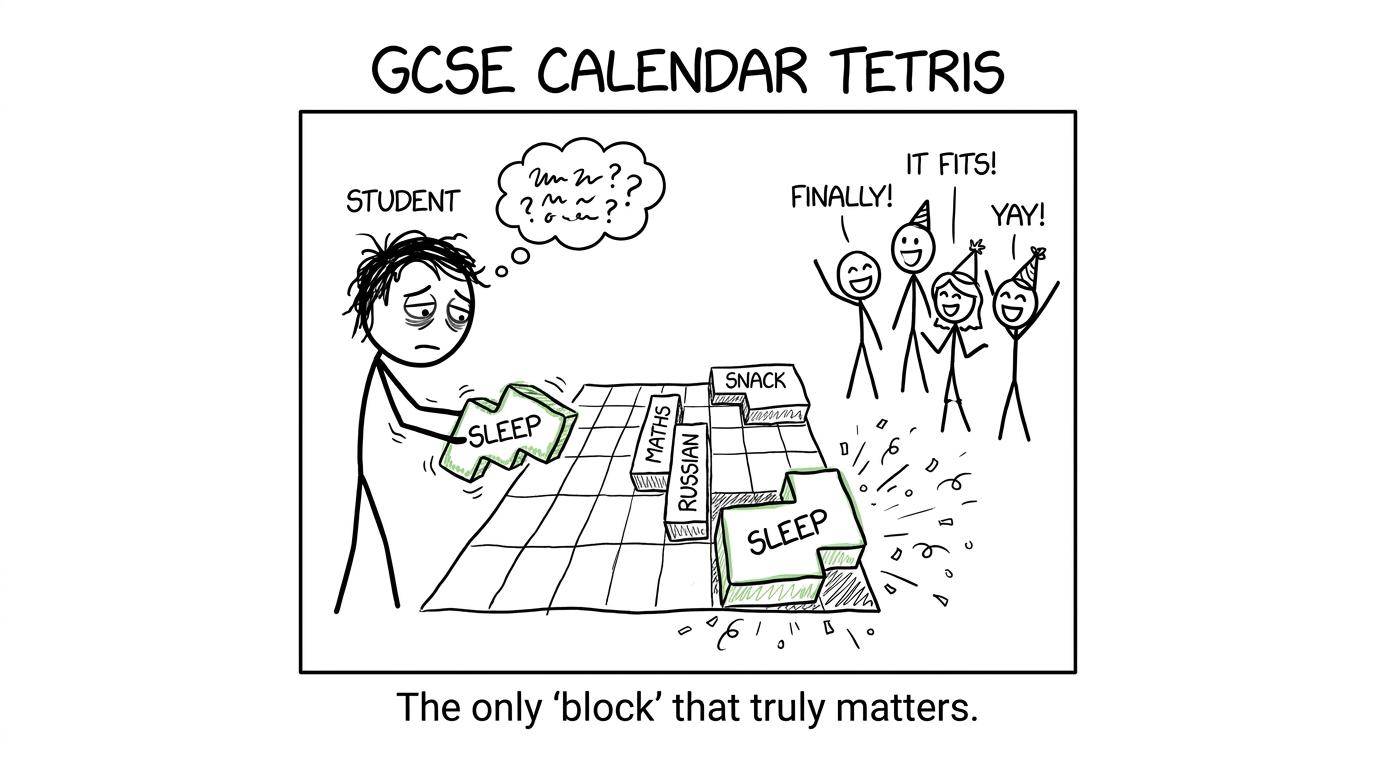 A student wins calendar Tetris by making room for Russian, maths, sleep and a snack
A calm plan for the final 24 hours
The day before Russian Paper 3 is not the moment to rebuild the entire course. It is the moment to protect what you already know.
Complete one short reading task, mark it and inspect the cause of each error. Was the missing mark caused by vocabulary, a negative, the wrong tense, an incomplete answer or a misunderstanding of the question? That diagnosis is more valuable than completing several passages without review.
Then prepare the practical details:
- pack two black pens in a clear pencil case;
- check your school timetable and arrival time;
- set an alarm with enough time for travel disruption;
- remove notes, watches and electronic devices from your exam kit;
- choose a sensible stopping time for revision;
- keep your evening meal and bedtime routine normal.
If a maths examination is close, resist turning the evening into an exhausting full-paper session. Use the GCSE maths night-before plan or review a targeted set of questions. A short, accurately marked session is more useful than tired practice with no feedback.
Exam-room strategy for Paper 3
Read each instruction carefully before reading the passage in detail. Check whether the answer must be written in English or Russian, and use the mark allocation to judge how much information is required.
When a word is unfamiliar, do not let it consume the whole passage. Look at its role in the sentence, nearby words and the wider context. One unknown word does not necessarily prevent you from finding the answer.
For translation, aim to communicate the complete meaning in natural English. Check names, negatives, time references, quantities and links between clauses. Leave enough time to reread your translation against the original passage.
If anxiety interrupts your concentration, return to the next concrete action: read the instruction, underline the key idea mentally, find the relevant section and answer only what has been asked. Calm often arrives after action, not before it.
Common mistakes to avoid
Confusing Paper 3 with the speaking paper
Paper 3 is Reading and Understanding. Speaking is Paper 2 and is assessed separately within the relevant assessment window.
Assuming every centre starts at the same clock time
The official timetable states the afternoon session. Your school provides the exact arrival and start arrangements that apply to you.
Bringing a dictionary
Dictionaries are not permitted for Edexcel GCSE Russian Paper 3. Vocabulary sheets and personal notes are also unauthorised materials.
Revising for the wrong tier
Foundation lasts 50 minutes and Higher lasts 1 hour 5 minutes. Confirm your entry and practise using the correct paper code.
Ignoring the second Russian paper that afternoon
Paper 1 Listening and Understanding was also timetabled on 2 June in the afternoon. Candidates needed to follow their centre's instructions for the order, timing and supervision arrangements.
Treating predicted papers as predictions of exact questions
For maths revision, predicted papers are fresh exam-style practice, not a guarantee. Use Edexcel GCSE maths predicted papers alongside official past papers, topic practice, mark schemes and video solutions.
Keep the date in perspective
The final timetable placed Edexcel GCSE Russian Paper 3 on Tuesday 2 June 2026 in the afternoon. The useful next step was not simply remembering that date. It was knowing the tier, duration, room, arrival time, equipment rules and arrangements for the other Russian paper in the same session.
A timetable gives revision a boundary. Use it to make the next action smaller and clearer. For maths, begin with the free MathsGenie GCSE revision resources, then combine revision lessons and practice questions with mini tests, past papers, predicted papers, mark schemes and video solutions. One well-marked task today is worth more than a perfect plan that never begins.