

GCSE Russian Homework Grade Impact: Does It Matter?
GCSE Russian homework grade impact explained: learn what counts towards your final result, when homework helps, and how to balance it with maths revision.
A Russian homework task is due tomorrow. Your maths mock is getting closer. Both seem urgent, but only one evening is available. The real question is not whether homework is “good”. It is whether the work will improve the result that matters most.
The short answer to the GCSE Russian homework grade impact question is simple: ordinary homework does not directly contribute marks to your final GCSE Russian grade. For the current Pearson Edexcel GCSE Russian qualification, the result comes from assessments in listening, speaking, reading and writing. However, purposeful homework can improve the knowledge and fluency you need in those assessments. Its impact is indirect, potentially valuable and highly dependent on what you actually do.
If Russian homework becomes low-quality copying while maths remains a priority, your time may be better divided more carefully. The aim is not to ignore either subject. It is to stop treating every task as equally useful.
The quick answer: what should you do?
Use this checklist before committing a large revision block to Russian homework:
- Complete work required by your school, but ask what skill it is developing.
- Prioritise retrieval, vocabulary, translation, listening and speaking practice over decorative presentation or repeated copying.
- Use teacher feedback to correct errors rather than simply noting the mark.
- Avoid spending unlimited time perfecting a task that carries no direct examination marks.
- Protect regular maths practice, particularly if your mocks or past papers reveal important gaps.
- Review your priorities weekly, because the weakest subject or nearest assessment may change.
The best decision is rarely “all Russian” or “all maths”. It is usually a smaller, focused piece of Russian practice followed by a defined maths session.
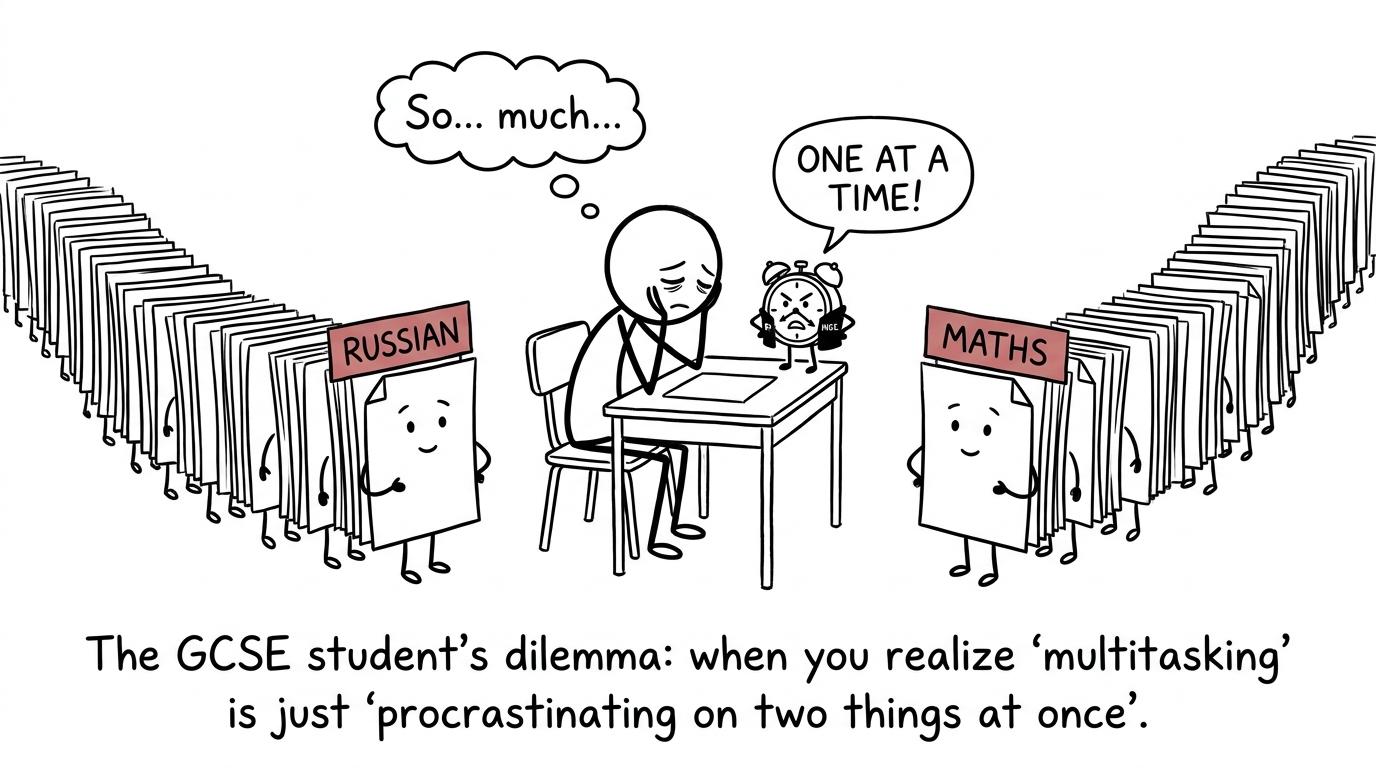 A GCSE student negotiating two queues of Russian and maths homework while a clock controls the evening
Does Russian homework count towards the final GCSE grade?
Ordinary classwork and homework are not separate components of the final Pearson Edexcel GCSE Russian grade. The qualification is assessed through four areas:
- listening and understanding;
- speaking;
- reading and understanding;
- writing.
Each area represents 25%25\%25% of the qualification. The final result is therefore based on performance across those four assessments, not on how many homework sheets you submitted during the course.
That distinction matters. A beautifully completed vocabulary poster does not automatically add marks to your final result. A short vocabulary task that helps you recognise and use words under examination conditions might.
Homework can also influence things around the qualification. It may help your teacher judge your progress, identify whether foundation or higher tier is appropriate, provide predicted-grade evidence and decide what support you need. Those consequences are important, but they are not the same as homework marks being added to your examination total.
Always follow guidance from your school and check the specification for the qualification you are taking. GCSE arrangements can differ by subject and awarding organisation. In maths, for example, students may follow Edexcel, AQA, OCR or Eduqas, so your revision should match the correct board and tier. MathsGenie’s GCSE Maths topics by exam board and tier guide helps you confirm the right route.
Why homework can still improve your Russian grade
Not counting directly does not mean not mattering. Training sessions do not appear on a match score, but the habits built there influence what happens when the result is recorded.
The Education Endowment Foundation’s evidence review reports a positive average impact from homework at secondary level. It also warns that the evidence base has limitations and that results vary. Quality appears more important than quantity. Tasks linked to classroom learning, designed for a clear purpose and followed by feedback tend to be more effective.
That gives homework three useful jobs.
It strengthens retrieval
GCSE Russian requires you to recall vocabulary, grammatical forms and structures without having a complete set of notes beside you. Closing the book and trying to retrieve a word is more demanding than rereading it, but the difficulty is useful. It reveals what you genuinely know.
Frequent, short retrieval is usually more valuable than one long session of passive highlighting. The same principle applies to maths: answering questions exposes uncertainty that reading a revision guide can hide.
It distributes practice over time
Languages are difficult to secure through last-minute revision because knowledge must become accessible quickly. Revisiting vocabulary and structures on several occasions gives you repeated opportunities to retrieve them.
A sensible pattern might include a brief first review, another after a few days and a later check. The intervals do not need to be perfect. The important feature is returning to the material after some forgetting has occurred.
It creates feedback before the exam
A corrected translation or writing task can reveal recurring problems with cases, verb forms, spelling and word order. That information has value only if you respond to it.
The useful loop is:
attempt⟶feedback⟶correction⟶new attempt\text{attempt} \longrightarrow \text{feedback} \longrightarrow \text{correction} \longrightarrow \text{new attempt}attempt⟶feedback⟶correction⟶new attemptStopping at the teacher’s mark wastes the most informative part of the task. This is also why maths mark schemes and video solutions matter: they turn a lost mark into a specific next action.
Which Russian homework gives the best return?
The title “homework” tells you where a task is completed, not whether it is effective. Judge the task by the examination behaviour it develops.
| Homework activity | Likely revision value |
|---|---|
| Retrieving vocabulary without notes | High when words are revisited and errors are corrected |
| Listening to suitable Russian and answering questions | High when it matches the required level and is checked |
| Preparing and recording spoken responses | High when pronunciation, accuracy and spontaneity are reviewed |
| Completing a translation or writing task independently | High when feedback leads to another attempt |
| Copying vocabulary repeatedly while looking at it | Limited because recognition can be mistaken for recall |
| Spending excessive time decorating notes | Low unless presentation genuinely helps later retrieval |
| Using translation software to produce an answer | Very low because it hides the knowledge gap |
There is no honest universal promise that completing a particular number of homework hours will raise your grade by a particular amount. Your starting point, task quality, feedback and consistency all matter. Claims such as “every hour equals a grade increase” should be treated cautiously.
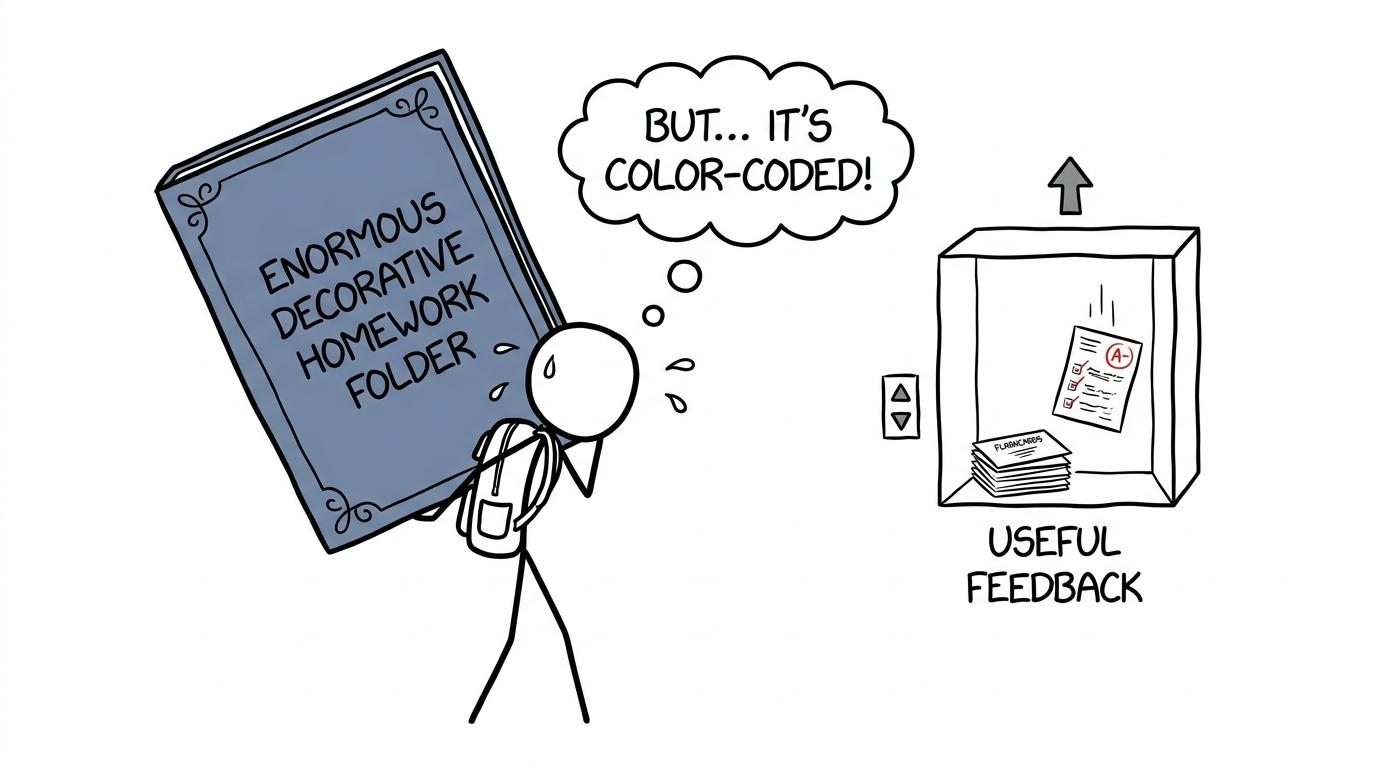 A giant decorative folder takes the stairs while flashcards and a marked paper use the useful-feedback lift
When your time may be better spent on maths
The relevant question for a student preparing for maths exams is not whether Russian matters. It is where the next focused block of time is most likely to protect or gain marks.
Maths may deserve priority when:
- a mock or past paper has exposed several weak core topics;
- you are close to an important grade boundary;
- your foundation or higher-tier entry depends on current performance;
- you can name a specific skill that needs repair;
- the Russian task has become passive copying with little learning value.
Russian may deserve priority when:
- the task prepares you for an approaching speaking assessment;
- vocabulary gaps are affecting listening, reading and writing together;
- your teacher has given precise feedback that you can act on;
- the deadline is immediate and the work can be completed purposefully;
- you have recently given maths substantial, effective practice.
Do not use preference as your only measure. Students naturally drift towards subjects that feel comfortable. Evidence is better. Use recent assessments, teacher feedback and unfinished corrections to decide.
For maths, begin at the free GCSE Maths revision hub, where you can choose your exam board and work with revision lessons, topic questions, papers and solutions. If you are unsure what to tackle first, the best order for learning GCSE Maths topics provides a structured route from core number skills to exam practice.
Build a balanced homework and revision routine
A routine should reduce repeated decisions. It should not become another elaborate project.
Give each session a measurable purpose
“Do Russian” and “revise maths” are too vague. Better targets include retrieving a defined vocabulary set, recording a speaking response, completing a maths mini test or correcting questions from a paper.
You can think about priority using three questions:
priority=urgency+weakness+likely mark value\text{priority} = \text{urgency} + \text{weakness} + \text{likely mark value}priority=urgency+weakness+likely mark valueThis is a decision prompt, not a literal examination formula. A task that is urgent, addresses a real weakness and closely resembles assessed work should usually come before one that merely looks productive.
Put a boundary around the task
Decide what completion means before starting. For Russian, that could mean one independent attempt, careful checking and a list of errors to revisit. For maths, it could mean one focused question set, marking and correction.
If exams are close, MathsGenie’s one-month GCSE Maths revision plan shows how to combine retrieval, topic practice and timed papers without trying to revise everything every evening.
Use errors to plan the next session
Keep a brief error log for both subjects. In Russian, record the vocabulary, grammar or pronunciation issue. In maths, classify the lost mark as a knowledge, process or accuracy problem.
Then revisit the error. A correction seen once is easy to forget; a correction successfully applied later is evidence of learning. MathsGenie’s guide to GCSE Maths topics that come up regularly can help you place gaps within the wider course, although no topic list can predict a paper with certainty.
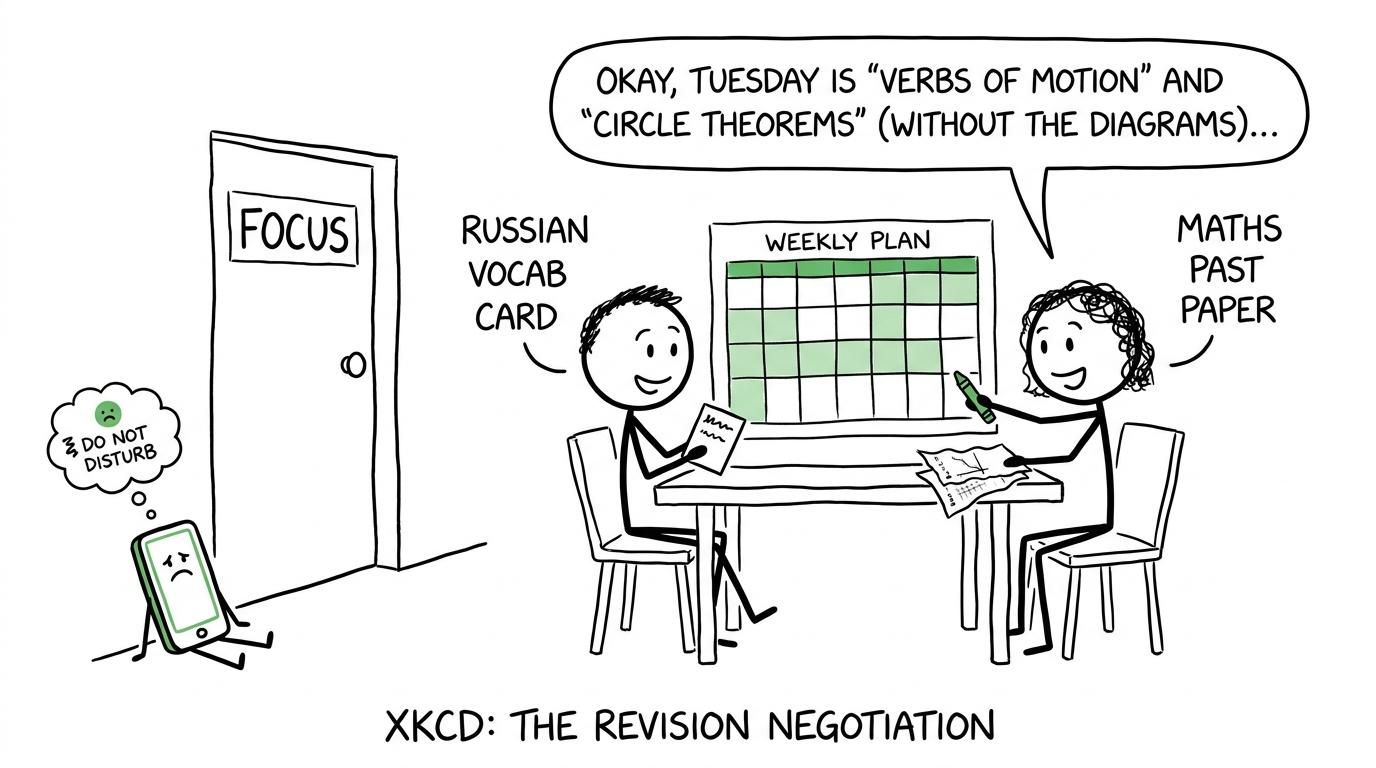 Russian vocabulary and a maths paper share a weekly calendar while a distracting phone waits outside
Common mistakes when judging homework value
Assuming completion automatically means learning
A finished task can create a comforting sense of progress. Test yourself without notes. If you cannot retrieve or apply the material, the task is not finished in the educational sense.
Spending equal time on every subject
Fairness is not the same as effectiveness. Your subjects will have different deadlines, weaknesses and examination demands. Allocate time using current evidence rather than a fixed emotional rule.
Ignoring teacher feedback
Feedback is most useful while you still remember your original thinking. Correct the work, explain the mistake and attempt a similar task later.
Replacing maths questions with maths reading
Watching a video or reading notes can rebuild understanding, but examination performance requires independent practice. Move from explanation to questions quickly. The MathsGenie home page brings together free GCSE and A Level revision resources, including practice questions, past papers and video solutions.
Abandoning Russian because homework is not directly assessed
This confuses the measurement with the preparation. Homework does not enter the final total directly, but effective vocabulary, listening, speaking and writing practice can improve the performances that do.
Make homework earn its place
The real GCSE Russian homework grade impact is not found in a homework mark. It is found later, when a familiar word is recognised quickly, a speaking response comes more naturally or a grammatical correction survives examination pressure.
So complete purposeful Russian homework, use feedback and stop when the useful work is done. Then protect time for maths according to your actual gaps. Use MathsGenie’s revision lessons to rebuild weak methods, practice questions and mini tests to check recall, and past papers, predicted papers, mark schemes and video solutions to prepare for the demands of the exam.
Start with one honest diagnosis on the GCSE Maths revision page. Let the marks you lose decide what you do next.











