GCSE Russian Foundation Tier Grade Cap Explained
GCSE Russian foundation tier grade cap is 5. Learn what the ceiling means, when Higher tier is needed and how to plan calm, effective GCSE revision.
A tier decision can look like a small letter on an exam entry form. Yet that letter quietly determines which grades are available. The GCSE Russian foundation tier grade cap is grade 555 under the current Pearson Edexcel specification. Even a near-perfect Foundation performance cannot produce a grade 666, 777, 888 or 999.
That does not make Foundation tier an inferior choice. It means the paper has a different purpose: to assess content within an accessible range and offer grades 111 to 555. But if your target is grade 666 or above, you need to discuss Higher tier entry with your teacher before the school’s entry deadline.
The answer at a glance
- The highest available grade on Foundation tier GCSE Russian is grade 555.
- Foundation tier offers grades 111 to 555.
- Higher tier normally offers grades 444 to 999.
- A grade 333 may be awarded on Higher tier when a candidate falls narrowly below the grade 444 boundary, as set out in the Pearson specification.
- You must take the same tier across the listening, speaking, reading and writing assessments.
- Grade boundaries can change between exam series, but the Foundation grade ceiling remains fixed by the specification.
- Students targeting grade 666 or above must be entered for Higher tier.
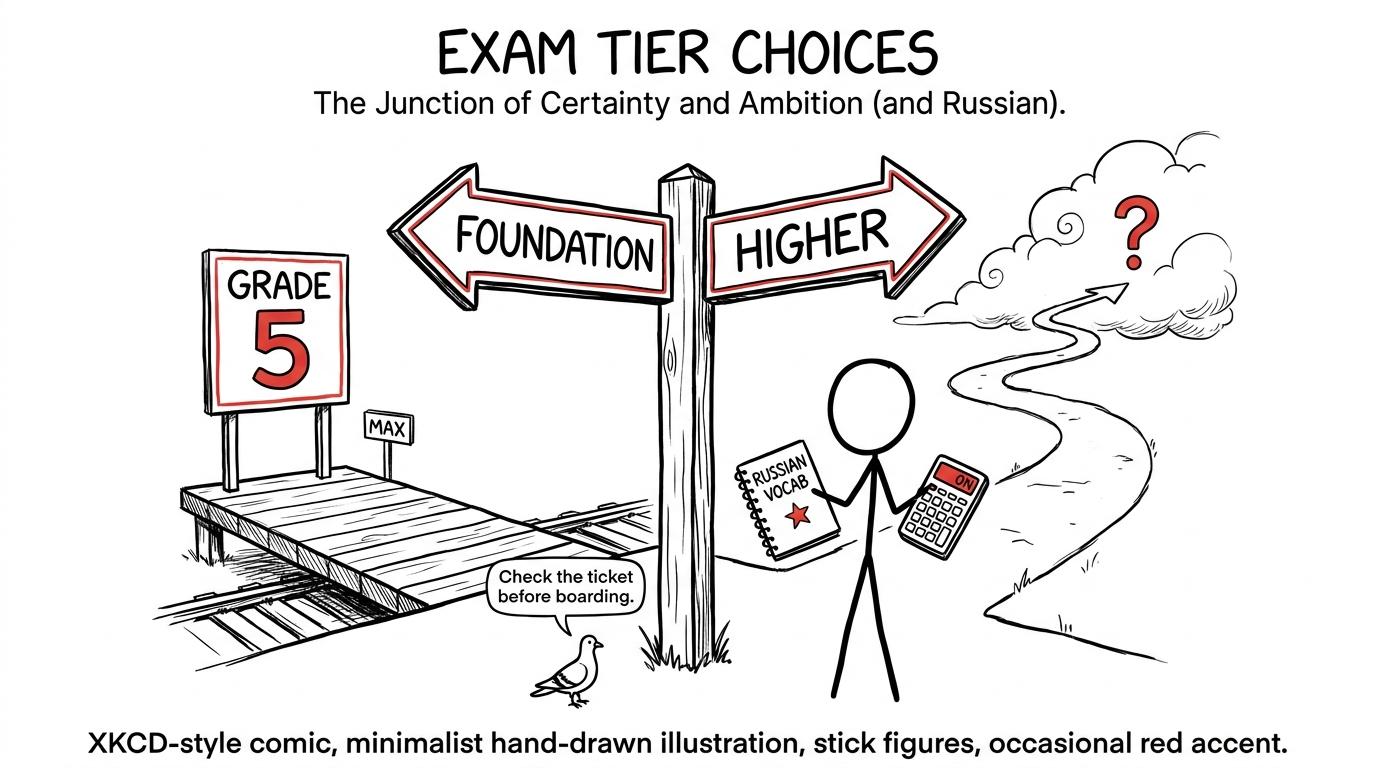 A student choosing between Foundation and Higher exam paths
What is the GCSE Russian foundation tier grade cap?
For the current Pearson Edexcel GCSE Russian qualification, the available grade ranges are:
| Tier | Grades normally available | Highest possible grade |
|---|---|---|
| Foundation | 111 to 555 | 555 |
| Higher | 444 to 999 | 999 |
The important word is available. Your final grade depends on the total subject mark across all four assessments, but your tier controls the range from which that grade can be awarded.
This means a Foundation candidate who earns a very high mark can receive grade 555, but not grade 666. The cap is not a penalty added after marking. Grades above 555 simply do not exist within the Foundation tier scale.
Individual papers do not receive separate GCSE grades. Marks from listening, speaking, reading and writing contribute to one overall Russian grade. Each skill accounts for 25%25\%25% of the qualification:
25%+25%+25%+25%=100%.25\% + 25\% + 25\% + 25\% = 100\%.25%+25%+25%+25%=100%.A strong performance in one skill can therefore support a weaker performance elsewhere, but no component can be ignored.
Why does GCSE Russian have two tiers?
Tiering allows an exam board to assess a broad range of attainment without making one paper either inaccessible at the beginning or insufficiently demanding at the end.
Foundation papers focus on the knowledge and language needed for grades up to 555. Higher papers provide access to the full upper range, including the more demanding language required for grades 666 to 999. That greater opportunity comes with greater difficulty.
This is familiar to GCSE maths students. A Foundation maths paper and a Higher maths paper assess related knowledge, but the wording, depth and balance of questions are not identical. You can explore that distinction through the free GCSE Maths revision hub, where resources are organised by exam board and tier.
The right question is therefore not simply, “Which tier sounds more ambitious?” It is, “Which tier gives me the best realistic route to my required grade?”
What the grade cap means for your target
If you are aiming for grade 444
Foundation tier can provide a direct route to grade 444. You can concentrate on securing core vocabulary, grammar, comprehension and communication without also preparing for the full demands of Higher tier.
A target grade should still be supported by evidence. Look at timed assessments across all four skills rather than relying on one good vocabulary test or one difficult mock.
If you are aiming for grade 555
Grade 555 is available on both tiers, but the routes are different. Foundation lets you pursue the top of its available range. Higher places grade 555 within a paper designed to distinguish performance extending towards grade 999.
There is no universal rule saying that every student targeting grade 555 should take one particular tier. Your teacher can compare your performance, consistency and confidence with the demands of each paper.
If you are aiming for grades 666 to 999
Higher tier is essential. The Foundation cap makes grades 666, 777, 888 and 999 unavailable, regardless of how many marks you earn.
If one of those grades is required for sixth form, a future language course or your personal goal, raise the issue early. Schools choose entries in advance, and Pearson requires candidates to be entered for one tier across all Russian papers.
Foundation is not automatically the safer choice
The word foundation can sound reassuring. But a paper is only safer when it matches the student sitting it.
A student capable of grade 777 work would limit their outcome by taking Foundation. Equally, a student struggling to access Higher questions may lose marks and confidence by choosing a tier based only on its maximum grade.
Think of tier choice as a decision about the range in which your current performance sits most securely. Useful evidence includes:
- recent listening, speaking, reading and writing assessments;
- performance under timed conditions;
- consistency across the four skills;
- teacher judgement based on specification content;
- the grade required for your next step;
- how well you respond to Higher-tier vocabulary and tasks.
One isolated result is rarely enough. A calm decision uses several pieces of evidence, just as a good maths revision plan begins by diagnosing repeated weaknesses. Maths students can use the weakest-topics revision method to turn marks into specific next actions.
How GCSE Russian is assessed
Pearson Edexcel GCSE Russian uses four assessments:
- listening and understanding;
- speaking;
- reading and understanding;
- writing.
Candidates must take a single tier across all four papers. You cannot, for example, take Foundation listening and Higher writing to create a personalised combination.
That rule matters because students often have an uneven profile. You might speak confidently but find listening difficult, or write accurately while reading slowly. Tier decisions must consider the complete qualification rather than your strongest component alone.
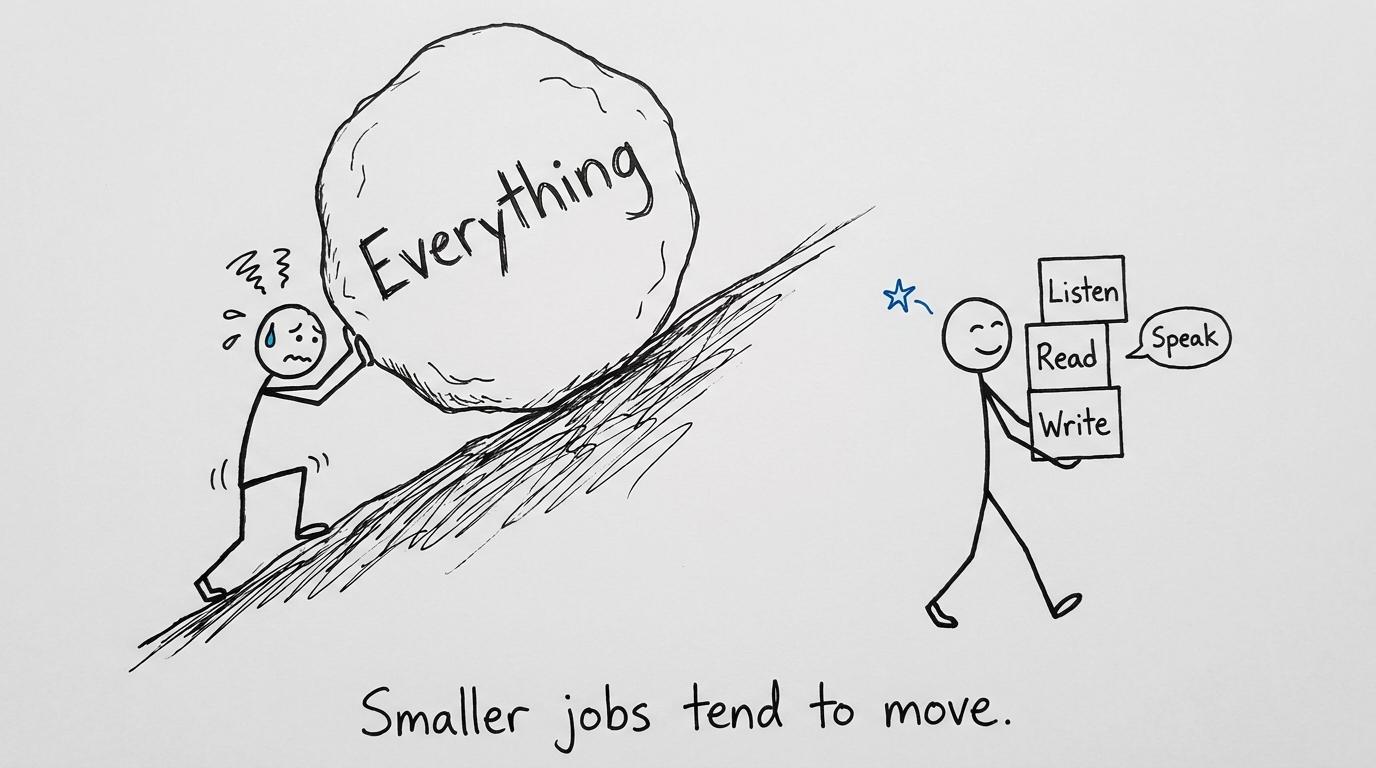 A student moving manageable boxes instead of one enormous revision boulder
A useful revision checklist is:
- practise all four skills every week;
- identify the skill losing the most marks;
- revise vocabulary through retrieval rather than rereading;
- complete tasks using the time allowed for your tier;
- review errors while the task is still fresh;
- return to the same weakness with a different question.
This resembles the short feedback cycles used in GCSE Maths mini tests. The subject changes, but the principle survives: attempt, mark, diagnose and repeat.
Grade boundaries are not the same as the grade cap
The grade cap and a grade boundary answer different questions.
The cap tells you the highest grade available on your tier. For Foundation Russian, that is always grade 555 while the current specification applies.
A grade boundary tells you the minimum overall mark needed for a grade in a particular exam series. Boundaries are set after the assessments have been taken and can vary between series to reflect differences in demand.
This is why an old boundary should not become your exact target. It may help you interpret a past paper, but it does not guarantee the boundary in your own year. Build a margin of safety by improving across the specification rather than trying to land on one historical mark.
Maths students should use the same caution with predicted papers. MathsGenie’s Edexcel GCSE Maths predicted papers provide valuable unseen practice, but predictions should support official past-paper work rather than replace it.
A practical conversation to have with your teacher
If you are uncertain about your Russian tier, ask precise questions:
- Which tier am I currently entered for?
- What is my working grade across all four skills?
- Which Higher-tier tasks are currently preventing me from reaching my target?
- What evidence would justify changing tier?
- When will the school make its final entry decision?
- What grade do I need for my planned next step?
Specific questions create useful answers. “Am I good enough for Higher?” is difficult to act upon. “Which two skills must become more consistent?” gives you a revision plan.
Then organise your time around those answers. If planning is the problem, adapt the structure in MathsGenie’s GCSE maths revision timetable or use the focused stages in the one-month revision plan. Keep the cycle, but substitute your Russian priorities where appropriate.
Common mistakes about Foundation tier Russian
Assuming a high Foundation mark can become grade 666
It cannot. Grade 555 is the ceiling, even when your mark is comfortably above the grade 555 boundary.
Confusing a boundary with the cap
Boundaries may move. The available grade range is fixed by the specification. Do not treat last year’s grade 555 mark as a permanent threshold.
Choosing Higher only because it offers grade 999
Access to a higher ceiling does not guarantee a higher outcome. Base the decision on assessment evidence, your target and teacher advice.
Revising only your strongest skill
Your final result combines listening, speaking, reading and writing. Comfortable practice can feel productive while leaving the largest weakness untouched.
Assuming your Russian tier matches your maths tier
Tier decisions are subject-specific. You could appropriately take Higher maths and Foundation Russian, or the reverse. Confirm each entry separately.
Completing papers without analysing errors
A completed paper is evidence, not the finished revision process. Use the mark scheme, classify lost marks and revisit the weak skill. The approach in using past papers properly is designed for maths, but its feedback discipline transfers well to other GCSE subjects.
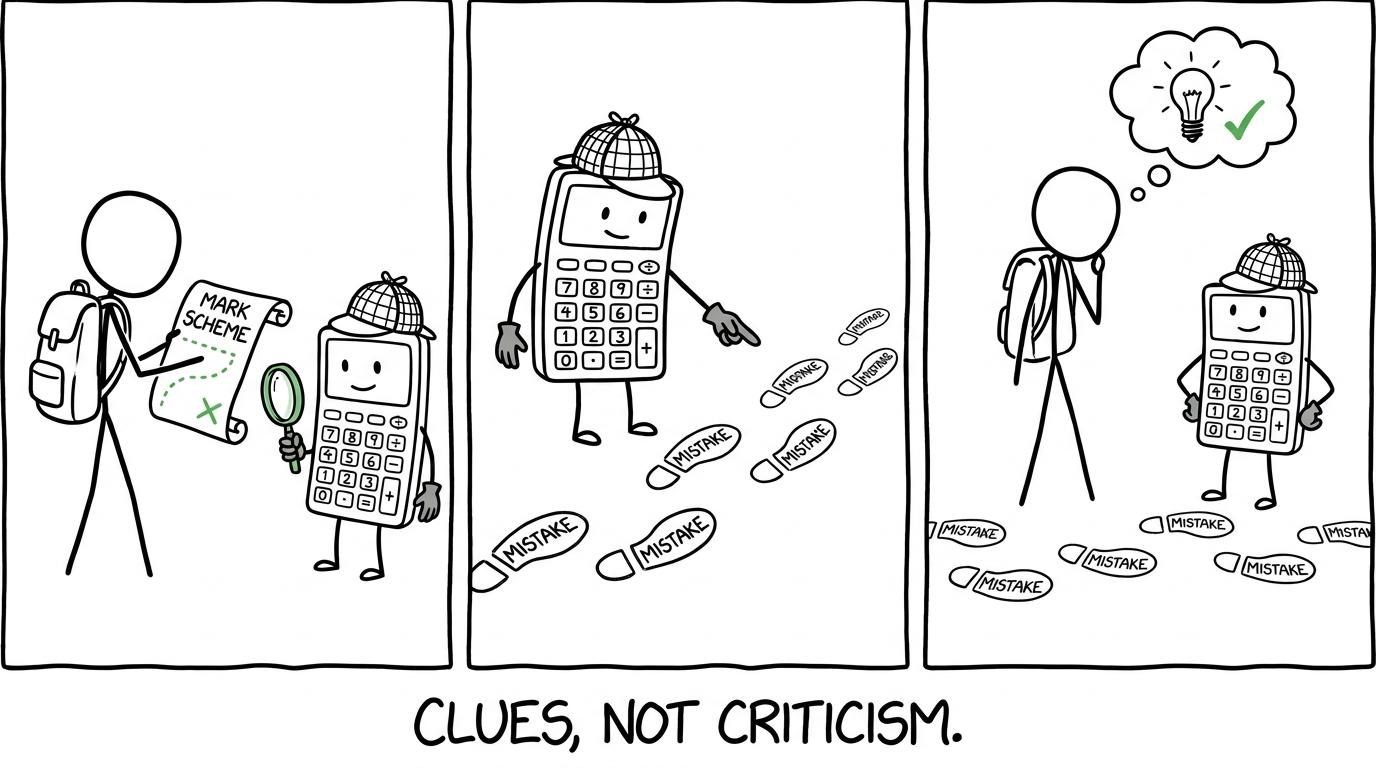 A student treating the mark scheme as a treasure map
Make the tier serve the goal
The GCSE Russian Foundation tier cap is simple: the highest possible grade is 555. What deserves more thought is what that fact means for you.
If grade 555 meets your goal and Foundation reflects your current performance, the cap need not be a concern. If you need grade 666 or above, Higher tier is not optional. Speak to your teacher early, use evidence from all four skills and confirm the entry arrangements rather than relying on assumptions.
The same principle applies to maths revision: know the paper you are sitting, know the grade you need and let evidence direct your next session. Start with MathsGenie’s free GCSE Maths revision resources, then combine revision lessons and practice questions with mini tests, past papers, predicted papers, mark schemes and video solutions. A grade target becomes far less intimidating once it has been turned into the next clear action.