GCSE Russian Access Arrangements: Request Guide
GCSE Russian access arrangements explained: who to ask, evidence, extra time rules for listening and speaking, and key approval deadlines for schools.
The hardest part of an exam should be showing what you know. It should not be reading a page you cannot access, writing through pain, processing instructions too quickly or trying to manage a recognised condition without your usual support.
If you need GCSE Russian access arrangements, speak to your school's SENCo, learning support team or exams officer as early as possible. You cannot normally submit the application yourself. Your school or examination centre must establish your needs, gather evidence, trial suitable arrangements and, where required, apply through the official Access Arrangements Online system before the deadline.
The important word is early. Extra time and other arrangements are not informal favours that can simply be added on exam day. They must reflect your normal way of working and preserve the skills that GCSE Russian is designed to assess.
GCSE Russian access arrangements checklist
Start with these actions:
- Tell your SENCo, exams officer or learning support team what difficulty you experience.
- Ask whether the school already has evidence from lessons, assessments or previous support.
- Use the proposed arrangement in Russian mock assessments where appropriate.
- Confirm whether a formal assessment or specialist evidence is needed.
- Ask which parts of GCSE Russian the arrangement can legally cover.
- Check that any required online application has been approved.
- Confirm the room, timings, equipment and supervision before each assessment.
The school makes the formal decision and application, but students and parents can begin the conversation. Do not wait for an examination entry form or the final revision weeks.
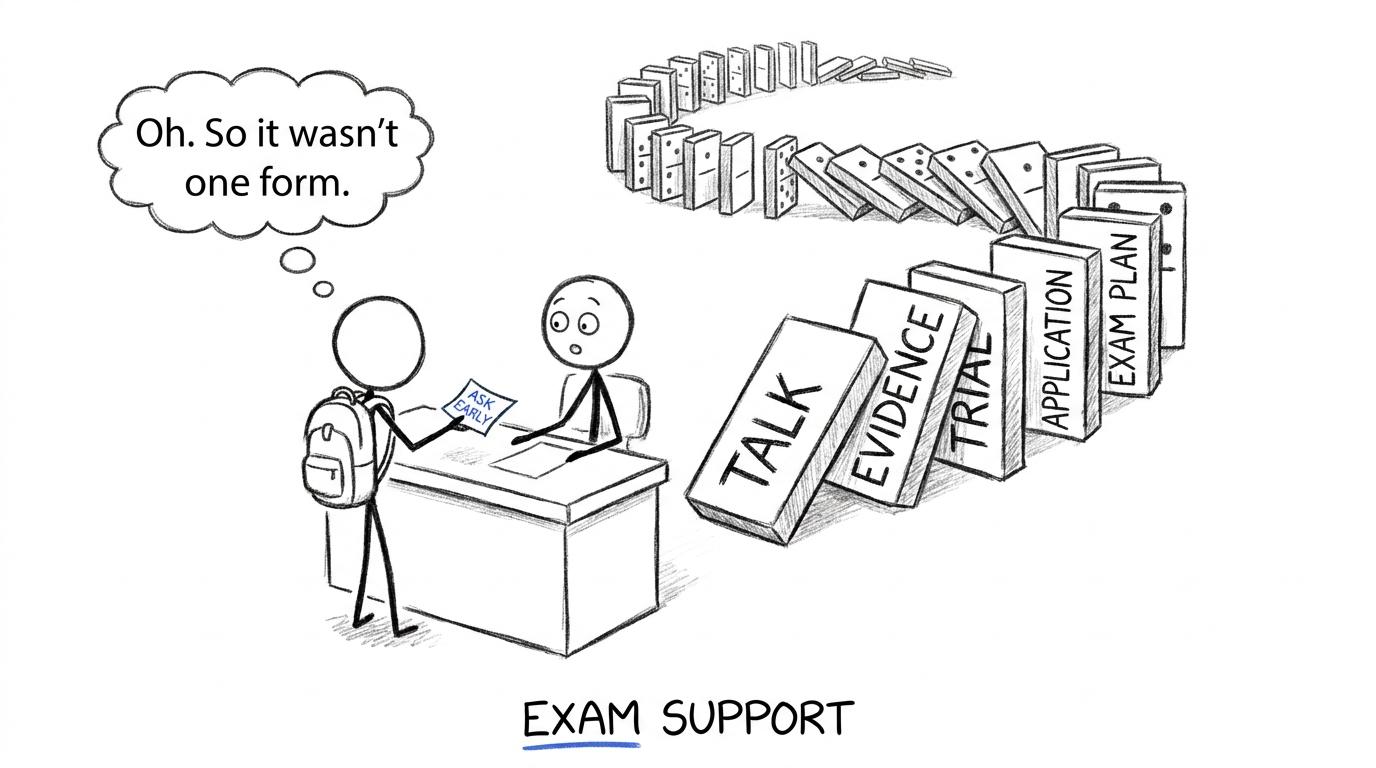 A student discovers that requesting exam support involves a calm sequence rather than one mysterious form
What are access arrangements?
Access arrangements are changes made before an assessment for a student with an evidenced need. They can support students with special educational needs, disabilities, learning difficulties, sensory impairments or temporary injuries.
Depending on the individual, arrangements might include:
- extra time;
- supervised rest breaks;
- a smaller or separate room;
- a word processor;
- modified papers;
- coloured overlays or enlargement;
- a computer reader or reader, where the assessment permits one;
- a scribe or speech-recognition technology, subject to strict rules;
- amplification equipment or other approved support.
This is not a menu from which a student chooses the most helpful-looking option. The centre must identify an arrangement that removes a substantial disadvantage without changing what the question is testing.
A diagnosis does not automatically produce one particular arrangement. Equally, a student does not always need a newly obtained diagnosis before raising a concern. The evidence requirements depend on the difficulty and the requested support, so the SENCo should advise on the correct route.
Access arrangements are also different from special consideration. An access arrangement is planned before an assessment. Special consideration may be requested after an unexpected event, such as a temporary illness or serious disruption, has affected performance.
How to request access arrangements
Speak to the right person
Begin with your SENCo or equivalent learning support lead. If you are unsure who that is, ask your form tutor, Russian teacher or exams officer.
Explain the practical barrier rather than requesting a percentage immediately. For example, describe whether you struggle to process recorded language quickly, need breaks because of a medical condition, cannot write comfortably for sustained periods or use assistive technology in lessons.
If you are a private candidate, contact prospective examination centres well before making an entry. A centre must be willing and able to gather or hold the required evidence, process the application, provide suitable staff and rooms, and conduct the speaking assessment correctly. Not every centre can offer every arrangement.
Build evidence of your normal way of working
JCQ rules place considerable weight on a student's normal and current way of working. This might be shown through:
- support routinely used in lessons;
- timed classroom assessments;
- mock examinations;
- teacher observations;
- samples of work;
- records showing that an arrangement improves access, completeness or accuracy;
- an assessment by the centre's appointed assessor, where required;
- relevant specialist evidence for a disability, medical condition or sensory impairment.
For applications for 25%25\%25% extra time processed from September 2025, current JCQ guidance also requires supporting centre-based evidence, such as mock papers and focused staff comments, alongside the relevant form. Schools must keep evidence available for inspection.
This is why mocks matter. They are not merely rehearsals for marks. They help the school see whether extra time, rest breaks, technology or another adjustment actually addresses the barrier.
Let the centre process the application
The SENCo and exams officer work together. They determine the evidence route, complete the relevant records and process online applications where required. Some arrangements, including certain basic equipment or supervised rest breaks, may be centre-delegated and do not require an online application, but they must still be appropriate and organised correctly.
Students should be told when an online application will be processed and how their information will be used. Ask for confirmation of the outcome rather than assuming that a conversation means approval.
How extra time works in GCSE Russian
Pearson Edexcel GCSE Russian assesses listening, speaking, reading and writing. The specification has Foundation and Higher tiers, and students take the same tier across all four papers. Because each component tests a different language skill, approved extra time is not applied identically everywhere.
Listening
For a candidate formally approved for 25%25\%25% extra time, Pearson produces special listening recordings incorporating the additional allowance. The centre must obtain the correct recording securely and arrange appropriate invigilation and timing.
This is not usually handled by casually leaving the standard recording running after everyone else has finished. The structure of a listening paper matters because students must hear and process recorded Russian at controlled points. Schools should use mock listening assessments to identify how the approved time best supports the candidate and follow Pearson's instructions for that examination series.
Speaking
Extra time for the speaking assessment usually applies to the supervised preparation period. Pearson's current guidance allows eligible candidates up to 25%25\%25% of the maximum permitted assessment time for the relevant tier, managed according to their needs and normal way of working.
Extra time during the recorded speaking itself needs specific approval and supporting detail. The centre should explain why additional preparation alone is insufficient and provide evidence from mock speaking assessments. Without the relevant permission, the recorded assessment must remain within the specification's permitted time.
Reading
GCSE Russian reading assesses the ability to understand written language. A human reader cannot read the assessed Russian text aloud because that would change a reading task into a listening task. Current JCQ rules may permit a computer reader because the candidate operates it independently, but its use must be approved and arranged correctly.
This distinction is easy to miss: an arrangement may be permitted in one subject or component and restricted in another because the assessment objectives differ.
Writing and the use of a scribe
A scribe in a modern foreign language examination is subject to strict conditions. Students must produce their own Russian spellings, so foreign-language words generally have to be dictated letter by letter. JCQ guidance recognises that this is time-consuming and provides specific rules around additional time where an approved scribe is involved.
A scribe is not permitted in a speaking test. The SENCo must check both JCQ rules and Pearson's subject guidance rather than assuming that an arrangement used in GCSE maths transfers unchanged to Russian.
Dictionaries are not permitted in Pearson Edexcel GCSE Russian, including during speaking preparation. Being bilingual or having Russian as a home language does not itself create eligibility for extra time or a dictionary.
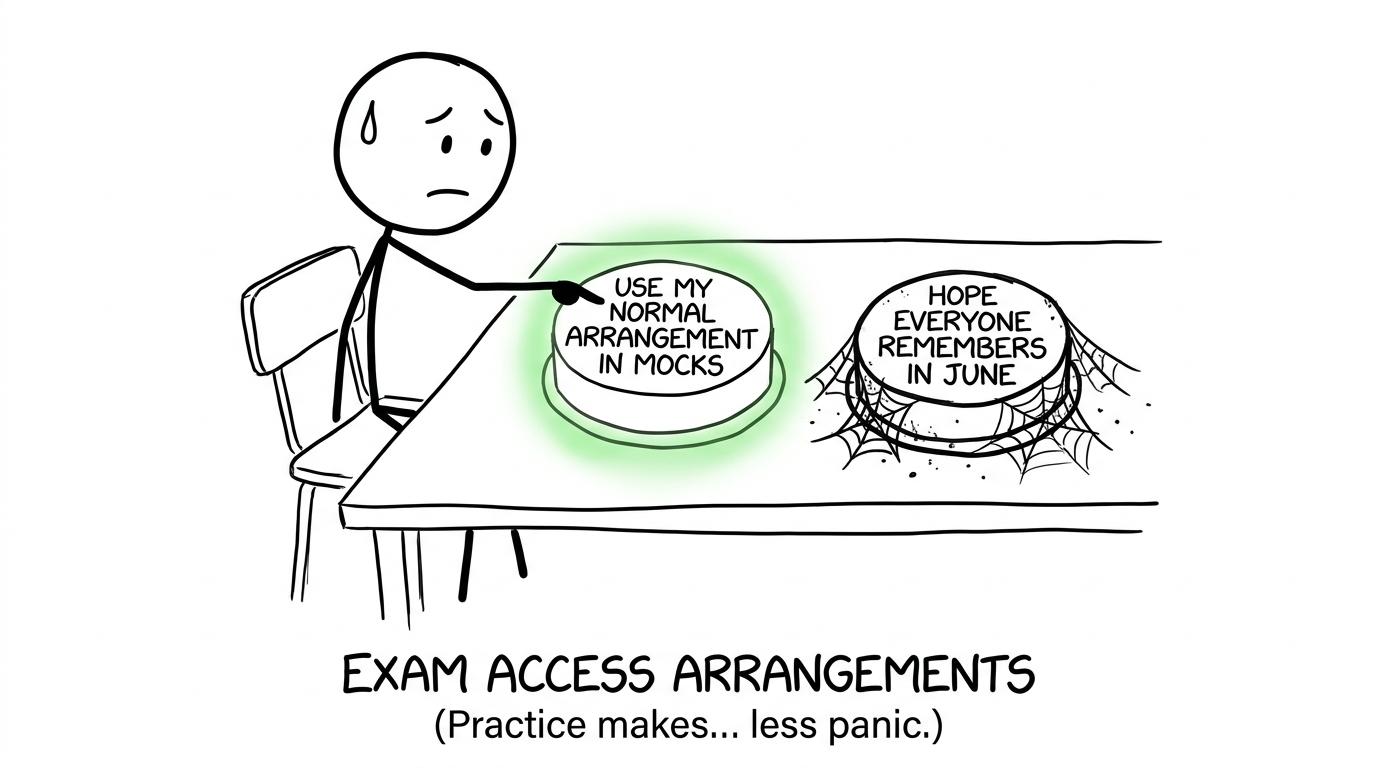 A student chooses to practise approved arrangements in mocks rather than relying on exam-day hope
The approval timeline
For a summer examination series, begin the conversation during Year 10 or early in Year 11 wherever possible. A sensible sequence is:
Early in the course
Tell the school about existing diagnoses, medical evidence, previous arrangements or difficulties becoming visible in lessons. The school can observe your normal way of working and decide whether support should be trialled.
Autumn term of Year 11
Use proposed arrangements in internal assessments and mocks. Complete any assessment required by the centre's appointed assessor. Private candidates should secure a centre and discuss support before entry deadlines become urgent.
Before the published JCQ deadlines
The centre completes forms, gathers teacher evidence and processes required applications online. Modified papers usually have an earlier deadline because they must be prepared and delivered in the correct format.
For the June 2026 series, the published deadline was 31 January 2026 for modified papers and 21 March 2026 for other online access-arrangement applications. These dates are given as a concrete illustration, not as permanent annual dates. JCQ publishes new regulations and deadlines for each academic year, so students preparing for a later series must ask their centre to check the current edition.
Before speaking and written assessments
Confirm exactly what will happen. Ask about preparation time, listening materials, rest breaks, rooming, equipment and who will supervise each component. If circumstances change, tell the school immediately rather than waiting for the assessment day.
Use the same arrangements in maths revision
An approved arrangement should become familiar, not remain a surprise reserved for June. If extra time, rest breaks or a word processor also applies to your maths papers, practise under those agreed conditions.
Start with the GCSE Maths revision hub, then use GCSE Target Tests for short timed sessions. A mini test can reveal whether your arrangement supports sustained access without turning every practice session into a full examination.
As confidence grows, follow MathsGenie's guide to using GCSE past papers properly. Choose materials that match your board and tier using the GCSE topics by exam board guide, and incorporate the conditions your school has approved.
Nearer the examinations, Edexcel predicted papers can provide fresh timed practice. A one-month GCSE maths revision plan also helps you schedule lessons, practice questions, marking and retesting without relying on exhausting last-minute sessions.
Common mistakes when requesting support
Waiting until the final weeks. Evidence, assessment, approval and practical planning take time. Modified papers have particularly early deadlines.
Assuming a diagnosis guarantees extra time. The arrangement must address an evidenced barrier and normally reflect how you work in lessons and assessments.
Assuming approval in maths works identically in Russian. Reading, listening and speaking have subject-specific restrictions because different skills are being assessed.
Not trialling the arrangement in mocks. A support plan can look sensible on paper but feel unfamiliar in practice. Mocks help the centre refine the details.
Confusing access arrangements with revision support. Extra time cannot replace knowledge, vocabulary or examination practice. It provides access to the assessment, not an easier assessment.
Failing to check the final plan. Know your room, start time, equipment, breaks and how extra time will operate in each component.
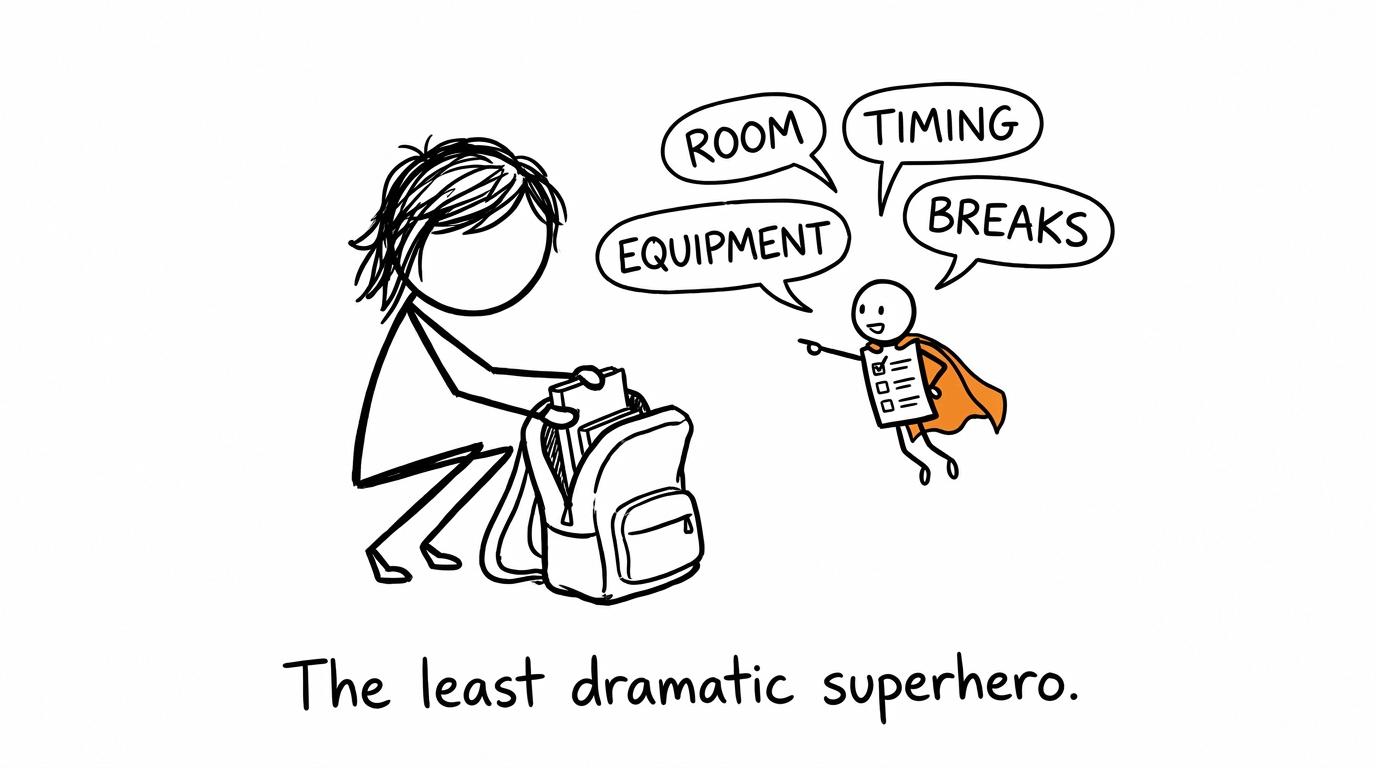 The humble exam checklist arrives as the least dramatic but most useful superhero
Make the exam conditions feel ordinary
A good access arrangement does something quiet but important: it allows the examination to measure the intended skill rather than the barrier surrounding it. Getting there requires an early conversation, credible evidence, practice in mocks and careful subject-specific planning.
Ask your SENCo or exams officer about GCSE Russian now, then bring the same clarity to maths. Build a realistic routine with MathsGenie's free revision lessons, practice questions, mini tests, past papers, mark schemes and video solutions. Use the GCSE maths revision timetable to plan the work, and keep the GCSE night-before checklist for the final practical details.
The goal is not to make the exam easy. It is to make it fair, familiar and ready for you to show what you know.