GCSE Russian 6 to 8: A Practical Revision Plan
GCSE Russian 6 to 8 explained: improve accuracy, spontaneity, inference and exam technique with a focused plan for listening, speaking, reading and writing.
A grade 6 often feels close to a grade 8. You already understand much of the Russian. You can communicate, follow familiar texts and produce extended answers. Yet the final distance can be frustrating because simply learning more vocabulary does not guarantee more marks.
The GCSE Russian 6 to 8 journey is usually about changing the quality of your performance: becoming more accurate, handling unfamiliar language, justifying ideas and responding without relying on memorised scripts. For the current Pearson Edexcel GCSE Russian qualification, a grade 8 also requires Higher tier entry.
If you are balancing Russian with maths exams, the good news is that the most effective revision process is similar in both subjects: diagnose the weakness, practise it under exam conditions, mark honestly, fix it and retest it.
Your grade 6 to grade 8 checklist
Focus on these changes:
- confirm that you are entered for Higher tier;
- replace broad vocabulary revision with precise retrieval practice;
- improve grammatical control, especially when using different time frames;
- explain and justify opinions rather than merely stating them;
- practise inference in listening and reading;
- prepare flexible speaking structures, not complete scripts;
- use official papers and mark schemes to identify repeated mark losses;
- retest corrected skills several days later.
The goal is not flawless Russian. It is sustained, effective communication with enough range, accuracy and independence to match grade 8 performance.
What separates a grade 6 from a grade 8 in GCSE Russian?
There is no permanent mark that defines either grade. GCSE grade boundaries are set after each examination series and can change with paper difficulty. Your final grade is based on your total subject mark, not a separate grade for each paper.
Official modern foreign language grade descriptors describe grade 8 performance as the ability to understand more complex and extended material, identify opinions, draw conclusions and infer meaning. In speaking and writing, students should manipulate language mostly accurately, explain ideas, justify opinions and use some complex language.
A grade 6 student may already communicate successfully, but performance is often less consistent. The difference tends to appear in four places:
| Grade 6 tendency | Grade 8 direction |
|---|---|
| Understands the main message | Extracts detail, opinion and implied meaning |
| Gives relevant answers | Develops and justifies answers |
| Uses learnt phrases correctly | Adapts language to an unfamiliar question |
| Uses several time frames | Controls time frames and agreements more consistently |
| Recovers slowly after a difficult question | Rephrases and sustains communication |
| Produces complexity occasionally | Uses range with enough accuracy to remain clear |
This is an important distinction. Grade 8 is not awarded for making every sentence complicated. Uncontrolled complexity can lose clarity. The stronger response combines ambitious language with dependable foundations.
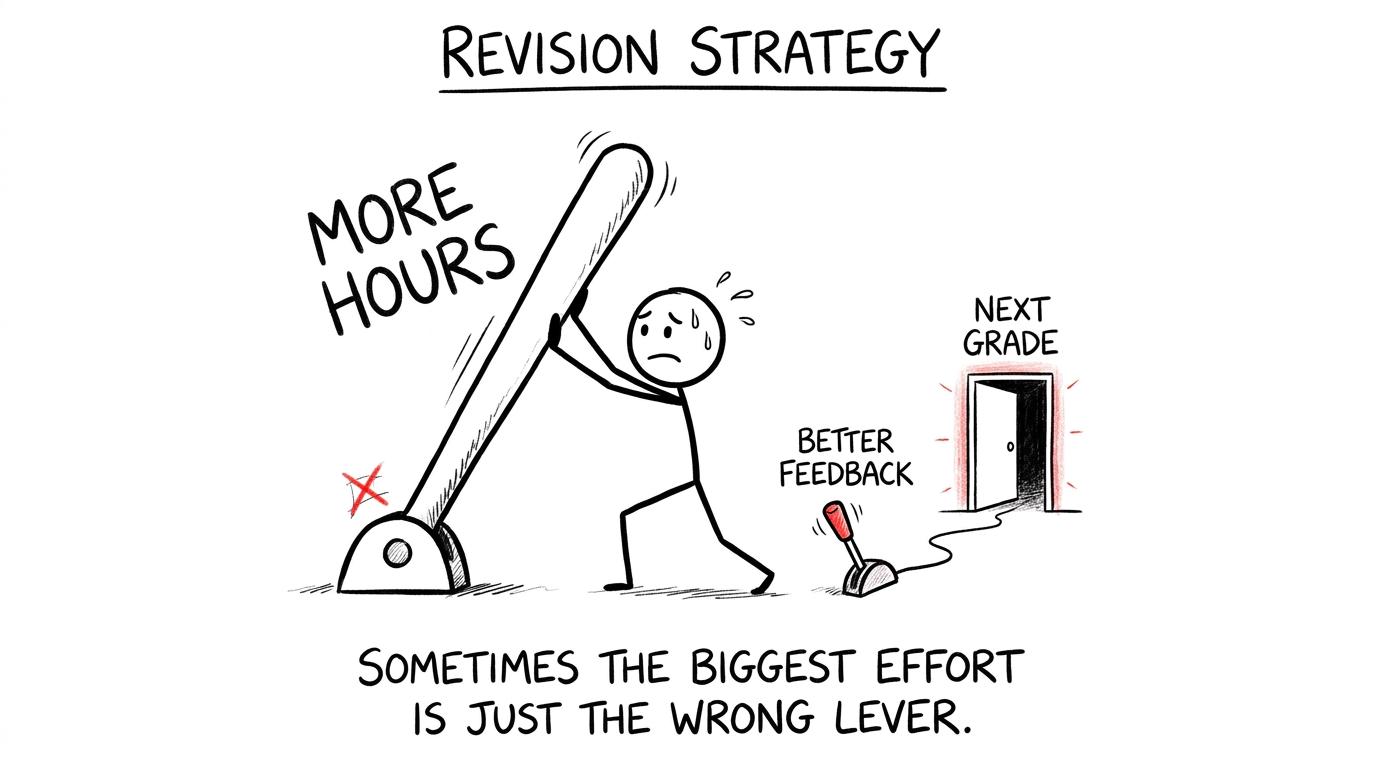 A revision lever showing why better feedback can matter more than simply adding hours
Know the assessment you are trying to improve
This guide focuses on Pearson Edexcel GCSE Russian, specification code 1RU0. Check your entry details with your teacher rather than assuming that another language's format applies.
The qualification has four externally examined components:
- listening;
- speaking;
- reading;
- writing.
Each contributes 25%25\%25% of the qualification. Foundation tier offers grades 1 to 5, while Higher tier offers grades 4 to 9, with a limited grade 3 safety net for students just below the relevant boundary. Therefore, a student targeting grade 8 must take Higher tier across all four papers.
Dictionaries are not permitted, including during speaking preparation time. That makes secure recall essential. Recognising vocabulary in a list is not enough; you need to retrieve it while listening, reading, speaking and writing.
Make specific changes in each Russian skill
Listening: move from recognition to interpretation
At grade 6, you may understand the topic but lose marks on a qualification, change of opinion or small detail. Grade 8 listening requires you to follow more extended material and draw conclusions from it.
Before the recording begins, read every question and predict the kind of information required: a reason, opinion, person, place or time. During the recording, listen for contrasts and corrections rather than collecting isolated familiar words. A speaker may introduce one idea and then reject it.
Practise short extracts without pausing. Mark immediately and label each error as vocabulary, sound recognition, detail, inference or question-reading. This is more useful than writing “listening is weak”. The MathsGenie guide to finding your weakest topics uses the same diagnostic principle for maths revision: name the smallest weakness you can actually repair.
Speaking: replace scripts with flexible building blocks
A memorised paragraph can sound impressive until the examiner asks an unpredictable question. Grade 8 speaking depends on sustaining conversation, responding effectively and manipulating language mostly accurately.
Prepare reusable structures for giving reasons, comparing alternatives, referring to past experiences and discussing future intentions. Then practise combining them around different themes. Record responses to unseen questions and listen for three things: whether you answered directly, whether you developed the answer and whether your grammar remained controlled.
Practise repair strategies too. If a word disappears, describe it another way. If you misunderstand, ask for clarification appropriately. Recovering is part of communication; freezing because the script has ended is not.
Reading: train inference, not just translation
Word-for-word translation is slow and can hide the overall meaning. Strong readers first identify purpose, viewpoint and tone, then return for precise details.
When reviewing an answer, underline the evidence in the Russian text. If you cannot show which phrase supports your conclusion, the answer may be a guess. Build tolerance for unfamiliar words by using context, word families, grammatical clues and contrasts before reaching for a vocabulary list.
Higher-tier reading includes extended and varied texts, as well as translation into English. Your English translation should communicate the full meaning naturally without adding details that are not present.
Writing: prioritise communication and controlled range
Grade 8 writing explains ideas, expresses and justifies opinions, and manipulates vocabulary and grammar mostly accurately. Before writing, convert the task into a short checklist so that every bullet point is covered.
Build range through purposeful choices:
- more than one time frame where the task allows it;
- linked reasons and consequences;
- justified opinions;
- varied sentence openings;
- accurate cases, agreements and verb forms;
- relevant detail rather than memorised padding.
Leave time to check high-value features systematically. First check verbs and time frames. Then check noun and adjective agreements, case endings, spelling and whether every task requirement has been answered. One reliable checking sequence is better than repeatedly rereading and hoping an error becomes visible.
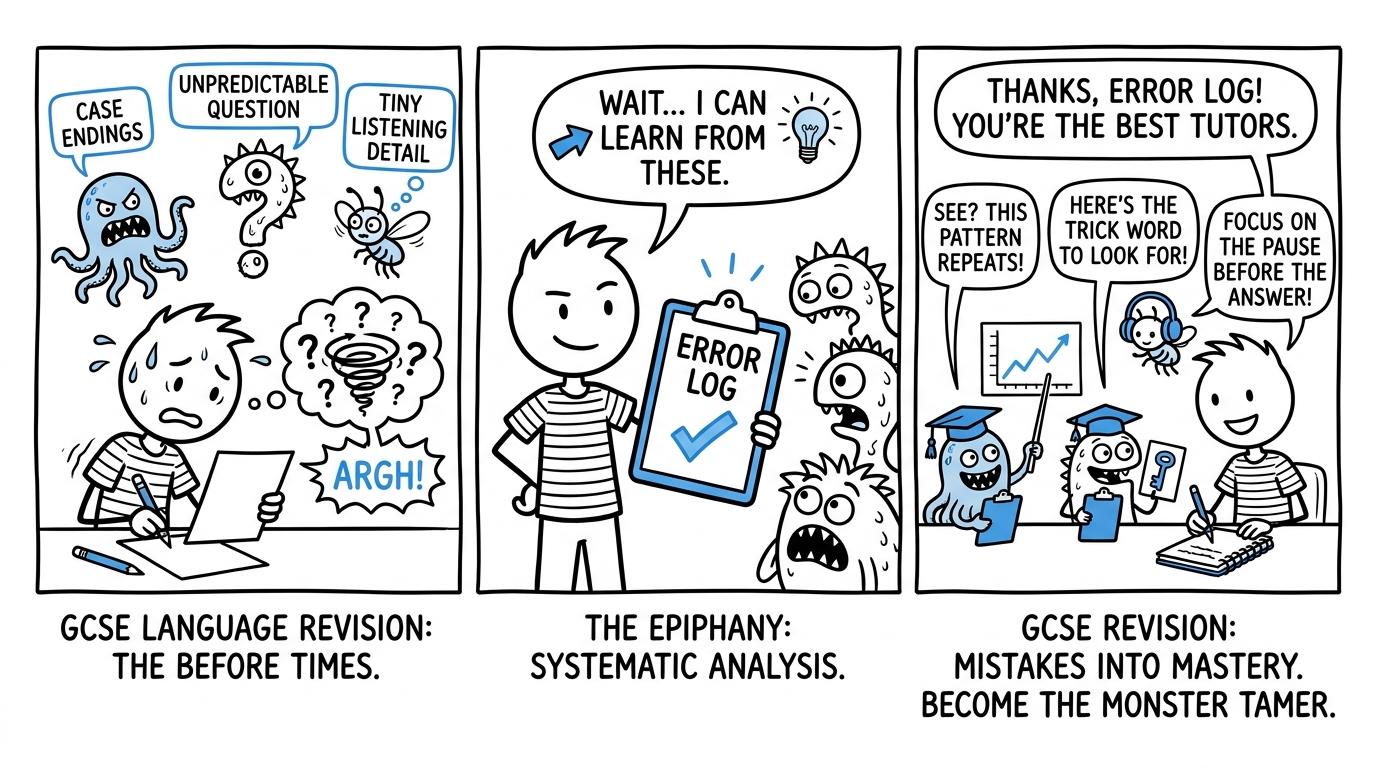 An error log turns intimidating Russian revision problems into useful feedback
Build a revision system that produces evidence
The grade jump becomes manageable when revision stops being a collection of activities and becomes a feedback loop.
Use this cycle for one Russian skill at a time:
- attempt a timed task without notes;
- mark it using the official mark scheme or teacher feedback;
- record the exact reason for each lost mark;
- complete focused practice on the weakest pattern;
- repeat a similar task after a gap;
- check whether the error has disappeared.
The MathsGenie 20-minute revision routine shows how short sessions can include retrieval, examination practice and immediate marking. The subject may be different, but the discipline transfers directly.
Keep a four-skill error log
Divide your log into listening, speaking, reading and writing. Useful entries are specific: missed negative, confused tense, unsupported inference, incomplete bullet point or inaccurate case ending.
Once a week, review the log and select the two patterns costing the most marks. Do not try to repair everything simultaneously. If you are also preparing for maths exams, use the MathsGenie revision planner to protect regular maths sessions while assigning separate blocks to Russian.
Use papers as diagnosis, not judgement
Complete official Russian materials for your own specification and tier. A paper is valuable only if it changes what you practise next. The same lesson is explained in MathsGenie's guide to using GCSE past papers effectively.
For maths, MathsGenie provides free GCSE maths revision resources, including lessons, question banks and papers across Edexcel, AQA, OCR, Eduqas, WJEC and CCEA. Those resources do not replace official Russian materials, but they can keep the rest of your GCSE revision organised while you apply the same attempt-mark-fix-retest process to Russian.
A realistic weekly plan
A balanced week should touch all four skills without giving each one an unfocused hour.
- First session: retrieve vocabulary and grammar from memory, then complete a short writing task.
- Second session: practise one listening extract and one reading text under timed conditions.
- Third session: answer unseen speaking questions aloud and review the recording.
- Weekend session: complete a longer timed component, mark it and update the error log.
- Final short session: retest the week's two most frequent mistakes.
Use spaced revisits rather than a single large vocabulary session. The MathsGenie guide to stopping forgotten content explains a useful pattern: retrieve material after a gap and later test it inside mixed exam practice.
When maths examination season approaches, add MathsGenie GCSE predicted papers and board-specific past papers to your timetable. If you take Edexcel maths, the Edexcel GCSE maths past-paper collection brings papers and mark schemes together. Keep Russian preparation tied to official Russian papers rather than substituting unrelated materials.
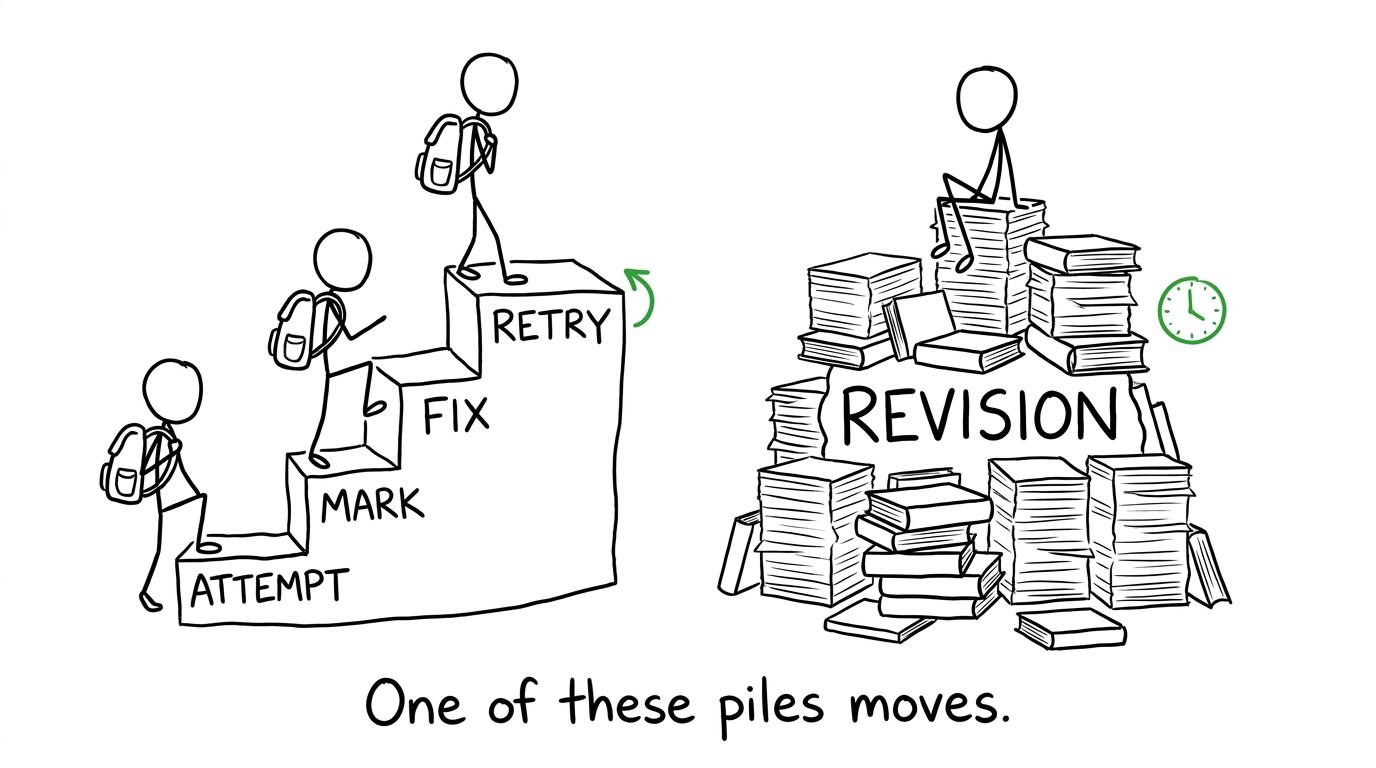 A student improves by climbing the attempt, mark, fix and retry loop
Common mistakes when aiming for grade 8
Memorising entire speaking answers
Scripts can reduce spontaneity and become fragile when a question changes. Memorise flexible language chunks, then practise adapting them.
Chasing complex grammar at the expense of accuracy
A complicated sentence is not automatically a high-grade sentence. Secure common verbs, agreements and cases before adding ambitious structures.
Revising vocabulary only from Russian to English
Recognition supports reading, but speaking and writing require recall in the opposite direction. Practise both directions and retrieve words inside sentences and themes.
Ignoring listening and reading errors
Students often spend longer on written work because it leaves visible evidence. Yet listening and reading together contribute half of the qualification. Record why comprehension marks were lost and train those causes directly.
Treating one strong mock as proof
Performance can vary by theme and paper. Look for consistency across several timed tasks rather than relying on one encouraging result.
Predicting a grade from an old boundary
Boundaries can vary between examination series. Use recent papers to measure skills and progress, but rely on official boundaries for the relevant series when results are issued.
Turn the gap into a set of small decisions
Moving from grade 6 to grade 8 in GCSE Russian is less about discovering a secret phrase and more about removing repeated weaknesses. Listen for implication. Read for evidence. Speak beyond the prepared answer. Write with controlled range. Then use feedback until the same errors stop returning.
Start with one timed task today and identify the two clearest mark leaks. While your Russian work should use official Edexcel materials and teacher feedback, MathsGenie can organise the wider revision journey. Use its free revision lessons and practice questions for maths, then progress through mini tests, past papers, predicted papers, mark schemes and video solutions. The subjects differ. The improvement loop does not.