

GCSE Results, Sixth Form Offers: What Happens Next?
GCSE results sixth form offers explained: follow each step from collecting grades to confirming enrolment, handling missed conditions and planning ahead.
Results day can make months of work feel as though they have been compressed into one envelope. But GCSE results and sixth form offers are rarely decided by a single dramatic moment. Your results are checked against the conditions of your offer, then you follow the provider's confirmation and enrolment process.
If you meet every condition, your place will usually be confirmed once you complete the required steps. If you miss a grade, do not assume that the offer has disappeared. Contact the sixth form promptly and ask what options remain.
For the June series, GCSE results day in 202620262026 is Thursday 202020 August. Your school or exam centre decides how and when you receive your results, so check its instructions in advance.
Your results-day checklist
Before results day, have these ready:
- Your conditional offer and its exact entry requirements
- The sixth form's admissions telephone number and email address
- Your enrolment instructions, deadline and online login details
- Photo identification and any documents the provider has requested
- Details of an alternative course or provider
- A charged phone and access to your email
Entry requirements are not universal. A sixth form may have general requirements for joining Year 121212, additional grades for individual A Levels and rules about course capacity. Read your own offer rather than relying on what another student has been told.
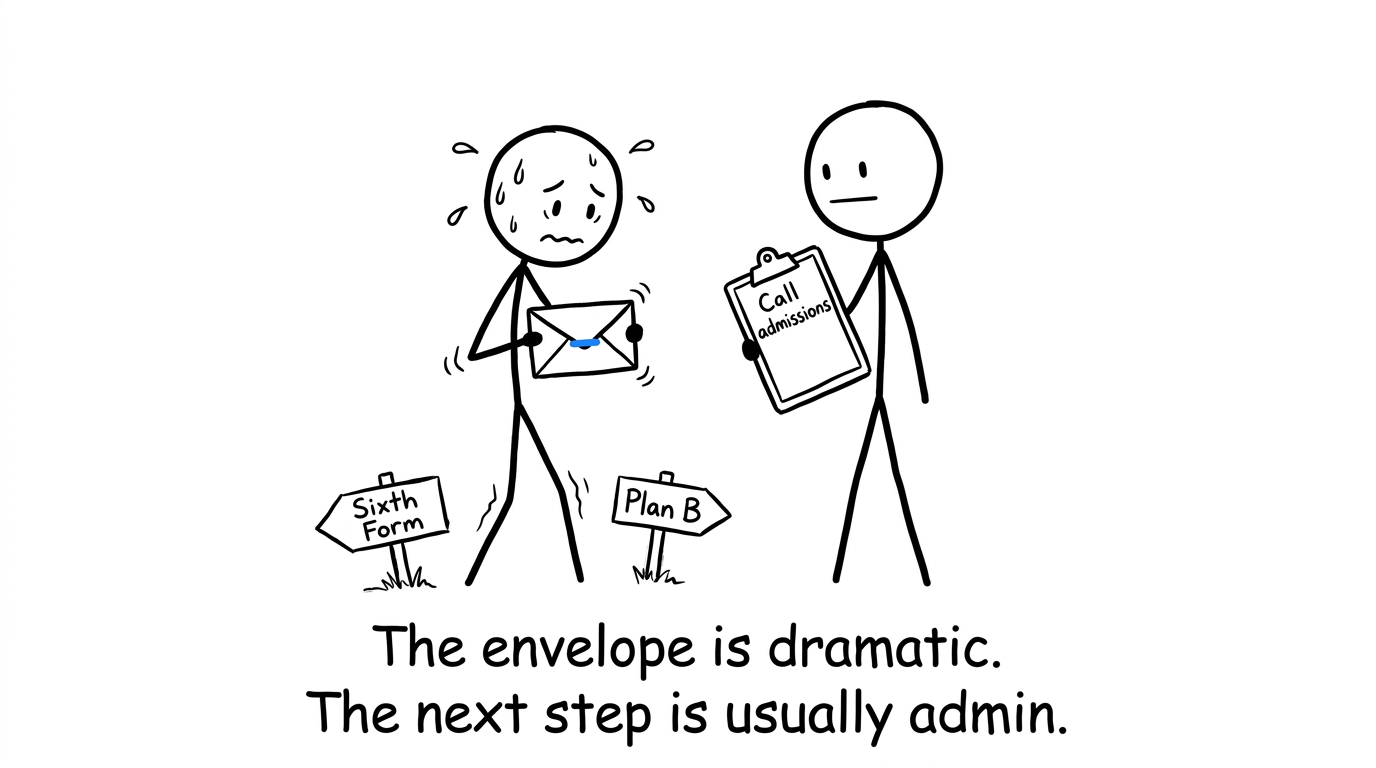 A student opens a GCSE results envelope beside sixth-form signposts
Step one: collect and check your GCSE results
Follow your school's instructions for collecting results or accessing them online. Check every subject and keep the official results slip safe. External applicants may need to upload or send evidence to their new sixth form.
Compare the grades carefully with both parts of your offer:
- General entry requirements: the grades needed to enter the sixth form
- Subject-specific requirements: the grades needed for each chosen A Level or course
For example, meeting the overall sixth-form threshold does not necessarily mean that you meet the separate requirement for A Level Maths. Exact requirements vary, so use the published policy and your offer letter as the authority.
Students still preparing for their exams can strengthen their position through GCSE Maths revision lessons and questions. If you take Edexcel, the Edexcel GCSE Maths revision hub brings the specification, topic practice and papers together.
Step two: report your grades and confirm your interest
A conditional offer means the place depends on stated conditions being satisfied. It is not necessarily converted into a confirmed place without action from you.
Some providers ask applicants to upload their results. Others use email, telephone confirmation or an in-person enrolment session. Deadlines can fall on results day, so follow the instructions in your offer even when you have achieved every required grade.
Send clear evidence, complete every form and retain confirmation emails or screenshots. If an online system fails, contact admissions immediately and explain that you are trying to meet the deadline.
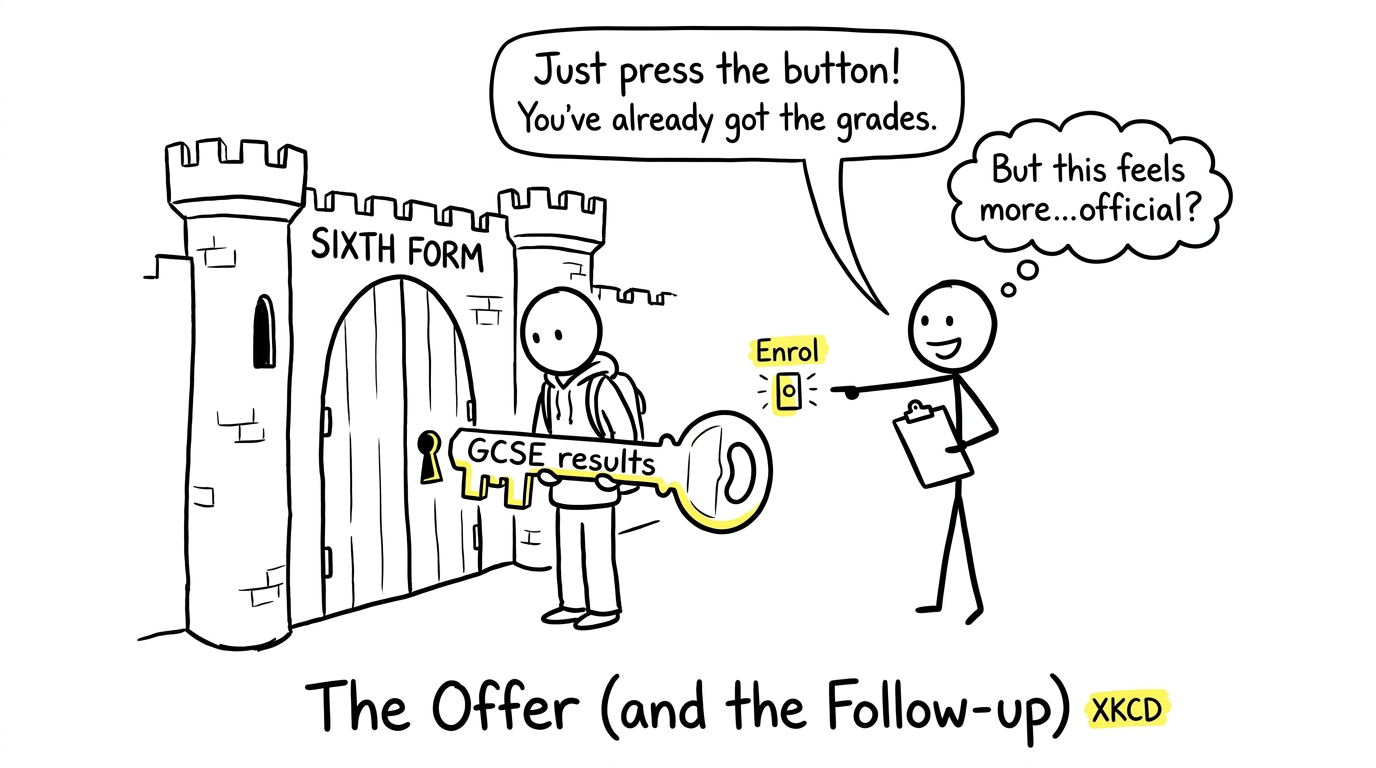 A student uses a GCSE results key but is reminded to ring the enrolment bell
Step three: wait for formal confirmation
Meeting the academic conditions is excellent news, but look for formal confirmation from the provider. This might arrive through an admissions portal, email, telephone call or enrolment appointment.
Check that the confirmation covers your intended subjects. Timetabling or course capacity can sometimes affect combinations, and the provider may discuss alternatives with you. Ask when teaching begins, whether there is summer work and what documents you must bring to enrolment.
If you are taking Maths, explore the GCSE-to-A-Level Maths transition guide and preview the free A Level Maths revision resources. The transition is easier when algebra, graphs and trigonometry remain familiar over the summer.
Step four: act quickly if you miss a condition
Missing one condition does not tell you the final decision. Speak to admissions as soon as possible, state your grades accurately and ask whether you can still be considered.
The sixth form might uphold the original condition, accept you after reviewing the full grade profile, suggest different subjects or offer another course. Its response will depend on its published policy, course suitability and available places. Flexibility is possible, but it should never be assumed.
Ask direct questions:
- Is my original subject combination still available?
- Could I change one subject and retain my place?
- Is there another suitable pathway?
- What is the deadline for deciding?
- Will you reconsider the decision if a grade changes after a review of marking?
If Maths is the issue, read what happens if you do not pass GCSE Maths. Students under 181818 who have not achieved the required standard in GCSE Maths or English will normally continue studying those subjects as part of their post-161616 programme, although the course available depends on the provider.
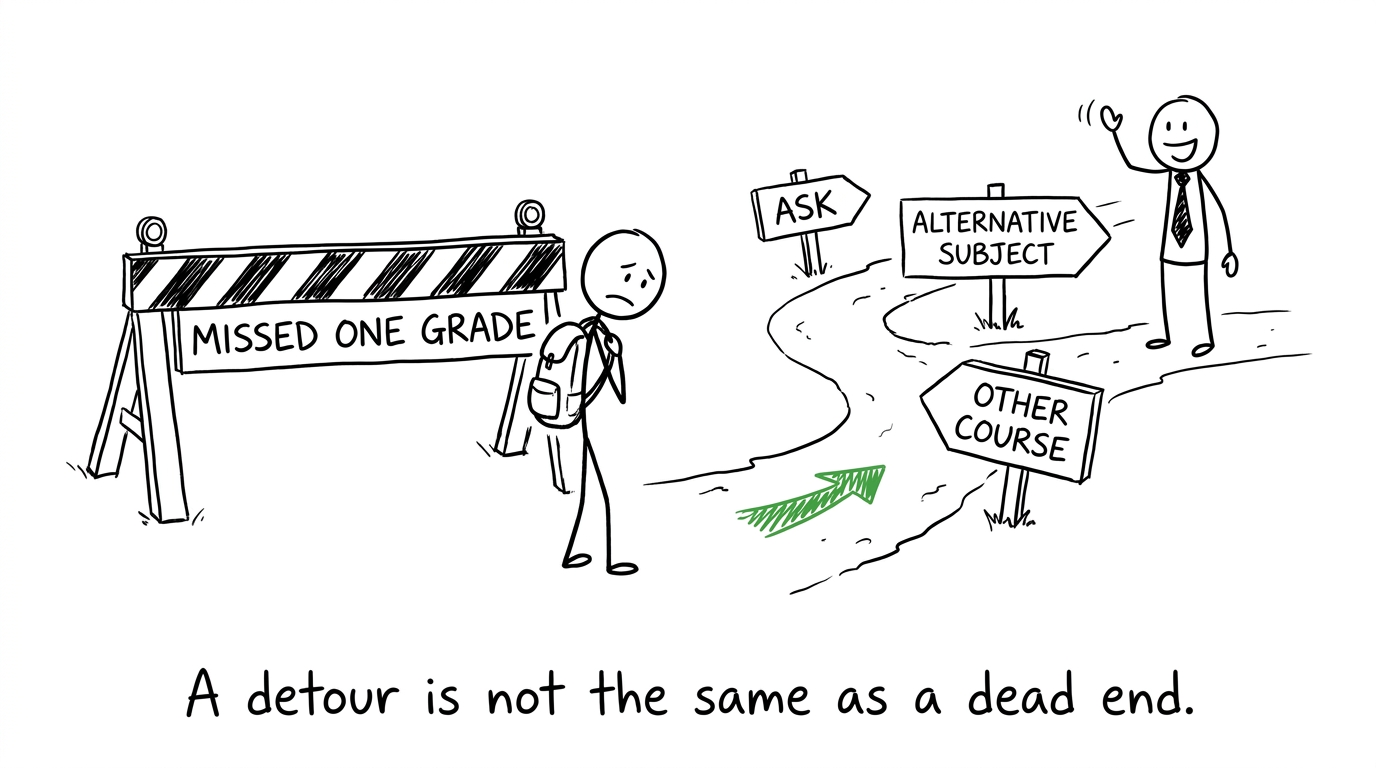 A student discovers that missing one grade may lead to a useful alternative route
Step five: discuss post-results services carefully
If a result looks unexpected, speak to your teacher or exams officer. Your centre can explain access to scripts, clerical re-checks and reviews of marking, along with the current exam-board deadlines and fees.
A review is not a guaranteed route to a higher grade. Marks and grades can remain unchanged, rise or fall. Ask a teacher to consider the marked work where possible, particularly when the result affects a sixth-form condition. Tell the provider that you are exploring a review, but do not assume it will reserve your place unless it confirms this.
Common mistakes on GCSE results day
Assuming that meeting the grades completes enrolment
You may still need to submit evidence, accept the confirmed place or attend enrolment. Missing an administrative deadline can create an avoidable problem.
Deciding that one missed grade means automatic rejection
Only the sixth form can tell you whether it will apply flexibility or suggest another route. Contact it before ruling yourself out.
Requesting a review without advice
A mark close to a boundary does not prove that marking was wrong. Discuss the script, potential outcomes and deadline with your school.
Having no alternative plan
A backup does not weaken your ambition. It protects your choices. Keep contact details for another provider and identify courses with different requirements.
Comparing grades without checking the offer
Another student's offer may involve different subjects or conditions. Your written offer and the provider's admissions policy are what matter.
Turn the offer into a starting point
A sixth form offer is a bridge between what you have achieved and what you want to learn next. Results day determines which route opens first, but your calm actions, checking conditions, contacting admissions and completing enrolment, determine how smoothly you cross it.
Until then, focus on earning the strongest grades you can. Use topic-by-topic GCSE Maths revision guides, test weaker areas with GCSE Maths mini tests, and finish with predicted GCSE Maths papers, mark schemes and video solutions.
Start by reading MathsGenie's guide to GCSE tier choices and sixth-form entry requirements, then build your revision plan backwards from the grade your next step requires.











