GCSE Resit vs Functional Skills: Which Should You Take?
GCSE resit vs Functional Skills explained. Compare recognition, difficulty, assessments, funding and employer acceptance before choosing your Level 2 route.
Failing to secure the maths or English grade you wanted can make the next step feel like a verdict. It is not. It is a choice between routes.
In the GCSE resit vs Functional Skills decision, a GCSE resit is usually best when your intended course, university or employer specifically requires GCSE Maths or English Language. Functional Skills Level 222 may be better when you need practical, work-related skills and your destination explicitly accepts the qualification. However, full-time students in England who entered post-16 education with GCSE grade 333 are normally required to continue studying GCSE under current Department for Education funding rules.
The right question is not simply, “Which is easier?” It is, “Which qualification will take me where I need to go?”
Your decision checklist
Before enrolling, find clear answers to these questions:
- What GCSE grade did you receive?
- Are you studying full-time or part-time?
- Does your college determine which qualification you must take?
- Does your intended course, apprenticeship or employer accept Functional Skills Level 222?
- Might you apply to university or enter a regulated profession later?
- Do you perform better in traditional exams or practical assessments?
- Is the course funded, and are there entry or assessment fees?
Do not rely on someone saying that Functional Skills is “basically the same”. Ask your destination for written confirmation. Qualifications can sit at the same level without being interchangeable for every application.
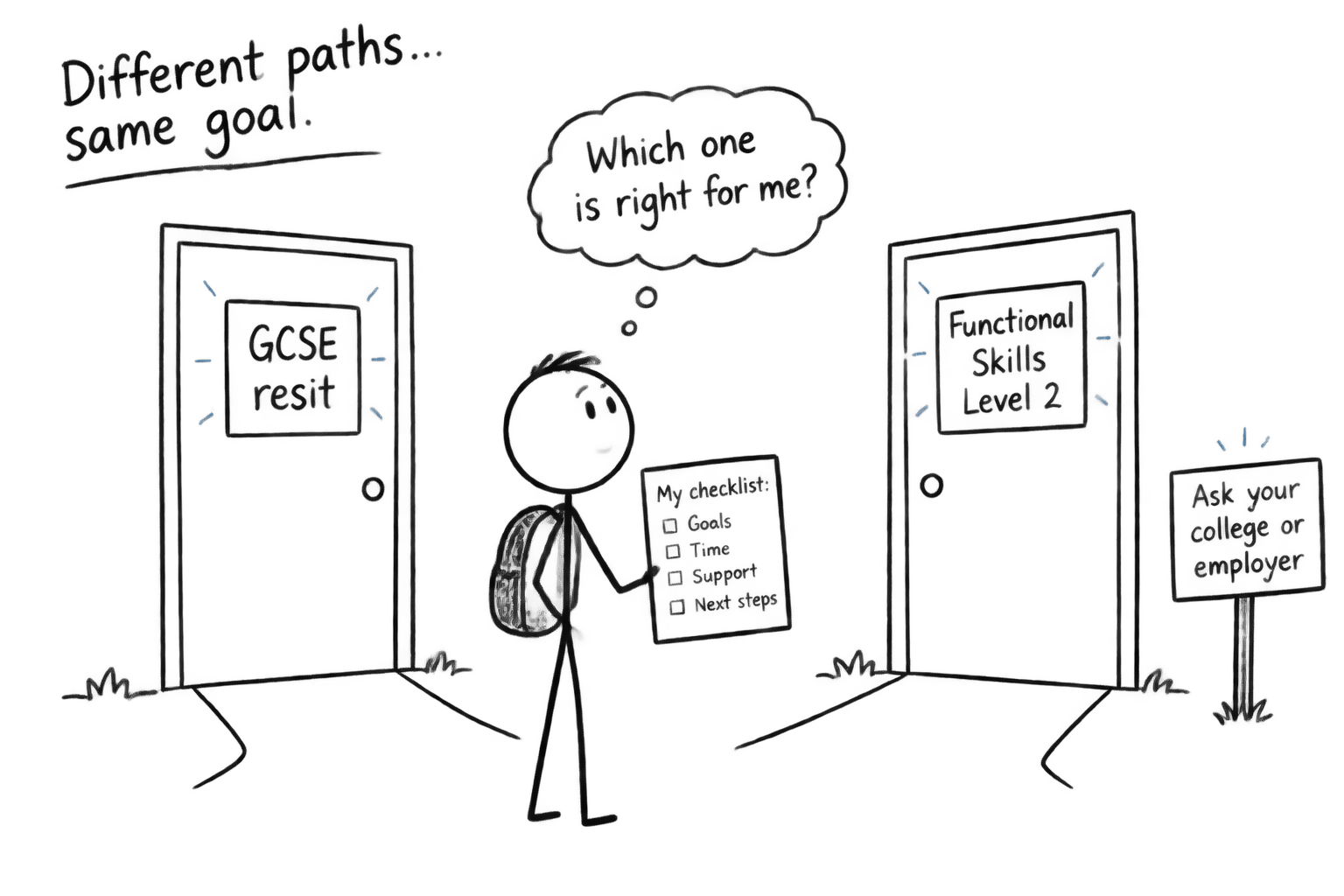 A student calmly choosing between GCSE resit and Functional Skills Level 2 doors
GCSE resit vs Functional Skills at a glance
| Question | GCSE resit | Functional Skills Level 222 |
|---|---|---|
| Qualification level | Level 222 at grades 9-4 | Level 222 when passed |
| Main emphasis | Broad subject knowledge and examination technique | Applying skills to practical situations |
| Maths assessment | GCSE papers, with foundation or higher tier | Externally set and marked assessment, often available on paper or screen |
| English assessment | Reading and writing examinations, plus spoken language arrangements | Reading, writing, and speaking, listening and communicating components |
| Recognition | Widely understood and commonly specified | Recognised Level 222 qualification, but acceptance depends on the destination |
| Typical timing | Fixed examination series | Often more flexible, depending on the provider and awarding organisation |
| Grades | Grades 9-1 | Pass or fail |
Both routes can demonstrate Level 222 attainment. That does not mean they contain identical content, use identical assessments or satisfy every organisation’s entry rules.
Which qualification has wider recognition?
GCSEs remain the more universally understood option. Employers, sixth forms, colleges and universities frequently describe entry requirements using a specific GCSE grade. If an application asks for “GCSE Maths and English Language at grade 444 or above”, you should not assume that Functional Skills will automatically be accepted.
Functional Skills Level 222 maths and English are regulated qualifications designed to demonstrate the application of essential skills. Many employers, training providers and apprenticeship programmes accept them. Their practical focus can be particularly relevant to employment and vocational education.
The difficulty is that employer policies differ. One vacancy may accept “GCSE grade 444 or Functional Skills Level 222”, while another may insist on GCSEs. Requirements can also differ between roles within the same sector.
Check three things before choosing:
- the exact wording of the entry requirement;
- whether “equivalent qualifications” are accepted;
- whether later progression, not merely initial entry, requires a GCSE.
This matters in careers with regulated training routes and for competitive university courses. A qualification that opens today’s door may not open the door after it. MathsGenie’s guide to GCSE grades for apprenticeships explains why checking the individual apprenticeship standard and employer remains essential.
Is Functional Skills Level 2 easier than a GCSE resit?
Functional Skills is often described as easier, but that is too simple to be useful.
A GCSE covers a broader specification. GCSE Maths may include algebra, geometry, probability, statistics, ratio and number skills. At foundation tier, the highest available grade is 555, while higher tier covers more demanding content and offers grades 9-4, with an allowed grade 333 for candidates who narrowly miss grade 444.
Functional Skills Level 2 maths concentrates more directly on using mathematical skills in realistic situations. Questions may require you to select information, make connected calculations and interpret an answer in context. This can feel more natural if abstract algebra was your main obstacle. It can still be demanding because the method is not always signposted.
The same principle applies to English. GCSE English Language tests close reading, comparison, analysis and extended writing within an exam-board specification. Functional Skills English assesses reading, writing, and speaking, listening and communicating through practical uses of language.
Your previous grade offers useful evidence. A student who narrowly missed grade 444 may already possess most of the required GCSE knowledge and need better timing, accuracy or exam technique. Someone with significant gaps may benefit from a more practical route, provided it meets their progression goal.
Explore the meaning of a GCSE Maths grade 2 rather than treating every unsuccessful result as the same problem.
How the assessment styles differ
GCSE Maths and English Language
GCSE resits follow an exam-board specification from Edexcel, AQA, OCR, Eduqas or another recognised board. GCSE Maths uses multiple written papers and is available at foundation and higher tier. English Language normally uses externally assessed reading and writing papers, alongside the spoken language arrangements specified by the board.
Maths and English Language can be retaken in the November series by eligible candidates, and they are also available in the summer series. Your centre decides entries and deadlines, so confirm the details rather than assuming you have been entered. The November GCSE resit guide provides a useful starting point.
Because the examination dates are fixed, GCSE revision has a clear finish line. Past papers become especially valuable: they teach timing, command words and how mark schemes award method marks.
Functional Skills maths and English
Functional Skills assessments are set and marked under awarding-organisation arrangements. Providers can often offer more flexible assessment dates than the fixed GCSE timetable, although availability depends on the centre.
Functional Skills maths tests your ability to use mathematical reasoning and procedures in practical contexts. Delivery and paper structure can vary by awarding organisation, so check the specification and sample assessment for the qualification you will actually take.
Functional Skills English has separate reading, writing, and speaking, listening and communicating requirements. At Level 222, reading and writing are externally assessed. Speaking, listening and communicating is commonly assessed by the centre under the awarding organisation’s rules. You must satisfy the required components to achieve the complete qualification.
When Functional Skills counts for DfE funding
This is where a personal preference can meet a funding rule.
For the 2026-27 academic year in England, the Department for Education’s maths and English condition of funding applies to students on relevant 16-19 study programmes and T Levels who have not already achieved the required Level 222 attainment.
A full-time student who achieved GCSE grade 333 in maths or the relevant English circumstances must normally study towards GCSE. A part-time student with grade 333 may study an approved qualification that meets the condition. Students with grade 222 or below, or no grade, can generally study an approved stepping-stone qualification or work towards GCSE or Functional Skills Level 222. Passing an eligible Functional Skills Level 222 qualification can satisfy the condition where the student’s prior attainment permits that route.
The condition is a requirement placed on funded institutions. It does not mean every student receives an unrestricted choice, and it is not identical to an employer’s recruitment rule.
Rules for English also consider prior attainment in English Language and English Literature. Your college should review the current DfE table against your exact grades and programme status.
Eligible adults in England who are aged 191919 or over may be able to receive funded English or maths provision up to Level 222 if they have not already achieved the required standard. Residency, previous attainment and local funding arrangements matter. Funding systems also differ across Scotland, Wales and Northern Ireland, so confirm your position with the provider before enrolling.
When a GCSE resit is probably the better choice
Choose, or expect to be directed towards, a GCSE resit when:
- your target course or employer specifically names GCSE;
- you achieved grade 333 and are a full-time post-16 student in England;
- you were close to grade 444 and your knowledge remains secure;
- you may need the qualification for university or a regulated career;
- you want a graded result rather than a pass or fail outcome.
A resit should not be a replay of Year 111111. Start with diagnosis. Use GCSE Maths revision resources organised by exam board and grade, then test individual weaknesses using GCSE Maths mini tests. Build towards 45-minute GCSE Maths tests, full past papers and predicted papers.
The useful sequence is simple: revise the lesson, answer practice questions, mark the work honestly, watch the video solution and return to the error. A mark scheme is not merely a score sheet. It is a description of what the examiner needed to see.
When Functional Skills may be the better choice
Functional Skills may suit you when:
- your college is allowed to offer it under the funding rules;
- your intended employer or training provider confirms acceptance;
- practical application suits you better than a broad GCSE specification;
- you need flexible assessment opportunities;
- you are an adult seeking a recognised Level 222 qualification for work or progression.
It can be an efficient and respected route. But efficiency only helps when the destination accepts the result. If your long-term plan is uncertain, GCSE often preserves more options.
If you are returning through college, read the guidance on retaking GCSEs at sixth form or college before discussing your programme with the resit team.
Common mistakes when choosing your route
Assuming Level 2 means identical
GCSE grade 444 and Functional Skills Level 222 both represent Level 222 attainment, but the qualifications are not identical. Organisations can set their own entry requirements.
Choosing solely because one route sounds easier
Assessment style matters more than reputation. Practical multi-step problems can be difficult, just as familiar GCSE questions can become manageable with structured practice.
Checking only the next course
Look one step beyond it. Ask what you will need for the apprenticeship, degree, promotion or professional registration that may follow.
Ignoring the exact English requirement
GCSE English Language, English Literature and Functional Skills English are distinct qualifications. Never assume that one automatically substitutes for another.
Repeating the same revision habits
More hours do not repair an ineffective method. Use topic lessons, practice questions, mini tests, mark schemes, video solutions and a revision planner to turn mistakes into a focused schedule. For English, a consistent routine such as this 20-minute GCSE English revision approach is stronger than occasional panic.
Make the choice that keeps the right door open
The best qualification is not the one with the friendliest reputation. It is the one that fits your current attainment, complies with your provider’s funding rules and is accepted by the destination you care about.
Get confirmation from your college and intended employer. Then commit fully to the route rather than continuing to debate it. If GCSE Maths is the answer, MathsGenie gives you free revision lessons, practice questions, mini tests, past papers, predicted papers, mark schemes, video solutions and a revision planner. One result does not define your ability. What you do with the evidence from it can change the next one.