

Grade 2 GCSE Maths Meaning: What to Do Next
Grade 2 GCSE maths meaning explained, with resit options, course implications and a practical MathsGenie revision plan to help you work towards grade 4.
Results Day can make one number feel much larger than it is. If you are searching for the grade 2 GCSE maths meaning, the immediate answer is this: you have received a recognised GCSE grade, but you have not yet reached the grade 4 standard pass.
That may affect entry to some college courses, sixth forms, apprenticeships and jobs. It also means you will probably need to continue with maths after Year 11. But a grade 2 is not a permanent judgement about your ability. It is evidence of where your understanding stood on a particular set of papers, and evidence can be used to build a better plan.
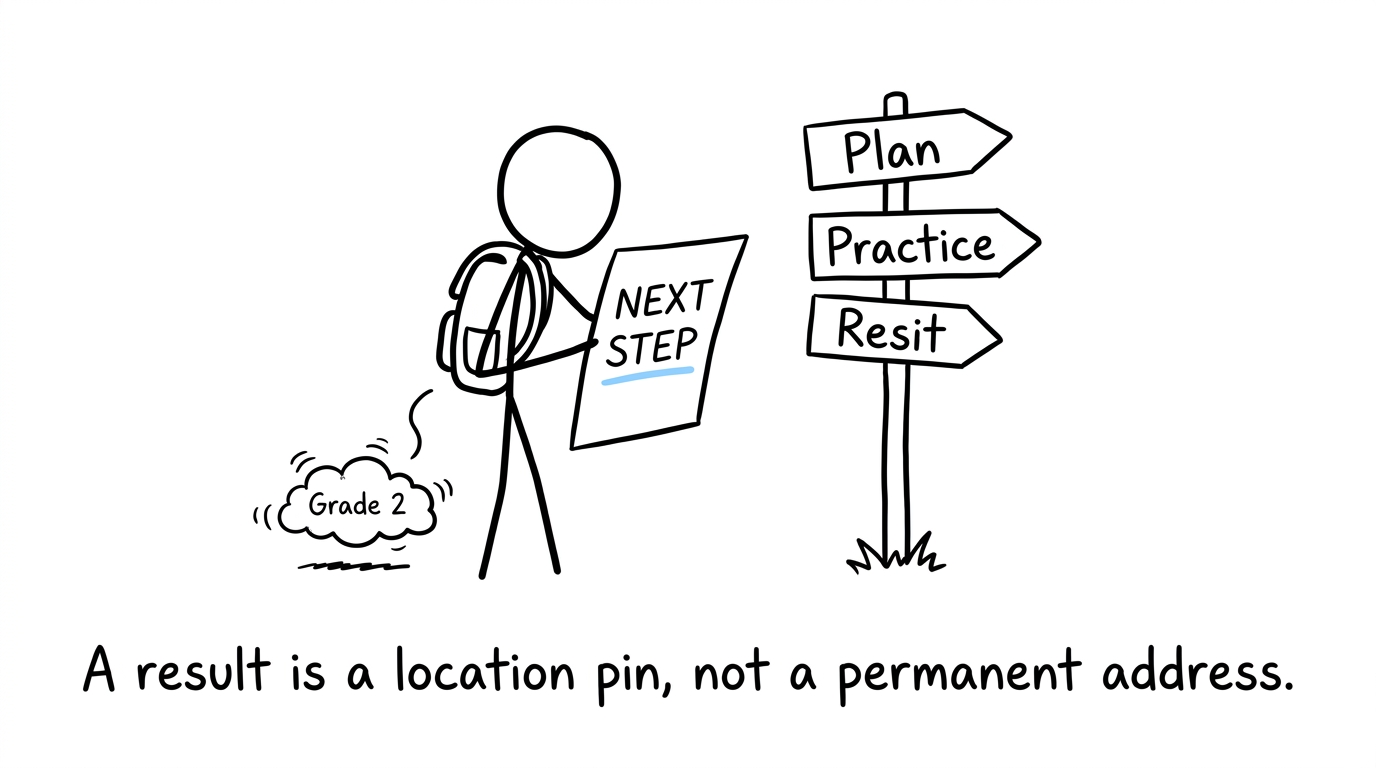 A result is a location pin rather than a permanent address
What does a grade 2 in GCSE Maths mean?
GCSEs in England use grades 9-1, with grade 9 being the highest. Grade 4 is described as a standard pass, while grade 5 is a strong pass. A GCSE Maths grade 2 is below both thresholds.
It does not mean that you understood nothing. To earn the grade, you collected marks across the papers and demonstrated some mathematical knowledge. Your next task is to identify which skills are secure and which gaps prevented you from reaching grades 3 and 4.
Foundation tier offers grades 1-5. Higher tier normally offers grades 4-9, with a narrow grade 3 safety outcome available. A grade 2 therefore sits within the Foundation tier range.
Grade boundaries change between exam series and exam boards, including Edexcel, AQA, OCR and Eduqas. Do not compare your raw mark with a boundary from another year or board. Ask your school or college for your paper marks and check the boundaries for your exact qualification.
Your Results Day checklist
Take these steps before making a long-term decision:
- Confirm your exam board, tier and marks for each paper.
- Ask how far your total was from grades 3 and 4.
- Check the maths requirement for your intended course or apprenticeship.
- Discuss resit arrangements with your school, college or exam centre.
- Ask whether a review of marking is appropriate if there is a specific reason to suspect an error.
- Begin with the free GCSE Maths revision hub, where you can select your exam board and find relevant resources.
A review of marking is not simply a second attempt to gain extra marks. The result can rise, remain unchanged or fall, and deadlines apply. Your centre should explain the evidence, cost and risk before you consent.
What next after grade 2 maths?
Resit GCSE Maths
For many students, resitting is the clearest route towards grade 4. GCSE Maths is available in the summer, and a November series is also available to eligible students who are aged 16 or over by 31 August of that year. Entries must be arranged through an approved exam centre.
A resit means taking the complete qualification again, not only the paper on which you scored least. All papers must be taken at the same tier and in the same series.
If you study in England and continue in funded post-16 education without grade 4 in maths, you will normally need to keep studying maths. Students with grade 2 or below may, depending on their programme and provider, study GCSE Maths or an approved stepping-stone qualification. Rules and course requirements can differ elsewhere in the UK, so confirm your position with your provider.
Continue with your course while improving maths
A grade 2 does not automatically close every route. Some colleges offer courses where you continue maths alongside your main subject. Others require grade 3 or 4 before entry, especially where the course uses substantial numerical skills.
Contact the provider rather than assuming. Ask whether it offers conditional entry, a lower-level starting course or a route that allows you to resit GCSE Maths alongside your programme.
Consider a stepping-stone qualification
An approved alternative, such as an appropriate Functional Skills qualification, may help some students rebuild confidence before another GCSE attempt. However, it is not automatically treated as equivalent to GCSE grade 4 by every course, employer or apprenticeship.
Ask two questions: does the qualification meet your current funding arrangement, and will it be accepted for your intended next step?
How to move from grade 2 towards grade 4
The gap is rarely solved by repeatedly completing full papers without reflection. Start with the foundations: calculations, negative numbers, fractions, decimals, percentages, ratio, simple algebra, angles, area, averages, graphs and basic probability.
Use this repeatable routine:
- Complete a short set of Foundation questions without notes.
- Mark it carefully using the solutions or mark scheme.
- Record whether each lost mark came from knowledge, method, accuracy or misunderstanding the question.
- Revisit the relevant revision lesson and practice questions.
- Take a mini test before returning to a full paper.
MathsGenie's free GCSE resources let you move from explanations to exam questions and solutions without jumping between unrelated materials. Edexcel students can use the dedicated Edexcel GCSE Maths revision page and then progress to Edexcel past papers with mark schemes.
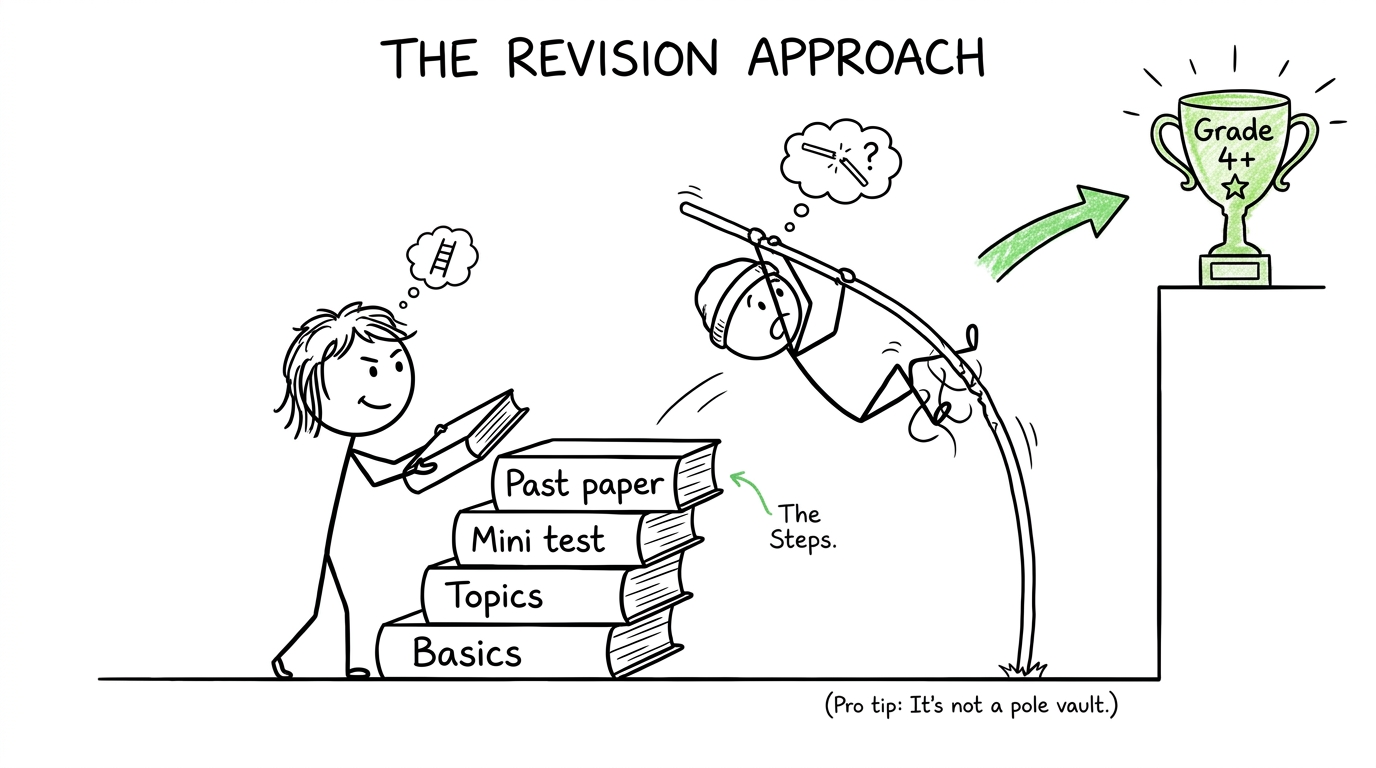 Building revision stairs instead of trying to jump directly to the finish
Past papers become valuable when they reveal what to revise next. The guide to using Edexcel Maths past papers properly explains how to work under timed conditions, mark accurately and create an error log. When suitable papers are available, GCSE predicted and practice papers can provide further exam-style practice.
Common mistakes after receiving a grade 2
Revising only the hardest topics
Grade 4 is built on dependable foundation marks. Secure arithmetic, fractions, percentages, ratio and simple algebra before spending most of your time on difficult questions.
Treating every wrong answer equally
A forgotten method needs reteaching. A calculator-entry mistake needs a checking habit. A misread question needs better exam technique. Label the cause before choosing the fix.
Waiting until the resit is close
Short, regular sessions are more manageable than a last-minute rush. Begin while your exam experience is still fresh and review weak topics each week.
Ignoring the mark scheme
Mark schemes show where method marks are available. Clear working can earn credit even when the final answer is incorrect, so practise setting out each stage logically.
A grade is information, not an identity
A grade 2 tells you that the next stage needs structure. Confirm your course requirements, arrange the right resit or stepping-stone route, and rebuild the topics that produce dependable Foundation marks.
Start with the MathsGenie GCSE Maths revision hub. Use the revision lessons and practice questions to repair gaps, mini tests to check progress, and past papers, mark schemes, video solutions and predicted papers to prepare for the real exam. The goal is not to pretend Results Day did not happen. It is to make that result the beginning of a better method.











