GCSE English Language and Literature 20 Minute Study Routine
GCSE English language and literature 20 minute study routine for busy students, covering reading, writing, quotations and analysis without cramming.
Revision becomes difficult when every subject seems to demand the whole evening. Maths needs practice questions. English Literature needs quotations. English Language needs reading and writing practice. Meanwhile, homework is still arriving.
A GCSE English language and literature 20 minute study routine solves a smaller, more useful problem: what can you do today that genuinely improves your English without pushing maths aside? The answer is one focused task, one attempt from memory and one short correction. You are not trying to revise an entire qualification each evening. You are keeping important skills available until longer weekend sessions and mock exams put them under pressure.
This routine is designed for students balancing English with GCSE maths revision. It takes 202020 minutes, requires little preparation and prevents every unfinished task from being transferred to the night before the exam.
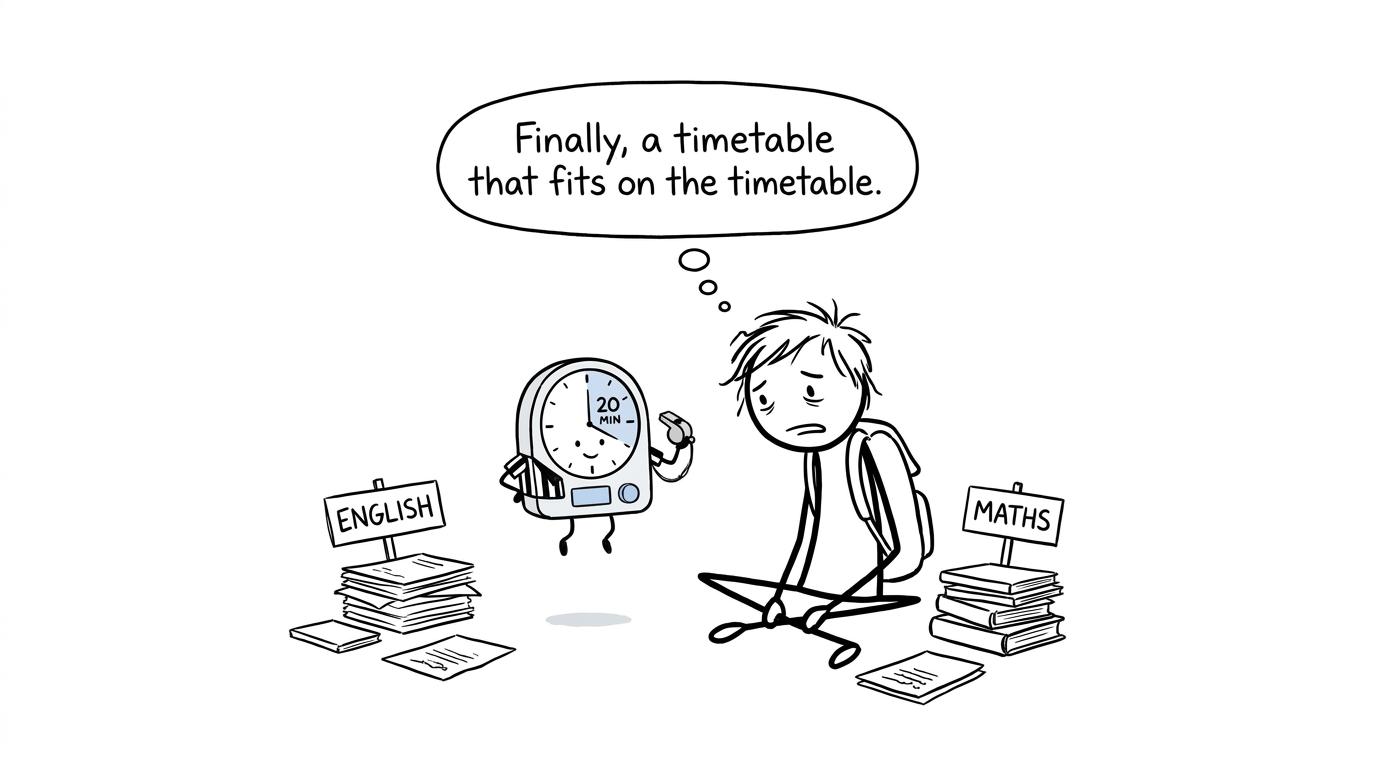 A GCSE student balancing English and maths with a friendly twenty-minute timer
Your 202020-minute revision checklist
Before starting, choose one target. Not a whole paper and not an entire novel.
- Set a timer for 202020 minutes and put your phone out of reach.
- Spend 333 minutes retrieving knowledge without notes.
- Spend 121212 minutes completing one focused English task.
- Spend 555 minutes checking, correcting and recording the next step.
- Alternate Language and Literature across the week.
- Add a longer timed response when your weekend allows it.
- Keep the routine beside your maths plan using the MathsGenie revision planner.
The routine is deliberately small. A plan that fits an ordinary Tuesday is usually more valuable than an ambitious timetable that only survives until Thursday.
How the daily routine works
Retrieve for 333 minutes
Close your notes and write down what you can remember. For Literature, this might be quotations, themes, character changes or contextual ideas. For Language, it could be structural methods, persuasive techniques, punctuation choices or the requirements of a particular question.
Retrieval reveals the difference between recognition and recall. A quotation can look familiar on a flashcard while remaining unavailable when you face a blank exam page. Trying to recall it first gives your revision a purpose: you can now see exactly what needs repairing.
Practise for 121212 minutes
Complete one small task connected to your target. Suitable tasks include:
- annotating a short unseen extract;
- planning an analytical paragraph;
- selecting evidence for a Literature theme;
- writing an opening or ending for a creative response;
- comparing two ideas or perspectives;
- improving the vocabulary, punctuation and sentence control in an old answer;
- planning a response to an exam-board question.
GCSE English Language assesses reading and writing. National subject content gives each side half of the written qualification, while the spoken language endorsement is reported separately and does not contribute to the final GCSE grade. The precise paper structure differs between AQA, Edexcel, OCR and Eduqas, so practise the question types used by your own board rather than relying on a generic checklist.
Check for 555 minutes
Do not finish when the writing stops. Use the final 555 minutes to compare your work with class guidance, an official mark scheme or an examiner-style model supplied by your school.
Record one specific correction, such as:
- explain the effect rather than merely naming a technique;
- connect the quotation more directly to the argument;
- identify the audience before choosing the tone;
- use context to illuminate the text rather than replace analysis;
- vary sentence openings without losing clarity.
Specific corrections can guide tomorrow. “Improve English” cannot.
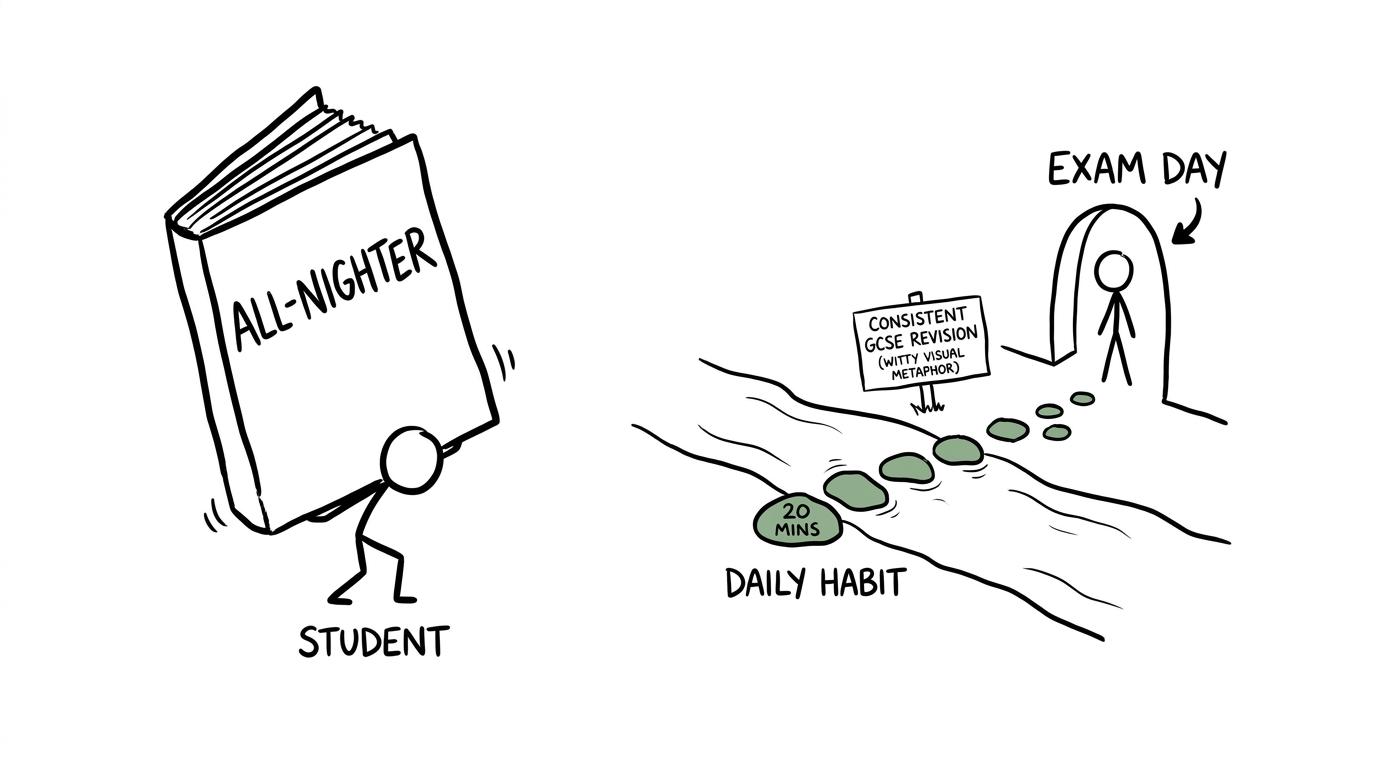 A small daily habit crossing towards exam day while an all-nighter struggles
A weekly GCSE English Language and Literature routine
A weekly rotation prevents Literature knowledge from consuming every session while Language skills go unpractised. Adapt the texts and paper questions to your specification.
| Day | Focus | Suggested 121212-minute task |
|---|---|---|
| Monday | Literature knowledge | Recall quotations for one theme, then check their wording and meaning |
| Tuesday | Language reading | Annotate how language or structure shapes a short extract |
| Wednesday | Literature analysis | Plan one argument supported by carefully chosen textual references |
| Thursday | Language writing | Draft one section for a clear audience, purpose and form |
| Friday | Mixed retrieval | Test this week’s quotations, methods and corrections without notes |
| Weekend | Timed application | Complete a longer paragraph, question or paper section and review it |
If you miss a day, continue with the next session. Do not create an hour-long punishment block to repay the timetable. Consistency is supposed to reduce pressure, not manufacture more of it.
Students with a crowded revision schedule can use the same principle for maths. The GCSE maths revision timetable guide explains how to combine focused topic work, marking and timed practice without revising everything at once.
Make English Language practice active
English Language revision can become vague because the examination uses unseen texts. Yet unseen does not mean unpreparable. You are practising repeatable decisions: interpreting information, analysing language and structure, comparing perspectives, evaluating a text and writing effectively for a given purpose and audience.
Choose tasks that produce evidence of thinking. Highlighting six metaphors is less useful than choosing one detail and explaining how it influences the reader. Reading a model answer is less useful than planning your own response before comparing the two.
Writing deserves regular attention too. Across GCSE English Language specifications, technical accuracy matters alongside content and organisation. Spend some sessions editing old work for spelling, punctuation, grammar, sentence control and vocabulary. Other sessions should focus on shaping tone and structure. Accuracy and imagination are not competing goals; controlled writing makes an idea easier to trust.
Build Literature knowledge around arguments
For GCSE English Literature, the shared assessment objectives require students to respond to texts, support interpretations with textual references, analyse language, form and structure, and understand relationships between texts and their contexts. Accurate written expression is also assessed.
That means a quotation is not the finished product. Learn it with three connections:
- the idea or argument it can support;
- the writer’s choice you could analyse;
- another moment in the text that develops or complicates it.
Keep quotations short enough to recall accurately and flexible enough to use for more than one theme. Your exact set texts, anthology and exam arrangements depend on your board and school, so follow your specification and teacher’s guidance.
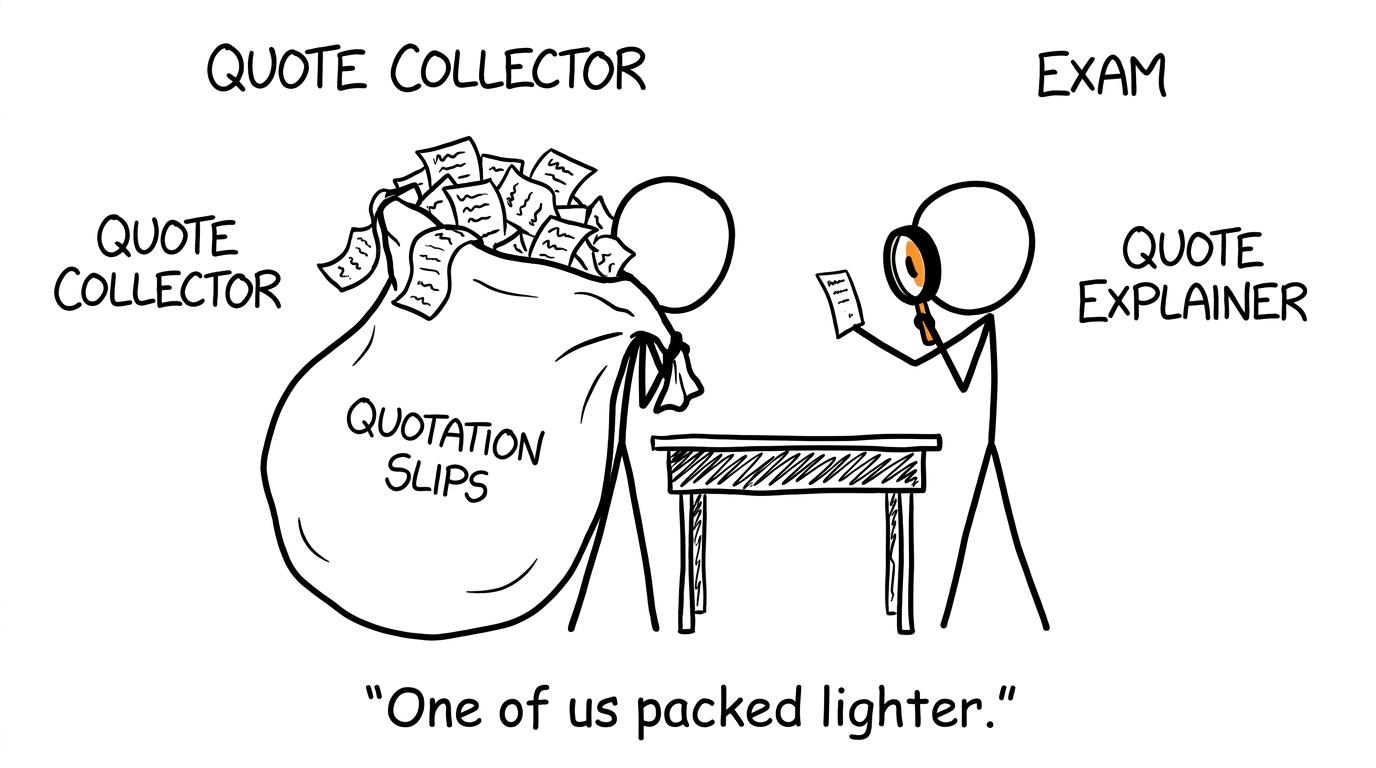 Quote Collector carries a huge sack while Quote Explainer studies one quotation carefully
Fit English around GCSE maths revision
A daily English routine should protect maths time rather than compete with it. One practical pattern is to complete the 202020-minute English block before a separate maths session. The change of subject provides a clear boundary, and both sessions retain a specific purpose.
For maths, use the same basic cycle: retrieve, practise, mark and fix. Start from the GCSE Maths revision hub, where you can choose resources for your exam board and tier. Revision lessons and topic questions repair individual gaps; mini tests show whether the method remains secure.
Longer paper practice belongs elsewhere in the week. Students taking Edexcel can use Edexcel GCSE Maths past papers, while students on AQA can use AQA GCSE Maths past papers. Complete the correct foundation or higher paper, use its mark scheme, and turn lost marks into the next topics you practise.
If you are unsure when to introduce complete papers, the guide to starting GCSE past-paper practice explains how to progress from short sections to timed papers. English can follow a similar pattern: daily micro-practice builds the parts, while occasional longer sessions test whether those parts work together.
Measure progress without obsessing over hours
Hours completed are easy to count but do not show whether your answers are improving. At the end of each week, review your correction notes and ask:
- Can I recall last week’s quotations without looking?
- Can I explain effects precisely rather than list techniques?
- Can I identify audience, purpose and form quickly?
- Are the same spelling or punctuation errors returning?
- Can I plan a clear argument within a short time?
Choose next week’s tasks from the repeated weaknesses. This is the English equivalent of using a maths error log: the mistake stops being a verdict and becomes an instruction.
Common mistakes in a 202020-minute study routine
Trying to cover too much
“Revise Macbeth” is too large for one short session. “Recall three quotations showing how Macbeth responds to fear” is usable. Narrow targets create visible progress.
Rereading for the entire session
Notes and revision guides can refresh understanding, but they should not occupy all 202020 minutes. Close the material and produce something: a plan, paragraph, annotation or retrieval list.
Memorising quotations without interpretations
A collection of evidence does not automatically become an argument. Attach each quotation to meaning, method and the development of the text.
Ignoring the exam board
AQA, Edexcel, OCR and Eduqas do not use identical paper structures or question wording. Check your specification, set texts and teacher guidance before building the weekly rotation.
Skipping feedback
Unmarked practice can preserve the same mistake. Use mark schemes carefully, but remember that English responses may allow more than one valid interpretation. Look for the qualities rewarded rather than trying to reproduce one supposedly perfect answer.
Turning a missed day into an all-nighter
Cramming often appears to solve a timetable problem by borrowing from sleep and tomorrow’s concentration. Resume the routine instead. For the final evening before a maths paper, the GCSE maths night-before plan offers a similarly calm alternative to panic-driven revision.
A small routine that leaves room for every subject
Twenty minutes will not replace reading your set texts, completing full responses or sitting timed papers. It was never meant to. Its job is to keep English knowledge and skills moving on busy days, so the longer sessions begin with familiarity rather than panic.
Choose tomorrow’s English target now. Put it into the MathsGenie revision planner, then organise your maths around the free revision lessons, practice questions and mini tests in the GCSE hub. As the exams approach, add past papers, predicted papers, mark schemes and video solutions.
An all-nighter asks one evening to rescue everything. A routine asks today to do its share.