Apprenticeships After GCSE: What Grades Do You Need?
Apprenticeships after GCSE explained: discover typical entry grades, apprenticeship levels and what to do if maths or English is below grade 4.

Opening a vacancy and seeing “GCSE maths and English required” can make an apprenticeship feel decided by one results envelope. Usually, it is not that simple. For apprenticeships after GCSE, there is no single grade requirement across every occupation and employer. Many vacancies ask for grade 444 or above in maths and English, but some Level 222 routes accept applicants without formal qualifications and include further English and maths training.
The decisive document is the individual vacancy. Read its essential requirements before assuming that your grades are either sufficient or insufficient.
Apprenticeship grades at a glance
Use this checklist when comparing opportunities:
- Check the apprenticeship level and occupation.
- Separate the employer's entry criteria from the level's educational equivalent.
- Look for required subjects, especially maths, English and science.
- Distinguish between “essential” and “desirable” grades.
- Ask the provider what English and maths training is included.
- Apply while still at school if the closing date allows it.
- Keep revising until your final exams; a stronger grade creates more choices.
The information below focuses mainly on England. Apprenticeship systems and terminology differ in Scotland, Wales and Northern Ireland, so students elsewhere should check the rules and vacancy information for their nation.
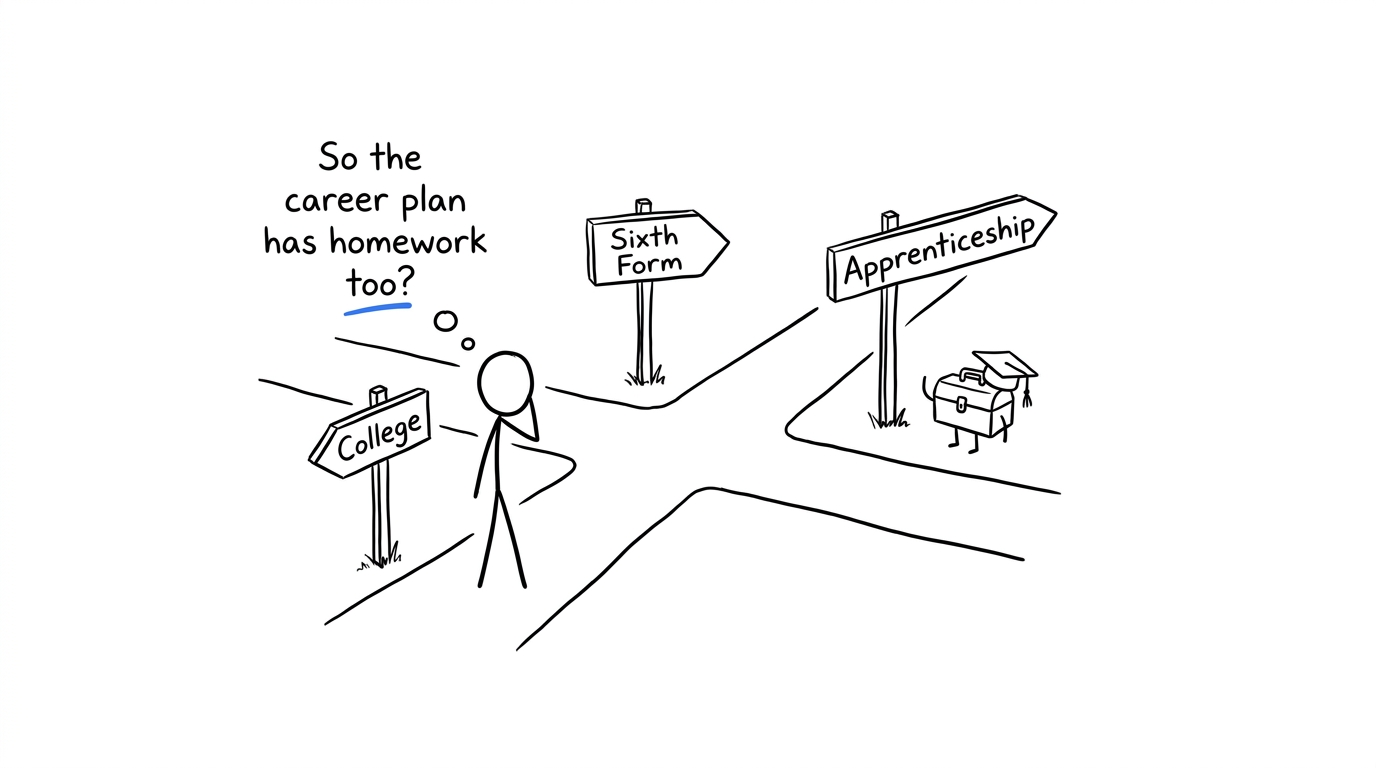 A student choosing between college, sixth form and an apprenticeship
What GCSE grades do you need for an apprenticeship?
The short answer is that GCSE grades for apprenticeships are set vacancy by vacancy. Employers may consider your qualifications alongside your application, interview, attitude, relevant experience and potential to do the job.
Grade 444 in GCSE maths and English is a common requirement because it represents Level 222 attainment. Technical, engineering, construction, finance and digital vacancies may ask for particular subjects or higher grades. Other employers list these grades as desirable rather than essential.
A hypothetical Level 222 customer service vacancy might accept applicants without specified GCSE grades, while a competitive engineering vacancy might require maths, English and science at grade 444 or above. These are illustrations, not universal rules; the actual advert always takes priority.
Understanding apprenticeship levels
An apprenticeship level describes the standard of the training. It does not automatically tell you the grades needed to enter it.
| Apprenticeship route | Level | Broad educational equivalent |
|---|---|---|
| Foundation or intermediate | 222 | GCSE level |
| Advanced | 333 | A Level standard |
| Higher | 444 to 777 | Higher education standard |
| Degree | 666 or 777 | Bachelor's or master's degree standard |
Students leaving Year 111111 commonly consider Level 222 or Level 333 opportunities. A Level 222 apprenticeship can provide an entry point into an unfamiliar industry. A Level 333 vacancy may expect stronger GCSE results, previous experience or subject-specific knowledge.
Do not confuse equivalence with entry requirements. Saying that Level 333 is broadly equivalent to A Level standard describes the training undertaken, not a rule that every applicant must already hold A Levels.
Why maths and English matter
Maths in an apprenticeship is rarely a page of abstract calculations waiting beside a toolbox. It appears through measurements, estimates, costs, tolerances, data, stock levels, schedules and spreadsheets. Employers need confidence that an apprentice can use numbers accurately when the result affects real work.
Under current rules in England, apprentices aged 161616 to 181818 when they start must undertake English or maths qualifications as part of their programme if they do not already hold suitable equivalents. The precise completion requirement depends on the apprenticeship level and programme, so confirm it with the training provider.
A result below grade 444 therefore does not necessarily close the apprenticeship route. It may mean continuing towards GCSE maths or an approved Functional Skills qualification during the programme. However, achieving grade 444 or above before applying can widen your choice and reduce the qualifications you need to complete alongside work.
 An employer inspecting skills while a calculator hides behind a CV
Choosing a route after Year 11
If you achieve grade 444 or above
You will satisfy the maths threshold stated by many vacancies, although employers can ask for more. Search across Level 222 and Level 333 roles, then compare the occupation, training provider, location, working hours and progression route.
If you achieve grade 333 or below
Look for vacancies without a grade 444 entry condition and ask how English and maths will be delivered. Foundation or Level 222 opportunities may provide an accessible first step. Your school careers adviser, local college and apprenticeship provider can help you check whether a vacancy is realistic.
If you want a higher or degree apprenticeship later
You can progress in stages. One route might move from Level 222 to Level 333 and then to higher training. Alternatively, you could complete A Levels or another Level 333 qualification before applying. Progression is possible, but it is not automatic; later vacancies may have new academic and occupational requirements.
How to improve your maths grade before applying
Start with the requirement attached to your preferred vacancies. A clear target makes revision less vague.
Use the GCSE maths revision hub to choose your exam board and tier. There are dedicated resources for Edexcel GCSE maths, AQA GCSE maths, OCR GCSE maths and Eduqas GCSE maths.
Build a simple weekly cycle:
- complete a short set of practice questions;
- mark it immediately;
- identify the topic behind each lost mark;
- use a revision lesson or video solution;
- attempt another question without notes.
Once individual topics feel secure, move to Edexcel GCSE maths past papers, OCR GCSE maths past papers or the corresponding page for your board. GCSE predicted papers can provide further exam-style practice, while the GCSE one-month revision plan helps organise the final stretch.
Common mistakes when applying
Assuming every employer wants the same grades. Requirements vary between vacancies, even within one industry.
Treating “equivalent to GCSE” as an entry rule. It describes the apprenticeship's level, not necessarily the qualifications needed beforehand.
Ignoring essential subjects. An advert may request maths and English plus science, computing or another relevant GCSE.
Not applying because predicted grades are uncertain. You can often apply while still at school. State your predicted grades accurately and explain when final results are expected.
Stopping maths revision after finding a flexible vacancy. Better results still increase your options and strengthen the numeracy you will use at work.
Turn your next grade into another option
An apprenticeship is not an easier version of education. It is a paid job combined with structured training, and employers are choosing someone they can trust to learn and contribute. Grades matter, but they sit inside that larger decision.
Begin by checking real vacancies and recording their essential requirements. Then turn the maths grade you need into a revision target. MathsGenie gives you free revision lessons, practice questions, mini tests, past papers, predicted papers, mark schemes and video solutions. Choose your exam board, find the marks you are losing and start closing the gap today.