

GCSE Religious Studies Grade: Sixth Form Entry
GCSE religious studies grade sixth form entry explained: learn when RS matters, what admissions teams prioritise, and how to protect your maths options.
A disappointing result can make one grade feel as though it has swallowed the whole results sheet. If you are searching for GCSE religious studies grade sixth form entry guidance, the short answer is reassuring: most sixth forms and colleges will not treat Religious Studies as the single deciding grade unless you want to study Religious Studies, philosophy or a closely related course.
Your RS result can still contribute to your overall GCSE profile. However, admissions teams generally give more direct weight to English, maths, your total number of qualifying grades and the subjects connected to your chosen course. There is no universal national RS grade required for sixth-form entry, so the published criteria for your chosen provider are what matter.
The quick entry-requirements checklist
Before worrying about one result, check these five things:
- the provider's general entry requirement, such as a specified number of GCSEs at grade 444, 555 or above;
- its minimum grades in English and maths;
- the subject-specific requirements for each A Level or Level 333 course;
- whether it calculates a score using your best six, eight or another selection of GCSEs;
- whether full-course and short-course Religious Studies are counted differently.
Policies vary considerably. Recent published entry criteria for UK sixth forms include providers asking for a broad collection of grades, providers calculating totals from a student's best eight GCSEs and providers setting separate requirements for every A Level. That variation is why advice from a friend at another school may be completely accurate for them and wrong for you.
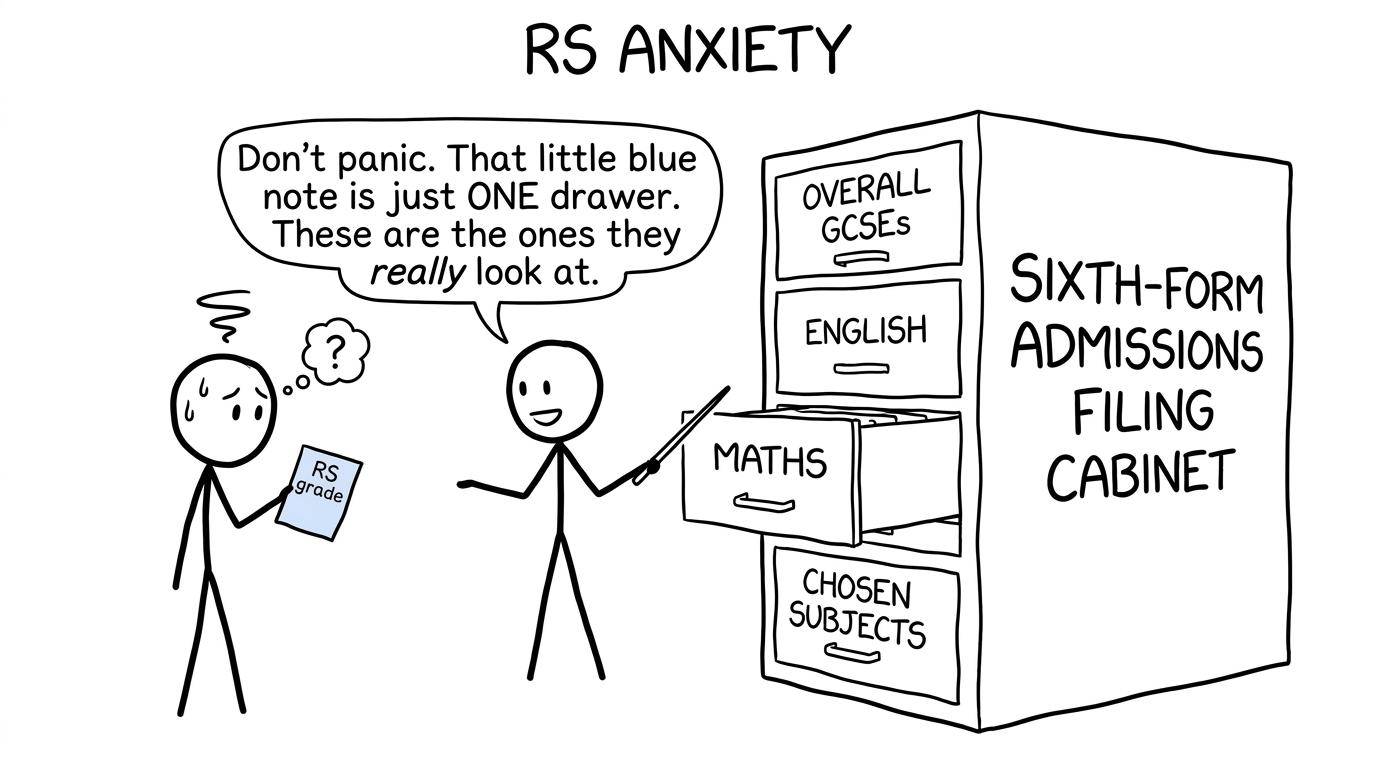 A student discovers that an RS grade is only one drawer in the sixth-form admissions cabinet
How much does your GCSE Religious Studies grade matter?
For most applicants, it carries some weight but not special weight. Religious Studies is normally considered in one of four ways.
It may count towards your overall GCSE profile
A sixth form might require five GCSEs at grade 444 or above, several grades at 555 or 666, or a minimum total calculated from your strongest results. In these systems, RS may help you reach the threshold just like geography, history, art or another accepted subject.
This means a strong RS grade can be useful even if you never study it again. Equally, one lower RS grade may have little effect if you comfortably meet the requirement through your other results.
There is an important detail here: some schools count only full GCSE courses, while others state how short-course RS will be treated. Do not assume that every qualification carries identical weight in a points calculation.
It matters more if you want to study A Level Religious Studies
Subject-specific requirements are where the RS grade becomes more significant. In published entry criteria, some providers ask for grade 555 or 666 in GCSE Religious Studies. Others accept a suitable grade in English, history, geography or another essay-based subject instead. Some say that prior GCSE Religious Studies is preferred rather than essential.
The pattern makes sense. A Level Religious Studies requires sustained reading, argument, evaluation and essay writing. A provider therefore wants evidence that you can manage those skills, but that evidence does not always have to come from GCSE RS itself.
If your grade is below the stated threshold, contact the admissions or subject team rather than guessing. Ask whether the criterion is absolute, whether an alternative humanities or English grade can be considered, and whether the course has space.
It can support another essay-based subject
RS may sometimes be accepted as evidence for philosophy, politics, sociology or another humanities course. This is provider-specific rather than a national rule. Your grade may therefore matter indirectly, especially if you did not take the closest GCSE equivalent to your proposed A Level.
It matters less when it is unrelated to your choices
If you are applying for Maths, Physics and Computer Science, admissions staff are more likely to focus on your GCSE Maths and science results alongside the general entry conditions. A weaker RS result is unlikely to outweigh strong performance in the subjects directly connected to that programme, provided you still meet the overall threshold.
Why maths often receives more attention
Maths has a distinct place in post-161616 progression. Many sixth forms explicitly require grade 444 or 555 in GCSE Maths for general entry. A Level Maths usually has a higher subject requirement, commonly around grade 666 or 777, while some providers ask for grade 888 for Further Maths. These are common patterns, not national thresholds.
In England, eligible students who have not achieved grade 444 or above in GCSE Maths must normally continue studying an approved maths qualification as part of their post-161616 programme under current funding rules. There is no equivalent national continuation requirement for Religious Studies.
So if revision time is limited, do not let anxiety about RS distract you from an explicit maths condition. Check your actual target first. If A Level Maths is part of your plan, read the guidance on choosing an A Level after GCSE Maths and use the GCSE Maths revision hub to strengthen the grade that the department will examine most closely.
What admissions teams are likely to prioritise
No single list applies everywhere, but published policies commonly separate entry decisions into three layers.
| Admissions layer | What may be considered | Where RS fits |
|---|---|---|
| General entry | Number of GCSEs, minimum grades and sometimes a total score | It may count as one accepted GCSE or contribute to the total |
| Core requirements | English and maths grades | RS does not usually replace an explicit English or maths condition |
| Course requirements | Grades in the subject being continued or a relevant alternative | RS matters more for Religious Studies, philosophy and some essay-based courses |
State-funded school sixth forms in England may set academic entry criteria. Under the School Admissions Code, those criteria must be the same for internal and external applicants. Further education and sixth-form colleges publish their own programme requirements, which can differ between academic and vocational pathways.
Predicted grades may help a provider make a conditional offer, but actual GCSE results are normally used to confirm whether academic conditions have been met. Read the current admissions policy for your intended year of entry, not an old prospectus saved elsewhere online.
What to do if your RS grade is lower than expected
First, compare the result with the written criteria rather than with the grade you hoped to receive. A result can feel disappointing without affecting your place at all.
Then follow this order:
- Check the general threshold. Do your other GCSEs already give you the required number or overall score?
- Check every chosen subject. Look for requirements in RS, English, maths, humanities and any named related subject.
- Confirm how RS is counted. This is particularly important if you took a short course.
- Contact the provider. Ask a precise question about the published condition and possible alternative evidence.
- Keep another suitable option available. A backup subject or provider gives you room to make a calm decision on results day.
Do not describe yourself as having “failed everything” because of one grade. Admissions policies are built from conditions, not from the emotional importance attached to a result.
Protecting your maths options while revising
The most useful response to entry anxiety is to turn vague worry into a grade target. Find the exact GCSE Maths requirement for your preferred programme, identify your current level and revise the gap.
Start by confirming your board and tier. Edexcel, AQA, OCR and Eduqas assess the national subject content through different paper structures, so use material aligned with the examination you will actually sit. The GCSE Maths topics by board and tier guide can help you build an accurate checklist. If you are still discussing tier with your teacher, the guide to Foundation and Higher GCSE Maths explains how the available grades differ.
A simple revision cycle works well:
- use a revision lesson to recover one weak method;
- complete practice questions without copying the solution;
- mark them and record the exact reason for each lost mark;
- retest the topic with a mini test;
- move to timed papers when the individual skills are secure.
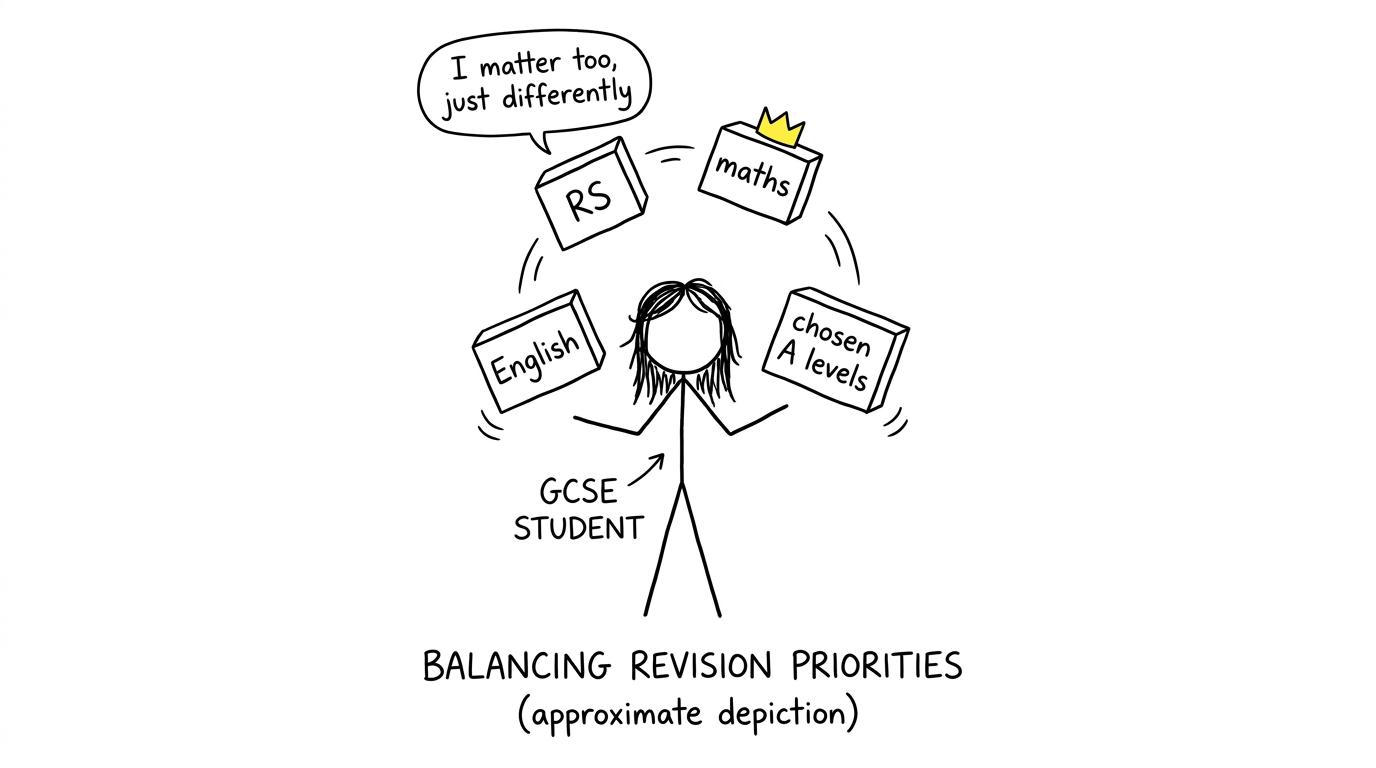 A student juggles RS, English, maths and chosen A Level books while the maths book wears a tiny crown
If the exams are close, use the one-month GCSE Maths revision plan to organise your time. On crowded school days, the 20-minute maths revision routine provides a smaller habit that is easier to repeat.
Paper practice should then reveal whether your methods survive under pressure. Edexcel students can use the Edexcel GCSE Maths past papers, checking mark schemes and solutions after each attempt. Nearer the examination, Edexcel predicted papers can provide additional realistic practice, but they should support full specification revision rather than replace it.
Common mistakes when judging sixth-form entry
Assuming every provider uses the same grades
A grade accepted by one college may fall below another's requirement. Always check the current policy for each place and course.
Confusing a general pass with guaranteed entry
In England, grade 444 is described as a standard pass and grade 555 as a strong pass. Neither automatically guarantees admission. A provider may set a higher general or subject-specific requirement.
Looking only at the RS requirement
You can meet the Religious Studies condition and still miss a general English, maths or total-points threshold. Read the whole admissions section.
Treating predicted grades as final decisions
Predictions can influence conditional offers, but providers may confirm places using actual results. Keep revising after submitting your application.
Giving equal revision time to unequal requirements
Fairness is not the same as strategy. Every subject deserves preparation, but an explicit grade needed for your chosen course should receive proportionate attention. That is particularly important when GCSE Maths determines access to A Level Maths, science, economics or computing pathways.
One grade is evidence, not a verdict
Your GCSE Religious Studies result can matter, especially when it contributes to an overall score or supports entry to Religious Studies and other essay-based courses. But for most students it is one part of a wider application, not the grade that decides everything.
Check the published policy. Separate general entry from subject entry. Ask the provider when the wording is unclear. Then direct your revision towards the grades that genuinely protect your next step.
MathsGenie makes that work easier. Begin with free revision lessons and practice questions, check progress through mini tests, and build exam confidence with past papers, predicted papers, mark schemes and video solutions. A sixth-form requirement is only a target on paper. Consistent, focused practice is how you turn it into a result.










