GCSE Religious Studies Extracurricular Club: Worth It?
GCSE religious studies extracurricular club: learn when joining can strengthen exam skills, when it cannot, and how to protect your GCSE maths revision.

A club can feel productive without necessarily being useful. An hour passes, an interesting debate unfolds, and everyone leaves knowing more, yet the next exam answer may look much the same as before.
So, does joining a GCSE religious studies extracurricular club improve your grade? It can, but only when the club turns discussion into specification knowledge, evidence, evaluation and exam practice. Membership alone does not earn marks. A well-run club can strengthen the thinking behind strong Religious Studies answers, while an unfocused society may simply take time away from maths and other priority subjects.
For a GCSE student balancing Religious Studies with foundation or higher tier maths, the real question is not whether clubs are generally worthwhile. It is whether this particular club improves what you can produce under exam conditions.
The short answer: when an RS club is worth joining
A Religious Studies club is most likely to help when it:
- follows the content studied by your class and exam board;
- develops accurate knowledge of beliefs, practices and sources of authority;
- makes you compare different religious and non-religious viewpoints;
- requires you to justify claims with relevant evidence;
- includes timed questions, peer review or teacher feedback;
- fits into your week without displacing essential maths revision, sleep or homework.
Be more cautious if meetings consist mainly of informal conversation, cover fascinating but irrelevant material, or leave you unable to explain what exam skill improved.
The sensible verdict is conditional: join if the club provides structured, syllabus-relevant practice and your timetable can absorb it. Do not assume that attendance automatically causes a higher grade.
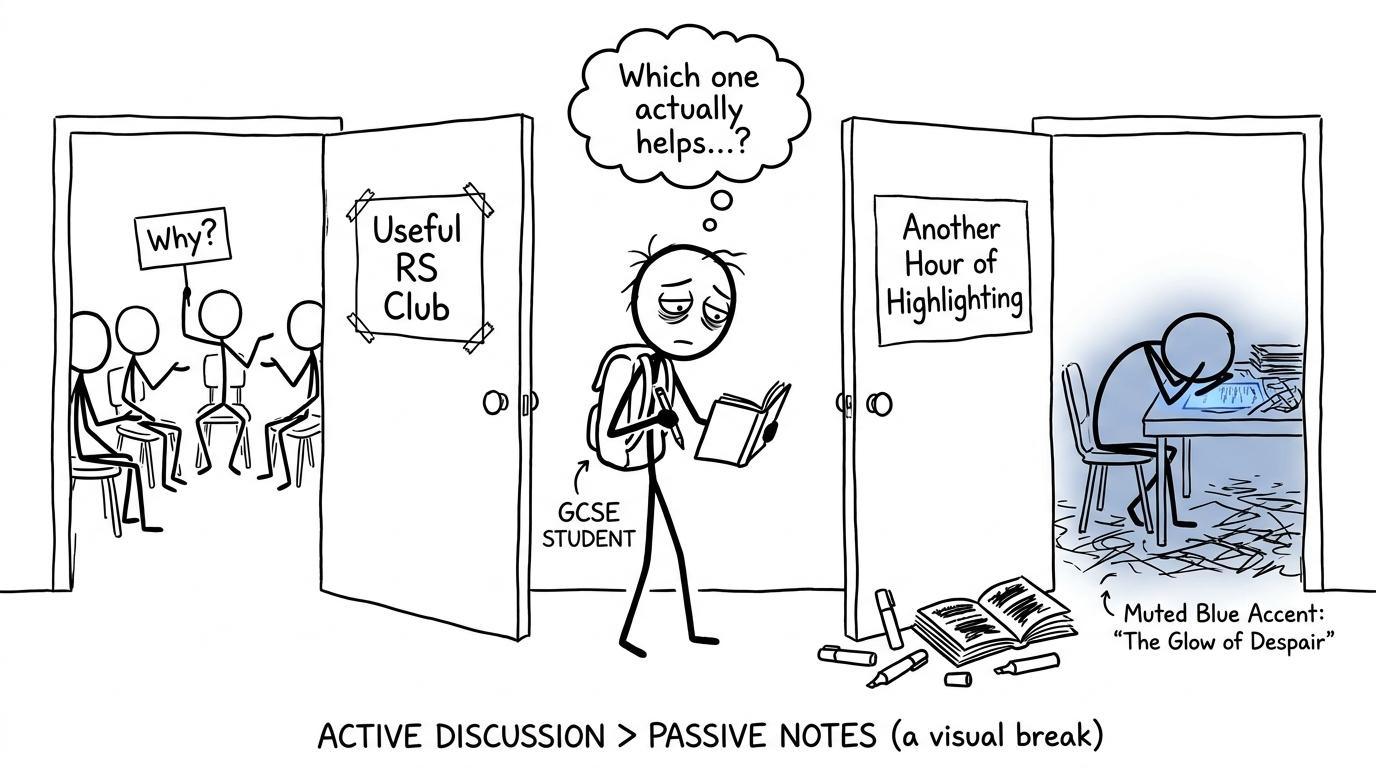 A student choosing between useful discussion and passive highlighting
What GCSE Religious Studies exams actually reward
Across GCSE Religious Studies specifications, students need more than personal opinions. Ofqual’s assessment objectives divide the qualification between two broad demands:
- AO1: knowledge and understanding of religion and belief, including beliefs, practices, sources of authority, influence, and similarities or differences;
- AO2: analysis and evaluation of religion and belief, including significance and influence.
For GCSE Religious Studies qualifications covered by the current Ofqual framework, each objective carries 50%50\%50% of the overall weighting. Exact paper structures and question styles vary between AQA, Edexcel, OCR and Eduqas, so students should check the specification and guidance used by their school.
This matters because a club is useful only if its activities connect to those demands. A discussion about whether war can ever be justified could develop AO2, for instance, but only if students learn to analyse contrasting positions, use accurate religious teaching and reach a supported judgement. A lively exchange of unsupported opinions is less valuable in an exam.
The Department for Education’s GCSE subject content also expects students to understand two religions, engage with sources of wisdom and authority, recognise diversity within and between traditions, and construct well-informed, balanced arguments. A good club creates additional opportunities to practise precisely those habits.
How a GCSE religious studies extracurricular club may help
It makes evaluation active
Evaluation is difficult to learn through highlighting alone. In discussion, another student can question an assumption, expose a weak link or present a perspective you had not considered. You must respond rather than merely recognise information on a page.
That pressure can improve the intellectual structure of extended answers. You begin to ask:
- What is the claim?
- What evidence supports it?
- Does every believer share this interpretation?
- What is the strongest counterargument?
- Which conclusion follows from the reasoning?
These questions are useful only if the club later converts them into written exam responses. Speaking fluently and writing a precise answer within a time limit are related skills, but they are not identical.
It can reveal diversity within beliefs
Weak Religious Studies answers sometimes describe every member of a religion as though they think and act in exactly the same way. A carefully managed club can challenge that oversimplification.
Comparing denominational, traditional, reformist or individual perspectives may help students understand common and divergent views. Discussions involving non-religious beliefs, including atheism and humanism where relevant to the specification, can also produce more balanced analysis.
Accuracy remains essential. Students should verify claims against class materials, the specification and reliable sources rather than treating the loudest contribution as fact.
It encourages retrieval and explanation
Explaining an idea without notes quickly reveals whether you understand it. If you cannot describe a belief clearly, connect it to a practice or recall an appropriate source of authority, the gap becomes visible.
A useful club might use low-stakes quizzes, quotation retrieval, concept sorting or short verbal explanations. These activities can complement classroom revision because they require students to bring knowledge to mind rather than reread it.
It may improve confidence and engagement
Wider research on extracurricular participation reports associations with several positive educational and personal outcomes. Some structured enrichment programmes have produced encouraging attainment results, while club participation has also been linked with confidence, communication and longer-term educational participation.
However, the evidence does not prove that joining any club causes a better GCSE Religious Studies grade. Students who attend clubs may differ from non-participants in motivation, prior attainment or access to support. Research also suggests that programme quality and direct links to academic learning matter.
The honest conclusion is modest: a structured academic club has plausible benefits, but there is no guaranteed grade increase.
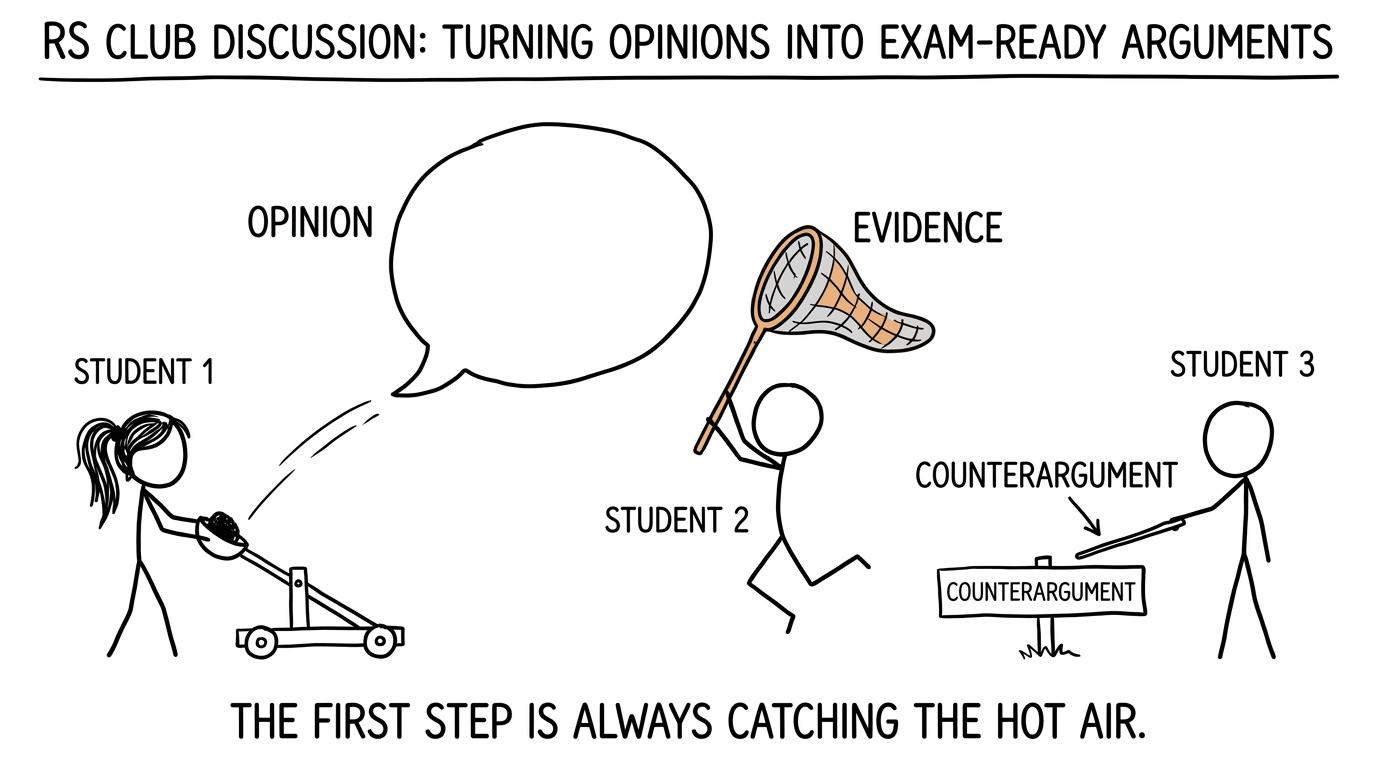 An RS opinion being caught by a net labelled Evidence
What an effective Religious Studies club should include
Before committing for a term, ask the teacher or organiser what actually happens in meetings. A productive programme should contain several of the following:
- sessions mapped to your school’s AQA, Edexcel, OCR or Eduqas specification;
- retrieval of key beliefs, teachings, practices and terminology;
- careful handling of sacred texts and other sources of authority;
- structured debates with assigned positions rather than improvised opinions;
- comparison of views within and between religions;
- planning and writing of extended responses;
- use of genuine mark schemes or examiner guidance;
- specific feedback on knowledge, analysis and judgement.
The strongest test is simple: after a meeting, can you identify something you can now recall, explain, compare or evaluate more effectively?
You could keep a small club record with three headings: knowledge gained, argument improved and question to practise. This turns an enjoyable activity into evidence of progress.
Protecting your GCSE maths revision time
An RS club may help one subject while quietly damaging another if it consumes your only reliable revision slot. Time is a budget. Every commitment has an opportunity cost.
Start by placing fixed lessons, homework, rest and the club into a realistic GCSE maths revision timetable. Then protect short, repeatable maths sessions rather than hoping to recover everything at the weekend.
The MathsGenie GCSE Maths revision hub lets you choose resources for your exam board and work through revision lessons, exam questions and solutions. On a busy club day, the twenty-minute GCSE maths revision routine can keep a topic active without demanding an entire evening.
A balanced weekly pattern might include:
- one Religious Studies club meeting;
- a short follow-up in which you convert discussion into an exam plan;
- several focused maths sessions based on actual weaknesses;
- one timed maths test or paper section;
- enough unallocated time for homework, rest and unexpected demands.
Do not measure balance by giving every subject identical time. Use evidence. The guide to finding your weakest GCSE topics can help you decide where maths time is most valuable.
 A weekly planner rescuing a student from an impossible stack of subjects
How to decide after a trial period
Try the club for a few meetings, then review it rather than relying on how enjoyable it felt. Ask yourself:
- Can I recall more specification content without notes?
- Are my arguments more balanced and better supported?
- Have I completed any written practice?
- Has a teacher or mark scheme identified improvement?
- Am I still completing planned maths revision?
- Do I leave with a clear next action?
If the answer is mostly yes, the club is probably earning its place. If it produces interesting conversations but no measurable improvement, suggest adding retrieval quizzes, timed planning or answer feedback. If the format cannot change, independent revision may be a better use of the hour.
Apply the same evidence-led thinking to maths. Edexcel GCSE Maths mini tests offer short checks, while the guide to using GCSE past papers properly explains how to turn lost marks into targeted practice.
Common mistakes when joining an extracurricular club
Treating attendance as revision
Being present is not the same as retrieving knowledge or producing an answer. Leave every session with a written summary, corrected misconception or question to practise.
Confusing debate skill with exam skill
A confident speaker may still write an unstructured response. Practise selecting evidence, organising paragraphs and reaching a justified conclusion under time pressure.
Learning material outside the specification at the wrong time
Wider reading can deepen understanding, but near an exam it should not replace required content. Know your board, route and religions before exploring attractive side topics.
Repeating inaccurate claims
Religious traditions contain internal diversity. Avoid claims suggesting that all believers hold one view, and check quotations or teachings before memorising them.
Letting one club overcrowd the week
An extracurricular activity should support education, not consume the time needed for every other subject. If maths has slipped, use the catch-up GCSE revision plan to rebuild a manageable routine.
Using predicted material as a promise
No club can know exactly what will appear. The same applies to maths predicted papers: they are practice tools, not guarantees. Use Edexcel GCSE Maths predicted papers alongside broad topic revision and official past-paper practice.
Make the club prove its value
A GCSE Religious Studies club can help your grade when it creates disciplined practice: accurate recall, thoughtful comparison, supported evaluation and written feedback. It is less likely to help when it offers conversation without specification focus or consumes time needed elsewhere.
The principle travels well across subjects. Improvement rarely comes from simply belonging to something. It comes from what you repeatedly do there, what feedback you receive and what you change next.
If you join, give the club a fair trial and track the result. Then keep your maths preparation steady with MathsGenie’s free revision lessons, practice questions, mini tests, past papers, predicted papers, mark schemes and video solutions. Choose one weak maths topic today, practise it, mark it carefully and let the evidence decide your next step.