GCSE Psychology Paper 2: What to Actually Expect
GCSE Psychology Paper 2 explained by exam board: timings, topics, question styles, research methods, maths skills and a practical plan for exam day.
The unsettling thing about a second paper is not usually the knowledge. It is the uncertainty. Will it feel like Paper 1 with different topics, or will the questions demand something new?
The honest answer is that GCSE Psychology Paper 2 depends heavily on your exam board. For AQA and OCR, its overall structure is broadly similar to Paper 1, although the content changes. For Pearson Edexcel, Paper 2 is noticeably different: it is shorter, centres on research methods and requires you to answer questions on two optional topics.
Across all three boards, expect a mixture of recall, application and evaluation. Research methods, data interpretation and extended writing matter too. Psychology is not divided into foundation and higher tiers, so every student taking a particular specification sits the same paper.
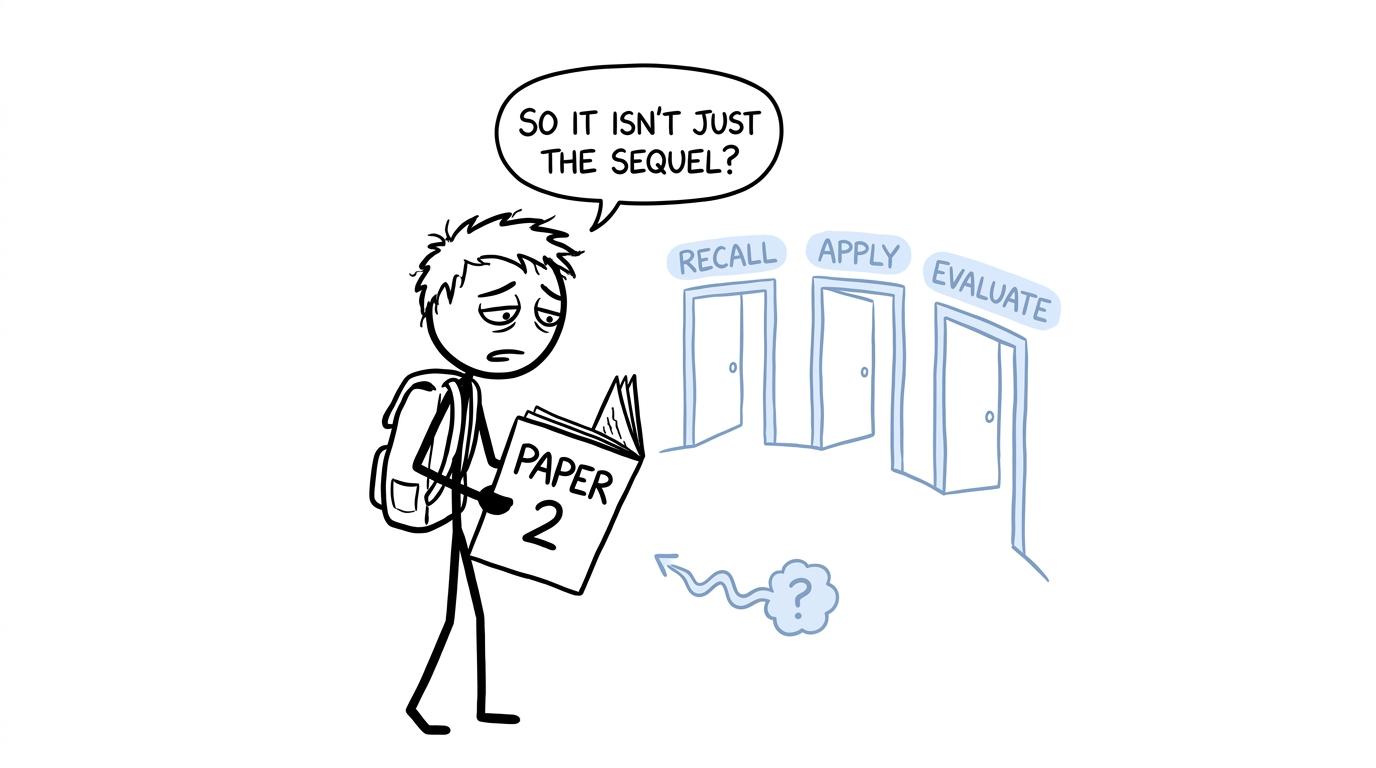 A student discovers that Paper 2 tests recall, application and evaluation
Your Paper 2 checklist
Before planning any revision, confirm these essentials:
- Your exam board: AQA, Pearson Edexcel or OCR.
- The exact Paper 2 topics on your specification.
- Whether you must answer every section or select optional sections.
- The duration and total marks shown by your board.
- The location and value of extended-response questions.
- Which research-method and maths skills could be assessed.
- Whether your teacher expects a particular structure for longer answers.
Do not revise from a generic topic list without checking your board. The title “Paper 2” hides three substantially different papers.
GCSE Psychology Paper 2 by exam board
The current specifications from AQA, Pearson Edexcel and OCR set out the following structures.
| Exam board | Time | Marks and weighting | Main Paper 2 content |
|---|---|---|---|
| AQA 8182/28182/28182/2 | 111 hour 454545 minutes | 100100100 marks; 50%50\%50% | Social influence; language, thought and communication; brain and neuropsychology; psychological problems |
| Pearson Edexcel 1PS0/021PS0/021PS0/02 | 111 hour 202020 minutes | 797979 marks; 45%45\%45% | Compulsory research methods plus two optional topics |
| OCR J203/02J203/02J203/02 | 111 hour 303030 minutes | 909090 marks; 50%50\%50% | Social influence; memory; sleep and dreaming; research methods |
These details should still be checked against your current specification and the instructions on the front of your question paper. Exam arrangements can be updated, and your school can confirm precisely which optional content it has taught.
AQA Paper 2
AQA Paper 2 is called Social Context and Behaviour. It contains four sections, each worth 252525 marks, covering:
- Social influence.
- Language, thought and communication.
- Brain and neuropsychology.
- Psychological problems.
You answer every question. Each section can contain multiple-choice questions, short answers and extended writing, so there is no safe topic to revise only as a collection of definitions.
Structurally, AQA Paper 2 resembles Paper 1: both last 111 hour 454545 minutes, carry 100100100 marks and contribute 50%50\%50% of the GCSE. What changes is the subject content. You are also expected to make connections across the course, and AQA includes a 999-mark synoptic question requiring knowledge to be drawn together.
Research methods is listed as a Paper 1 topic, but that does not make it irrelevant after Paper 1. Scenario-based or synoptic questions can still require you to understand how psychological research works.
Pearson Edexcel Paper 2
Edexcel Paper 2 differs most clearly from Paper 1. It lasts 111 hour 202020 minutes, carries 797979 marks and contributes 45%45\%45% of the qualification.
Section A is compulsory and examines research methods. It may include calculations, multiple-choice items, short-open answers, open responses and a 121212-mark extended response. It can also place research-method questions in contexts connected with compulsory Paper 1 topics.
Sections B to F cover five optional topics:
- Criminal psychology.
- The self.
- Perception.
- Sleep and dreaming.
- Language, thought and communication.
You answer two of these sections: the two your school has taught. This instruction matters. Attempting an unfamiliar third option wastes time and does not create extra credit.
Edexcel Paper 2 places particular emphasis on applying knowledge. That means a memorised definition is often only the beginning. You may need to use it in an unfamiliar study, explain what data show, identify a methodological weakness or justify an improvement.
OCR Paper 2
OCR Paper 2 is called Studies and Applications in Psychology 2. It lasts 111 hour 303030 minutes, carries 909090 marks and contributes 50%50\%50% of the qualification.
It covers:
- Social influence.
- Memory.
- Sleep and dreaming.
- Research methods.
You answer all questions. The paper contains short- and medium-tariff questions as well as one extended essay worth 131313 marks. That essay appears in Section C and is synoptic, so it asks you to connect ideas and reach a supported judgement rather than reproduce one isolated page of notes.
Research methods appears in both OCR papers. It should therefore remain part of your revision throughout the course, not be treated as a chapter that can be abandoned after one mock.
What question types does Paper 2 favour?
Although the exact balance varies, Paper 2 usually rewards four connected skills.
Precise knowledge
Questions using words such as identify, state, outline or describe need accurate psychological knowledge. Learn the specialist term, but also know what it means and how it relates to the relevant theory, study or process.
A vague answer may sound sensible while missing the feature named in the mark scheme. Precision matters more than decorative writing.
Application to a scenario
Application questions provide a person, group, investigation or everyday situation. Your job is to connect psychological knowledge to the details given.
A useful habit is to underline the detail that makes the scenario distinctive. Then use that detail explicitly. If your answer could have been written without reading the scenario, it probably has not applied enough knowledge.
Analysis and evaluation
Evaluation requires more than labelling a study “unrealistic” or a sample “small”. Explain why the issue matters. Does it reduce generalisability? Could it weaken validity? Does another piece of evidence support or challenge the conclusion?
Strong evaluation forms a chain: make the point, support or explain it, and connect it back to the claim being assessed.
Extended writing
Longer questions reward selection and organisation as well as memory. Read the command word, note every topic or study you have been told to include, and decide on your overall judgement before writing.
A brief plan can prevent an answer from becoming a list of facts. Paragraphs should contribute distinct knowledge, application or evaluation rather than repeat the same criticism in different language.
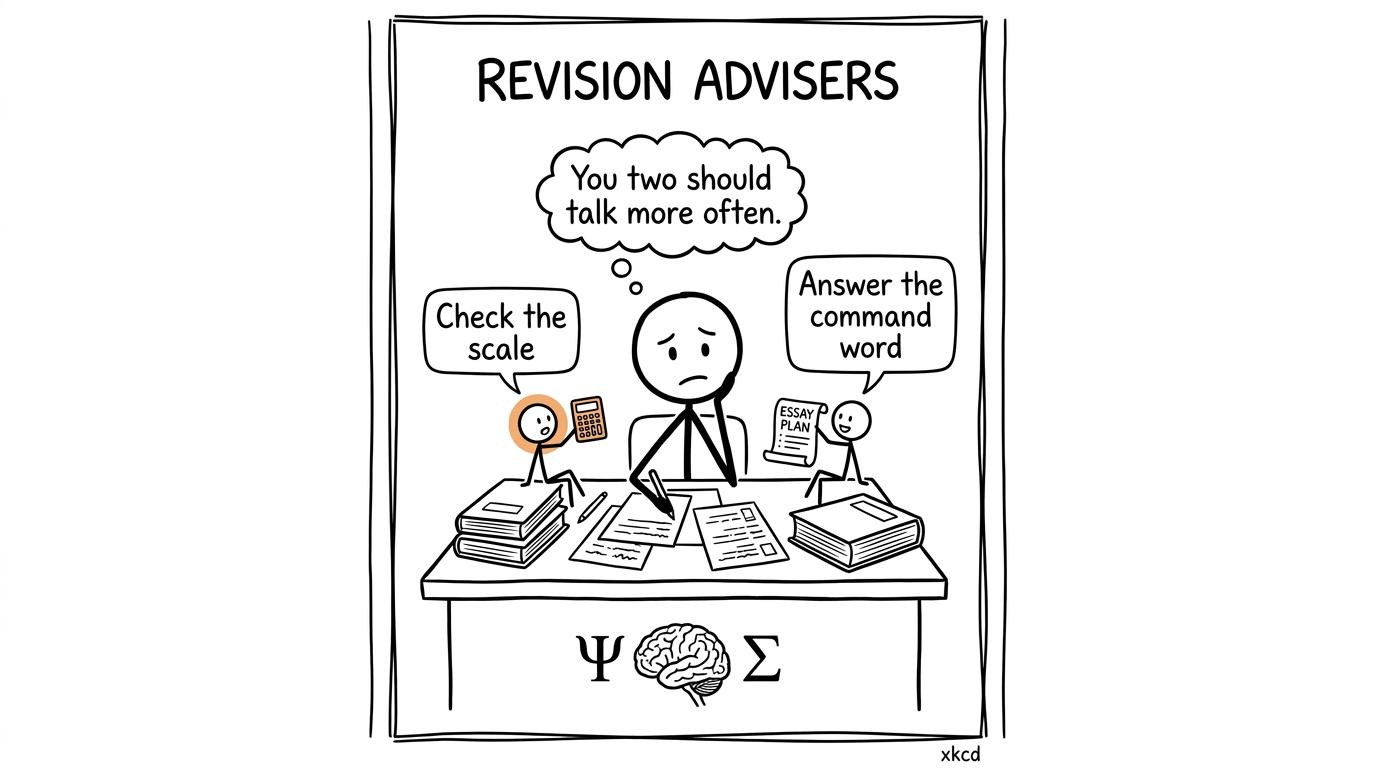 A calculator and an essay plan give revision advice
The maths you may meet in psychology
Psychology does not become a GCSE maths paper, but research methods can require confident handling of numerical information. Depending on the specification and question, you may need to interpret tables and graphs or work with averages, percentages, ratios and spread.
Useful relationships include:
mean=sum of scoresnumber of scores\text{mean}=\frac{\text{sum of scores}}{\text{number of scores}}mean=number of scoressum of scores percentage=partwhole×100\text{percentage}=\frac{\text{part}}{\text{whole}}\times 100percentage=wholepart×100 range=highest score−lowest score\text{range}=\text{highest score}-\text{lowest score}range=highest score−lowest scoreYou should also distinguish correlation from causation. A scatter diagram may show that two variables are related, but it does not by itself prove that one variable caused the other.
MathsGenie's OCR Psychology handling data guide reviews averages, range, frequency tables and common graphs in a psychological context. For additional numerical practice, use the averages from frequency tables revision guide and its active-recall averages flashcards.
The important habit is to show your working, read scales carefully and interpret the result in context. A correct calculation without a requested conclusion may not complete the question.
How to manage the time
All three papers allow roughly one minute per mark overall, but that is a guide rather than a command. Multiple-choice questions may take less time; extended responses need planning and checking.
Use three passes:
- First pass: answer accessible questions and collect secure marks.
- Second pass: return to questions requiring deeper thought or longer writing.
- Final pass: check calculations, missed pages, selected options and incomplete conclusions.
Do not let one short-answer question consume the time intended for an extended response. The number of marks indicates the likely depth. A 111-mark identification does not need a page; a 121212- or 131313-mark response does not need one unsupported sentence.
Practise this under realistic conditions. The principles in MathsGenie's guide to using GCSE past papers properly apply beyond maths: sit the paper, mark it honestly, diagnose lost marks and repair the underlying weakness.
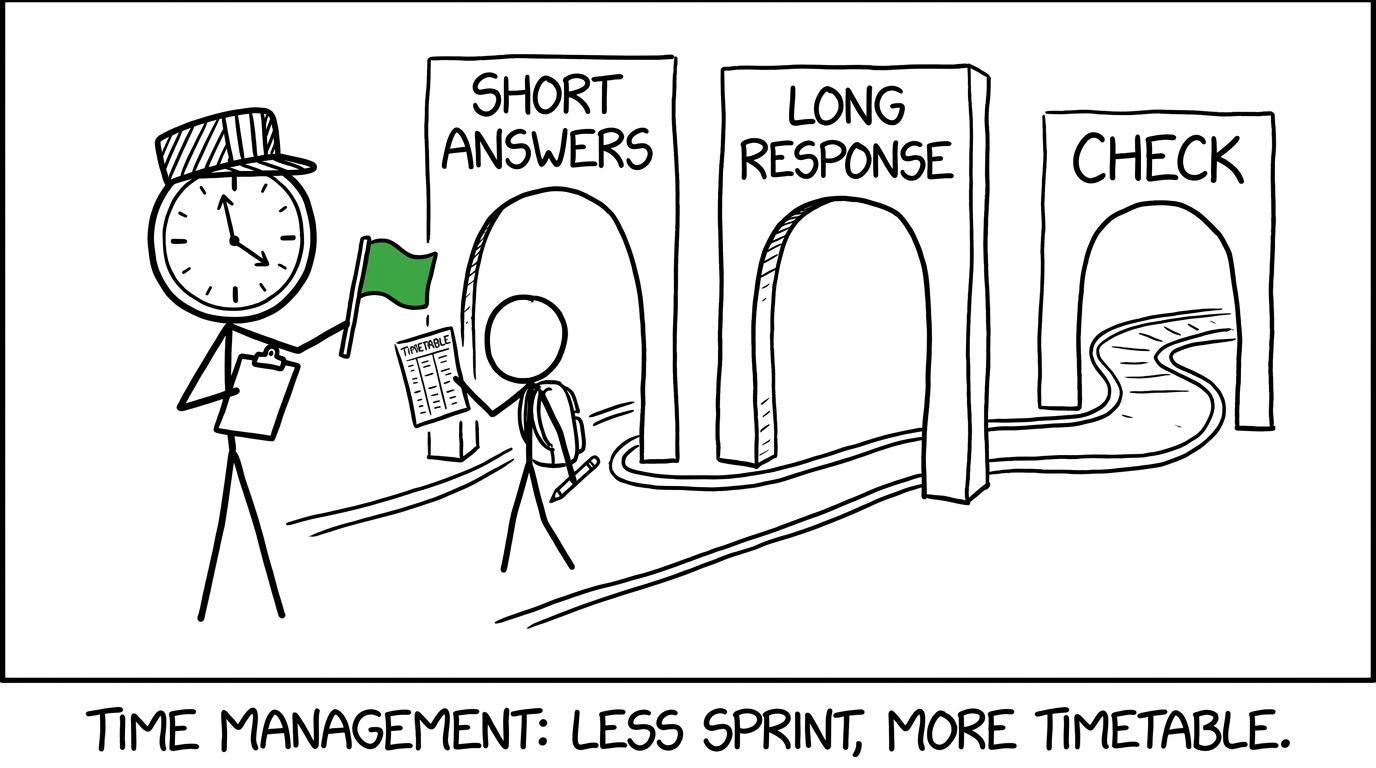 An exam clock guides a student through a calm timetable
A revision plan that matches the paper
Start by dividing your revision into four lanes:
- Content recall: theories, studies, definitions and findings.
- Application: unfamiliar scenarios and study descriptions.
- Evaluation: strengths, weaknesses and justified conclusions.
- Research methods: designs, variables, sampling, ethics and data.
After a timed paper, label each lost mark by cause: missing knowledge, weak application, incomplete evaluation, maths error, misread instruction or poor timing. This turns a disappointing total into a useful plan.
Do not immediately repeat the whole paper and mistake familiarity for improvement. First repair the weak area, then retest it. MathsGenie's advice on when to redo a past paper explains why a gap between attempts produces more honest evidence.
If you are balancing psychology with maths revision, keep the same cycle across both subjects: learn, practise, mark, fix and retest. MathsGenie's free GCSE and A Level revision hub provides topic lessons, practice questions and video support, while Edexcel GCSE maths predicted papers can help you rehearse maths separately under exam conditions.
Common mistakes on Paper 2
Revising the wrong specification
AQA, Edexcel and OCR do not place identical topics on Paper 2. Confirm your board and paper code before downloading resources.
Answering every Edexcel option
Edexcel candidates answer compulsory Section A and only the two optional sections they studied. Follow the paper instructions rather than treating every printed page as compulsory.
Writing generic application answers
Use details from the scenario. Naming a theory without connecting it to the person, behaviour or investigation usually limits the response.
Giving undeveloped evaluation
A criticism needs a consequence. Explain how the weakness affects validity, reliability, generalisability, ethics or the conclusion.
Ignoring research methods
Research methods is central to Edexcel Paper 2 and OCR assesses it in both papers. AQA students may also need it when questions draw together knowledge across the course.
Treating marks as a word-count target
Marks indicate depth, not an exact number of lines. Focus on relevant, developed material and leave enough time for the highest-tariff response.
Go into Paper 2 knowing its shape
An exam becomes less intimidating when it stops being mysterious. Paper 2 is not simply “the other half” of psychology: its content, timing and preferred questions depend on your board. AQA changes the topic set while keeping a parallel structure. OCR combines three Paper 2 topics with research methods and a synoptic essay. Edexcel creates a more distinctive paper built around compulsory research methods and two selected options.
Confirm your specification, practise the real question styles and let each marked paper tell you what to revise next. For the numerical skills that psychology can expose, make MathsGenie your free base for revision lessons, practice questions, mini tests and video solutions. Then carry the same disciplined process into your maths past papers, mark schemes and predicted papers: one paper, one correction and one stronger habit at a time.