GCSE Psychology Grade Boundaries Year to Year
GCSE psychology grade boundaries year to year explained with recent AQA data, typical shifts, reasons boundaries move and practical revision advice.
A grade boundary can feel like a finish line that someone moves while you are still running. You complete a past paper, compare your mark with last summer’s figures and wonder whether the same score will be enough this year.
The short answer is that GCSE psychology grade boundaries year to year do change, usually by a few marks, although larger movements are possible. In the latest published AQA data available before summer 202620262026 results, boundaries rose by around 101010 to 121212 marks between June 202420242024 and June 202520252025, depending on the grade. That was a noticeable shift, but it reflected differences in the assessments rather than a deliberate decision to make the qualification harder.
Grade boundaries are not targets fixed before the exam. They are set after the papers have been taken and marking is nearly complete. Your best strategy is therefore simple: understand the historical range, build a sensible safety margin and concentrate on earning marks.
GCSE psychology grade boundaries at a glance
Here is the essential checklist:
- A grade boundary is the minimum total mark required for a grade.
- Boundaries are normally confirmed after marking, not predicted in advance.
- A harder paper generally leads to lower boundaries; an easier paper generally leads to higher ones.
- Psychology boundaries differ by exam board and specification.
- AQA GCSE Psychology has two papers worth 100100100 marks each, producing a total of 200200200 marks.
- Unlike GCSE maths, AQA GCSE Psychology does not have foundation and higher tiers.
- Previous boundaries are useful reference points, but they cannot guarantee your future grade.
- Revising to sit just above one old boundary is risky. Aim to create a margin.
Students preparing for several subjects can use the GCSE Maths Revision hub to keep their maths preparation separate from psychology while following the same evidence-based habit: practise, mark, diagnose and retest.
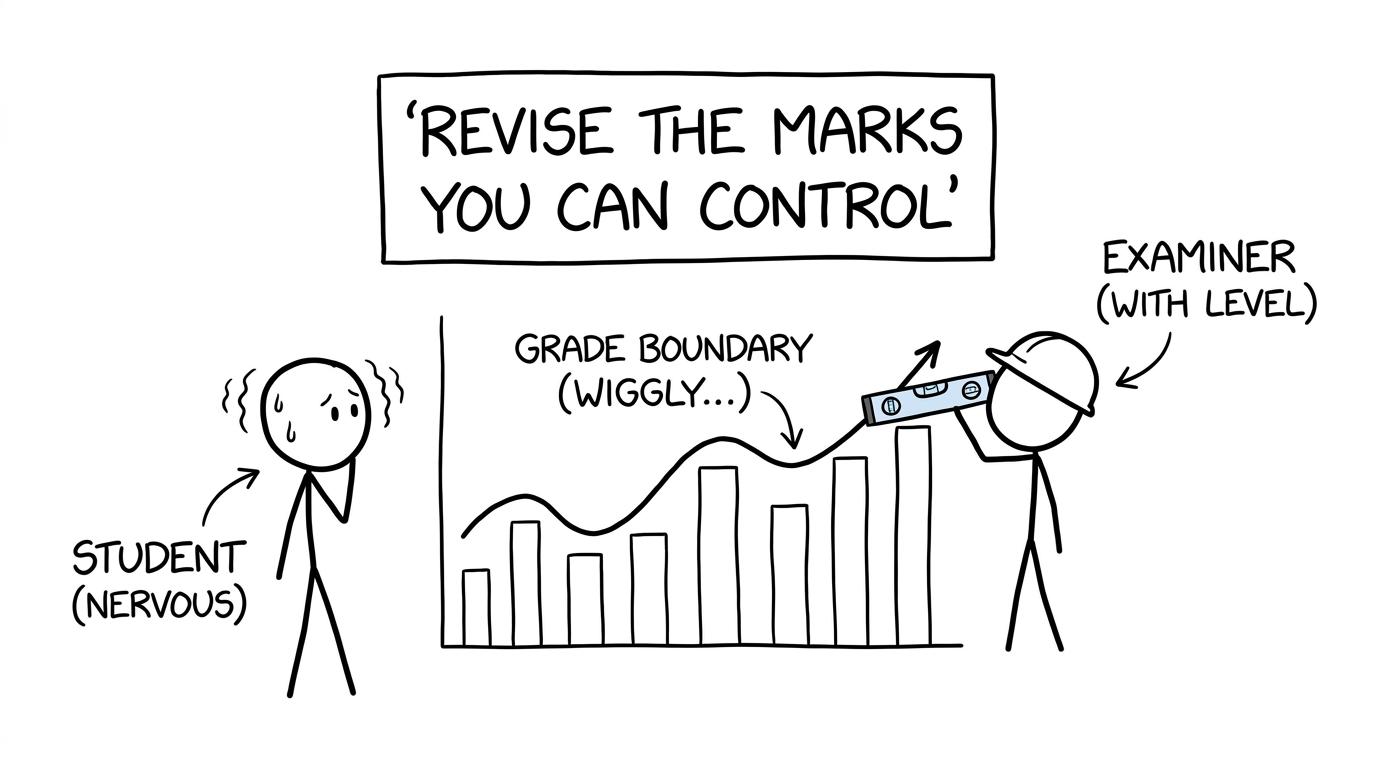 A student watches a grade boundary move while focusing on controllable revision
How much have AQA Psychology boundaries moved?
The table below uses AQA’s confirmed subject boundaries for specification 818281828182. It shows selected grades from the four most recent complete summer series available at the time of writing. Each boundary is out of 200200200 marks.
| Exam series | Grade 999 | Grade 777 | Grade 555 | Grade 444 |
|---|---|---|---|---|
| June 202220222022 | 159159159 | 132132132 | 969696 | 797979 |
| June 202320232023 | 161161161 | 135135135 | 979797 | 787878 |
| June 202420242024 | 158158158 | 130130130 | 929292 | 747474 |
| June 202520252025 | 170170170 | 142142142 | 103103103 | 848484 |
The pattern is more useful than any single figure.
Between 202220222022 and 202320232023, the selected boundaries changed by between 111 and 333 marks. In 202420242024, they fell by between 333 and 555 marks. Between 202420242024 and 202520252025, however, they increased by between 101010 and 121212 marks.
Across the whole four-year period, the range was:
- 121212 marks at grade 999
- 121212 marks at grade 777
- 111111 marks at grade 555
- 101010 marks at grade 444
Because the qualification is out of 200200200, a 121212-mark range is equivalent to:
12200×100=6%\frac{12}{200}\times 100 = 6\%20012×100=6%So do boundaries change much? Most annual movements in this short sequence were modest, but the 202520252025 increase shows why you should not assume that next year’s threshold will sit within one or two marks of the previous one.
This is also why historical boundary analysis must be done carefully. Maths students can see the same principle across a longer period in the GCSE Maths Grade Boundaries History: raw marks move, while the awarding process aims to preserve the standard represented by each grade.
Why GCSE Psychology grade boundaries change
Paper difficulty is the main reason
Every summer’s papers contain new questions. Exam boards work to maintain a consistent level of demand, but they cannot know exactly how students will respond until the papers have been sat and marked.
If a paper proves easier, students tend to gain more raw marks. The boundary may then rise so that the quality of work required for a grade remains comparable with earlier years. If the paper proves harder, the boundary may fall.
This creates a counter-intuitive result: a higher boundary does not necessarily mean it was harder to earn the grade. It often indicates that students found the assessment more accessible.
Statistical evidence and examiner judgement are combined
Ofqual’s published guidance explains that exam boards consider evidence about the cohort and how the assessment performed. Senior examiners then examine work around provisional boundaries and compare its quality with work awarded the same grades previously.
The final decision is not made by applying one automatic percentage. Nor is it based only on whether students describe a paper as easy or difficult online.
The purpose is consistency of standards. A grade 777 should represent comparable attainment from one year to the next, even if the raw mark needed to reach it changes.
There is no quota for each grade
A common worry is that only a fixed number of students are allowed to receive each grade. Ofqual states that there are no quotas limiting how many grades can be awarded.
National results may still remain broadly stable because awarding considers evidence about the cohort and previous standards. That is different from deciding in advance that a set number of students must pass or fail. Your individual result depends on your marks and where they fall against the final boundaries for your qualification.
Different specifications require different comparisons
AQA and Pearson Edexcel publish their own GCSE Psychology boundaries. Their papers, mark totals and specifications are not interchangeable.
Always check:
- the exam board;
- the specification code;
- the exam series;
- whether the figure is a subject boundary or a notional paper boundary; and
- the maximum available mark.
A raw mark only becomes meaningful when placed over the correct total. If a boundary is bbb and the maximum mark is mmm, its percentage equivalent is:
Boundary percentage=bm×100\text{Boundary percentage}=\frac{b}{m}\times 100Boundary percentage=mb×100Do not compare raw marks from qualifications with different totals. The same warning applies in maths: OCR GCSE Maths grade boundaries should not be compared directly with another board’s raw marks without accounting for the maximum mark and assessment structure.
Subject boundaries matter more than paper boundaries
For AQA GCSE Psychology, Paper 111 and Paper 222 each contribute 100100100 marks. The final grade is based on the combined total:
Qualification mark=Paper 1 mark+Paper 2 mark\text{Qualification mark}=\text{Paper 1 mark}+\text{Paper 2 mark}Qualification mark=Paper 1 mark+Paper 2 markExam boards may publish notional component boundaries for individual papers. These can help teachers understand performance, but they do not usually determine the qualification grade independently. One weaker paper can therefore be balanced by stronger performance on the other.
This matters psychologically as well as mathematically. Leaving an exam convinced that one paper went badly does not tell you your final grade. There is still another set of marks contributing to the total.
How to use old boundaries without misleading yourself
Historical boundaries are useful for interpreting a completed past paper. They are less useful as a prediction of precisely what will happen next summer.
Use this process:
- Complete both papers from the same exam series.
- Mark them using the official mark schemes.
- Add the two marks.
- Compare the total with the subject boundaries for that exact series.
- Record the grade as a historical indication, not a guaranteed forecast.
- Identify where marks were lost and practise those skills again.
The important part comes after calculating the grade. A past paper tells you where your current weaknesses are. Revision begins when you repair them. MathsGenie’s guide to using GCSE past papers properly explains how to turn a paper into an error log and a focused revision plan.
Build a safety margin rather than predicting one mark
Suppose an old boundary sits close to your current result. The wrong response is to decide that you need exactly one additional mark. Boundaries move, marking judgements can expose weaknesses in extended answers, and performance varies between papers.
Instead, aim for a range comfortably above recent boundaries. This is not an official predicted boundary. It is simply prudent planning.
Track separate sources of lost marks, such as:
- missing psychological knowledge;
- weak application to an unfamiliar scenario;
- limited evaluation;
- imprecise research-methods terminology;
- incorrect interpretation of data; and
- incomplete responses to command words.
The same diagnostic method works across your timetable. The MathsGenie weakest-topics guide shows how to classify lost marks and prioritise the areas that offer the greatest return.
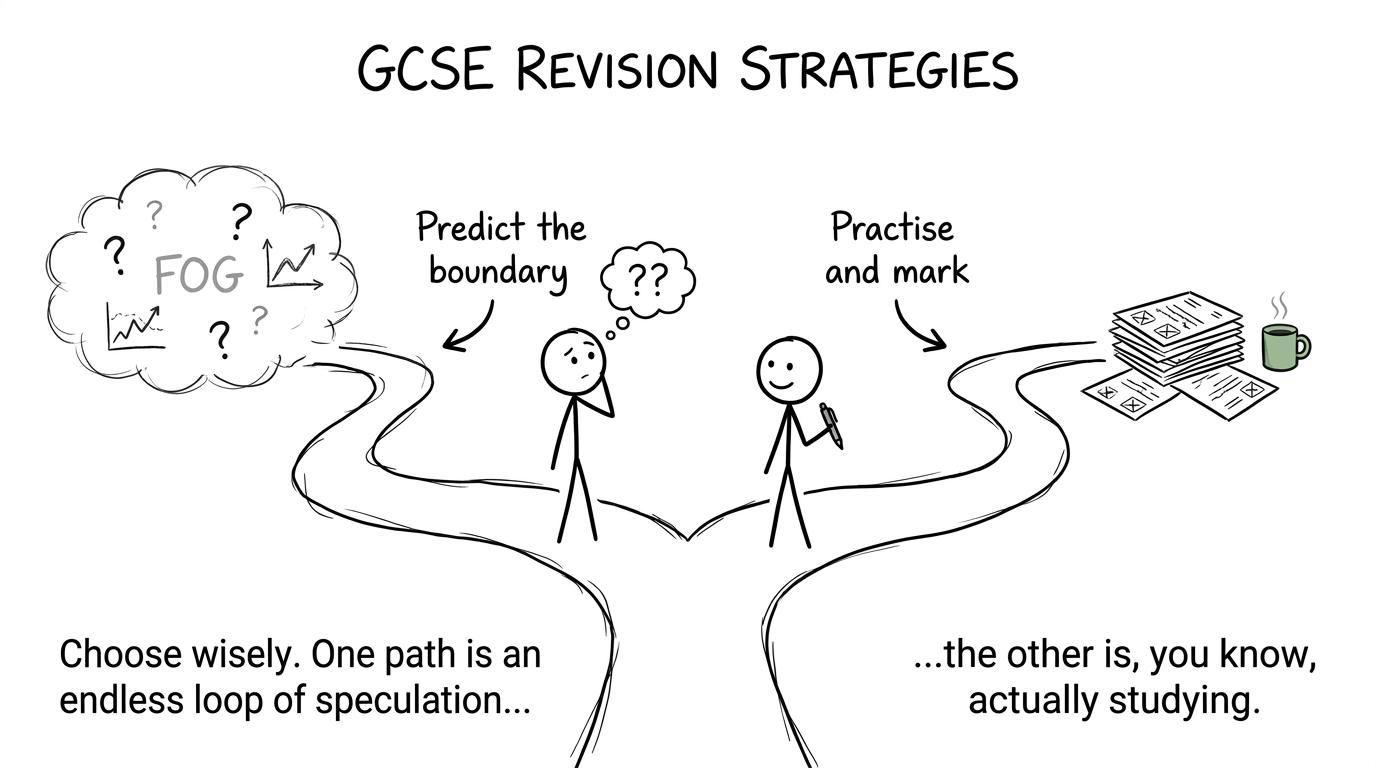 Two revision paths show that practising and marking is safer than predicting boundaries
What this means for students also revising maths
Psychology and maths assess different knowledge, but the boundary lesson is identical: do not build your plan around an unofficial prediction.
For maths, make sure you use the correct Edexcel, AQA, OCR or Eduqas papers and the correct foundation or higher tier. For psychology, confirm your own board and specification rather than borrowing figures from another qualification.
Then use a repeatable cycle:
- learn or review one weak area;
- answer exam-style questions;
- mark them strictly;
- record why marks were lost;
- revisit the weakness; and
- retest it under time pressure.
Short tests can make that process manageable. Maths students can use Edexcel GCSE Maths Mini Tests before progressing to full papers. Nearer the exam, Edexcel GCSE Maths Predicted Papers can provide unfamiliar practice, but they should never be treated as a promise about exact questions or boundaries.
Common mistakes when reading grade boundaries
Treating one year as a permanent pass mark
There is no fixed percentage that always produces a grade 444, 555, 777 or 999. Boundaries are set for a particular specification and exam series.
Comparing the wrong exam boards
A boundary from AQA cannot be applied to an Edexcel paper. Check the board and specification code before interpreting your mark.
Using one paper to estimate the final grade
The AQA Psychology grade is based on the combined mark across both papers. A notional boundary for one component is not a separate final grade.
Assuming a higher boundary means harsher grading
A higher raw-mark boundary commonly reflects a more accessible assessment. The awarding process is intended to keep the quality of work represented by a grade comparable.
Revising only until you scrape an old boundary
A result one mark above a previous threshold offers little protection against normal variation in paper difficulty or your own performance. Build stronger knowledge and a reasonable marks margin instead.
Trusting unofficial predictions
Final boundaries cannot be known before the awarding process is complete. Online estimates may be interesting, but they are not confirmed figures from the exam board.
Focus on the marks that are still available
The useful conclusion is not that boundaries are unpredictable. It is that they are outside your control.
Recent AQA GCSE Psychology data shows mostly small annual movements followed by a more substantial rise in 202520252025. That is enough variation to make precise boundary prediction a poor revision strategy. It is not a reason to panic. The system adjusts raw-mark thresholds because papers differ, while aiming to preserve the meaning of each grade.
Your job is narrower and more practical: know the specification, practise complete papers, mark honestly and turn every dropped mark into a revision decision.
For your maths preparation, start with the free MathsGenie GCSE revision resources. Use revision lessons and practice questions to repair weak topics, mini tests to check recall, and past papers or predicted papers to develop exam technique. Mark schemes, video solutions and the revision planner then help you decide what to do next.
You cannot choose next summer’s boundary. You can keep moving your own mark further away from it.