GCSE Physics Revision Environment: Does It Matter?
GCSE physics revision environment advice that separates useful changes from hype, helping you focus, practise effectively and remember more for exams.
A desk can look perfect and still be a terrible place to learn. The pens are lined up, the lamp is warm, and the notes have somehow acquired six different highlighter colours. Yet forty minutes later, no questions have been answered.
So, does your GCSE physics revision environment genuinely matter? Yes, but not because one special room makes knowledge stick. It matters when it protects your attention, reduces the effort needed to begin and helps you practise effectively. A modest kitchen table with your phone elsewhere can outperform an immaculate bedroom desk surrounded by distractions.
The environment supports the work. It cannot replace the work.
The short answer: what actually matters
A useful revision space should help you:
- begin without spending ages arranging everything;
- concentrate without frequent interruptions;
- retrieve knowledge rather than merely reread it;
- complete calculations on paper;
- mark answers and record mistakes;
- return regularly enough for spaced practice;
- occasionally work under quiet, timed, exam-like conditions.
You do not need silence, expensive equipment or a dedicated study. You need a place where the right actions are easier than the distracting ones.
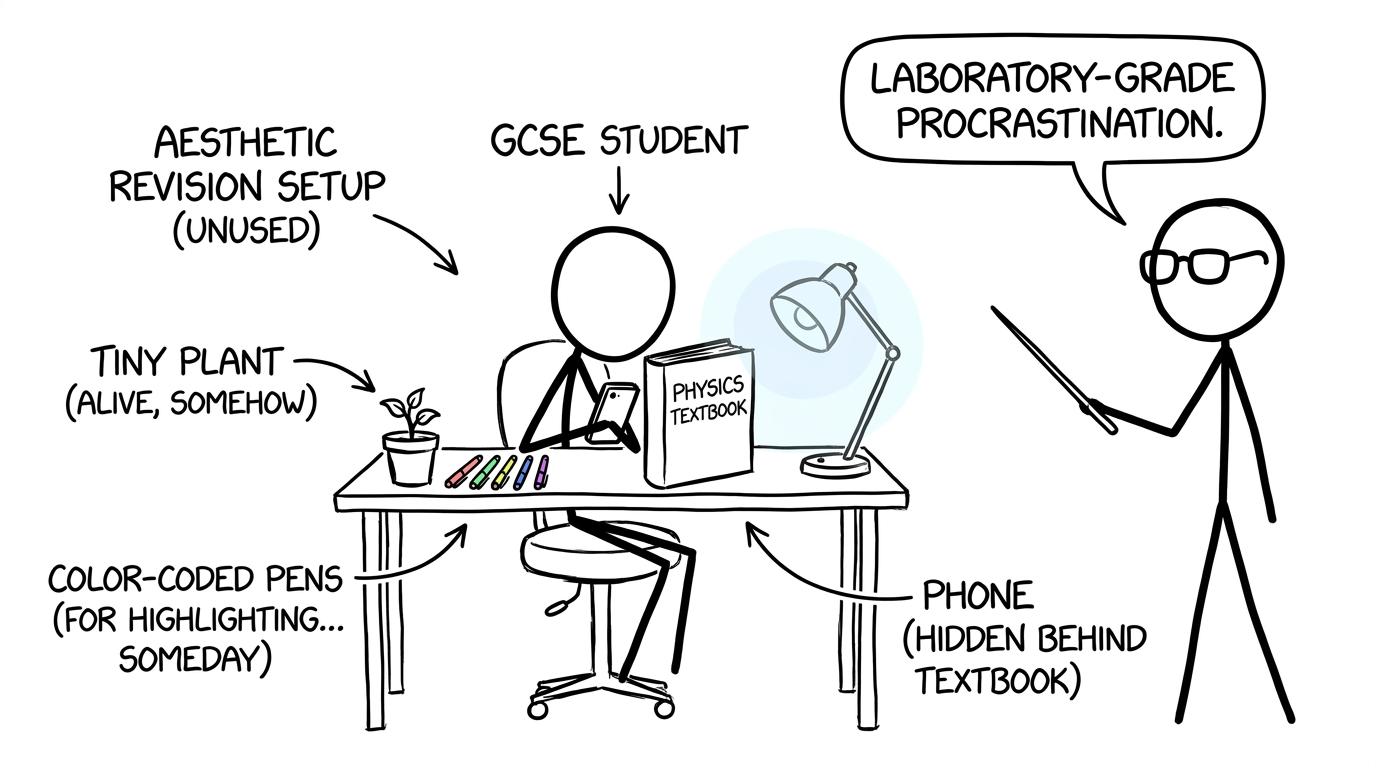 A perfect revision desk hiding laboratory-grade procrastination
Why your GCSE physics revision environment matters
Attention is part of the learning process
Physics revision asks your working memory to hold several things at once: the quantities in a question, their units, the relevant physical relationship and the algebra needed to rearrange it. An interruption can break that chain.
Recent research supports the basic idea that active mobile-phone distraction harms immediate recall. A 202420242024 meta-analysis combined 272727 controlled experiments involving young adults and found a negative effect from mobile distractions. GCSE students are not identical to university-age participants, so the result should not be stretched too far. Still, it supports a sensible conclusion: texting, scrolling and responding to notifications while learning are not harmless background activities.
Evidence about whole-school phone bans is more mixed. That distinction matters. A policy applied to every student is not the same as choosing to put your own phone outside the room for a focused revision session.
You do not need to fear the device. Just give it a job. Use it for a timer or video solution when necessary, then remove it from reach before answering questions.
A good space lowers the friction of starting
Motivation is unreliable. Friction is more manageable.
If every session begins by finding a calculator, clearing laundry, locating the correct paper and deciding what to revise, much of your energy disappears before the first question. A prepared folder, a pen, a calculator and one written task can make starting almost automatic.
That is why the environment matters even when it has no direct effect on memory. It shapes behaviour. MathsGenie's guide to GCSE Physics revision without wasting time uses a simple cycle: attempt, mark, fix and reattempt. Your space should make that cycle easy to follow.
The method matters more than the room
A silent library cannot rescue passive revision. A student can spend an hour copying notes beautifully and retrieve almost none of them tomorrow.
By contrast, a less-than-perfect room can still support strong learning if the student closes the notes, answers questions from memory, checks the answers and returns to mistakes later. Retrieval practice and spacing have a stronger educational purpose than creating an aesthetic workspace.
The practical order is therefore:
- choose an effective revision task;
- remove the distractions most likely to interrupt it;
- organise the minimum equipment needed;
- test whether the routine produces better answers.
If you are unsure how to make notes active, use MathsGenie's method for turning GCSE Physics notes into active recall.
Build a revision space that helps knowledge stick
Put the phone beyond automatic reach
Turning a phone face down is helpful only if you do not turn it face up again thirty seconds later. A drawer, another room or an agreed place with a parent creates a physical pause between impulse and action.
If you need the phone for a video, watch the chosen explanation, write down the next task and put the phone away before practising. Avoid opening a revision video and then allowing an algorithm to choose the rest of your evening.
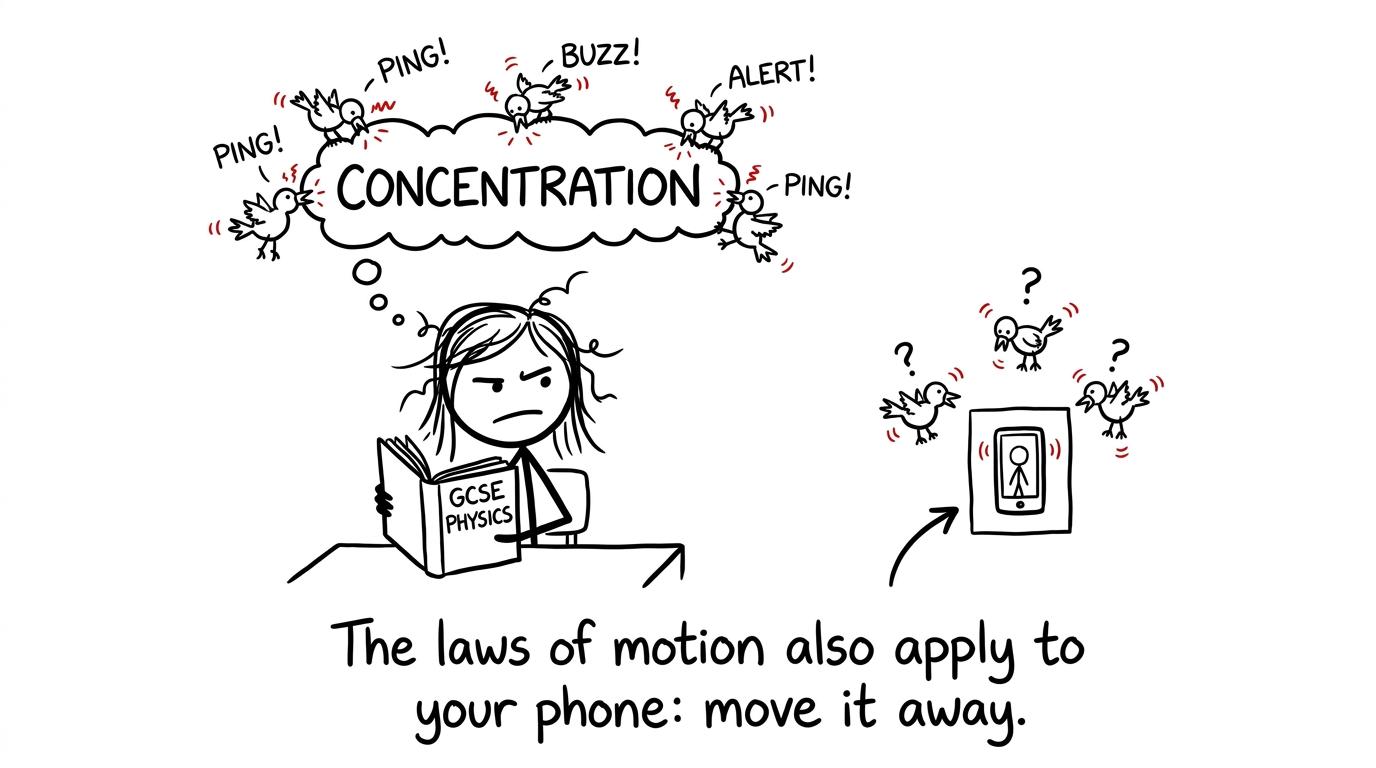 Phone notifications discover that distance is a useful revision force
Match sound to the task
There is no universal rule that music always ruins revision. The effect depends on the person, the sound and the task. Lyrics are more likely to compete with reading or writing because both require language processing. Familiar instrumental music may feel less intrusive, but feeling focused is not the same as learning successfully.
Test it honestly. Answer one comparable set in silence and another with your normal music. Compare concentration, accuracy and how much you can explain later without notes. Keep the condition that produces better work, not simply the one that feels more pleasant.
For a timed Physics paper, quiet conditions are usually the more realistic rehearsal. Learning to sit with silence is also a useful exam skill.
Keep only the next task visible
A pile containing every topic can turn revision into a reminder of everything you do not know. Narrow the field.
Place one topic, one question set and the relevant mark scheme on the desk. Write a precise target such as “complete the electricity calculation questions and correct every unit error”. That is more actionable than “revise Physics”.
If choosing the topic is the problem, follow MathsGenie's process for finding your weakest GCSE Physics topics. Diagnosis prevents the comfortable habit of revising only what you already know.
Make marking part of the setup
A question without feedback is unfinished. Keep the mark scheme available but closed while you attempt the task. Afterwards, mark strictly and classify each lost mark as:
- a Physics knowledge gap;
- a maths-method gap;
- an exam-technique error;
- a unit, rounding or reading mistake.
The detailed guide to using AQA GCSE Physics past papers properly shows how to turn paper practice into targeted improvement. The same attempt-and-review principle applies to Edexcel, OCR and Eduqas, although you must use material matching your own specification.
Match the environment to the revision task
There is no single best place because different tasks need different conditions.
Learning or revisiting a concept
A video lesson can work at a desk where you can pause, sketch a diagram and write questions. Do not watch from bed if that reliably turns an active task into passive viewing. After the explanation, close it and reconstruct the key idea without help.
Practising calculations
Physics calculations deserve a proper writing surface. You need room to show the equation, rearrangement, substitution and unit. Familiar relationships such as
V=IR V = IR V=IRor
v=fλ v = f\lambda v=fλstill demand mathematical fluency. Being given an equation does not mean you automatically know which quantities to use or how to change its subject.
For the 202620262026 and 202720272027 exam series, full equation sheets are provided for GCSE Physics and the physics components of Combined Science. Students should nevertheless check the current instructions for their exam board and qualification. The sheet reduces memorisation demands, but it does not remove the need to interpret equations, convert units and calculate accurately.
MathsGenie is particularly useful when the obstacle is mathematical rather than physical. Students who are hovering around a pass can use this GCSE Physics pass-grade revision strategy to prioritise rearranging formulae, standard form, proportional reasoning and graph skills.
Completing timed papers
Timed work should gradually resemble the exam: a clear desk, permitted equipment, no hints, no phone and the correct time limit. This does not mean every revision session must feel like an examination. Early practice should be supportive; later practice should test performance.
MathsGenie's advice on when to start GCSE past papers explains how to move from topic questions to timed sections and complete papers. Near the exam, the GCSE Physics exam-week checklist can help you keep the final days calm and focused.
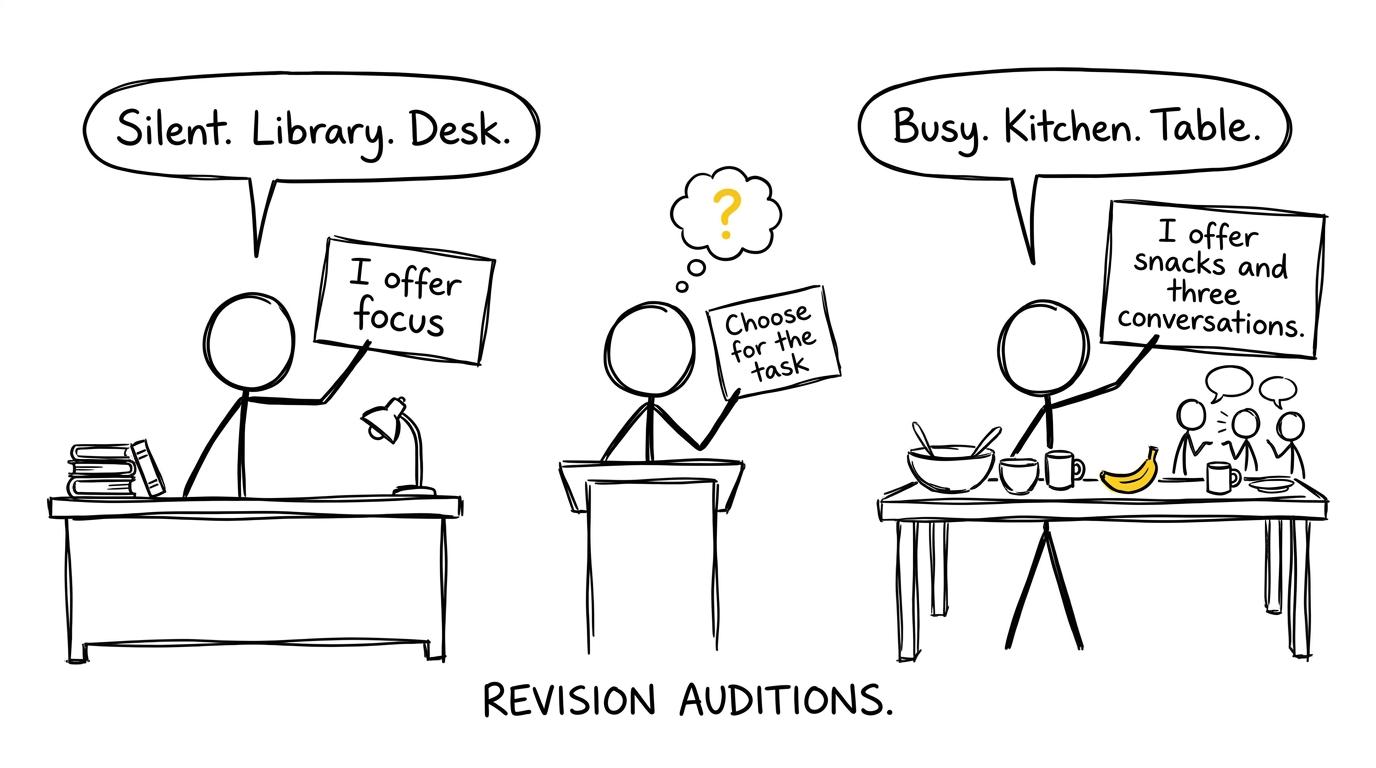 A library desk and kitchen table audition for the role of revision space
What if you cannot find a quiet place?
Advice about ideal study spaces can sound detached from real life. Bedrooms are shared. Kitchens are busy. Libraries close. Some students care for siblings or travel between homes.
Work with the environment you have rather than treating perfection as an entry requirement.
- Agree a short interruption-free window with people at home.
- Use a school library, homework club or classroom when available.
- Keep resources in one portable folder or bag.
- Download the exact materials you need before leaving Wi-Fi.
- Use headphones or simple ear protection if background noise is unavoidable.
- Split revision into shorter, clearly defined tasks when long quiet periods are unrealistic.
Consistency can compensate for glamour. The familiar routine of opening the folder, attempting questions and marking them may become a cue to begin, wherever the desk happens to be.
Run your own revision-environment test
Rather than accepting generic advice, compare two realistic setups over several sessions. Keep the topic difficulty and session length broadly similar. Then record:
- how quickly you started;
- how often you switched tasks;
- how many questions you attempted;
- which errors appeared;
- what you could recall the next day;
- whether you completed the marking.
Do not judge the environment only by how productive it felt. Judge it by visible evidence. A demanding session can feel uncomfortable precisely because retrieval is harder than rereading.
For students balancing Physics with maths preparation, a sustainable GCSE maths revision timetable can prevent one subject from consuming every available evening.
Common revision-environment mistakes
Improving the desk instead of revising
Tidying can be useful, but it can also become respectable procrastination. Set up only what the next task requires, then begin.
Keeping every resource open
Multiple tabs, textbooks and videos create choices. Choose one source for explanation, one question set and one mark scheme.
Revising in comfort without testing recall
Comfort helps you return, but learning still requires effort. Close the notes and retrieve the idea before checking.
Using breaks as an invitation to scroll
A short break can become an unplanned disappearance. Stand up, drink water or move around, then return at a predetermined time.
Copying another student's perfect routine
The best environment is not the one that photographs well. It is the one you can access consistently and in which your answers improve.
Your environment should make good revision easier
Where you revise matters, but it is not destiny. The room influences attention, interruptions and the ease of beginning. What makes Physics stick is what happens inside that room: retrieval, calculations, exam questions, honest marking and repeated correction.
Start small. Clear enough space to write. Put the phone elsewhere. Choose one exact task. Then use MathsGenie's free revision support to identify weak areas, strengthen the maths behind Physics and practise under realistic conditions. Combine revision lessons and practice questions with past papers, mark schemes, video solutions, mini tests and carefully chosen predicted papers.
The perfect desk is optional. The next honest attempt is not.