GCSE Physics Revision Without Wasting Time
GCSE Physics revision without wasting time: use maths-first methods, past papers, mark schemes and targeted practice to boost grades fast.
GCSE Physics revision has a sneaky way of stealing time. You sit down with the best intentions, read a page on forces, highlight a few lines, maybe copy a definition, and an hour disappears. It feels like work, so your brain gives you credit for it. But in the exam hall, the mark scheme doesn’t reward effort; it rewards answers. If you’re a GCSE student who’s also revising maths, you already have an unfair advantage: Physics is mostly maths with a story attached. The fastest route to better grades is to revise like the exam marks, not like the textbook.
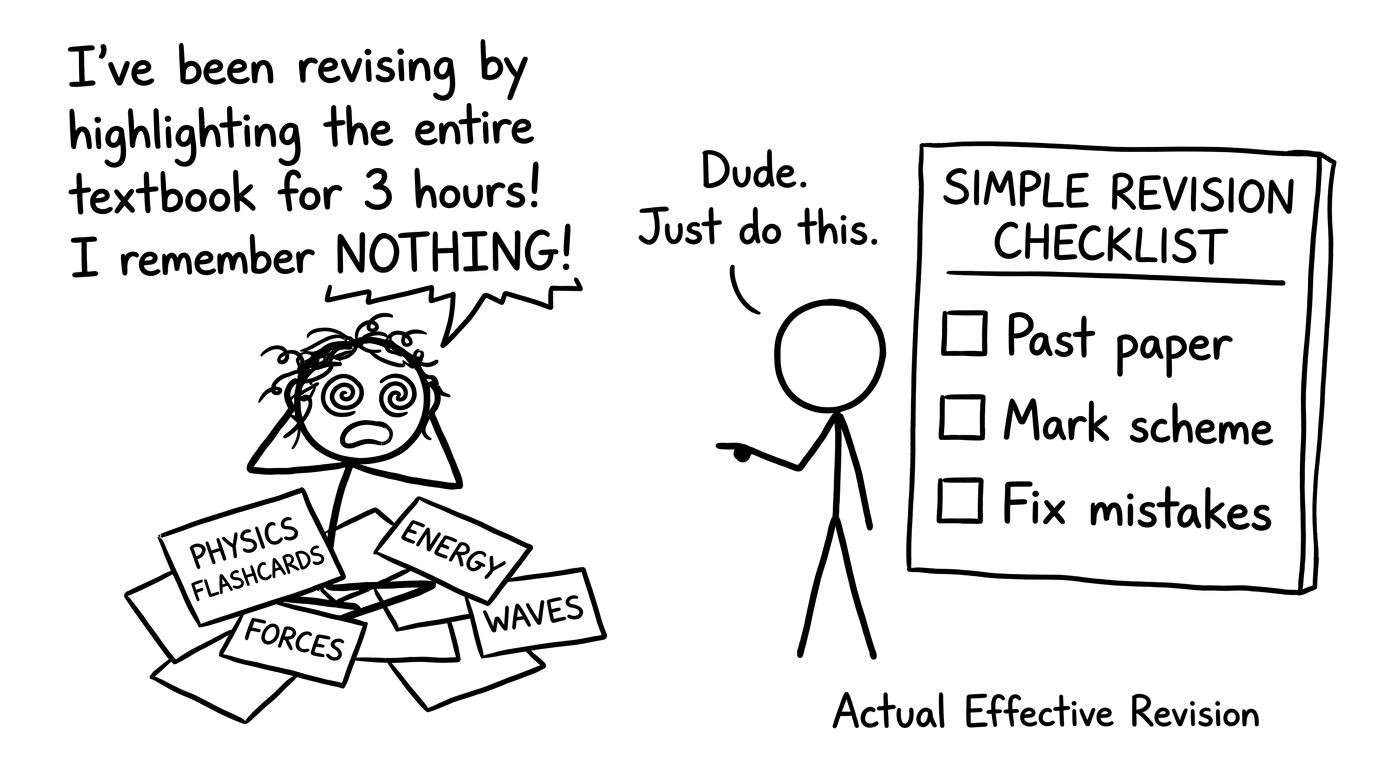 A student discovers the simplest revision loop
The no-waste GCSE Physics revision checklist
If you want a simple rule: revise what the exam will ask you to do, not what the topic can contain.
Here’s the high-impact checklist:
- Start with exam questions and identify your weak spots quickly.
- Use the mark scheme to learn what counts as a valid explanation.
- Build a short list of “repeat offenders” (units, rearranging formulae, graphs, standard form).
- Practise the maths skills that sit underneath most Physics marks.
- Cycle: attempt -> mark -> fix -> reattempt.
For the maths side of that cycle, YesGenie is built for speed: revision lessons, practice questions, mini tests, and past papers with solutions. Keep these open as your “maths support layer” while you do Physics:
- GCSE Maths Revision
- Edexcel GCSE Maths Predicted Papers
- Edexcel GCSE Maths Mini Tests
- GCSE Past Papers Hub
- Edexcel GCSE Maths Revision Guides
- AQA GCSE Maths Lessons
- Resources (Predicted Papers + Mini Tests)
Why GCSE Physics revision wastes time (and how to stop it)
The trap: revision that feels productive
Most time-wasting revision has one thing in common: it’s low feedback. Reading notes, rewriting pages, watching videos without pausing; they don’t force you to find out what you can’t yet do.
In GCSE Physics, “what you can’t yet do” usually shows up in three places:
- You can’t choose the right equation.
- You can’t rearrange it accurately.
- You lose marks to units, powers of ten, or rounding.
That’s why the fastest revision is question-first. You want your mistakes to appear quickly, like a torch beam in a dark room.
The fix: make every session produce a list
At the end of a 40-minute GCSE Physics revision session, you should have at least one of these:
- A corrected worked solution you can reattempt tomorrow.
- A small “error log” rule (e.g. “Convert $ $\text{cm}^2
by dividing by $10{,}000$”).
- A micro-skill to practise in maths (e.g. standard form, ratio, gradients).
When revision produces nothing concrete, it’s almost always wasting time.
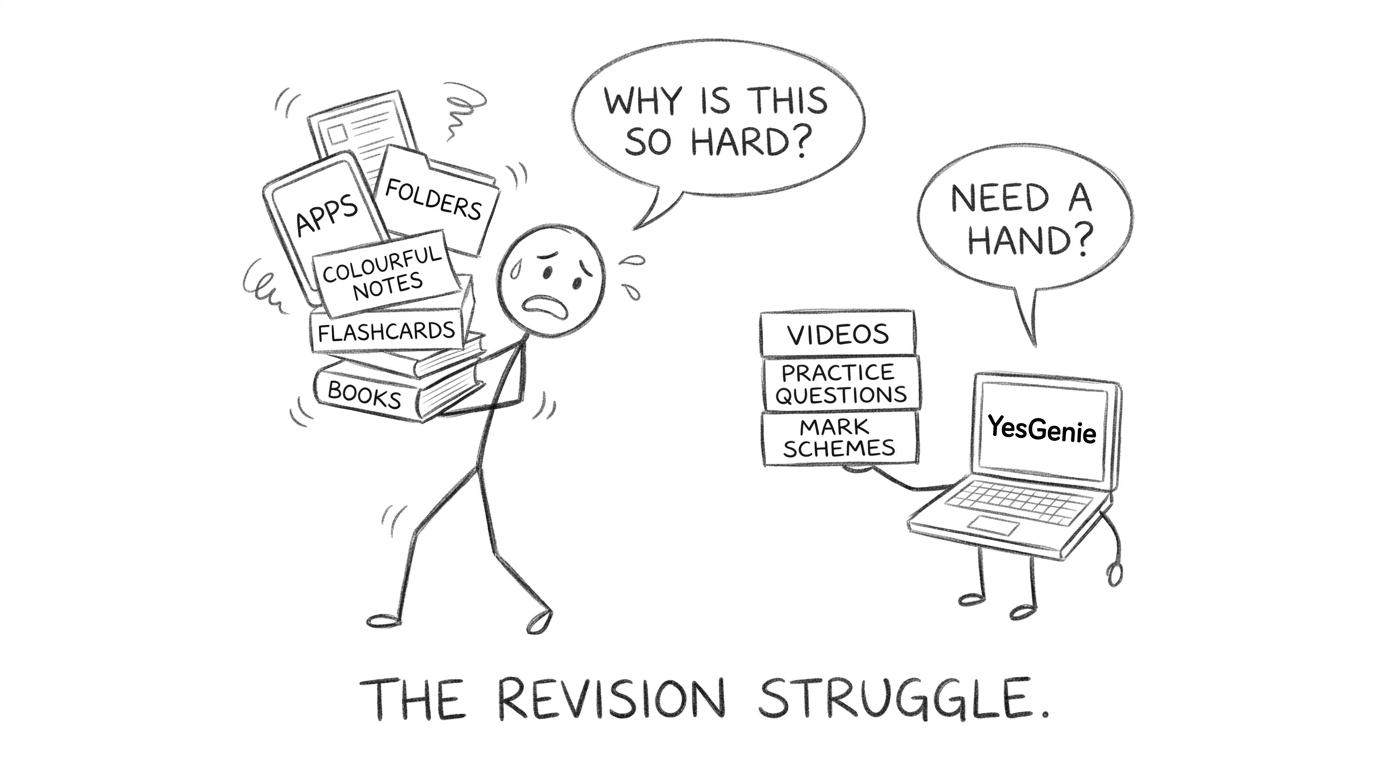 Too many resources, not enough marks
The maths-first strategy for GCSE Physics
GCSE Physics is split across exam boards (AQA, Edexcel, OCR, Eduqas), but the maths skeleton is familiar. If you strengthen the skeleton, the topic knowledge sits more neatly on top.
Rearranging formulae (the core speed skill)
A huge chunk of GCSE Physics marks are “substitute and solve”. The time-waster is hesitating during rearrangement.
Worked example (rearranging and substituting):
A car travels at speed vvv for time ttt, covering distance sss.
s=vt s = vt s=vtIf s=1500 ms = 1500\text{ m}s=1500 m and t=75 st = 75\text{ s}t=75 s, find vvv.
Rearrange:
v=st v = \frac{s}{t} v=tsSubstitute:
v=150075=20 v = \frac{1500}{75} = 20 v=751500=20So v=20 m s−1v = 20\text{ m s}^{-1}v=20 m s−1.
The Physics is simple; the mark is usually lost when students rush the rearrangement or the units. If rearranging feels slow, practise the same skill in maths with changing the subject of a formula.
Use YesGenie to drill that exact skill in a maths context:
Standard form and prefixes (the silent mark thief)
Physics loves powers of ten. GCSE questions often hide difficulty inside unit prefixes.
Worked example (prefix conversion):
Convert 3.6 km3.6\text{ km}3.6 km to metres.
Since 1 km=1000 m1\text{ km} = 1000\text{ m}1 km=1000 m,
3.6 km=3.6×1000 m=3600 m=3.6×10³ m. 3.6\text{ km} = 3.6 \times 1000\text{ m} = 3600\text{ m} = 3.6 \times 10^3\text{ m}. 3.6 km=3.6×1000 m=3600 m=3.6×10³ m.Convert 45 mA45\text{ mA}45 mA to amperes.
Since 1 mA=10−3 A1\text{ mA} = 10^{-3}\text{ A}1 mA=10−3 A,
45 mA=45×10−3 A=0.045 A=4.5×10⁻² A. 45\text{ mA} = 45 \times 10^{-3}\text{ A} = 0.045\text{ A} = 4.5 \times 10^{-2}\text{ A}. 45 mA=45×10−3 A=0.045 A=4.5×10⁻² A.This is where GCSE Physics revision becomes efficient: you practise one conversion skill and it pays back across electricity, waves, and required practicals.
For the maths underpinning (standard form, indices), keep your maths revision ticking alongside:
Graphs: gradients and areas (Physics in disguise)
Every exam board expects you to interpret graphs. Your advantage as a maths student is that you can turn “read the graph” into a method.
Worked example (gradient):
Suppose a distance-time graph has two clear points: (10,40)(10, 40)(10,40) and (25,100)(25, 100)(25,100) where time is in seconds and distance is in metres.
Gradient:
gradient=100−4025−10=6015=4. \text{gradient} = \frac{100 - 40}{25 - 10} = \frac{60}{15} = 4. gradient=25−10100−40=1560=4.So the speed is 4 m s−14\text{ m s}^{-1}4 m s−1.
If you’re not consistently confident with gradients, that’s not a Physics problem; it’s a maths topic to patch.
How to use past papers without wasting time
Past papers are not just for the last week. They are how you discover what the exam keeps asking.
A good GCSE Physics past-paper routine looks like this:
Attempt in small chunks
Do 202020 a few 303030 minutes of questions. Stop before your concentration drops. Your goal is accuracy, not exhaustion.
Mark brutally and specifically
Use the mark scheme like a teacher would: circle the exact phrase or value that earns the mark.
Create a “next time” rule
Every mistake becomes a rule you’ll apply tomorrow. Examples:
- “I will always write units on the final line.”
- “I will check if I need to convert $ $\text{cm}