GCSE: How to Find Your Weakest Topics in Physics
GCSE Physics revision: find your weakest topics fast using past papers, maths skills and a simple tracker. Build a plan with YesGenie resources.
The quiet problem behind most GCSE Physics revision
GCSE Physics revision rarely fails because you “don’t get Physics”. It fails because your effort is spread too thin, like butter across too much toast. You do a bit of everything, feel busy, and still lose marks in the same places. The frustrating part is that you often can’t see those places clearly. In the moment, every topic feels equally urgent.
The good news is that weakness leaves fingerprints. It shows up in the questions you avoid, the formulae you half-remember, and the steps where your working suddenly gets vague. If you can collect that evidence calmly, you can turn GCSE Physics into something manageable: a shortlist.
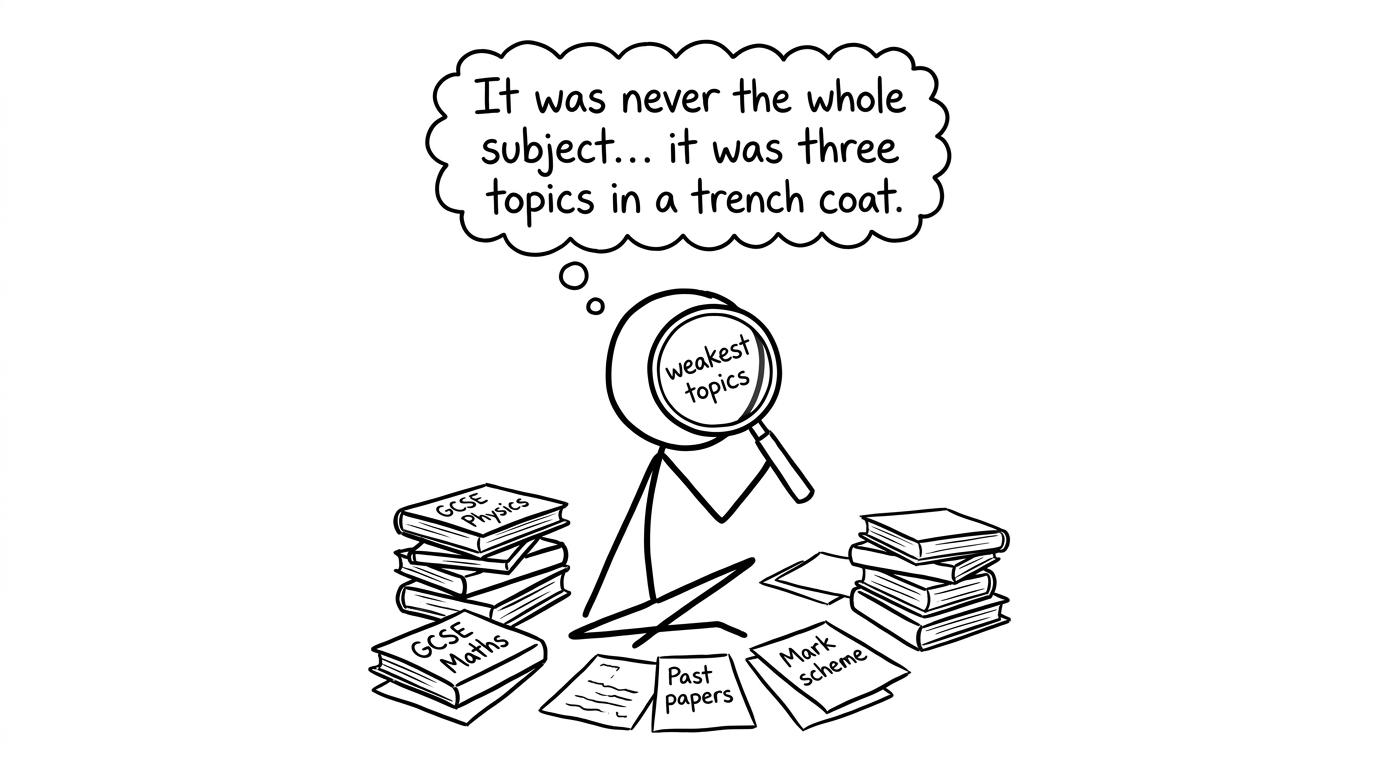 Student with magnifying glass finding weak topics
This guide shows you how to find your weakest topics in GCSE Physics in a way that suits maths-minded students too, because most “hard” Physics marks are actually earned through clear maths.
A quick checklist to find weak topics (in one evening)
- Pick one exam board (AQA, Edexcel, OCR, Eduqas) and stick to it for your diagnosis.
- Do one short paper section (or timed set of questions) and mark it strictly.
- Create a weak-topic log: topic name, question type, why you lost marks, and the exact fix.
- Split errors into three buckets: Physics understanding, maths method, exam technique.
- Use targeted practice: a short lesson, then questions, then a re-test.
If you want ready-made exam practice for maths skills that keep appearing in Physics, you can pair your Physics work with:
- Edexcel GCSE Maths Mini Tests
- Edexcel GCSE Maths Past Papers
- GCSE Maths Other Resources (self-assessment sheets)
Why “weakest topics” are usually patterns, not chapters
Most students think weak topics are big labels like “Electricity” or “Forces”. But in GCSE Physics, weaknesses are usually smaller and more specific:
- “I can’t rearrange formulas when the subject is in the denominator.”
- “I misread graphs and mix up gradient with a coordinate.”
- “I lose marks on units and standard form.”
Those are skills, not chapters. And many of them are maths skills wearing a Physics badge.
A powerful way to diagnose weakness is to ask a more honest question:
“At what exact step do I start guessing?”
That step is the beginning of your weakest topic.
Use a GCSE paper as a mirror (not as a judgement)
To find your weakest topics, you need data that behaves like the exam. That’s why GCSE past papers are better than random practice at the diagnosis stage.
On YesGenie you can access GCSE Past Papers across subjects and exam boards. For your maths support alongside Physics calculations, use the dedicated maths collections like Edexcel GCSE Maths Past Papers.
The method: “20 marks to reveal the cracks”
- Choose a paper for your exam board.
- Answer roughly 20 marks of mixed questions (about 20-25 minutes).
- Mark it immediately.
- For every dropped mark, write a one-line reason.
You are not trying to prove you’re good at GCSE Physics. You are trying to reveal where you’re not yet consistent.
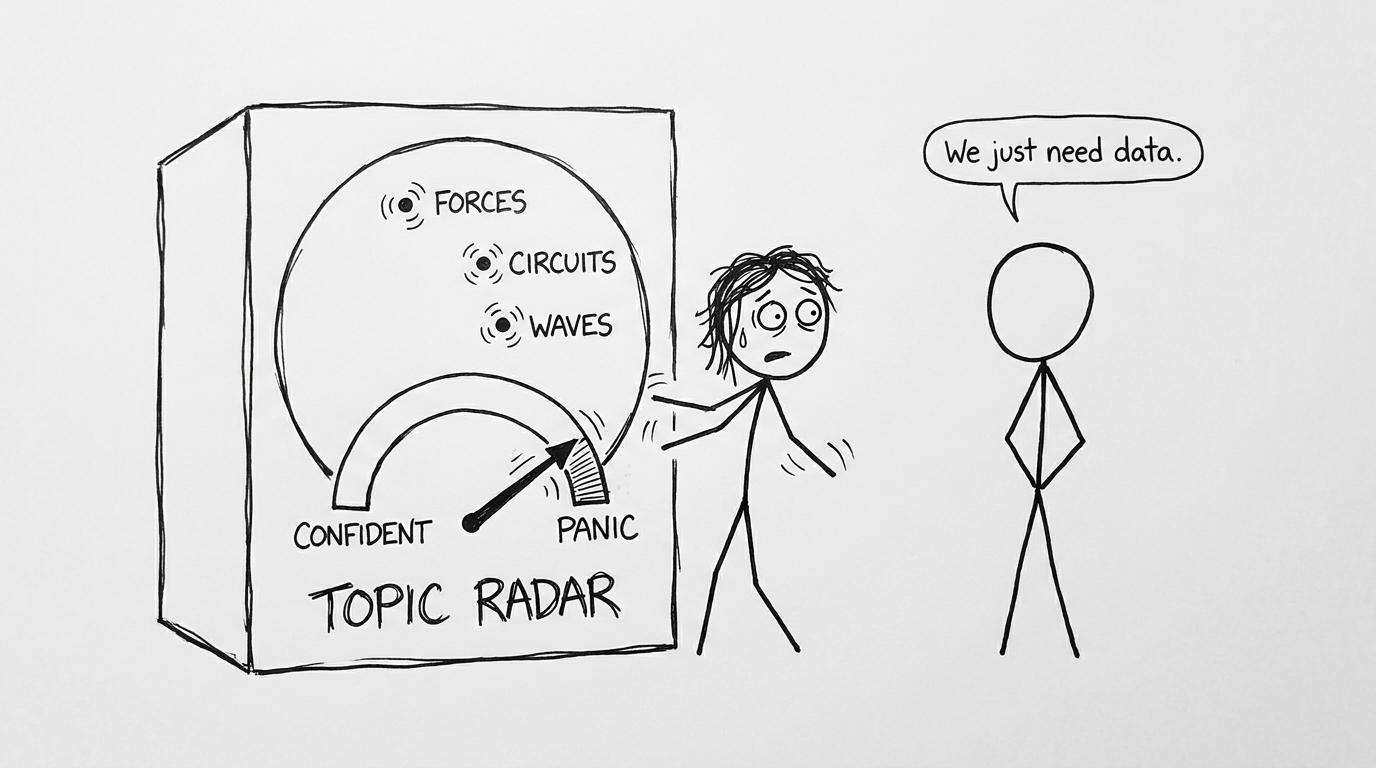 Topic radar machine dial
Build a weak-topic log that actually changes your grades
A weak-topic log is a simple table in a notebook or spreadsheet. What matters is the quality of the note, not the format.
Use these columns:
- Topic tag (e.g. “Moments”, “Series circuits”, “Energy transfers”)
- Question type (e.g. “multi-step calculation”, “graph”, “required practical”)
- What I did (one sentence)
- Why I lost marks (choose one: understanding / maths / exam technique)
- Fix (the smallest next action)
For the maths side of the “Fix”, you’ll often end up on a small cluster of GCSE maths skills. YesGenie makes these easy to practise topic-by-topic, for example:
- Changing the Subject of a Formula (GCSE Maths Questions)
- Standard Form (GCSE Maths question bank via Eduqas list)
- Speed and Density (GCSE Maths question bank via Eduqas list)
(Those topics appear constantly in GCSE Physics calculations, even when the paper doesn’t call them “maths”.)
The three buckets: understanding, maths, exam technique
When you mark GCSE work, don’t just write “careless”. That word hides the real cause.
Physics understanding errors
These are concept mistakes: you don’t know the relationship or you confuse ideas (like weight vs mass, series vs parallel behaviour, or what radiation does). Your fix is usually: revise the idea, then do a handful of questions.
Maths method errors
These are process mistakes: rearranging, substitution, percentages, units, gradients, proportional reasoning. The fix is: practise the maths method separately, then return to the Physics context.
Exam technique errors
These are mark scheme misses: you didn’t state the obvious, you skipped units, you rounded too early, you didn’t show a step that earns method marks. The fix is: copy the mark scheme language once, then apply it.
Worked example: spotting a weakness in formula rearranging
A classic GCSE Physics moment is knowing the formula but freezing when you have to rearrange it.
Suppose you see:
V=IR V = IR V=IRand the question gives V=12V = 12V=12 and R=8R = 8R=8 and asks for III.
Rearrange for III by dividing both sides by RRR:
I=VR I = \frac{V}{R} I=RVNow substitute:
I=128=1.5 I = \frac{12}{8} = 1.5 I=812=1.5So I=1.5 AI = 1.5\text{ A}I=1.5 A.
If you lost marks here in a GCSE paper, your weak topic is not “Electricity”. It’s “rearranging formulas confidently” (and maybe “remembering units”). Your fastest fix is targeted GCSE maths practice on rearranging, then reattempting a circuits question.
Worked example: the graph step where marks disappear
Another frequent GCSE Physics weakness is turning a graph into a calculation.
If a distance versus time graph is straight, its gradient is speed. If two points on the line are (0,0)(0,0)(0,0) and (12,60)(12,60)(12,60), then:
speed=gradient=ΔdΔt=6012=5 \text{speed} = \text{gradient} = \frac{\Delta d}{\Delta t} = \frac{60}{12} = 5 speed=gradient=ΔtΔd=1260=5So the speed is 5 m/s5\text{ m/s}5 m/s.
The diagnosis question to ask yourself is: did you choose two clear points, or did you pick messy coordinates and create your own error? Many GCSE students can do the formula but choose poor points under pressure.
To strengthen this, mix Physics graph questions with GCSE maths graph skills using short practice sets and timed papers, such as Edexcel GCSE Maths Mini Tests or a half-paper from Edexcel GCSE Maths Past Papers.
Turn your log into a plan: the 3-pass fix
Once you’ve identified your weakest topics, the temptation is to create a huge timetable. Don’t. Use a 3-pass loop that keeps you honest.
Pass 1: Learn the exact gap
Read one concise explanation, watch one walkthrough, or re-read your notes. The aim is not total mastery. It’s to remove confusion.
Pass 2: Practise the smallest skill
Do 6-10 questions on that exact type. If it’s a maths skill within GCSE Physics, practise the maths directly (rearranging, standard form, proportions), then go back to Physics context.
Pass 3: Re-test under time
Reattempt a similar question in timed conditions. If you still drop marks, your weakness is deeper than you thought and needs another loop.
 Revision timetable weather forecast
Common mistakes when finding your weakest GCSE topics
- Only doing your favourite topics. This creates confidence without coverage, and your GCSE marks stay stuck.
- Using “I knew it really” as an excuse. In exams, what you can do reliably under time is what counts.
- Not separating Physics vs maths errors. If the issue is rearranging, re-reading a Physics textbook won’t fix it.
- Ignoring units and significant figures. GCSE papers reward correct units, and mark schemes can be strict.
- Changing method every time. Weakness shrinks when you repeat a stable method and refine it.
- Not using mark schemes. You can’t guess what earns marks; you have to look.
Bringing it back to YesGenie: make weakness measurable
The moment you can name your weakest topics, GCSE Physics becomes less like a fog and more like a map. You stop revising “everything” and start revising what actually moves marks. Your weak-topic log turns panic into a plan.
Use YesGenie to keep that plan practical: practise timed sets using GCSE Past Papers, tighten your calculation skills with Edexcel GCSE Maths Mini Tests, and revisit core methods with targeted question practice like Changing the Subject of a Formula (GCSE Maths Questions). If you want a broader overview of what’s available for planning and self-checking, start at Resources and the GCSE Maths Other Resources.
 Exam hall calculator joke
Pick one GCSE paper section tonight, mark it properly, and write down the first three weak topics you see. Then use YesGenie’s lessons, practice questions, past papers and predicted papers to close those gaps with calm, repeatable steps. That’s how grades move: not by doing more, but by doing what matters most in your GCSE exams.