GCSE Physics Exam Week Checklist (Simple + Calm)
GCSE Physics exam week checklist for calm, high-impact revision. Use maths methods, timed practice and YesGenie past papers to lift marks fast.
The night-before feeling (and why a checklist beats panic)
GCSE exam week has a particular sound: the zip of a pencil case, the thud of a revision guide, and that quiet thought: what if they ask the one thing I didn’t revise? Physics makes that feeling sharper because it’s not just facts. It’s methods. It’s diagrams. It’s maths in disguise.
A simple checklist helps because it turns revision from a fog into a few small moves you can actually complete. And if you’re mainly a maths student, that’s good news: the best GCSE Physics marks often come from doing the maths cleanly, showing working clearly, and avoiding the classic unit traps.
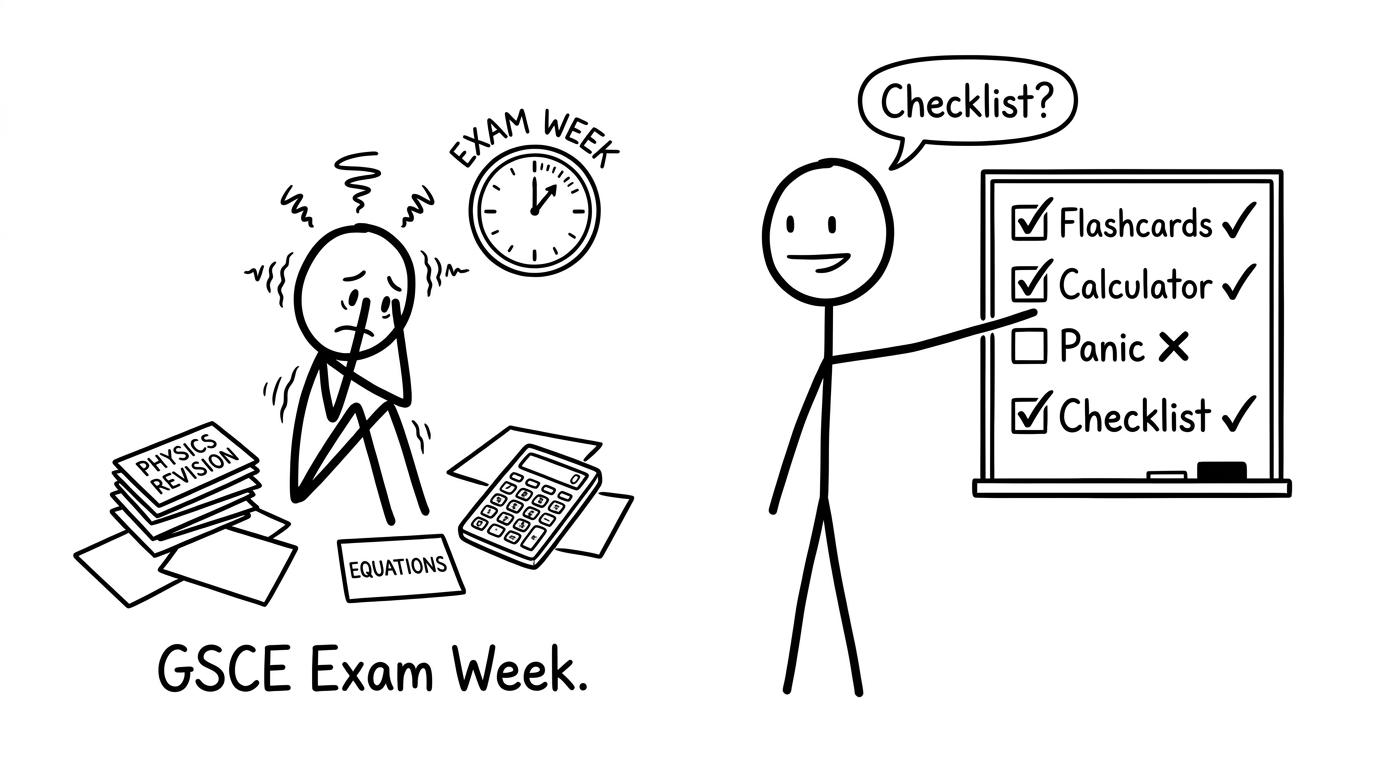 A stressed student meets a calm checklist friend
Your simple GCSE Physics exam week checklist
Use this as a daily loop during GCSE Physics exam week (AQA, Edexcel, OCR or Eduqas). It’s short on purpose.
The non-negotiables
- Know your paper: separate science or combined science, tier (if applicable), and which topics are assessed.
- Do one timed paper section each day (not always a full paper). Mark it the same day.
- Fix two weak areas with targeted questions (not re-reading).
- Do one “maths-in-physics” skill drill: rearranging, standard form, graphs, percentages.
- Do a 10-minute formula and units sweep.
The night-before routine
- Pack: calculator, spare batteries, ruler, protractor (if needed), black pens.
- Pick 10 formulae/relationships and write what each symbol means.
- One short set of questions only (to keep confidence high).
- Sleep beats cramming.
Throughout the week, keep your maths sharp using YesGenie’s GCSE resources like GCSE Past papers and the wider Resources hub.
Why GCSE Physics revision is secretly a maths problem
Physics questions are often marked like maths questions: you get method marks for the setup even if your final number is slightly off. That means your working is not decoration; it’s credit.
If you practise GCSE maths properly, you’re also training for physics:
- rearranging equations accurately
- converting units confidently
- using standard form without fear
- interpreting graphs and gradients
- estimating and checking reasonableness
YesGenie is built for that kind of practice: you can do a timed paper, check a mark scheme, then watch a video solution when you’re stuck. For maths paper practice, start with GCSE Past papers or exam-board collections such as Eduqas GCSE Maths Revision.
The daily plan: 60-90 minutes that actually moves marks
Timed practice (30-45 minutes)
Pick a set of questions and do them under exam conditions. If you revise in longer blocks, your brain learns “comfort revision”. Timed practice teaches you how GCSE questions feel.
If you’re doing GCSE maths alongside physics, add a short maths paper too. YesGenie makes this manageable with Edexcel GCSE Maths Mini Tests and the broader GCSE Mini Tests.
Mark and reflect (15 minutes)
Mark immediately. Then write two tiny notes:
- What did I do wrong? (method, unit, substitution, reading)
- What will I do next time? (a single rule)
Fix two weak areas (15-30 minutes)
Weak areas should be specific: “I mess up unit conversions” beats “electricity is hard”. Use topic questions and repeat until it’s boring.
If your weak area is maths-based, you can quickly plug the gap using GCSE maths practice and mark schemes on YesGenie. You can even watch worked solutions for exam questions, for example a GCSE Maths video solutions page.
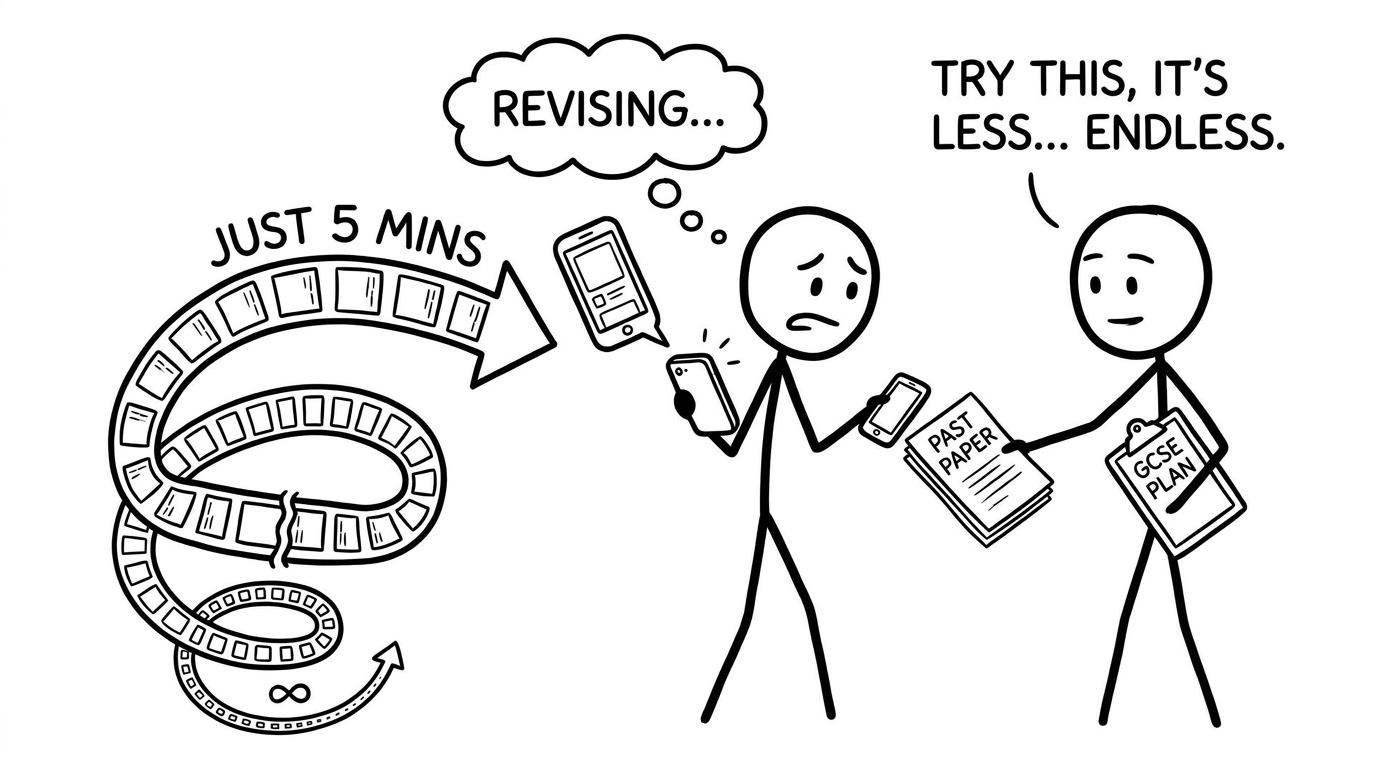 Infinite scroll vs the clipboard plan
Worked example: rearranging a physics equation (the GCSE way)
A lot of GCSE Physics marks are “just” algebra with units.
Example: Use V=IRV = IRV=IR to find RRR when V=12 VV = 12\text{ V}V=12 V and I=0.30 AI = 0.30\text{ A}I=0.30 A.
Start with the formula:
V=IR V = IR V=IRMake RRR the subject by dividing both sides by III:
R=VI R = \frac{V}{I} R=IVSubstitute values:
R=120.30 R = \frac{12}{0.30} R=0.3012Compute:
R=40 R = 40 R=40So R=40 ΩR = 40\,\OmegaR=40Ω.
Exam-week takeaway: If you can rearrange confidently, you pick up method marks even when you’re under pressure. Build that habit with short bursts of algebra practice, then apply it to physics questions.
Worked example: standard form and unit conversion (the quiet mark-makers)
Example: A wire has length 2.5 km2.5\text{ km}2.5 km. Write this in metres, then in standard form.
Convert kilometres to metres:
2.5 km=2.5×1000 m=2500 m 2.5\text{ km} = 2.5 \times 1000\text{ m} = 2500\text{ m} 2.5 km=2.5×1000 m=2500 mWrite 250025002500 in standard form:
2500=2.5×10³ 2500 = 2.5 \times 10^3 2500=2.5×10³So the length is 2.5×10³ m2.5 \times 10^3\text{ m}2.5×10³ m.
In GCSE Physics, this shows up everywhere: distances in m\text{m}m, times in s\text{s}s, and tiny quantities written in powers of ten. If standard form is a wobble point, treat it like a daily warm-up.
Worked example: graph skills that cross over with GCSE maths
Physics graphs often reward the same skills as GCSE maths graphs: reading values, finding gradients, and using proportional reasoning.
Example: A distance-time graph is a straight line. A student travels 120 m120\text{ m}120 m in 15 s15\text{ s}15 s. Find the speed.
Speed is gradient on a distance-time graph:
speed=distancetime=12015=8 \text{speed} = \frac{\text{distance}}{\text{time}} = \frac{120}{15} = 8 speed=timedistance=15120=8So the speed is 8 m s−18\text{ m s}^{-1}8 m s−1.
Exam-week takeaway: Always write the fraction first. It slows you down in the good way and makes your units easier to track.
The 10-minute formula and units sweep (daily)
This is the part most students skip, then regret.
Units sweep
- Write down the units you keep mixing up (for example, cm\text{cm}cm vs m\text{m}m, minutes vs seconds).
- Do two quick conversions.
- Put a box around your final unit in every calculation.
Formula sweep
Even if your exam board provides an equation sheet, you still need to know when to use each relationship and what each symbol means. Spend 10 minutes a day pairing formulae with a one-line meaning.
If you want a wider habit of quick daily starters, YesGenie also has Starters that work well as a warm-up before papers.
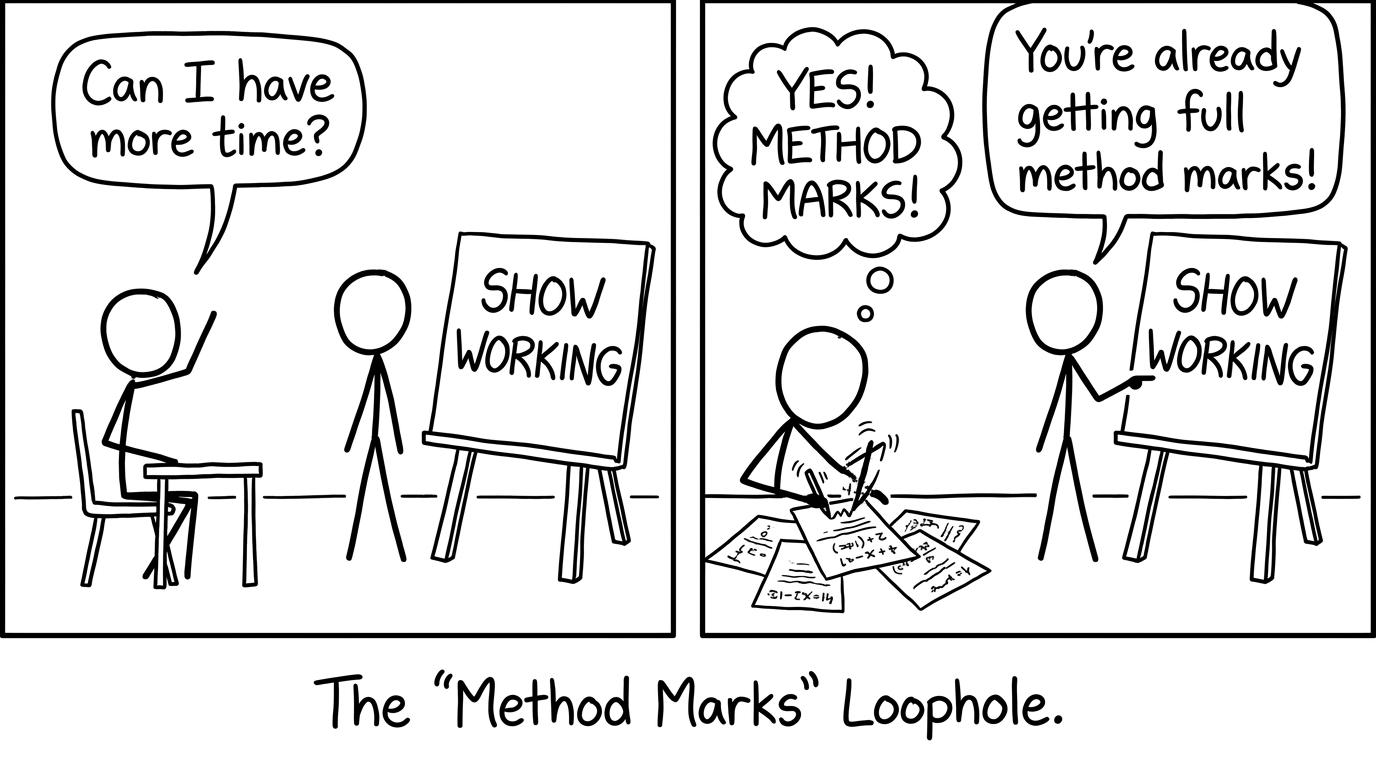 The exam hall "show working" reminder
Common mistakes in GCSE Physics exam week (and how to avoid them)
Treating revision like reading
Reading notes feels productive because it’s calm. But GCSE Physics marks come from doing. Swap one page of reading for four exam-style questions, then mark them.
Dropping units or rounding too early
Units are marks. Write them every time. And keep calculator accuracy until the end, then round once.
Not showing the setup
If you only write the final number, you’re gambling. Set out the formula, rearrangement and substitution so you collect method marks.
Over-revising the night before
When you’re tired, you make silly mistakes: wrong substitution, missed negative sign, incorrect conversion. A shorter, calmer routine usually scores higher.
Mixing exam board expectations
AQA, Edexcel, OCR and Eduqas all assess similar content, but the style of question can differ. The fix is simple: practise with papers that match your course, mark them properly, and note patterns in the mark schemes.
Bringing it together: a calm week beats a heroic night
GCSE Physics exam week doesn’t reward the student who panics the hardest. It rewards the one who can repeat a small process: timed practice, mark honestly, fix two weak points, and keep units and algebra tidy. That’s why this checklist works: it’s boring in the right way.
If you want that process to feel easier, build your week around YesGenie. Use GCSE Past papers for proper exam practice, GCSE Mini Tests for quick daily drills, and the wider Resources section when you need predicted papers, topic practice, and structured revision. Keep your workings clear, keep your units honest, and let each day’s mistakes tell you what to practise next.
When GCSE exam week ends, you won’t remember every question. You’ll remember that you showed up with a plan, and that usually shows up in the marks.