GCSE Physical Education Results Day Questions
GCSE physical education results day questions answered clearly: grades, boundaries, practical marks, reviews and sensible next steps for families.

Results day compresses months of work into one small line on a results slip. For GCSE PE students, that line can feel especially difficult to interpret because the final grade combines written examinations, practical performance and analysis work. These GCSE physical education results day questions explain what your result means, what to check and what to do if something appears wrong.
The short answer is reassuring: collect the facts before making a decision. Find your component marks, check the published grade boundaries and speak to your PE teacher or exams officer before requesting any post-results service.
Your results-day checklist
- Confirm the qualification and exam board: AQA, Edexcel, OCR, Eduqas or WJEC.
- Record your final grade and total mark where available.
- Ask for your individual component marks.
- Compare your total with the official grade boundaries for your exact specification.
- Speak to your school promptly if you suspect an error.
- Check entry requirements directly with your sixth form, college or training provider.
- Avoid comparing raw marks with friends taking another exam board.
You can also open the free GCSE Physical Education revision hub to find board-specific past papers, revision guides, flashcards and grade tools.
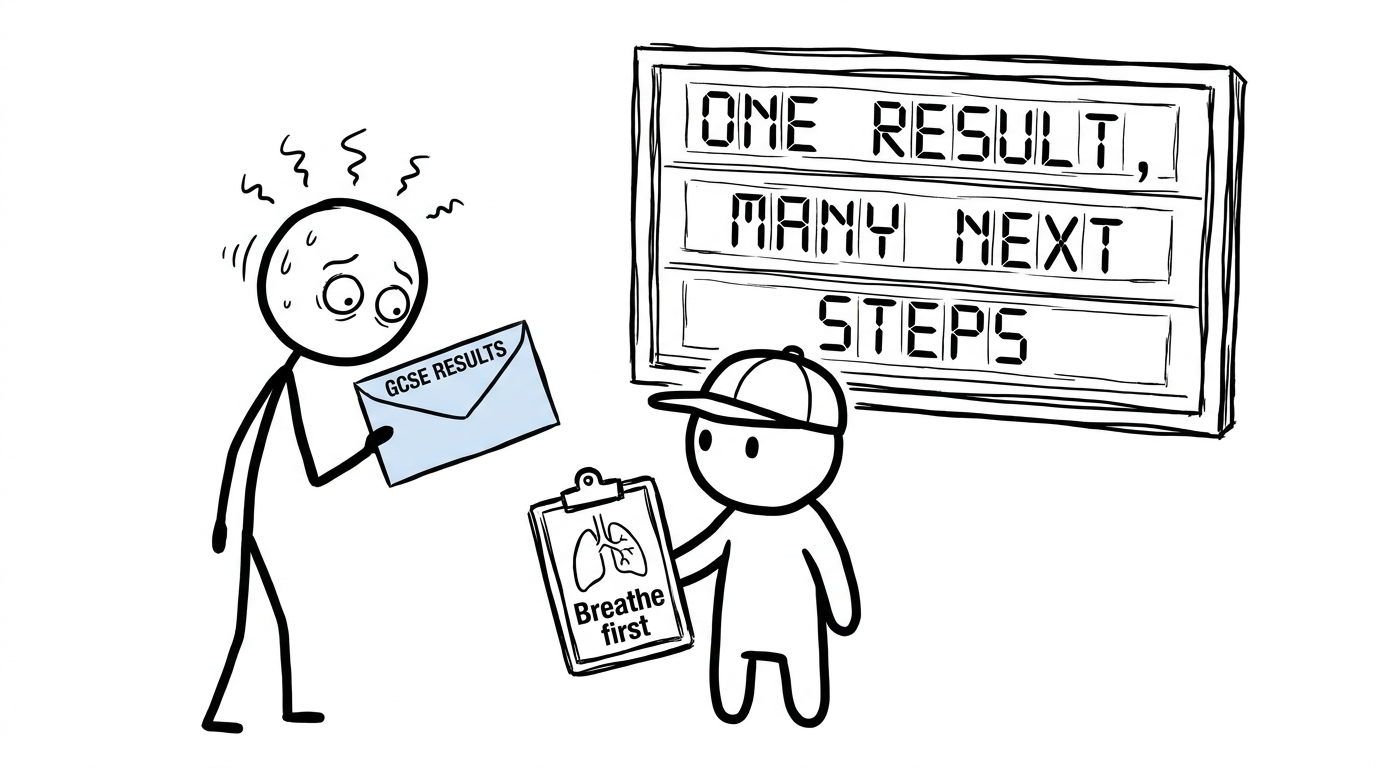 A nervous student opens a results envelope beside a tiny coach reminding them to breathe
When is GCSE results day in 2026?
GCSE results are released to students on Thursday 20 August 2026. Your school decides when and how you can collect them, so check its arrangements rather than assuming the building will open at a particular time.
If you cannot attend, contact the school beforehand. It may offer secure online access or allow an authorised person to collect your results, but local procedures vary.
What will my GCSE PE result show?
Your results slip should show the qualification and final grade on the grades 999-111 scale. It may not provide the full breakdown of marks from each paper and non-exam assessment component.
Ask your PE department or exams officer for your component marks if you need more detail. These reveal whether marks came from the written papers, practical performance or analysis and evaluation work. Students following AQA can also use the AQA GCSE Physical Education revision page to revisit the assessment structure and past papers.
How is the final GCSE PE grade calculated?
For the current AQA, Edexcel, OCR and Eduqas GCSE PE specifications, externally assessed written work contributes 60%60\%60% and non-exam assessment contributes 40%40\%40% overall. Within that structure, the precise paper marks and scaling arrangements vary by board.
Your raw component marks may therefore be scaled before they are combined. The final grade is based on the overall weighted total, not on informally averaging the grades you thought you achieved in each part.
This is why the correct exam board matters. An Edexcel student checking AQA boundaries is comparing two different assessments. The Edexcel guide to health, fitness and performance illustrates how MathsGenie resources remain aligned with the relevant specification.
Why are this year’s grade boundaries different?
Grade boundaries are set after the assessments have been marked. Exam boards use evidence about paper difficulty and student performance so that the standard required for a grade remains comparable between years.
A higher boundary does not automatically mean grading became harsher. It can reflect a more accessible paper. A lower boundary can reflect a more demanding one. There is no fixed quota limiting how many students may receive each grade.
Always use the boundary document for the correct year, exam board and specification. Do not rely on predictions posted before results day.
What if I am one mark below the next grade?
First, pause. Being close to a boundary is a reason to investigate, not proof that the mark is wrong.
Ask your teacher to examine the component breakdown and consider whether there is credible evidence of a marking or administrative error. A review is most sensible when the paper contains responses where the mark scheme may not have been applied correctly, not simply because the total is disappointing.
Remember that marks can rise, remain unchanged or fall after a review. The grade can consequently change in either direction.
Can I ask for a GCSE PE re-mark?
The formal service is normally called a review of marking, rather than a re-mark from scratch. The reviewer checks whether the original examiner applied the mark scheme correctly and whether any administrative error occurred.
Requests are usually submitted through your school or college, and candidate consent is required because the mark may decrease. For the June 2026 series, the JCQ deadline for awarding bodies to receive review-of-results requests is 24 September 2026, but schools commonly set earlier internal deadlines. Contact your exams officer immediately rather than waiting.
A clerical re-check is different: it checks matters such as whether every part was marked and whether marks were totalled and recorded correctly.
Can my practical performance mark be reviewed?
Practical performance and analysis work are internally assessed and externally moderated. Before marks were submitted, your school should have provided a process for requesting a review of its internal marking.
After results, a review of moderation is not an individual re-mark of one student’s performance. It is generally requested by the centre for the relevant cohort and is available where moderation changed the centre’s marks. Speak to your head of PE if the practical component looks unexpected; students and parents should not approach the exam board independently as a first step.
What GCSE PE grade do I need for sixth form or college?
There is no single national entry grade covering every course. Requirements are set by individual sixth forms, colleges and training providers. Some courses consider GCSE PE alongside English, maths, science and your overall GCSE profile; others may not require GCSE PE specifically.
Check the published entry requirements and contact admissions if you narrowly missed an offer. Do not assume that one grade automatically closes the route.
If maths is part of your next-step requirement, use the GCSE Maths revision hub to review board-specific lessons, question banks and papers. The guide to the best order for learning GCSE Maths topics can help you restart with a clear sequence.
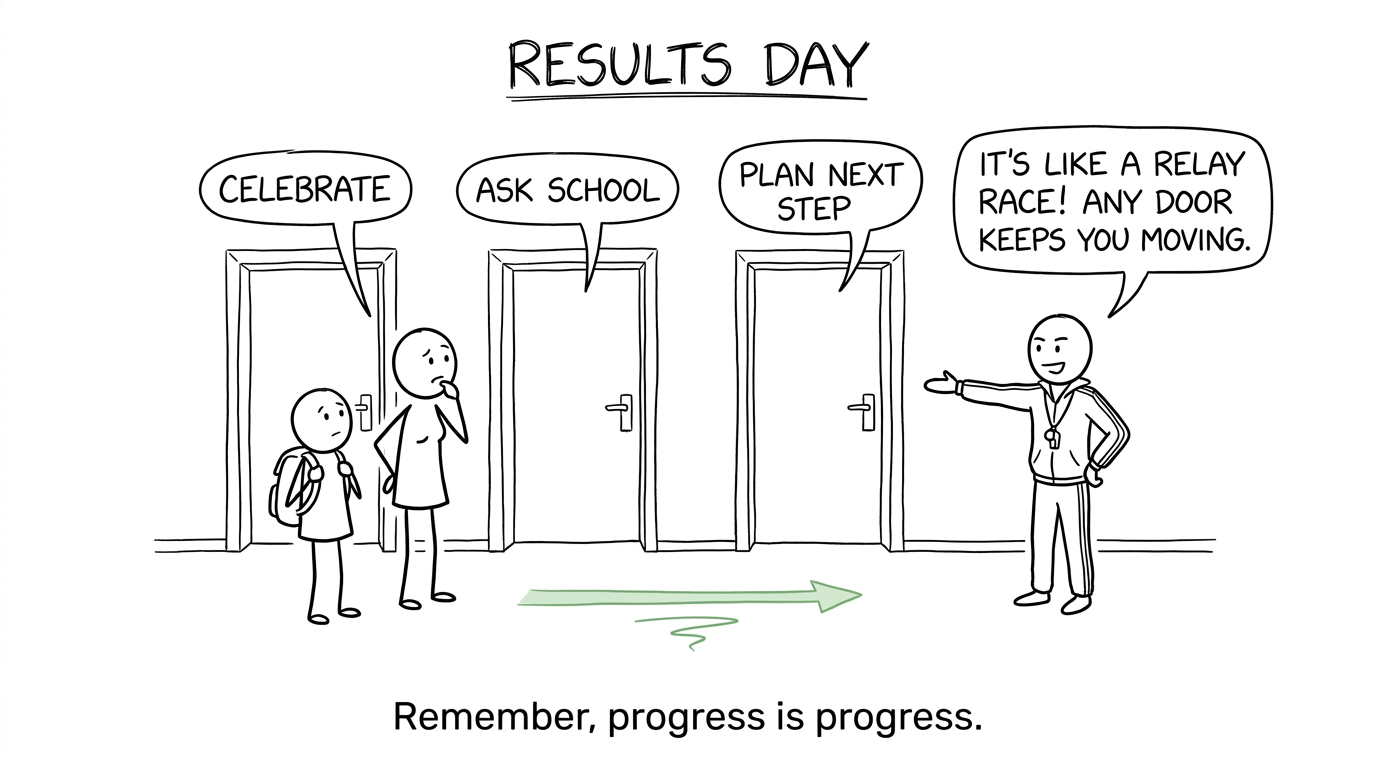 A student and parent choose between three reassuring results-day doors while a teacher explains that each leads forward
What should I do on results day?
Make one decision at a time. Celebrate what went well, then separate urgent actions from worries that can wait.
If a course place is affected, contact the provider that day. If a PE mark appears questionable, email your exams officer and PE teacher. If the result highlights gaps for future revision, use past papers to diagnose them rather than rereading everything.
MathsGenie’s guide to finding your weakest GCSE topics offers a practical error-log method. You can then use active recall for GCSE revision and GCSE predicted papers when preparing for later assessments.
Common results-day mistakes
- Comparing boundaries across different boards or specifications.
- Treating a boundary prediction as an official figure.
- Assuming that being close to a boundary guarantees a successful review.
- Forgetting that a reviewed mark can decrease.
- Waiting until the national deadline instead of checking the school’s earlier deadline.
- Confusing a clerical re-check, review of marking and review of moderation.
- Assuming a disappointing PE grade automatically prevents progression.
Move forward with evidence, not panic
A result matters, but the next informed action often matters more. Gather the component marks, use the correct boundaries and let your school advise whether a review has genuine grounds.
For continued support, start with MathsGenie’s free GCSE Physical Education resources. Choose your exam board, revisit revision lessons and practice questions, then use past papers, mark schemes, flashcards and grade tools to turn uncertainty into a clear plan.