GCSE Music Last Minute Revision Plan: 3 Calm Days
GCSE music last minute revision plan: follow a calm three-day schedule for listening, set works, terminology and exam technique without panic.
The exam is three days away. Your set works suddenly seem to contain a thousand details, every instrument sounds like every other instrument, and the notes you meant to organise are still scattered across several folders.
Here is the useful truth: a GCSE music last minute revision plan cannot rebuild the entire course, but it can still improve what you recognise, recall and write under pressure. Spend day one diagnosing gaps, day two practising listening and written responses, and day three consolidating the highest-value material before protecting your sleep.
That is the whole strategy. Not perfect coverage. Better decisions.
Your three-day GCSE Music revision checklist
Before beginning, confirm your exam board and paper details with your teacher, timetable and specification. Edexcel, AQA, OCR and Eduqas do not use identical areas of study, set works or question formats.
Your plan is to:
- check the correct exam board, date, start time and equipment
- identify your weakest areas rather than rereading everything
- revise musical elements through active listening
- retrieve set-work knowledge without notes
- practise short and extended written answers
- use an official past or sample paper and its mark scheme
- build a one-page final recall sheet
- stop heavy revision early enough to sleep properly
The written listening and appraising component accounts for a substantial part of GCSE Music. For example, current AQA and OCR specifications allocate 40%40\%40% of the qualification to their examined listening and appraising component. The precise structure varies, so use material made for your board rather than assuming that another board's questions will match yours.
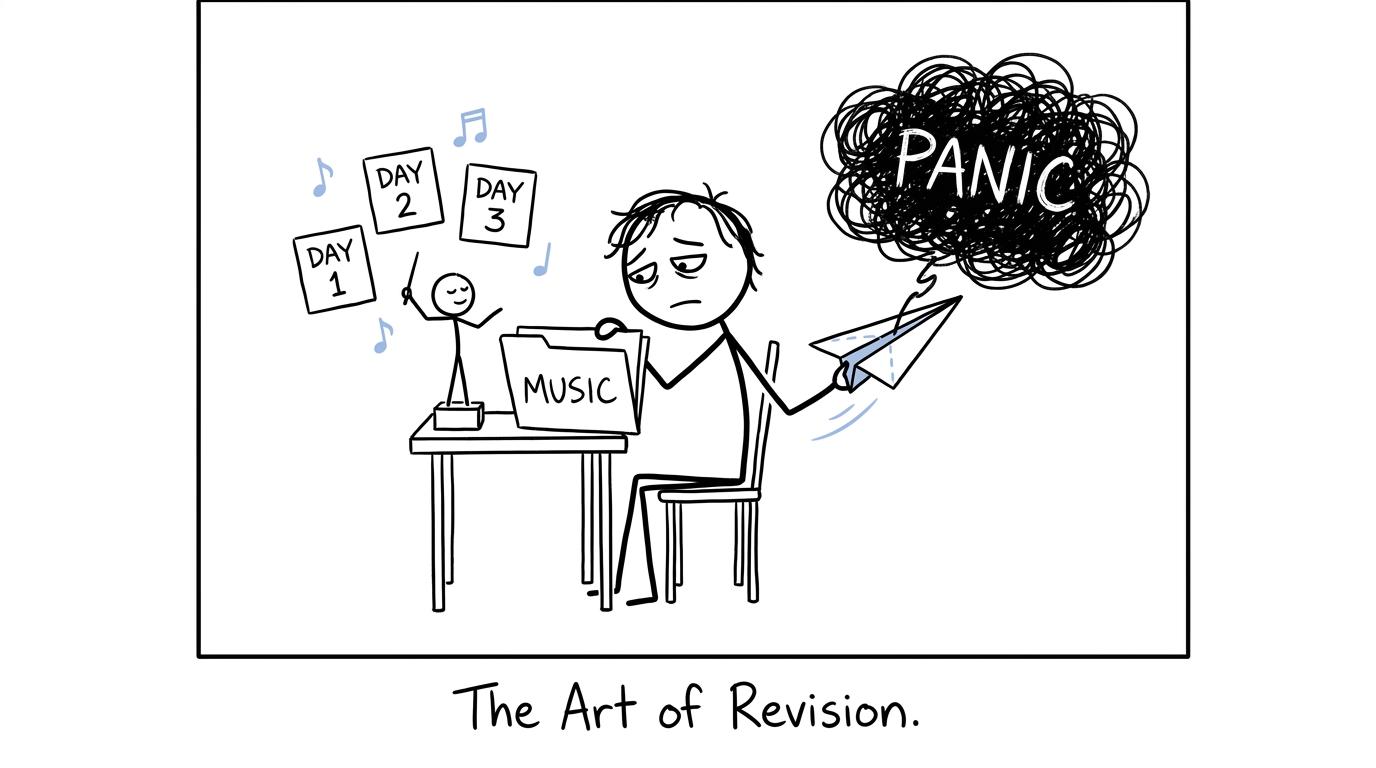 A student turns a panic cloud into a calm three-day plan
Day one: diagnose, organise and recover the essentials
Panic encourages a strange form of productivity. You colour-code a title, move papers between piles and watch a long revision video. It feels busy, but it does not reveal what you can actually remember.
Day one should create clarity.
Confirm what your exam assesses
Write down your exam board, paper duration, areas of study, prescribed works and main question types. Use your school's current specification or checklist. This matters because the boards organise their content differently.
AQA, for instance, assesses unfamiliar listening across its areas of study and contextual understanding of selected study pieces. OCR's listening and appraising paper focuses on its specified areas of study and includes aural recognition and contextual knowledge. Your own course may use different terminology and repertoire.
Do not spend time revising a piece simply because it appears in somebody else's online checklist.
Take a short diagnostic test
Choose part of an official past paper or sample assessment and attempt it without notes. Include some listening questions and, if your paper requires one, a longer response. This is not a prediction of your grade. It is a searchlight.
Mark it with the official mark scheme, then sort each lost mark into one of four categories:
- aural recognition: you did not hear or identify the feature
- terminology: you recognised something but could not name it precisely
- set-work knowledge: you could not recall the relevant detail or context
- exam technique: your answer was vague, unsupported or incomplete
Limit your repair list to the three areas costing you the most marks. A useful diagnosis might be “texture vocabulary”, “instrumental sonorities” and “supporting comparisons with evidence”. “Revise Music” is too large to act upon.
This is the same evidence-first principle explained in MathsGenie's guide to finding your weakest GCSE topics quickly. When maths exams are happening in the same week, diagnosis prevents one subject from consuming every available hour.
Rebuild your musical-elements framework
Create a single sheet covering the categories your specification expects. These commonly include:
- melody
- harmony and tonality
- rhythm and metre
- tempo
- dynamics
- articulation
- texture
- timbre, sonority and instrumentation
- structure
Under each heading, write vocabulary you can define and recognise. Avoid copying an enormous glossary. The goal is to connect sound, term and effect.
Then listen to short extracts from material approved or provided by your school. Pause after each extract and say what changed. A strong observation is specific: identify the musical element, describe the feature and explain its effect where the question requires this.
Finish day one with closed-book retrieval of your prescribed works. For each one, recall the composer or artist, genre, period or context, structure, instrumentation and several distinctive musical features. Check your notes only after trying.
Day two: turn knowledge into exam answers
Day one finds the gaps. Day two does the work most likely to convert knowledge into marks: listening, writing, checking and correcting.
Practise active listening, not background listening
Listening to a set work while doing something else may make it familiar, but familiarity is not the same as analysis. In the exam, you need to direct your attention.
For each extract, choose one focus for the first hearing and another for the next. You might listen first for instrumentation and texture, then for harmony and structure. Write brief observations immediately rather than waiting until the extract ends.
If the question provides a stated number of playings, practise within that limit. Build the habit of using any reading time to underline command words and predict what you need to hear.
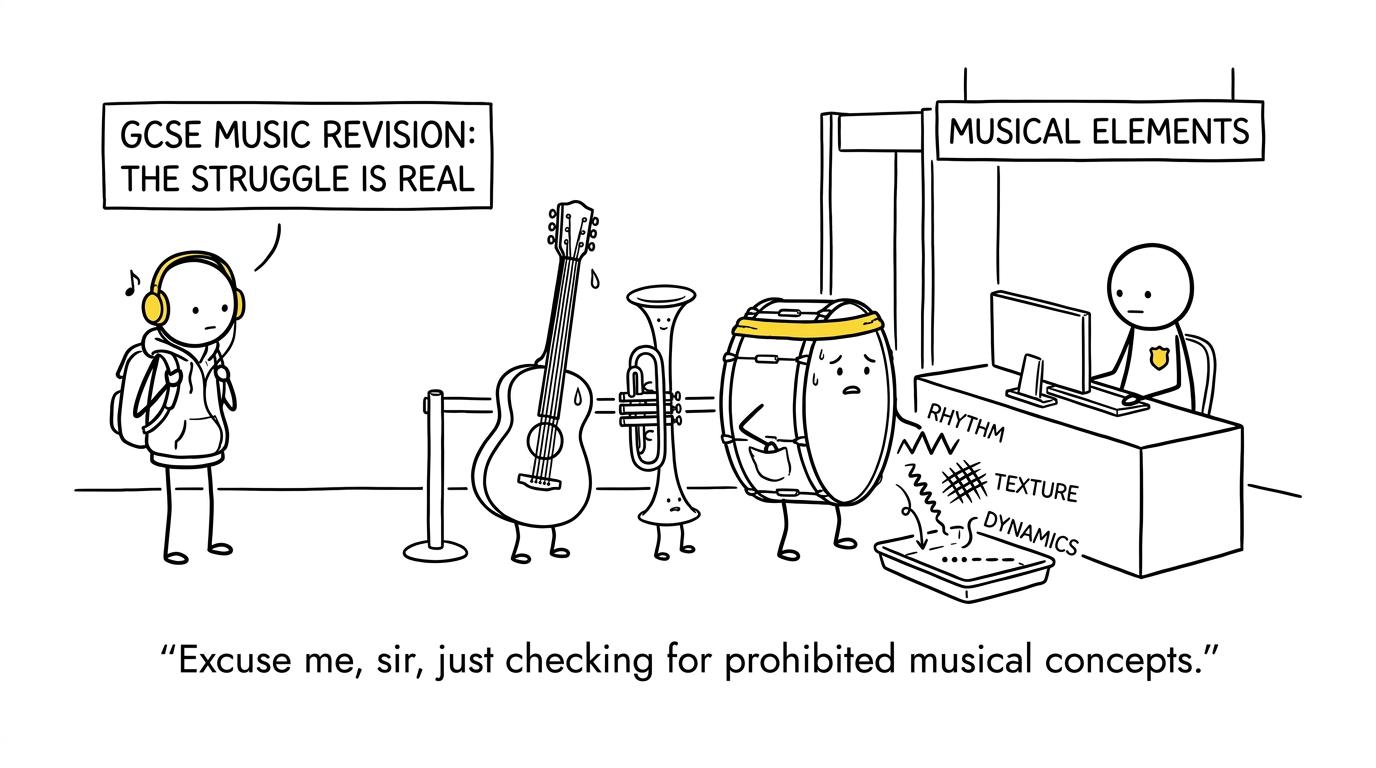 Cartoon instruments pass through musical-elements security
Improve short answers through precision
A common weak answer describes a general feeling: “It gets dramatic” or “the music becomes exciting”. That may be true, but it often lacks the musical evidence needed by the question.
Replace general language with identifiable features. Depending on the extract, useful evidence could concern a crescendo, thicker texture, faster rhythmic activity, dissonance, a change of register or the entrance of a new instrumental group.
Keep your claim proportional to what you can hear. Do not force advanced terminology into an answer unless you understand it and can apply it accurately.
Practise the longer response required by your board
Check exactly what your specification asks. You may need to analyse, evaluate or compare music, sometimes referring to a prescribed work and sometimes responding to unfamiliar material.
Plan before writing. A reliable paragraph should:
- make a relevant musical observation
- name the element or technique precisely
- support it with evidence from the music
- connect it to the question
- compare directly where comparison is required
Use the mark scheme after your attempt. Look for the difference between merely mentioning features and developing a coherent, supported answer. Then improve the original response rather than immediately abandoning it for another question.
If maths also needs attention, use a bounded session rather than allowing Music to swallow the evening. MathsGenie's twenty-minute maths revision routine can preserve daily contact with formulae and methods while Music receives priority. The wider GCSE Maths revision hub provides board-specific papers and topic practice when you need a focused task.
End with retrieval
Close your notes and write everything you remember about each priority set work. Then check in a different colour. The missing information becomes tomorrow's final list.
This feels harder than rereading because retrieval exposes uncertainty. That difficulty is useful. MathsGenie's advice on stopping GCSE content from being forgotten follows the same principle: recall first, check second, then revisit the gap.
Day three: rehearse, refine and stop
The final day is not the moment to open an untouched textbook chapter. It is for making your existing knowledge easier to access.
Complete one controlled exam rehearsal
Attempt a timed section or a complete paper if your energy and schedule allow. Match your board's instructions, use the permitted materials and play recordings only as directed.
Mark the work immediately. Select no more than three final repairs. These should be precise actions such as:
- revise the sound and definition of three texture terms
- learn the structure of one prescribed work
- rewrite one comparison paragraph with direct evidence
Do the repair, then reattempt the relevant question without looking at the answer.
Past-paper practice should become a loop: attempt, mark, diagnose, repair and retest. Maths students can see the same process in MathsGenie's guide to using OCR GCSE Maths past papers properly. Although the subjects differ, the feedback habit remains valuable.
Build your final recall page
Your one-page sheet should contain prompts, not paragraphs. Include:
- the musical elements you tend to overlook
- easily confused terms and short definitions
- prescribed-work structures and distinctive features
- contextual facts required by your specification
- reminders about command words
- your three recurring exam mistakes
Test yourself from this page in the afternoon. On the evening before the exam, use it only for a brief check.
Protect the final evening
Pack your pens, pencils and any equipment specified by your school. Check the venue and start time. Set an alarm and decide when revision ends.
NHS exam guidance recommends manageable revision, regular short breaks and past-paper practice. It also advises against all-night cramming: sleep supports thinking and concentration, while panicked late-night work can leave you less able to use what you know.
If another paper follows Music, make a tiny next-subject list and leave it for tomorrow. MathsGenie's calm GCSE exam-week checklist and night-before maths plan can help you switch subjects without starting another panic cycle.
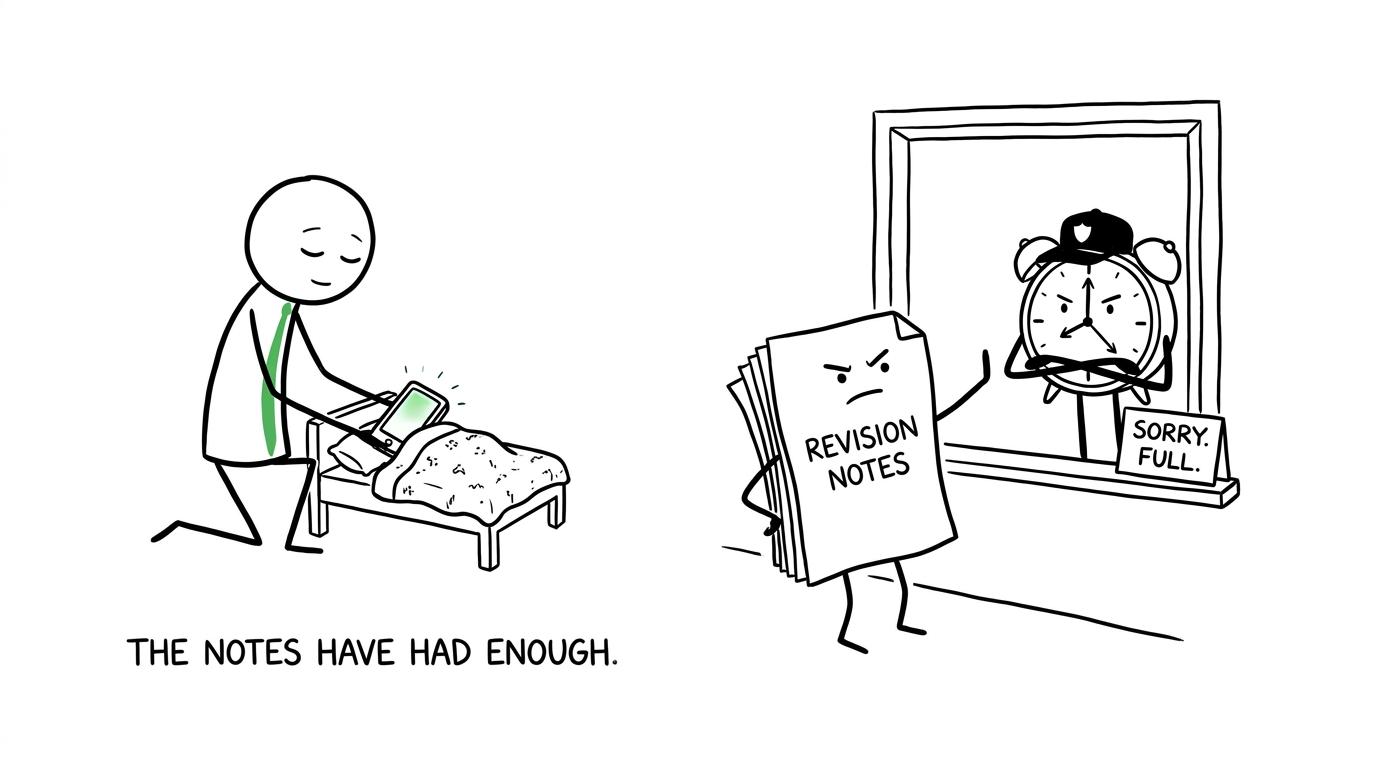 An alarm clock stops revision notes from interrupting sleep
Common last-minute GCSE Music revision mistakes
Trying to cover everything equally
Three days reward prioritisation. Give more time to weaknesses revealed by questions, not topics that feel comfortable or appear first in your folder.
Memorising facts without listening
Music is an aural subject. A definition is more useful when you can connect it to a sound. Combine vocabulary retrieval with focused extracts.
Using impressive words inaccurately
Precise, correct terminology is stronger than complicated terminology used at random. If you cannot explain a term simply, check it before putting it in an answer.
Ignoring the command word
“Identify”, “describe”, “explain”, “compare” and “evaluate” ask for different kinds of response. Underline the instruction and make every sentence serve it.
Doing papers without reviewing them
A paper completed and forgotten mainly measures your current position. The learning happens when you use its mark scheme, identify the cause of lost marks and reattempt weak questions.
Sacrificing sleep for one more chapter
An extra exhausted hour is not automatically an extra productive hour. Set a finish time. A calm brain that can retrieve its knowledge is more useful than a larger pile of notes.
Three days can still be used well
Last-minute revision is uncomfortable because time has become visible. Yet that visibility can help. It removes the luxury of vague intentions and leaves a simpler question: what action gives the next hour the best chance of improving an exam response?
Diagnose on day one. Practise listening and writing on day two. Rehearse, repair and rest on day three. Keep your work specific to your own exam board, and ask your teacher when the specification or set material is unclear.
Then protect the rest of your exam timetable. For maths, start with MathsGenie's free GCSE Maths revision resources, using revision lessons and practice questions to repair individual topics. Move to past papers, mark schemes, mini tests and video solutions when you need exam practice, with Edexcel predicted papers available for fresh specification-matched maths preparation.
You do not need to feel completely ready before you begin. Open the correct paper, find the first genuine gap and make one calm repair.