GCSE Modern Hebrew Revision Bootcamp: Worth It?
GCSE Modern Hebrew revision bootcamp: learn what courses offer, what to check before paying, and when structured holiday tuition is genuinely worthwhile.
Revision courses often sell something more attractive than lessons: relief. A fixed timetable, an experienced teacher and the promise that someone else has organised the difficult weeks ahead.
A GCSE Modern Hebrew revision bootcamp can be worth paying for when it provides specification-matched teaching, individual feedback and realistic practice in the skills you cannot improve efficiently alone, particularly speaking and listening. It is less likely to be worthwhile if it is simply a fast tour through vocabulary, delivered to a large mixed-ability group without marked work or speaking practice.
The important question is not whether intensive tuition sounds useful. It is whether the course solves your particular revision problem without taking too much money, time or attention away from maths and your other GCSE subjects.
The quick bootcamp value checklist
Before booking, check whether the course:
- follows the current AQA GCSE Modern Hebrew specification rather than a general Hebrew curriculum;
- covers listening, speaking, reading and writing;
- separates Foundation and Higher tier work appropriately;
- includes individual speaking practice and useful teacher feedback;
- uses exam-style questions, past assessment materials and mark schemes;
- explains class size, teaching hours and tutor experience clearly;
- provides resources or follow-up tasks after the course;
- fits around your maths revision and other examination commitments;
- has transparent cancellation, absence and refund terms.
If several of those details are missing, ask before paying. The word bootcamp describes intensity, not quality.
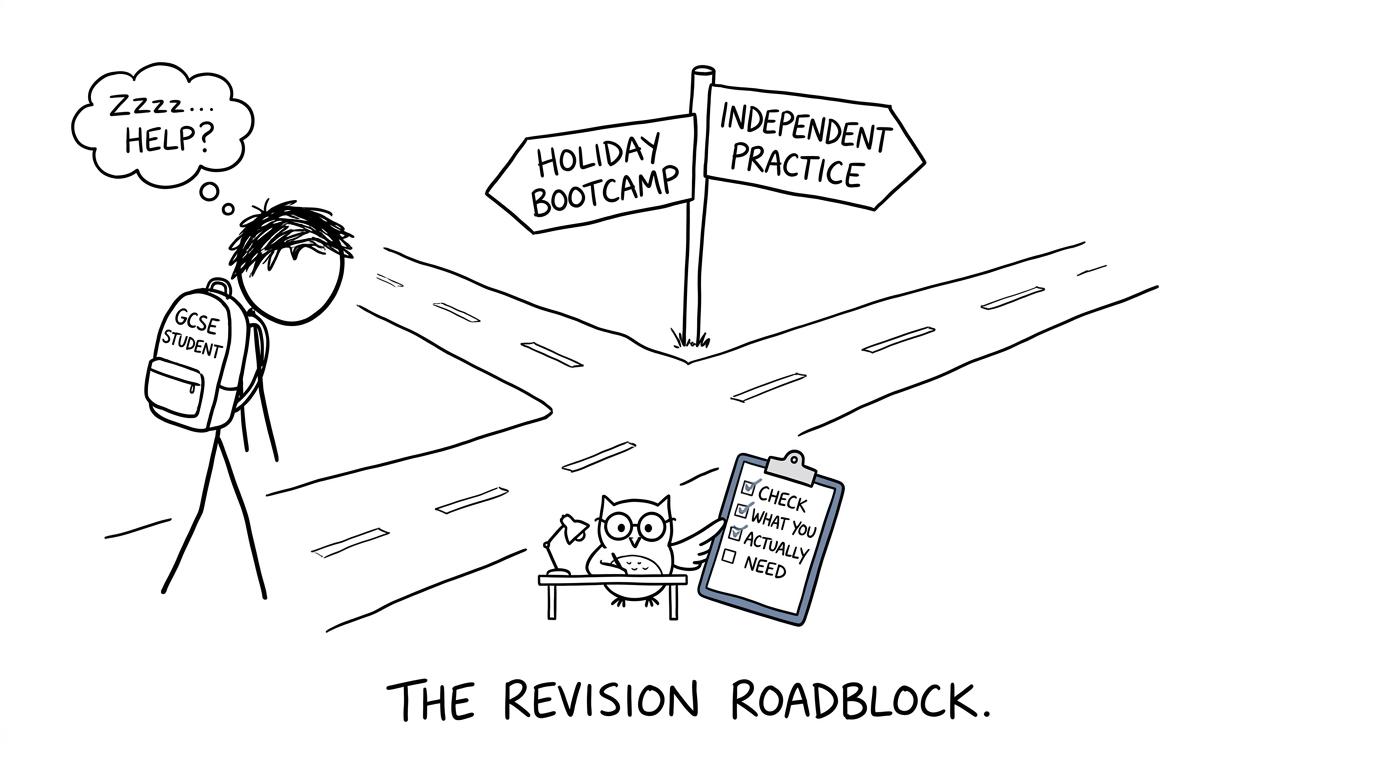 A student choosing between a holiday bootcamp and independent revision while an owl checks what is actually needed
What GCSE Modern Hebrew courses should prepare you for
GCSE Modern Hebrew is currently offered by AQA under specification code 8678. It is a linear qualification, so students take the assessments at the end of the course. The specification has Foundation tier, covering grades 111 to 555, and Higher tier, covering grades 444 to 999. A student must take all components at the same tier in the same examination series.
There are four assessed skills:
- listening;
- speaking;
- reading;
- writing.
Each contributes 25%25\%25% of the qualification. The content is organised around identity and culture; local, national, international and global areas of interest; and current and future study and employment.
That balance matters when judging a holiday course. A provider might be excellent at teaching conversational Hebrew but still offer weak GCSE preparation. Comfortable conversation is valuable, yet the examination also tests translation, comprehension, accurate written communication and responses in specific formats.
A credible provider should be able to explain how every session connects with the specification and assessment objectives. Current Department for Education subject content continues to apply to GCSE Modern Hebrew, even though revised arrangements have affected some of the larger GCSE language subjects. Students should therefore check Modern Hebrew information specifically rather than assuming that an announcement about French, German or Spanish applies to them.
What a GCSE Modern Hebrew revision bootcamp actually offers
Course formats vary considerably, so the label alone tells you very little. A short Easter class, an online weekend programme and a term-long evening course may all be marketed as intensive revision.
Specification and vocabulary consolidation
A useful course identifies gaps across the required themes rather than handing students an enormous vocabulary list. It should help you retrieve useful language, recognise synonyms and understand how familiar words appear in unfamiliar contexts.
Vocabulary teaching should lead into exam tasks. Memorising isolated words can create the feeling of progress without building the ability to follow a recording or construct a developed written response.
Speaking rehearsal
Speaking is where paid tuition can offer something genuinely difficult to reproduce alone. The AQA assessment includes a role-play, a photo-card task and a general conversation. Foundation and Higher speaking assessments have different overall timings, although the broad format is shared.
A strong bootcamp gives each student repeated opportunities to speak, respond spontaneously and receive precise feedback on communication, pronunciation, range, accuracy and fluency. In a large class, calculate how much individual speaking time is realistically available. A long session can still produce only a few minutes of useful practice per student.
Listening practice
Listening improvement requires more than playing recordings and revealing answers. Good teaching shows students how to use reading time, anticipate the kind of information required, distinguish key details from distractions and recover after missing a phrase.
Ask whether the course uses suitable GCSE-style audio and whether answers are explained. Simply recording a score does not reveal why the marks were lost.
Reading, translation and writing
The reading assessment includes comprehension and translation from Modern Hebrew into English. Writing assesses communication in Modern Hebrew and includes translation from English into Modern Hebrew. Higher-tier students also face more extended writing demands.
Worthwhile tuition should include marked work with feedback that you can act on. Comments such as “add more detail” are too vague. Better feedback identifies a recurring grammar error, an undeveloped response or a missed part of the task, then gives the student another opportunity to correct it.
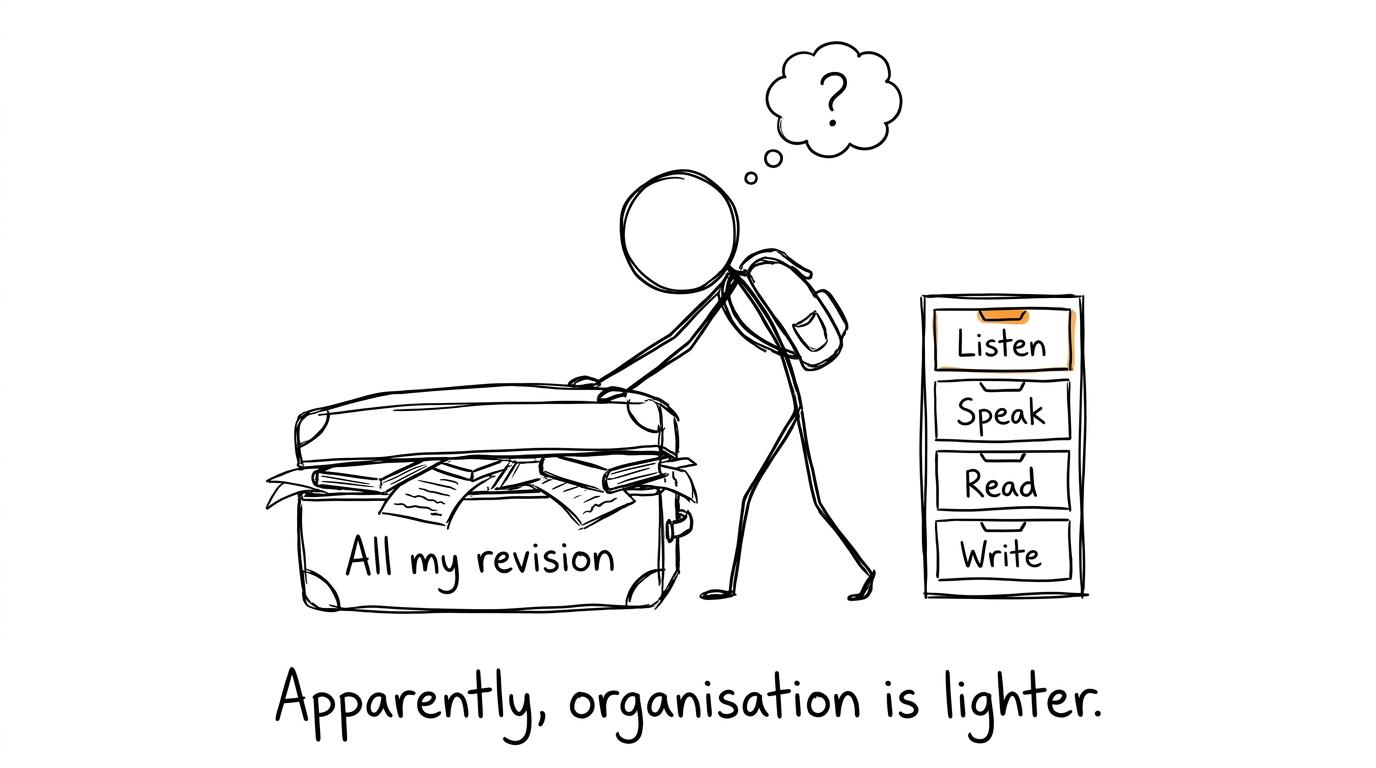 A student organises revision into listening, speaking, reading and writing instead of carrying one enormous suitcase
When paying is genuinely worthwhile
The best reason to buy a course is not panic. It is a clearly identified need that the course is equipped to meet.
You lack specialist teaching
Some students take Modern Hebrew outside their normal school timetable or have limited access to a teacher familiar with the GCSE assessment. A course can then provide structure, specification knowledge and informed feedback that are otherwise hard to obtain.
Your speaking needs live feedback
Speaking can be practised independently, but self-assessment has limits. A specialist tutor can notice whether your responses are too brief, whether errors repeatedly obscure meaning and whether you cope with unprepared questions.
You know the language but not the examination
A fluent or heritage speaker may still need help with formal accuracy, task completion, translation conventions and examination timing. Everyday confidence does not automatically produce full marks under a mark scheme.
The course creates accountable practice
A fixed commitment may help if independent revision repeatedly slips. But structure only has value when it produces active work. Completing speaking tasks, writing responses and correcting errors is revision; listening passively to several hours of explanation is not.
The feedback is genuinely personal
Look beyond the headline number of teaching hours. Value depends on what happens during them. Small groups, returned writing, individual speaking and a useful action plan often matter more than polished slides or a thick folder.
When a bootcamp is probably not worth the cost
Do not pay simply because examinations are approaching. A course is poor value when:
- you already receive strong, regular feedback from a specialist teacher;
- the advertised content does not identify AQA specification 8678;
- Foundation and Higher students follow identical tasks throughout;
- the class is too large for meaningful speaking practice;
- no written work is marked individually;
- “past paper practice” means completing papers without analysing errors;
- the course repeats content you have already mastered;
- attending would remove essential time from weaker subjects.
There is also no reliable basis for treating a bootcamp as a guaranteed grade increase. Providers can control teaching, resources and feedback. They cannot guarantee what a particular student will remember or produce in the examination.
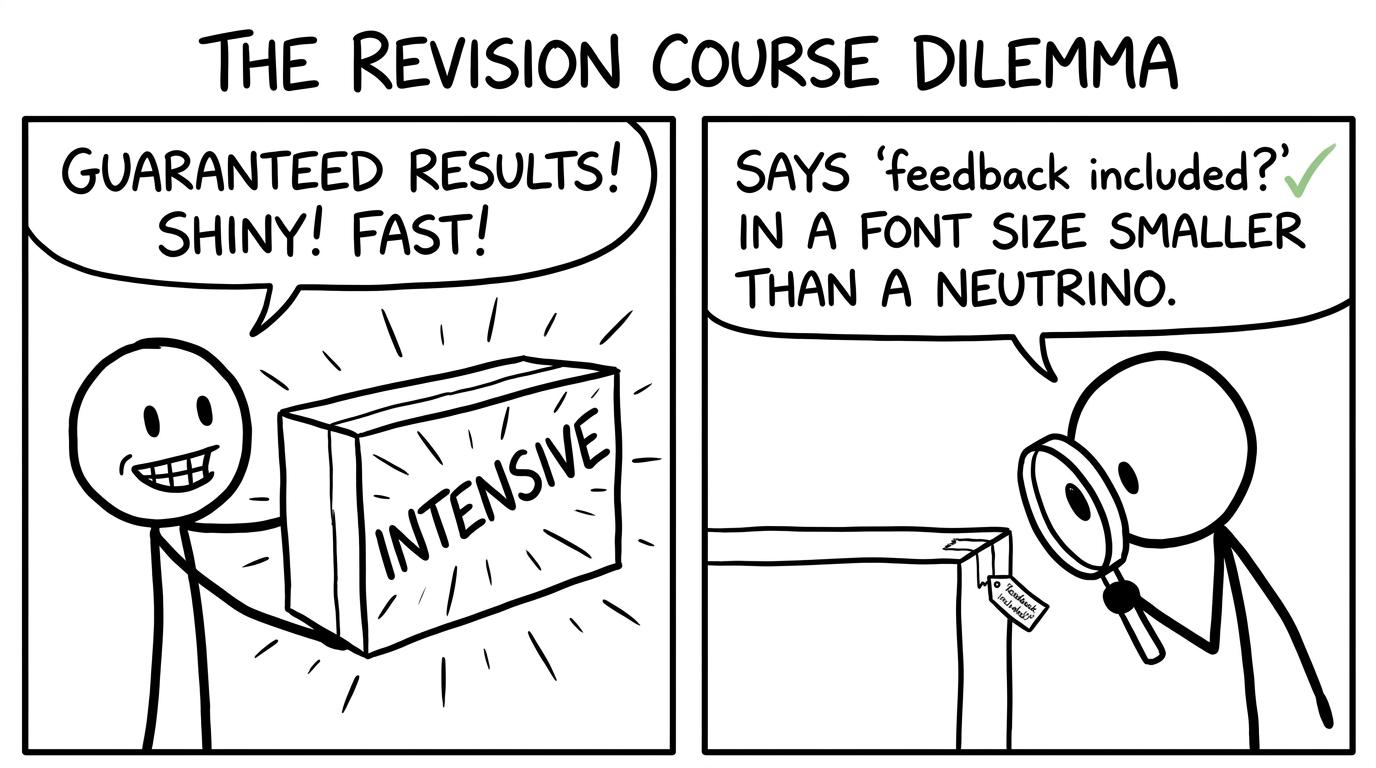 A student uses a magnifying glass to check whether feedback is included in an impressive intensive revision package
How to judge cost rather than just price
Course prices vary with duration, group size, delivery method, location and whether teaching is individual. Advertised prices can change, so compare current written details from providers rather than relying on an old listing.
Ask these questions:
- How many live teaching hours are included?
- How many students can be in the group?
- How much individual speaking time should I expect?
- Is written work marked before, during or after the course?
- Are recordings, resources or follow-up sessions included?
- Does the tutor have recent experience of the current specification?
- What happens if I miss a session?
A cheaper course with no feedback may offer less value than a shorter, focused session addressing one known weakness. Equally, expensive one-to-one tuition is wasteful if you have not first identified what needs fixing.
A useful pre-course test is to complete one listening or reading assessment, attempt a timed writing task and record a speaking response. Classify each problem as knowledge, accuracy, timing, task interpretation or confidence. Then ask the provider how the course addresses those exact gaps.
Protecting your GCSE maths revision time
The audience for a Modern Hebrew course is often preparing for several examinations at once. Every holiday day placed into one subject is unavailable to another. That opportunity cost matters.
Begin with the free GCSE Maths revision hub and use a paper or short test to see where your maths currently stands. If algebra, ratio, geometry or probability still contains major gaps, reserve time to repair them rather than allowing one intensive language course to occupy the whole holiday.
A balanced week might combine live Hebrew sessions with shorter maths blocks. The GCSE one-month revision plan provides a practical rhythm of diagnosis, focused practice and timed work. If full papers feel too heavy, use Edexcel GCSE Maths mini tests for contained practice.
As exams approach, move towards GCSE maths past papers. Sit the correct board and tier, mark it properly and use every lost mark to choose the next topic. The guide to using GCSE past papers properly explains the paper, mark, fix and retest cycle.
Near the final stage, GCSE predicted papers can add fresh exam-style rehearsal, but they should complement topic revision and official past papers rather than replace them. The same principle applies to Modern Hebrew: an intensive resource is most effective after you have diagnosed your needs.
Common mistakes when choosing a revision course
Buying before diagnosing
Anxiety encourages fast decisions. Complete some timed tasks first. Otherwise, you may pay for broad coverage when you need narrow feedback.
Confusing spoken confidence with exam readiness
Being comfortable in conversation is not the same as completing every bullet point, translating accurately or writing with sufficient range. Check all four assessed skills.
Ignoring group size
A course can advertise many hours while offering little individual participation. Ask for the maximum class size and the teaching format.
Assuming intensity guarantees retention
A concentrated course can clarify ideas, but learning fades without retrieval. Plan brief follow-up practice in the days and weeks afterwards.
Sacrificing every other subject
A bootcamp should fit inside a revision plan, not replace one. Use MathsGenie's GCSE maths revision timetable to protect regular maths practice around the course.
Make the decision that solves the real problem
A GCSE Modern Hebrew revision bootcamp is worth the cost when it gives you access to expertise, feedback and speaking practice that you cannot obtain elsewhere. It is not worth paying for a generic confidence boost, a rushed vocabulary recap or hours of passive teaching.
Ask for the specification, timetable, class size, feedback arrangements and current price in writing. Diagnose your weaknesses first. Most importantly, decide what you will do after the course, because improvement comes from using feedback repeatedly rather than merely attending.
Then keep the rest of your revision moving. Use MathsGenie's free revision lessons and practice questions to repair maths gaps, mini tests to check recall, and past papers, predicted papers, mark schemes and video solutions to build examination confidence. Start at MathsGenie and make each session answer one clear question: what am I better able to do now than I was before?