GCSE Media Studies Group Chat Study Tips
GCSE media studies group chat study tips to turn class messages into focused recall, useful feedback and better revision without the usual distractions.

A class group chat can feel productive long before it produces any learning. Someone shares a meme about the exam. Someone else asks which set product is on the paper. Three people reply with different answers. Forty messages later, everyone has been busy, but nobody has revised.
Effective GCSE media studies group chat study is different. Give the chat one precise purpose, ask questions that require recall, check answers against reliable course materials and finish with an individual task. The chat should start the thinking, not replace it.
That principle matters particularly if Media Studies is competing with GCSE maths for your attention. A useful chat can save time. A noisy one quietly consumes the revision session you meant to spend on algebra, statistics or geometry.
The group chat revision checklist
Before sending the first question, agree on a few rules:
- Set one topic and one finishing time for each session.
- Use the specification, teacher materials and current set-product list.
- Ask questions before posting answers.
- Separate factual recall from interpretation.
- Explain ideas using accurate media terminology.
- Correct mistakes kindly and show the source used.
- End with an independent exam task.
- Keep personal information, passwords and private school material out of the chat.
- Mute the conversation when the session ends.
A group chat works best as a small revision tool inside a larger plan. MathsGenie's free revision planner can help you protect time for maths alongside your other GCSE subjects.
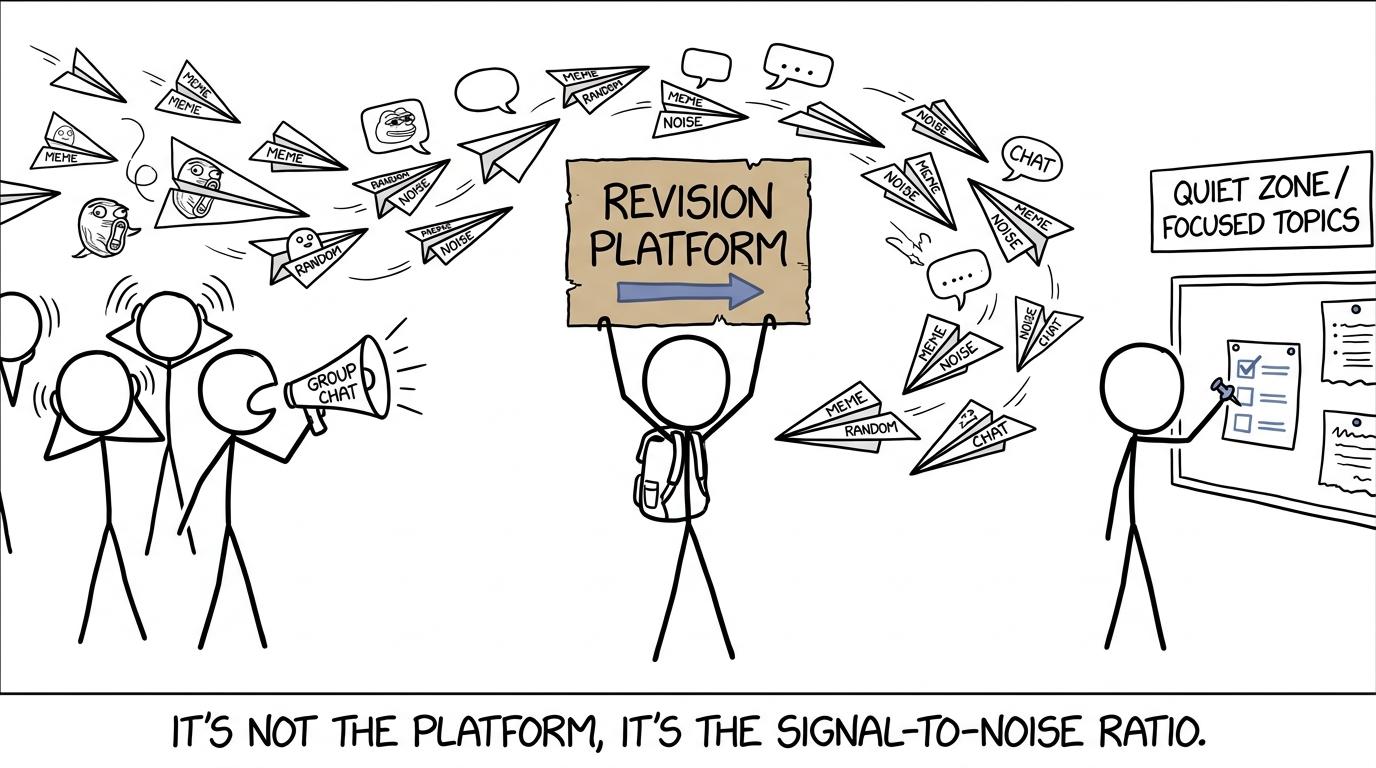 A revision platform trying to survive a storm of group-chat memes
Give every chat session one clear job
The greatest weakness of most revision chats is not distraction. It is vagueness.
“Shall we revise Media?” is too broad. A useful session needs a narrower target, such as recalling the conventions of one media form, comparing representations in two set products or planning the structure of an extended response.
Post the goal at the beginning and pin it if the platform allows:
Tonight's focus: media language in one confirmed set product. Finish by writing an independent paragraph using precise evidence.
This keeps the discussion aligned with what GCSE Media Studies actually assesses. Across current specifications, students study a theoretical framework involving media language, representations, industries and audiences. They also need to apply knowledge when analysing products, making judgements and, as part of the qualification, creating media products.
The exact papers, set products and terminology differ between AQA, OCR and Eduqas. Products can also change between assessment years. Never trust an old screenshot simply because it looks official. Confirm your exam board, specification and assessment year using information supplied by your teacher or exam board.
Turn messages into retrieval practice
Reading somebody else's notes feels fluent because the answer is already visible. Recall is harder: you must bring the idea to mind before checking it. That effort is useful.
Research on retrieval practice supports trying to recall previously learned material rather than relying only on rereading. However, retrieval is not magic. Questions need to be relevant, answers need feedback and the material should be revisited over time.
Use a question-first rule
One student posts a focused prompt without the answer. Everyone replies privately in their notes first, then posts a short response. Only afterwards does the group compare answers with class materials.
Strong prompts might ask members to:
- define a specialist term accurately;
- identify a convention and explain its effect;
- recall evidence from a set product;
- distinguish media language from representation;
- explain how an industry context shapes production;
- suggest how a product addresses a particular audience;
- outline a possible judgement for an extended response.
Avoid prompts that can be answered with “yes”, “no” or a copied sentence. The aim is to retrieve, connect and explain.
Revisit questions instead of burying them
A correct answer tonight does not guarantee recall in the exam. Save the strongest questions in a shared, clearly labelled bank and bring several back after a gap.
Spacing revision across separate sessions is generally more effective for long-term retention than putting every repetition into one evening. A simple rhythm is to revisit a question later in the week and again during a subsequent mixed quiz. Keep the schedule manageable rather than building an enormous system nobody uses.
This approach transfers well to maths. MathsGenie's 20-minute GCSE maths revision routine combines recall, exam-style questions and immediate checking without allowing revision to expand indefinitely.
Build answers, not just lists of facts
Media Studies requires knowledge, but examinations also reward analysis and developed reasoning. A chat containing isolated facts can therefore create false confidence.
Use a three-part response structure:
- Claim: make a clear point that answers the prompt.
- Evidence: identify a precise feature or detail from the relevant product.
- Reasoning: explain how that evidence creates meaning, constructs representation, addresses audiences or relates to context.
This is not a script to repeat mechanically. It is a check against unfinished thinking. If a message contains only a feature, ask what it communicates. If it contains a sweeping interpretation, ask which detail supports it.
The group should also distinguish between observations and interpretations. An observation identifies what is present. An interpretation explains a possible meaning. Different interpretations can be valid when they are grounded in accurate evidence and developed logically.
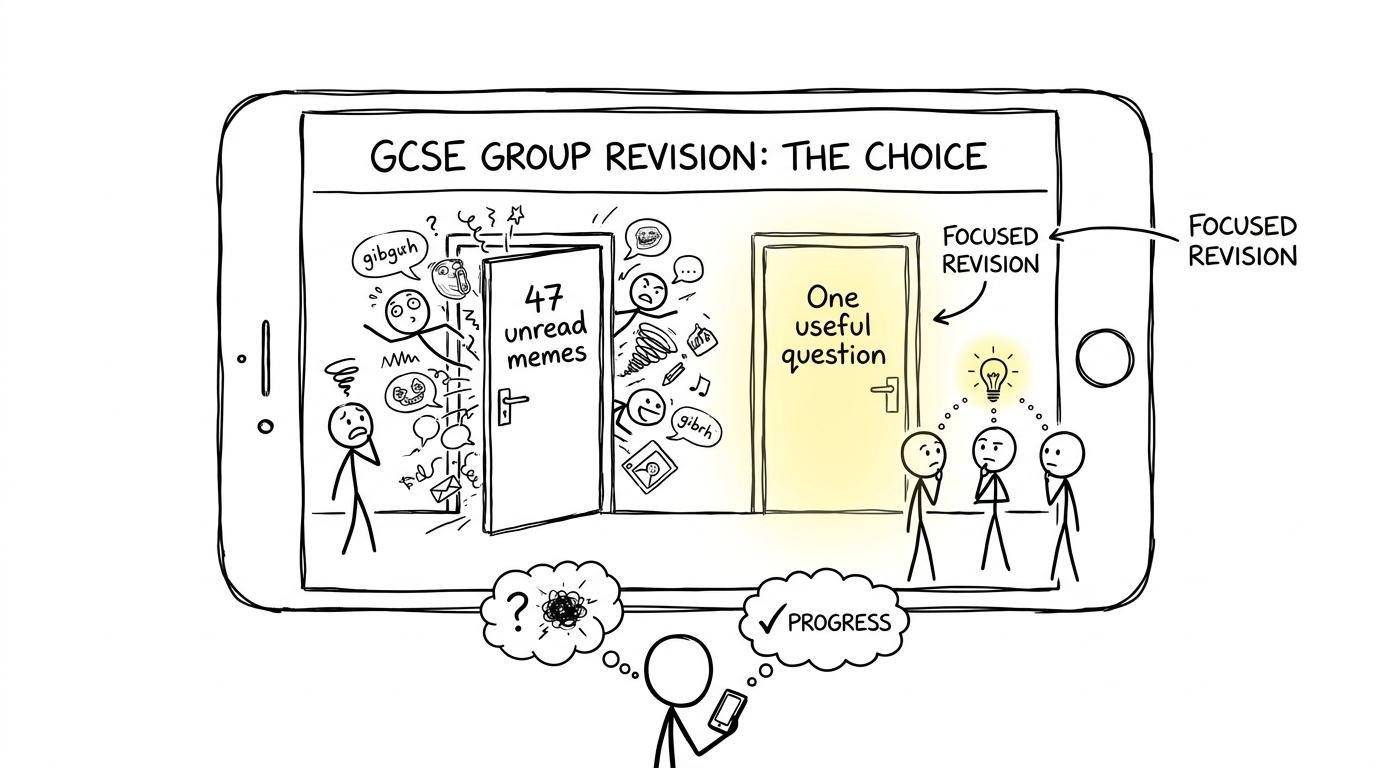 One useful question competing with forty-seven unread memes
Use roles to stop the loudest person taking over
Group revision becomes fragile when one confident student supplies every answer. The others may appear involved while doing little retrieval themselves.
Rotate simple roles:
- Host: states the topic and keeps the session on time.
- Question setter: posts prompts based on confirmed course material.
- Evidence checker: checks names, terminology and product details.
- Devil's advocate: asks for an alternative interpretation or stronger justification.
- Summariser: records agreed corrections and the next review date.
Roles make participation visible without turning the chat into another lesson. They also reduce the risk of misinformation travelling unchallenged.
If the group cannot settle a disagreement, mark it as unresolved and ask your teacher. Do not choose the answer with the most reactions. Popularity is not verification.
Finish every group chat with independent work
Conversation can help you generate ideas, but the examination is individual. You need to retrieve, select and organise material without notifications or hints from friends.
End each chat session with one silent task away from the conversation. This could be a short plan, a timed paragraph, a comparison grid completed from memory or a response to an unseen product. Then check it against your notes, teacher feedback or an appropriate mark scheme.
Use the same cycle in maths:
- attempt the task independently;
- mark it carefully;
- identify the exact weakness;
- return to the relevant lesson;
- practise again without help.
The guide to using GCSE past papers properly explains why the useful learning often happens after the paper, when mistakes are classified and repaired. For realistic maths practice, students can also use Edexcel GCSE Maths past papers with mark schemes and available solutions.
Protect your time, attention and privacy
A revision chat should have boundaries. Agree on a start time, an end time and whether social messages belong elsewhere. Turn off unnecessary alerts during independent work. If somebody misses the session, share a short summary rather than expecting them to search through hundreds of messages.
Keep the group limited to classmates you know. Follow your school's rules and the platform's age requirements. Do not share phone numbers publicly, reveal locations, post passwords or upload restricted assessment material. Check privacy settings, and remember that messages and images can be copied or forwarded.
If a message involves bullying, pressure, inappropriate content or unwanted contact, save the relevant evidence where safe to do so, use the platform's reporting controls and tell a trusted adult or teacher. Revision never requires tolerating behaviour that makes somebody feel unsafe.
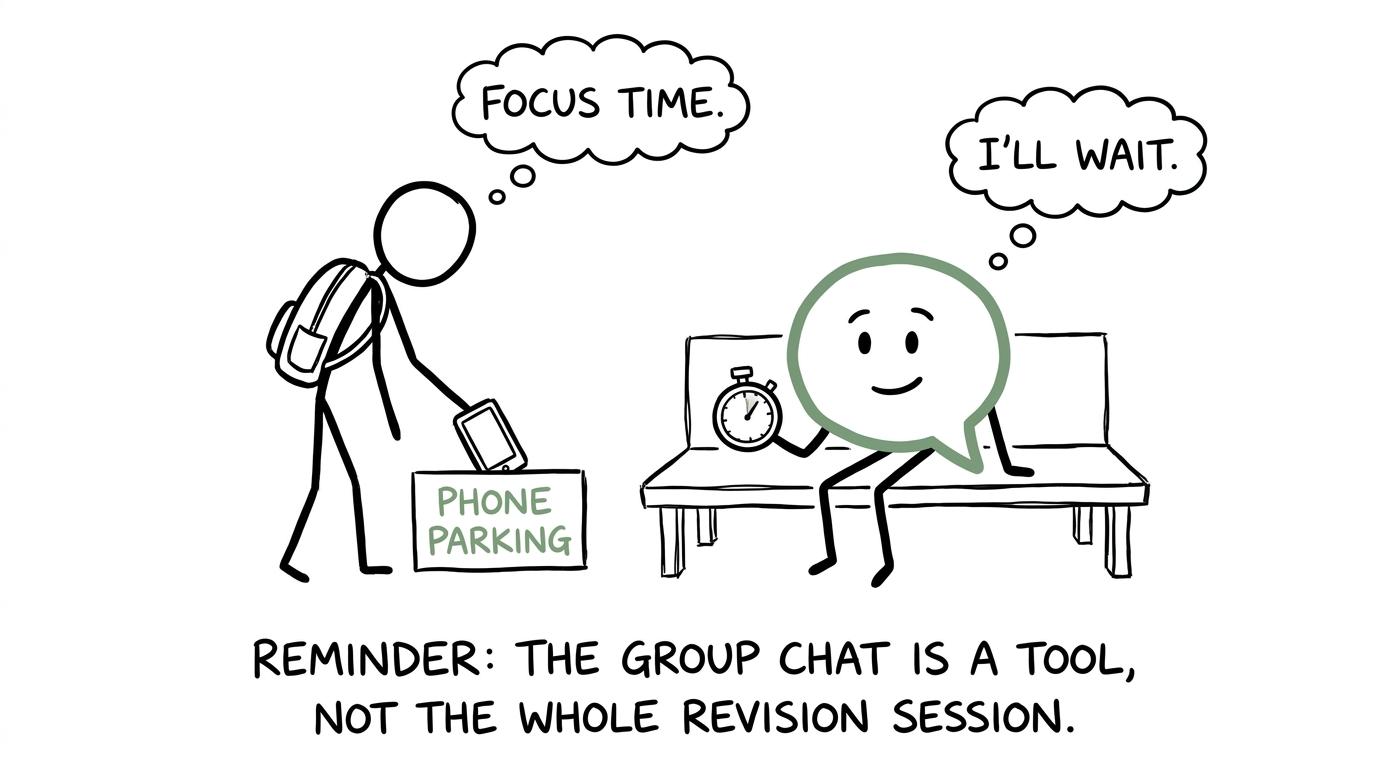 A group-chat bubble waiting while a phone is parked for independent revision
Keep Media Studies revision from swallowing maths time
The most visible subject can become the subject that receives all your attention. Group chats intensify this because other people's urgency arrives directly on your screen.
Plan by need rather than notification volume. Use a timetable that gives each subject a defined space, then move unfinished discussion to the next planned session. MathsGenie's guide to a GCSE maths revision timetable shows how to prioritise personal weaknesses, revisit topics and build towards timed papers.
For maths, keep the sequence simple: revision lesson, practice questions, feedback, mini test and paper practice. The free MathsGenie GCSE and A Level revision hub provides topic resources and exam questions, while GCSE predicted papers can support final exam-style practice. Predicted papers are practice resources, not guarantees of exact exam content.
Common group chat revision mistakes
Letting memes become the session
Humour can reduce tension, but it should be a break rather than the activity. Put social posts in a separate chat or allow them after the revision target is complete.
Copying polished answers
A model paragraph may look impressive while teaching you very little. Attempt the question first, compare responses afterwards and rewrite your own weakest section.
Trusting outdated set-product information
Exam boards can update set products and assessment materials. Check your board, specification and assessment year with your teacher before building quizzes.
Confusing disagreement with error
Media analysis can support more than one interpretation. Ask whether each reading uses accurate evidence and clear reasoning rather than forcing artificial agreement.
Revising only what the group enjoys
Popular topics can crowd out weak ones. Use marked work and teacher feedback to choose sessions, just as a maths diagnostic should guide your next topic.
Staying online after the useful work ends
Once the task is complete, leave or mute the chat. Attention is a revision resource too.
Make the chat smaller and the learning stronger
A productive group chat is not the one with the most messages. It is the one that leaves each person able to do more alone.
Choose one Media Studies target. Retrieve before checking. Support interpretations with evidence. Correct misinformation carefully. Then close the chat and complete an independent task.
Afterwards, protect the rest of your revision plan. Use MathsGenie's free revision lessons, practice questions, mini tests, past papers, predicted papers, mark schemes and video solutions to turn your maths weaknesses into specific next steps. Open the MathsGenie revision planner, schedule your next focused session and let the group chat remain what it should be, a useful tool, not the whole plan.