GCSE Maths Resit Study Plan: 16 Weeks to 2027
GCSE maths resit study plan for summer 2027, with 16 weekly topic blocks, mock checkpoints, past papers and practical revision routines.
Resitting GCSE Maths can feel different from taking it the first time. You already know what an exam hall feels like. You may also remember the questions that made time seem to move twice as quickly.
A GCSE maths resit study plan gives that experience somewhere useful to go. Rather than revising everything at once, this plan divides the course into manageable topic blocks, followed by mock checkpoints and a focused past-paper phase. It runs for 16 weeks from mid-January to early May 2027, before the first summer papers begin.
The aim is not to fill every evening. It is to build a routine you can continue alongside college, work or other qualifications. Start with the topics that support the rest of the course, measure what improves, and use mistakes to decide what happens next.
Your 16-week plan at a glance
The timetable has four phases:
- Weeks 1-4: rebuild number, ratio and algebra foundations
- Weeks 5-8: cover geometry, measures, graphs and statistics
- Weeks 9-12: repair weaknesses through mixed practice and mock papers
- Weeks 13-16: complete timed past papers and prepare for Paper 1
Plan three sessions each week:
- one lesson and skills session lasting 30-45 minutes
- one practice-question session lasting 30-45 minutes
- one mixed test or paper session lasting 45-90 minutes
If that is unrealistic, use four shorter sessions. The best maths resit revision timetable is not the most ambitious one. It is the one that survives a difficult week.
Before starting, confirm your exam board and tier with your school, college or examination centre. You can then select the right board through the GCSE Maths revision hub. Foundation and higher papers share many core skills, but their content and grade ranges are not identical.
Published 2027 timetables currently place the main AQA, Edexcel and OCR GCSE Mathematics papers on 14 May, 27 May and 14 June. Paper order and calculator rules vary by board, so use the timetable issued by your examination centre as the final authority.
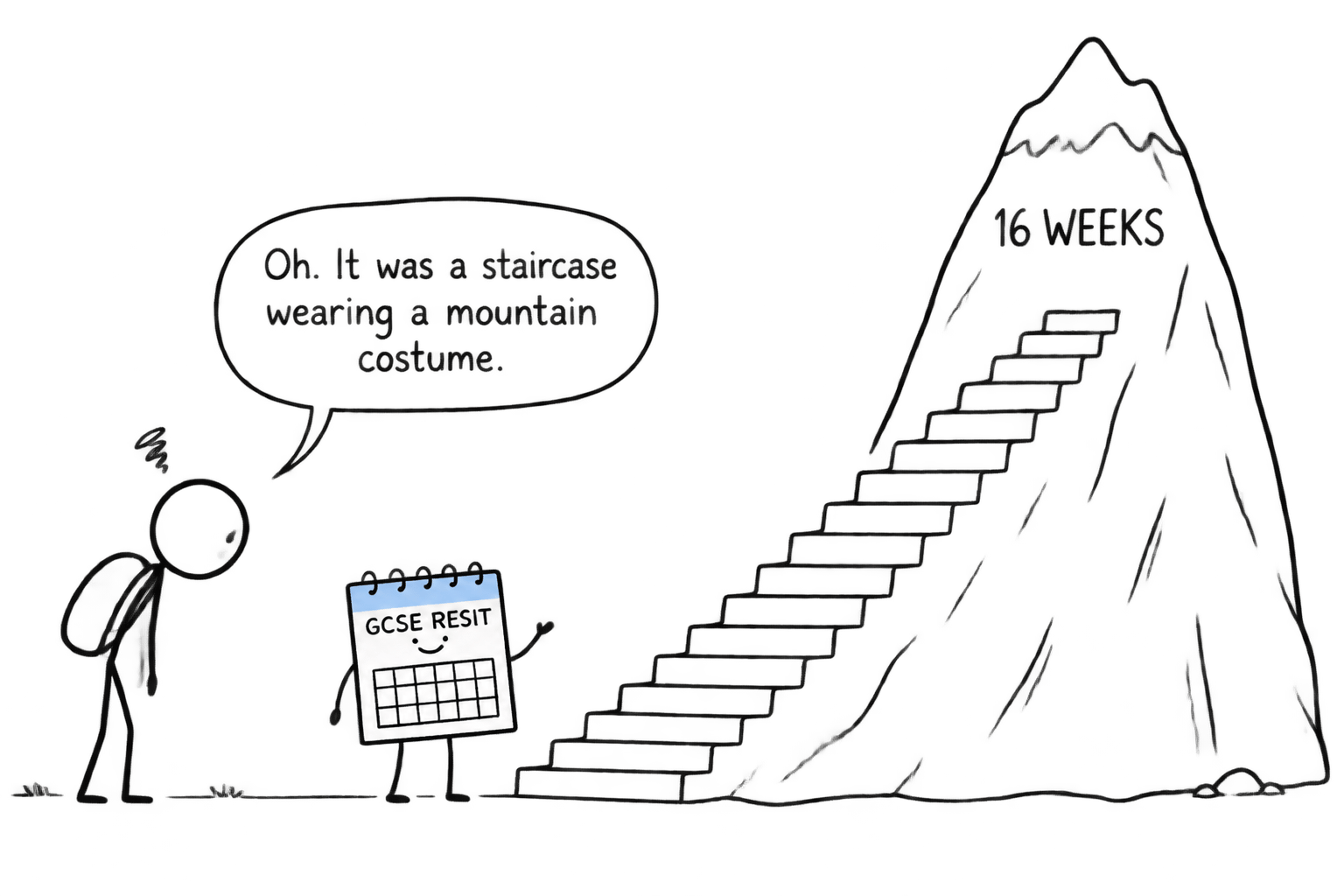 A GCSE resit student discovers that a 16-week revision mountain is really a staircase
Weeks 1-4: rebuild the foundations
The first month is deliberately unglamorous. Fractions, percentages and basic algebra may not look like the hardest material in the specification, but they appear inside more complicated questions. Weak foundations make every later topic more expensive in time.
| Week | Dates | Main topic block | Checkpoint |
|---|---|---|---|
| 1 | 18-24 January | Four operations, negative numbers, place value, estimation and calculator use | Complete a short diagnostic test and create an error log |
| 2 | 25-31 January | Fractions, decimals, percentages, percentage change and reverse percentages | Complete mixed number questions without notes |
| 3 | 1-7 February | Ratio, proportion, rates, unit conversions and best buys | Take a timed mini test and reattempt every error |
| 4 | 8-14 February | Simplifying expressions, substitution, expanding brackets and solving equations | Complete Mock Checkpoint 1 using a half-paper |
Do not use the first diagnostic as a prediction of your final grade. Its purpose is to identify patterns. Label each lost mark as one of four things: missing knowledge, wrong method, inaccurate calculation or misunderstood question.
Suppose a percentage question requires a multiplier. A decrease of 18%18\%18% uses
1−18100=0.82. 1-\frac{18}{100}=0.82. 1−10018=0.82.If you knew the method but entered 1.181.181.18, that is not a reason to revise the whole percentages unit. It is a precise error to repair.
Use your board-specific revision page for explanations, videos and exam-style questions. Edexcel students can begin with the Edexcel GCSE Maths revision resources. Keep one notebook or digital document for errors, corrected solutions and topics that need another attempt.
Weeks 5-8: connect the major topic areas
Once number and algebra are steadier, move into the topics where diagrams, formulas and interpretation become more important.
| Week | Dates | Main topic block | Checkpoint |
|---|---|---|---|
| 5 | 15-21 February | Sequences, coordinates, straight-line graphs and inequalities | Complete mixed algebra and graph questions |
| 6 | 22-28 February | Angles, polygons, bearings and constructions | Mark one timed geometry set |
| 7 | 1-7 March | Perimeter, area, volume, transformations and similarity | Build a list of formulas and facts you still forget |
| 8 | 8-14 March | Averages, charts, probability and scatter graphs | Complete Mock Checkpoint 2 under timed conditions |
Geometry deserves active practice. Watching a solution can make a method look familiar without making it retrievable. Close the video, redraw the information and complete a similar question independently.
For statistics and probability, practise reading the question before calculating. Decide what each figure represents and whether the answer should be a frequency, proportion, probability or average. On a probability scale,
0≤P(A)≤1. 0\leq P(A)\leq 1. 0≤P(A)≤1.That simple check catches impossible answers quickly.
At the end of Week 8, complete a full paper if your stamina allows. Otherwise, use two timed half-papers on separate days. Mark them strictly with the mark scheme, then use video solutions to understand methods you could not reconstruct yourself. MathsGenie's Edexcel GCSE Maths mini tests are useful when a full paper is still too large a step.
Weeks 9-12: turn mock results into decisions
A mock becomes valuable after it has been marked. The score gives you a snapshot, but the lost marks tell you what to do next.
| Week | Dates | Main topic block | Checkpoint |
|---|---|---|---|
| 9 | 15-21 March | Repair the three weakest foundation topics from Mock 2 | Retest each topic with unseen questions |
| 10 | 22-28 March | Multi-step ratio, algebra, geometry and problem-solving questions | Complete one timed mixed assessment |
| 11 | 29 March-4 April | Tier-specific content and remaining specification gaps | Check progress against your topic list |
| 12 | 5-11 April | Full-course consolidation | Complete Mock Checkpoint 3 as a full timed paper |
For foundation students, fluency with accessible questions matters enormously. Avoid abandoning number, ratio or basic algebra because you are tempted by the hardest material. Higher-tier students should also protect those reliable marks while adding topics required by their specification, such as more advanced algebra, trigonometry or functions.
Use a simple priority rule after each assessment:
- Red: you could not begin the question
- Amber: you recognised the topic but made a method error
- Green: you completed it correctly without help
Spend most of the next week on red and amber topics. Green topics still need occasional retrieval, but they should not consume the timetable merely because they feel comfortable.
If your schedule keeps collapsing, adapt the 20-minute GCSE Maths revision routine. A short lesson, several focused questions and one correction can preserve momentum until you have time for a longer paper.
Weeks 13-16: enter the past-paper phase
By mid-April, revision should become increasingly similar to the real assessment. That means unfamiliar question order, strict timing, correct equipment and fewer pauses to check notes.
| Week | Dates | Main topic block | Checkpoint |
|---|---|---|---|
| 13 | 12-18 April | Timed Paper 1 practice and non-calculator fluency where required | Mark the paper and rank lost marks by topic |
| 14 | 19-25 April | Timed calculator-paper practice and targeted repairs | Complete one paper plus two short repair sessions |
| 15 | 26 April-2 May | Full mock series or two full papers on separate days | Compare recurring errors across papers |
| 16 | 3-9 May | Final Paper 1 preparation, recall and light mixed practice | Complete the final checkpoint early in the week |
Use past papers from your own exam board and tier. MathsGenie's revision hub brings together question papers, mark schemes and supporting solutions, while the GCSE Maths topics by exam board and tier guide can help you check whether a weakness belongs on your specification.
Do not complete endless papers without analysis. A productive paper cycle is:
- Sit the paper under timed conditions.
- Mark it without adjusting answers.
- Record every lost mark by topic and error type.
- Review the relevant lesson or video solution.
- Complete focused practice questions.
- Reattempt the original question several days later.
Keep scores, but compare them carefully. Grade boundaries can vary between series, so raw marks are most useful for tracking your own improvement on comparable papers. Accuracy by topic is often a better guide to the next revision session.
You can place every session into the MathsGenie revision planner. Schedule specific tasks such as “ratio mini test” or “mark Paper 1”, rather than vague blocks labelled “maths”. Specific tasks remove the daily negotiation about what to revise.
What happens after Week 16?
Week 16 ends before the first main summer paper. After Paper 1, do not try to reconstruct every answer with friends or online discussions. Write down the topics that felt uncertain, then turn your attention to the remaining papers.
The gaps between papers are part of the summer resit maths plan. Continue with short mixed sessions, calculator fluency and focused work on topics not heavily tested in the previous paper. Predicted papers may provide extra practice, but they are not promises about what will appear. Cover the whole specification and treat predictions as mixed revision.
For a shorter final-stage structure, use the GCSE one-month Maths revision plan alongside your error log.
Common mistakes that weaken a resit plan
Revising only comfortable topics
Familiar work feels productive because answers arrive quickly. Improvement usually sits inside the questions you avoid. Keep some confidence-building practice, but let diagnostic results shape most sessions.
Watching without practising
Videos can clarify a method, but recognition is not the same as recall. Follow every lesson with questions completed independently and without notes.
Saving past papers until the final week
Past papers train pacing, concentration and question selection. Begin with sections or mini tests, then move towards full timed papers from Week 12 onwards.
Recording scores but not errors
A mark total cannot tell you whether the problem was fractions, algebra or reading the wording. Your error log should name the topic, explain the mistake and include a corrected method.
Ignoring exam-board and tier differences
Use resources that match your entry. Check your board, tier, calculator rules and final timetable with your examination centre rather than relying on a generic online schedule.
Make the next 16 weeks count
A resit is not a request to repeat the same experience. It is an opportunity to revise with better information. You know where confidence disappeared last time, where timing became difficult and which methods never became secure.
Start with Week 1, not with the entire mountain. Choose your board in the free MathsGenie GCSE Maths revision hub, complete a diagnostic, and put three realistic sessions into the revision planner. Then let each mini test, mock and past paper determine the next useful step.
Sixteen weeks is long enough for consistent practice to compound. One corrected mistake can look small. Repeated across an entire course, it becomes a different paper and a stronger result.