

GCSE Latin Revision Timetable Clash: A Realistic Plan
GCSE Latin revision timetable clash? Build a realistic six-subject plan that protects Latin recall, maths practice, proper rest and exam priorities.

The difficult part of revising six GCSE subjects is rarely finding something useful to do. It is deciding what deserves your attention tonight. A GCSE Latin revision timetable clash often appears when vocabulary, set texts and grammar compete with maths papers, science content and essay-based subjects.
The practical answer is not to divide every hour equally. Give Latin several short retrieval sessions each week, protect two or three deeper maths sessions, and adjust the balance according to exam dates, weaknesses and recent practice-paper results. That gives Latin enough repetition without allowing your other subjects to disappear.
Here is the basic plan:
- map every exam date and genuine school commitment;
- separate short recall tasks from longer exam practice;
- give Latin frequent, compact sessions;
- give maths protected problem-solving blocks;
- use marked work to decide what comes next;
- review the timetable once a week rather than rebuilding it daily;
- leave spare capacity for tired days and unexpected work.
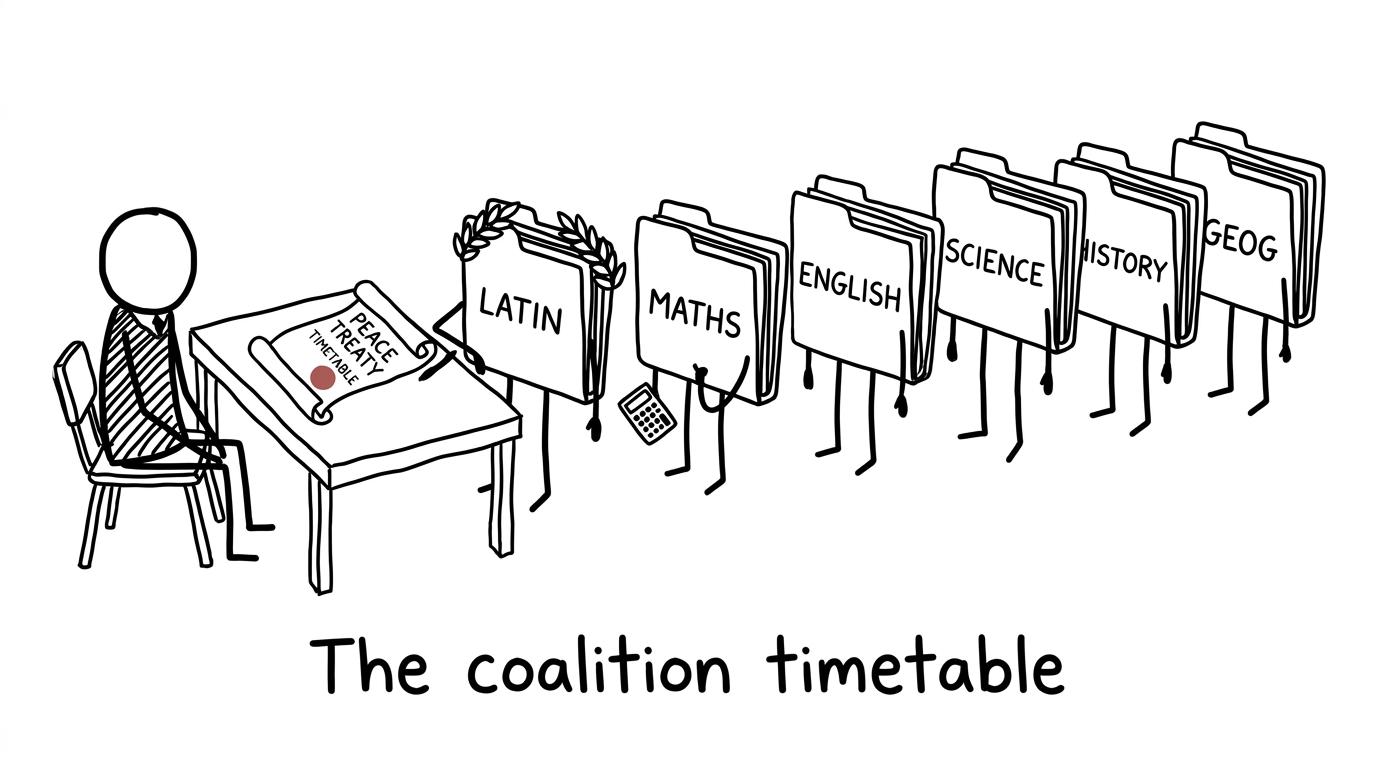 Six subject folders negotiating over a revision timetable
Why Latin creates a revision timetable clash
Latin has several kinds of learning packed inside one qualification. Depending on your exam board and options, you may need vocabulary, accidence, syntax, unseen translation, comprehension, prescribed literature and knowledge of Roman culture.
The current OCR GCSE Latin specification has a compulsory language component and two further literature or culture components. Its language assessment represents 50%50\%50% of the qualification. Eduqas also gives 50%50\%50% of its GCSE Latin qualification to Latin Language, alongside literature, sources or Roman civilisation components. You should still check the current specification and prescribed material for your own board because options and set texts differ.
That mixture matters for planning. Vocabulary benefits from regular recall, while translation requires uninterrupted concentration. Literature needs knowledge of the text as well as analysis. Treating all three as one vague task called “Latin revision” makes the subject feel larger than it is.
Maths creates the opposite problem. You can recognise a formula or method without being able to use it independently. Progress therefore depends on answering questions, checking solutions and returning to errors. Simply reading notes is not enough.
The clash is really between different types of attention. Your timetable should reflect that.
Start with an exam map, not a perfect weekly grid
Before assigning subjects to evenings, collect the final exam dates supplied by your school or college. Exam boards coordinate timetables and consider historical clash information, but individual candidates can still have papers close together or, occasionally, scheduled at the same time.
If two official examinations appear to clash, tell your exams officer immediately. Do not attempt to solve an official exam clash by choosing which paper to attend. Your centre will explain the arrangements that apply to you.
For revision planning, place each paper on one calendar and add:
- the exam board and paper name;
- whether your maths paper is foundation or higher tier;
- calculator or non-calculator status where relevant;
- Latin language, literature or civilisation components;
- coursework deadlines and unavoidable school events;
- one lighter evening each week.
Then work backwards. A subject with an earlier paper may temporarily receive more time, but later subjects should retain small maintenance sessions. Revision balance is dynamic. Equal time every week can be less fair than changing the emphasis deliberately.
Build the timetable from three types of session
A realistic six-subject plan becomes easier when sessions have specific jobs.
Short recall sessions
Use sessions of roughly 101010 to 202020 minutes for Latin vocabulary, principal parts, endings, quotations or details from prescribed sources. Close the book and retrieve the answer before checking it. The effort of recalling is the useful part.
Spacing these sessions across the week is generally more effective for durable memory than placing the same total time into one last-minute block. Small sessions are also easier to fit around homework, travel and family commitments.
Focused skill sessions
Reserve approximately 303030 to 505050 minutes for Latin translation, literature analysis or maths topic practice. Each session should have one clear outcome, such as identifying errors in unseen translation or completing exam questions on a weak maths topic.
MathsGenie’s free GCSE maths revision lessons and practice resources let you move from an explanation to exam-style questions without spending part of the session searching for suitable work.
Timed assessment sessions
Longer blocks are for whole papers, paper sections or mini tests under controlled conditions. They matter, but they should not dominate every evening. A full paper creates useful evidence only if you also allow time to mark it and repair the gaps it exposes.
The guidance on when to start GCSE past papers explains how to move from smaller diagnostic tasks towards full timed papers as the exams approach.
Give Latin a small daily foothold
Latin can survive a busy week surprisingly well if it keeps returning. Four short recall sessions and one deeper language or literature session are often more manageable than one enormous Sunday block. The precise amount should depend on your current knowledge, paper dates and teacher feedback.
A useful weekly pattern might contain:
- two vocabulary retrieval sessions;
- one grammar or syntax check;
- one set-text or source recall session;
- one longer translation or literature task;
- one brief review of errors from marked work.
This is a framework, not a quota. If unseen translation is costing you marks, move time towards language. If vocabulary recall is secure but literature evidence is vague, change the balance. OCR and Eduqas both place substantial weight on language, so it should not quietly disappear beneath set-text revision.
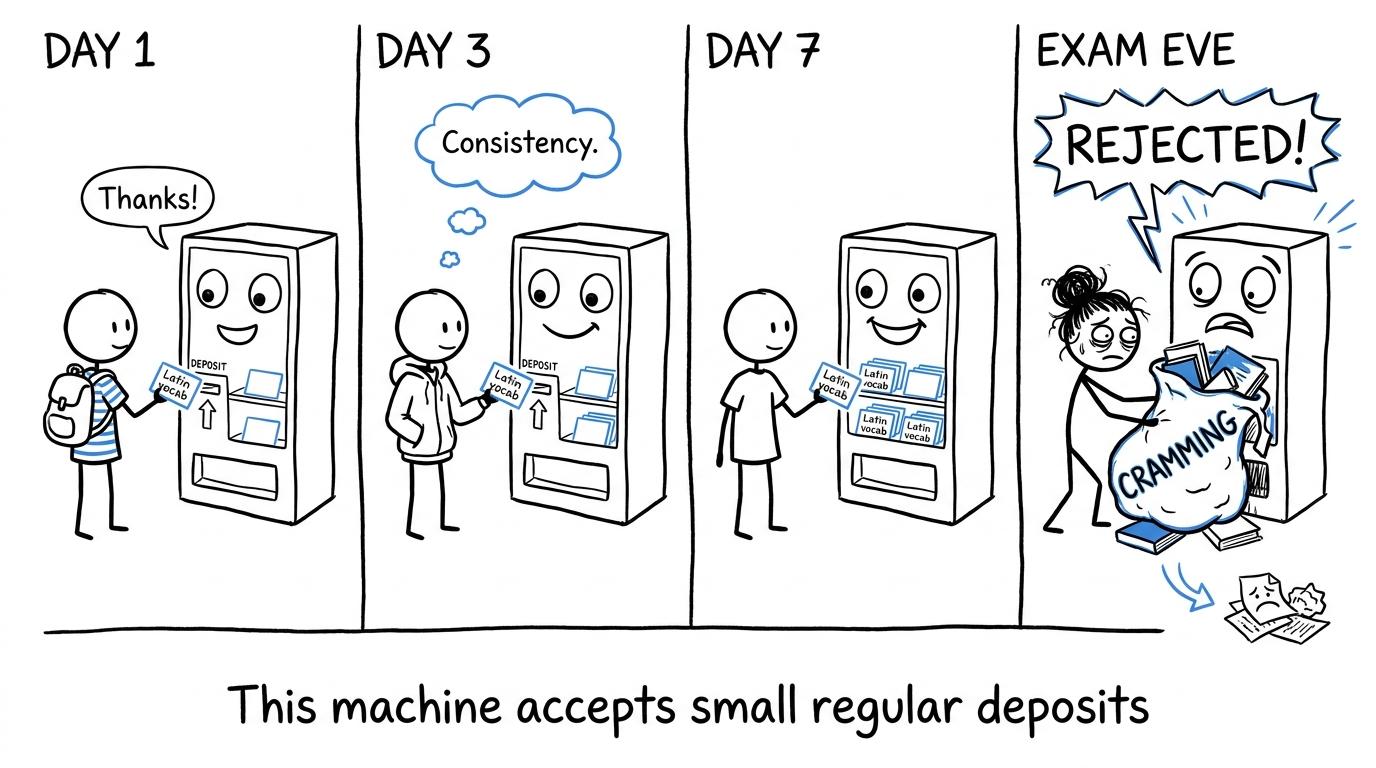 A revision machine accepting small regular Latin vocabulary deposits
Protect maths without revising it every night
Maths needs continuity, but continuity does not mean doing a full paper daily. Two or three purposeful sessions can achieve more than seven evenings of unfocused question browsing.
Use a simple cycle:
- diagnose a weakness with a mini test or paper section;
- revisit the relevant method;
- answer questions without notes;
- mark the work carefully;
- record why each mark was lost;
- return to the same skill after a gap.
The mistake log is especially valuable. Separate errors caused by missing knowledge from those caused by arithmetic, notation, misreading or time pressure. Your next session should respond to the cause rather than merely repeat the paper.
If you take Edexcel, Edexcel GCSE Maths predicted papers provide timed practice with mark schemes and worked solutions. Predicted papers are useful for fresh practice, but they are not promises about exact exam content. GCSE predicted topics revision guidance explains how to use recurring skills without gambling your revision on guesses.
Students following AQA, OCR or Eduqas maths should use materials matching their own specification and paper structure. Across boards, the underlying routine remains the same: attempt, mark, diagnose and repair.
Use a weekly budget rather than a rigid daily promise
A timetable should guide decisions, not create guilt. Instead of promising that every subject will receive exactly the same time each day, set a realistic weekly budget.
For example, decide how many focused blocks are available after lessons, homework, meals, exercise and sleep. Assign those blocks according to:
- exam proximity;
- likely marks available;
- weaknesses shown by recent work;
- the kind of concentration required;
- whether the subject already receives substantial lesson time.
Keep around one block unallocated. This buffer absorbs a difficult homework task, illness or a session that takes longer than expected. Without a buffer, one disrupted Tuesday can make the whole week appear to have failed.
When a Latin paper is close, Latin may receive the extra block. When a maths paper follows, transfer it to timed maths practice. This is planned imbalance, not neglect.
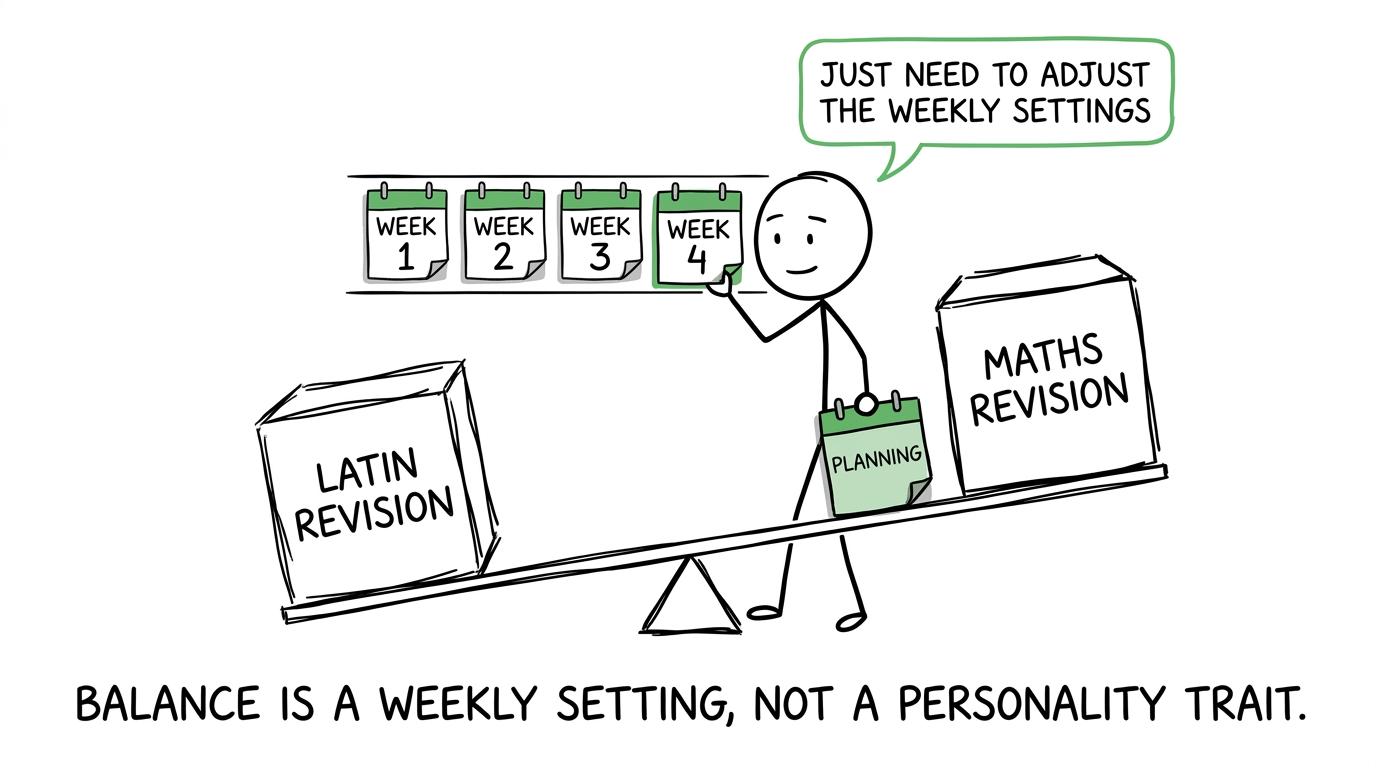 Latin and maths balancing on a flexible weekly revision seesaw
Make every session produce evidence
A revision plan improves when it responds to evidence rather than anxiety. At the end of a task, record one of three outcomes:
- secure enough to revisit later;
- partly secure and worth testing again;
- not secure and requiring explanation or teacher support.
For maths papers, mark schemes reveal where method marks are earned and where precision matters. The guide to using Edexcel GCSE Maths past papers properly shows how marking, logging errors and reattempting difficult questions turn a paper into future progress.
Use a similar principle in Latin. After a translation, identify whether the problem came from vocabulary, endings, sentence structure or English expression. After literature practice, distinguish missing textual knowledge from weak analysis. “Revise Latin more” is too broad to be useful. “Retest passive verb endings on Thursday” can become an action.
What to change during exam week
As papers begin, stop trying to preserve an ordinary revision timetable. The next examination deserves attention, but the subject after it should retain a small foothold.
After an exam, avoid spending the afternoon reconstructing every answer with friends. The paper is finished. Eat, rest and move to the next controlled task. If maths is approaching, the GCSE maths exam-week checklist offers a calm structure for final practice, marking and preparation.
Keep final sessions selective. Review known errors, key Latin vocabulary, difficult constructions and maths methods that have previously cost marks. A last-minute attempt to cover the entire specification usually creates noise rather than confidence.
Common mistakes when fitting six subjects together
Giving every subject identical time
Subjects differ in exam date, weighting, confidence and revision method. Fair planning responds to those differences.
Writing “Latin” or “maths” as the task
Name the output: vocabulary retrieval, unseen translation, algebra questions or a timed paper section. Specific tasks are easier to begin and assess.
Turning every free hour into revision
A timetable with no meals, movement, rest or spare capacity will collapse. Sustainable plans include limits.
Completing papers without reviewing them
The score is only a diagnosis. The improvement comes from understanding lost marks and practising the weak skill again. Advice on making a paper feel manageable is available in how to make GCSE maths papers feel easier.
Dropping Latin until the weekend
One long session encourages familiarity but gives fewer opportunities for retrieval. Keep brief Latin contact across the week and use the longer block for demanding work.
Rebuilding the timetable after one missed session
Move the highest-priority unfinished task into the buffer or next suitable block. Do not spend revision time redesigning the entire calendar.
A timetable should reduce decisions
The best timetable is not the most colourful or crowded. It is the one that tells you what to do when energy is limited. Give Latin frequent opportunities for recall, protect deeper sessions for translation and maths problem-solving, and let marked work determine the next priority.
Then make the maths side easy to run. Start with MathsGenie’s free GCSE maths revision hub, choose a focused revision lesson, complete the practice questions, and check your work using the available mark schemes and video solutions. As exams approach, add mini tests, past papers and predicted papers under timed conditions.
Six subjects do not need six equal pieces of every evening. They need a realistic weekly system, honest evidence and the freedom to change emphasis when the calendar changes. Build that system now, then let MathsGenie help you turn each protected maths block into marks.










