GCSE Italian 4 to 7: A Practical Revision Plan
GCSE Italian 4 to 7: discover the changes in vocabulary, grammar, speaking and exam technique that can move your performance up the grade bands.
A grade 4 in GCSE Italian often means you can communicate the main idea, recognise familiar language and complete straightforward tasks. A grade 7 demands something more deliberate: developed answers, secure time frames, broader vocabulary, careful listening and the confidence to adapt language when a question changes.
That makes the GCSE Italian 4 to 7 journey less about memorising hundreds of impressive phrases and more about improving what happens under pressure. You need to understand more precisely, communicate more fully and make fewer errors that obscure your meaning.
The shortest answer is this: move from recognising Italian to retrieving and manipulating it. Practise all four skills, use Higher tier material, analyse mark schemes and make every correction feed into your next session.
Your grade 4 to grade 7 checklist
Use this as a quick diagnosis:
- Confirm that you are preparing for Higher tier, where grade 7 is available.
- Build active vocabulary by topic rather than merely rereading word lists.
- Use past, present and future time frames with growing accuracy.
- Extend opinions with reasons, examples and consequences.
- Practise listening without relying on every word being familiar.
- Develop speaking answers without memorising rigid scripts.
- Read for detail, tense, attitude and implied meaning.
- Complete timed writing and translation tasks.
- Record mistakes by cause and revisit them within the week.
- Use your exam board's specification and current assessment materials.
What separates a grade 4 from a grade 7 in GCSE Italian?
Official modern foreign language descriptors are published at grades 2, 5 and 8 rather than every individual grade. They are intended as broad indicators, not mark schemes. Even so, the movement between the grade 5 and grade 8 descriptions reveals what stronger performance looks like.
At the lower end of this journey, a student generally conveys meaning in familiar situations, gives simple opinions and understands key points. Closer to grade 7, the student deals with longer and more complex material, identifies opinions, infers meaning, sustains conversation and manipulates grammar with greater accuracy.
| Grade 4 habits | Grade 7 direction |
|---|---|
| Gives brief, relevant information | Develops points with reasons and detail |
| Relies on familiar vocabulary | Selects varied language and handles some unfamiliar words |
| Uses simple structures repeatedly | Combines secure simple language with some complex structures |
| Recognises the general message | Extracts details, opinions and implied meaning |
| Uses time frames inconsistently | Refers successfully to past, present and future events |
| Recites prepared speaking material | Adapts answers and responds to unpredictable questions |
| Makes frequent errors that sometimes blur meaning | Maintains clarity, including when attempting ambitious language |
The important distinction is not perfection. Grade 7 work can contain errors. The difference is that communication remains clear and the student demonstrates range, control and independence.
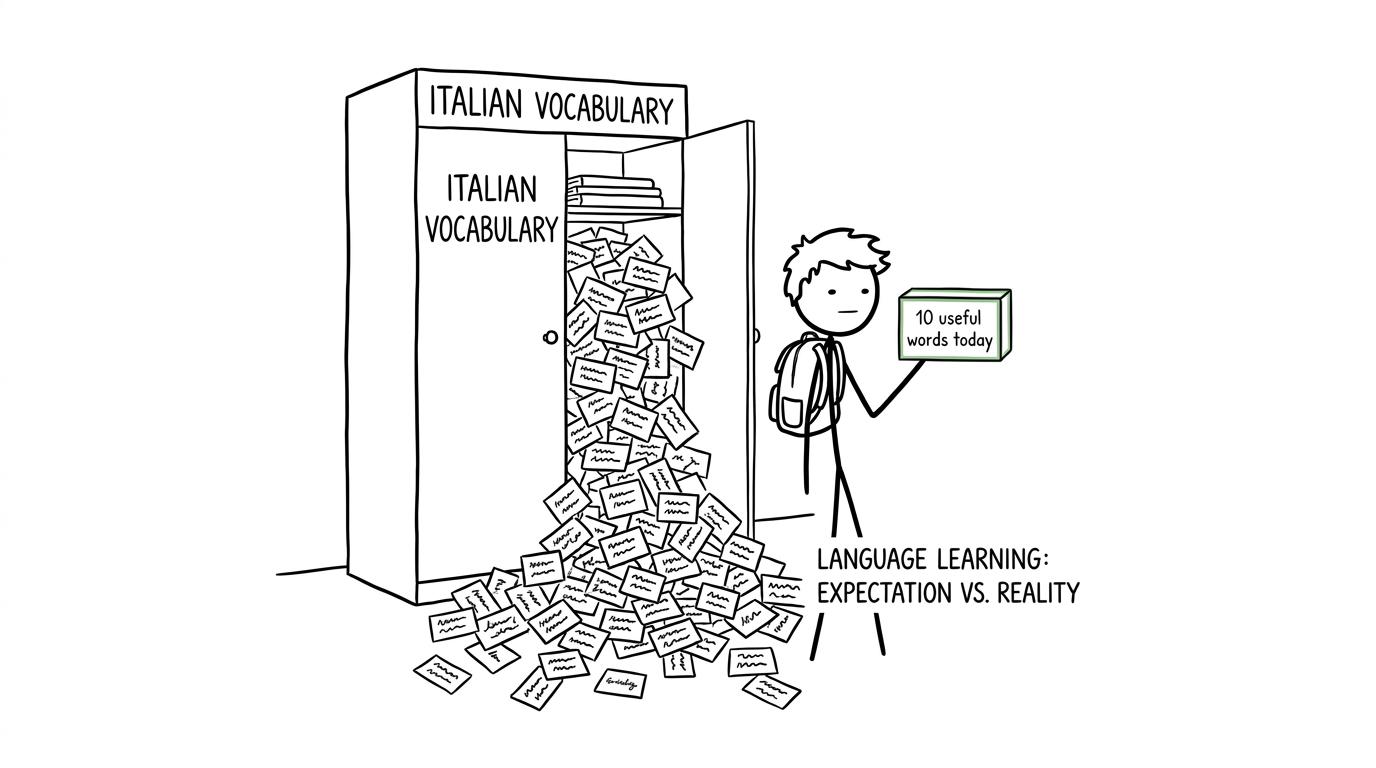 A student controls a wardrobe full of Italian vocabulary by choosing a small daily box
Make vocabulary active rather than familiar
A word can feel familiar on a revision card yet disappear during a speaking assessment. Recognition and retrieval are different skills.
Build vocabulary in small topic groups, but test it in both directions. Seeing an Italian word and recalling its English meaning helps reading. Seeing the English meaning and producing Italian is harder, but it is what speaking, writing and translation require.
Prioritise language that performs several jobs:
- high-frequency verbs;
- opinion and justification phrases;
- time markers;
- connectives;
- adjectives and intensifiers;
- language for comparing, explaining and disagreeing;
- vocabulary from your exam board's prescribed themes.
Do not treat the specification's vocabulary list as a guarantee that every Higher tier word will be familiar. Current GCSE Italian requirements allow Higher tier assessments to include less familiar language. Context, word families and grammar therefore matter alongside memorisation.
A productive vocabulary session ends with retrieval: cover the answers, say the words aloud, spell them and use them in your own response. The same active-recall principle appears in MathsGenie's GCSE Maths revision hub, where learning becomes useful only when it is followed by independent practice.
Strengthen grammar without making every answer complicated
Students sometimes hear “use complex language” and begin forcing fragile constructions into every sentence. That can reduce clarity rather than improve a response.
Secure the grammar with the greatest reach first:
- present-tense verb forms and common irregular verbs;
- a reliable past time frame;
- a reliable future time frame;
- agreements involving nouns, articles and adjectives;
- negatives and object pronouns;
- modal verbs followed by an infinitive;
- comparative language;
- conjunctions that create longer, connected sentences.
Then add selected higher-level structures that you genuinely understand. Range matters, but controlled range is worth more than decoration. Your aim is to choose language according to meaning rather than insert memorised phrases regardless of the question.
Create a short error log with categories such as verb ending, agreement, spelling, word order and missed detail. This mirrors the feedback loop in MathsGenie's guide to revising efficiently for GCSE Maths: attempt, mark, diagnose, fix and retest.
Improve each of the four GCSE Italian skills
For current AQA and Pearson Edexcel GCSE Italian specifications, listening, speaking, reading and writing each contribute 25%25\%25% of the qualification. A grade increase is therefore rarely built on writing alone. Improvement must be broad enough to survive across all four components.
Listening: stop waiting for every word
Grade 7 listening depends on tracking meaning while some vocabulary remains unknown. Before the recording begins, inspect the questions and anticipate the type of information required. During the recording, listen for time markers, negatives, changes of opinion, reasons and contrasts.
After practice, do not record only whether an answer was wrong. Ask why:
- Did you not know the vocabulary?
- Did you miss a negative?
- Did you confuse who performed the action?
- Did you recognise the word too slowly?
- Did you write the first plausible answer before the speaker corrected it?
Replay short sections after marking and transcribe what you hear. This connects sound, spelling and grammar far more effectively than repeatedly playing a whole paper.
Speaking: prepare building blocks, not a script
A memorised paragraph can sound fluent until the examiner asks an unexpected question. Higher performance requires interaction: listening, responding, developing an idea and recovering when the conversation moves away from rehearsed material.
Prepare flexible building blocks for opinions, reasons, comparisons and different time frames. Practise answering the same question in several ways. Record yourself, listen back and check pronunciation, verb forms, pauses and whether you actually answered the question.
Try a simple extension rule: after the direct answer, add a reason and one relevant detail. Longer is not automatically better, but developed answers give you more opportunities to demonstrate range.
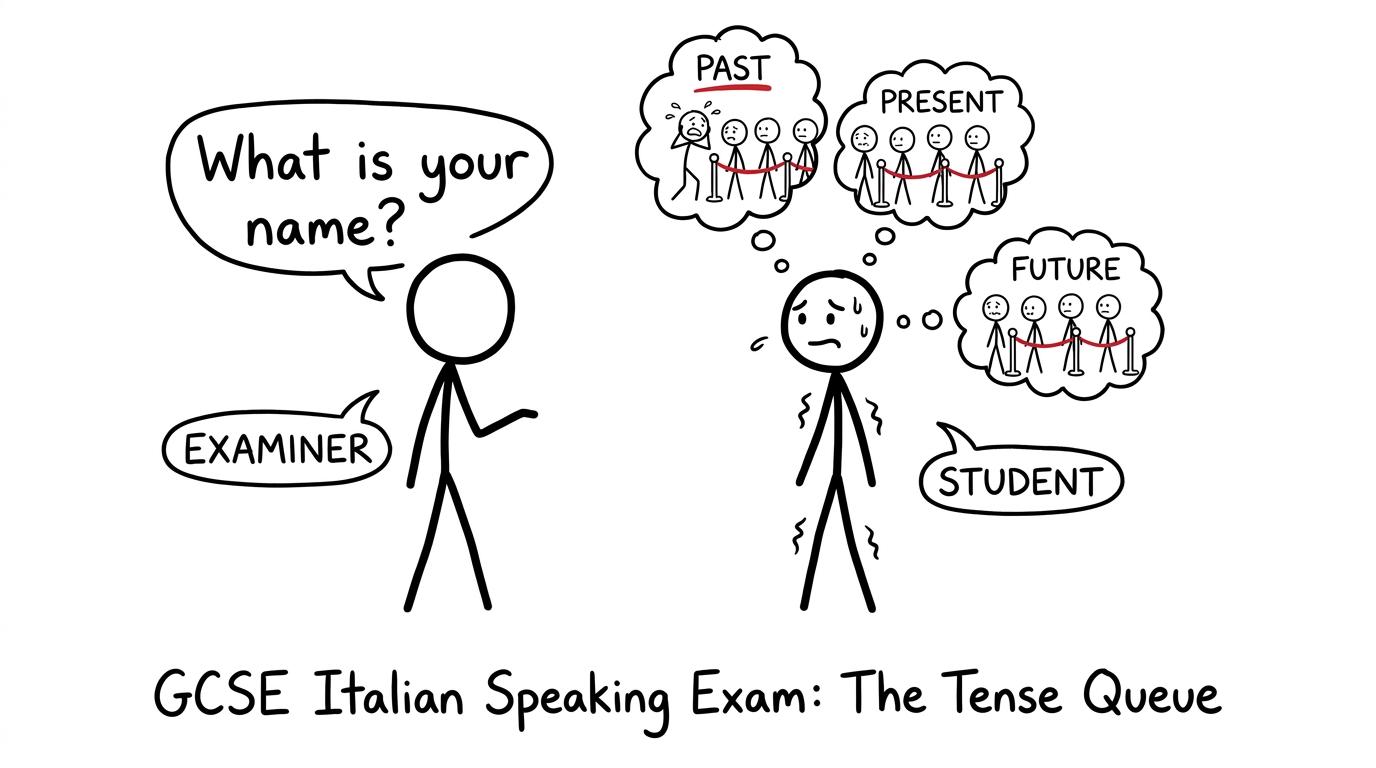 Past, present and future wait politely to enter a GCSE Italian speaking answer
Reading: become a language detective
At grade 4, spotting a familiar word may be enough to locate a basic answer. At grade 7, that same strategy becomes dangerous because distractors often reuse vocabulary from the question.
Underline the evidence supporting your answer. Check the subject of each verb, identify the time frame and notice contrast words that reverse the direction of a sentence. When a word is unfamiliar, inspect its prefix, suffix, surrounding words and relationship to vocabulary you already know.
Translation into English should sound natural while preserving every important detail. Check negatives, quantities, pronouns and tense before moving on.
Writing: make coverage your first priority
Read every bullet point carefully and plan which content and time frame each requires. A polished paragraph cannot earn marks for a bullet point you ignored.
Build the response around clear communication, then improve it with varied vocabulary, justified opinions and controlled structures. Leave time to check high-value features: verb endings, agreements, spelling, accents, negatives and whether each time reference is clear.
Use mark schemes to compare your response with the assessment criteria rather than simply counting corrections. The method described in MathsGenie's guide to using past papers properly transfers well: sit the task, mark it honestly, identify the main causes of lost marks and reattempt the weakest parts.
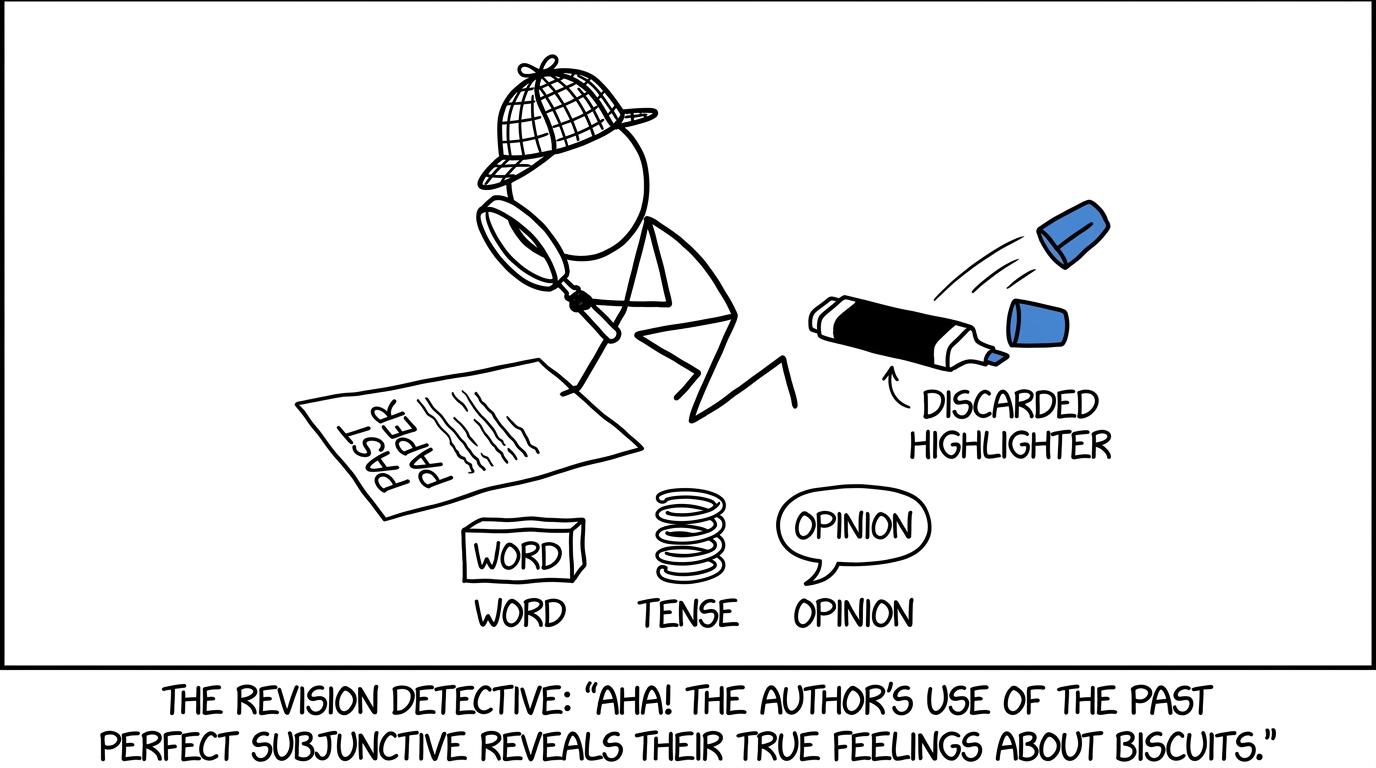 A student detective searches a past paper for clues about word, tense and opinion
Build a weekly revision system
A grade jump is usually the result of repeatable feedback, not one heroic weekend. A balanced week could include:
- one vocabulary retrieval session;
- one grammar and translation session;
- one focused listening session;
- one recorded speaking session;
- one timed reading or writing task;
- one review of errors from earlier sessions.
Use the same rhythm each week, but let your evidence determine the focus. If listening errors repeatedly come from negatives, practise negatives in listening rather than vaguely deciding to “do more Italian”.
MathsGenie's GCSE revision timetable guide offers a useful structure for balancing short learning sessions with longer timed practice. Its guide to starting GCSE past papers also explains why papers should be introduced in phases rather than saved until the final days.
When you practise Italian papers, use materials for your exact exam board, specification and tier. AQA and Pearson Edexcel formats differ, so confirm task requirements with your teacher and current specification. Grade 7 is a Higher tier outcome; both boards require students to take all components at the same tier.
Do not build your plan around one historical grade boundary. Boundaries change between exam series because they reflect the demands of that year's assessments. Track your raw performance, skill weaknesses and mark-scheme feedback instead.
The specific changes most likely to move you up
If your time is limited, make these changes first:
- Replace rereading with closed-book retrieval.
- Replace complete speaking scripts with adaptable answer frameworks.
- Replace isolated tense drills with timed responses using several time frames.
- Replace “I got it wrong” with a precise reason for every lost mark.
- Replace occasional long sessions with shorter, repeated contact.
- Replace untimed comfort practice with some unfamiliar tasks under exam conditions.
- Replace ambitious but inaccurate phrases with controlled, reusable structures.
- Replace passive marking with a corrected second attempt.
This is also how strong maths revision works. MathsGenie's Edexcel GCSE Maths past papers and predicted papers are designed to turn attempts into diagnosis, followed by targeted practice and solutions. Italian requires different content, but the improvement loop is the same.
Common mistakes when aiming for grade 7
Revising only writing
Writing feels controllable, but each of the four skills carries substantial weight. Protect time for listening and spontaneous speaking.
Memorising answers word for word
Rigid scripts are difficult to adapt and can lead to irrelevant answers. Memorise useful language patterns, then practise rebuilding responses.
Adding complexity before securing accuracy
A smaller set of reliable structures creates a foundation for ambitious language. Complexity should extend meaning, not hide uncertainty.
Ignoring the exact task
Missing a bullet point, tense or command can limit an otherwise strong response. Underline the task requirements before beginning.
Completing papers without analysing them
A score describes one performance. It does not tell you what to do tomorrow. Categorise errors and reattempt the relevant section.
Turn better habits into better grades
Moving from a grade 4 to a grade 7 in GCSE Italian is not about sounding like a native speaker. It is about becoming a more independent GCSE candidate: retrieving vocabulary, controlling several time frames, developing ideas, detecting detail and adapting when the language is unfamiliar.
Start with one assessed task. Mark it, identify three recurring weaknesses and plan the next week around them. Then repeat the cycle.
And if Italian is only one part of a crowded GCSE timetable, let MathsGenie simplify the maths side. Use the free GCSE Maths revision lessons and practice questions, then progress to past papers, predicted papers, mini tests, mark schemes and video solutions. Fewer decisions leave more attention for the work that changes grades.