GCSE ICT Grade: Does It Matter for Sixth Form Entry?
GCSE ICT grade sixth form entry explained: learn how much colleges care, when ICT matters, and why maths, English and course grades often count more.
Does your GCSE ICT grade matter for sixth form entry?
Results day has a strange way of making every grade feel equally enormous. One disappointing result can appear to outweigh everything else, even when an admissions policy says otherwise.
The short answer to the GCSE ICT grade sixth form entry question is reassuring: most sixth forms and colleges do not treat ICT as a universal entry requirement. They usually place more weight on your overall GCSE profile, GCSE maths and English, and the subjects most closely related to your chosen course.
Your ICT grade can still matter. It may contribute to the number of GCSE passes you need, affect entry to a related digital course, or help when two applicants have similar profiles. But it is rarely the single grade deciding whether you can continue into post-161616 education.
The crucial detail is that entry requirements are set by individual providers. Read the current admissions policy and course prospectus for every place you are considering rather than relying on a general rule.
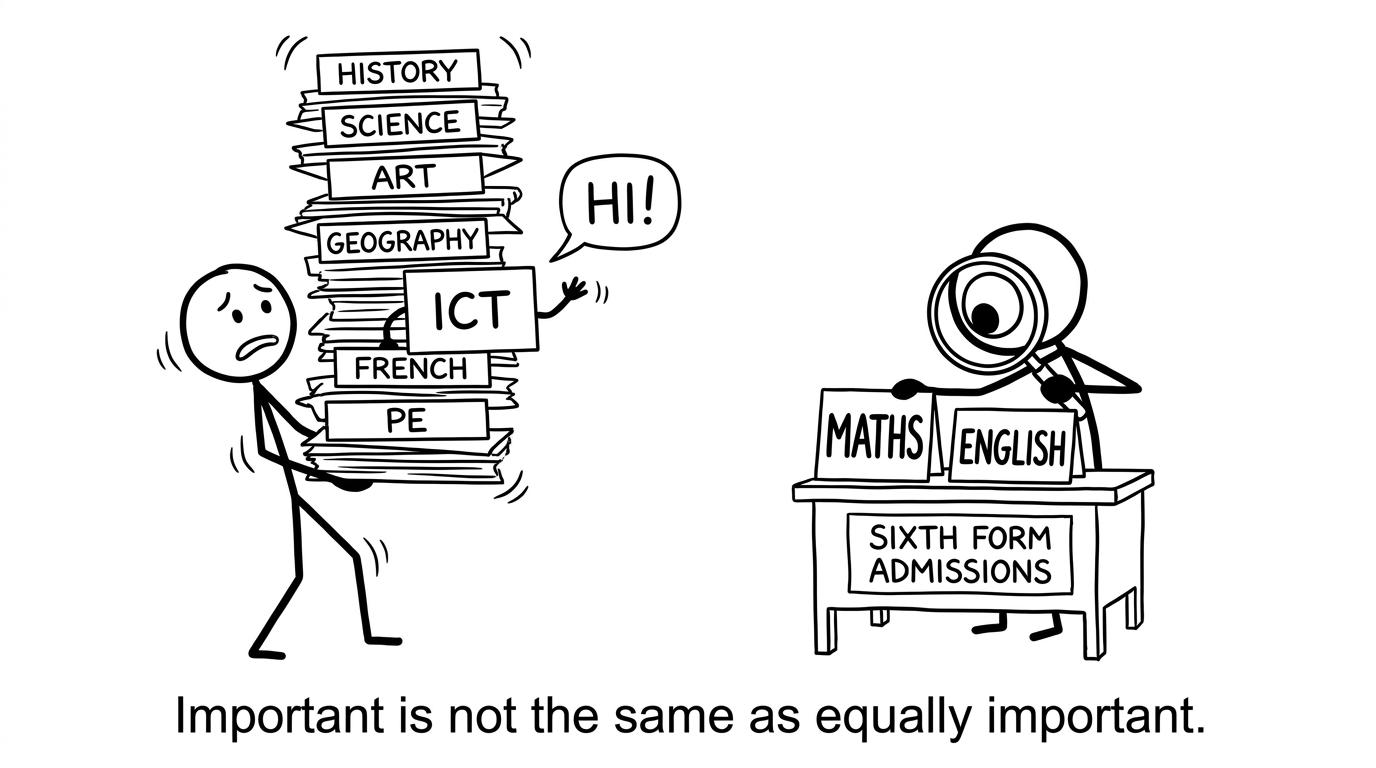 A sixth-form admissions desk examining Maths and English grades while ICT waves from the stack
The quick admissions checklist
Before worrying about one ICT result, check these five things:
- General entry threshold: How many GCSEs must be at grade 444, 555 or above?
- Maths and English requirements: Does the provider require grade 444 or grade 555 in each?
- Course-specific grades: What does each A Level, T Level or vocational course require?
- Qualification type: Is your result GCSE ICT, GCSE Computer Science or a vocational digital qualification?
- Admissions year: Are you reading the policy for the year in which you will actually start?
This turns a vague fear into a practical question: does your exact grade meet the exact published rule?
How much weight do sixth forms actually put on ICT?
There is no universal percentage or national weighting for ICT. In practice, its importance usually falls into one of four categories.
| Situation | Likely weight given to ICT |
|---|---|
| ICT is simply one of your GCSE subjects | Usually part of your overall grade profile |
| You are applying for an unrelated A Level | Usually limited unless the prospectus names ICT |
| You are applying for IT, computing or a digital vocational course | Potentially significant, depending on the course rules |
| Your application is borderline | It may contribute to a wider judgement alongside other results |
Many sixth forms publish a general requirement such as a specified number of GCSEs at grades 999 to 444, 999 to 555 or 999 to 666. Some also calculate an average or total from your best results. In these systems, ICT may count without receiving any special status: it is one tile in the mosaic rather than the whole picture.
Subject requirements can be more decisive. A sixth form may ask for a particular grade in the subject you want to continue, while courses not offered at GCSE may use a related subject instead. That is why two courses at the same institution can treat your ICT result differently.
Why maths and English usually receive more attention
Current sixth-form admissions policies commonly name GCSE maths and English explicitly. ICT is much less often a general requirement.
There is also a structural reason. In England, Department for Education funding rules require eligible students on post-161616 programmes who have not achieved grade 444 or above in GCSE maths or English to continue working towards approved qualifications in the relevant subject. A full-time student with grade 333 will generally need to continue towards GCSE maths or English under those rules.
There is no equivalent national condition requiring every student to continue ICT. That does not make ICT unimportant; it means maths and English occupy a different position in post-161616 education.
If your time is limited and you are balancing several borderline subjects, protecting your maths and English grades is therefore often the sensible priority. Start with the GCSE Maths revision hub, where you can choose your exam board and work through revision lessons, exam questions and papers.
For a clearer map of what to revise, use the GCSE maths topics by exam board and tier. It separates Foundation and Higher content across Edexcel, AQA, OCR and Eduqas rather than treating GCSE maths as one indistinct subject.
When your ICT grade matters more
You need it as one of your required passes
Suppose a provider asks for a certain number of GCSEs at or above a stated grade. ICT may be included in that count if the institution accepts the qualification and it meets its rules.
In that case, the subject itself is not necessarily being prioritised. The grade matters because it helps you cross the overall threshold. Check whether vocational qualifications, short courses or older qualifications are counted in the same way as full GCSEs.
You are applying for a related course
ICT can carry more weight when you apply for an IT, digital, computing or technology pathway. Yet you should not assume that every computing course demands GCSE ICT.
Some Computer Science courses focus more closely on GCSE maths because programming, algorithms and logical problem-solving depend on mathematical confidence. Other providers may accept evidence from Computer Science, ICT or another digital qualification. A vocational IT course may use broader entry criteria.
The correct question is not simply, “Is ICT relevant?” It is, “Which prior qualification and grade does this particular course require?”
Your overall profile is close to the threshold
If you comfortably satisfy the general and subject-specific conditions, one lower ICT result is unlikely to overturn the whole application unless ICT is expressly required.
If you narrowly miss the threshold, every result can become more important. A provider might consider available places, predicted grades, verified circumstances or alternative courses, but discretion is never guaranteed. The published policy remains your safest guide.
You want to demonstrate digital confidence
A strong result may support the story told by your application, particularly for a relevant course. However, evidence of interest does not normally replace a mandatory grade. Admissions decisions begin with eligibility before moving to the broader picture.
GCSE ICT, Computer Science and digital qualifications are not identical
Students often use “ICT” as a convenient label for several different qualifications. Admissions teams may not.
In England, the reformed GCSE ICT was discontinued, with the final examinations taking place in 201920192019. Current pupils are more likely to hold GCSE Computer Science or a vocational digital or information technology qualification. Arrangements can differ elsewhere in the UK, so the exact title and awarding organisation matter.
Write the qualification exactly as it appears on your statement of entry or results document. If an admissions page refers to “ICT or equivalent”, ask the provider whether your course is included. Do not translate it into what you think they mean.
This distinction also matters because GCSE Computer Science is not merely a newer name for ICT. Computer Science gives greater attention to computational thinking, algorithms, programming and computer systems. A digital or IT qualification may place more emphasis on applying technology in practical contexts.
 A student holding an upside-down prospectus at a sixth-form and college crossroads
How to check your real entry position
Begin with the provider's current prospectus and admissions policy. Look separately for general entry requirements and course-specific requirements; they are often presented in different sections.
Then contact admissions if any wording is unclear. Useful questions include:
- Does my exact ICT or digital qualification count towards the general GCSE total?
- Is ICT required or merely recommended for my intended course?
- If the course asks for Computer Science, will my qualification be accepted as an equivalent?
- Which maths grade is required for Computer Science, IT or another technical course?
- What alternative pathway may be available if I miss one condition?
Keep the answer in writing where possible. Requirements can change between admissions cycles, and advice from a friend who applied last year may no longer match the published rules.
What should you prioritise during GCSE revision?
Admissions criteria are not a reason to neglect ICT. They are a reason to allocate revision time intelligently.
First, identify any non-negotiable grades for your intended destination. Next, protect the subjects that appear in both the general criteria and your course requirements. For many students, maths and English will sit near the top of that list. Then address subjects, including ICT or Computer Science, that contribute to the required overall profile.
 A student overwhelmed by seven books receiving a calm weekly revision planner
If maths is one of the grades standing between you and your preferred course, build revision around evidence rather than mood. The GCSE maths revision timetable explains how to balance topic practice with timed questions, while the one-month GCSE maths revision plan provides a more concentrated structure.
Use a paper to find weaknesses, not merely to generate a score. The guide to using GCSE past papers properly shows how to mark, diagnose and retest mistakes. Nearer the examination, Edexcel GCSE Maths predicted papers can provide an additional dress rehearsal for Edexcel students.
Prioritising is not the same as abandoning a subject. It means giving the next revision session to the grade most likely to affect your available choices.
Common mistakes when judging entry requirements
Assuming every sixth form uses the same rules
One provider may require a broad set of passes, while another sets a higher overall threshold. A college may also offer several levels of course with different criteria. Always check each destination separately.
Treating ICT and Computer Science as interchangeable
They are distinct qualifications. Use the official title and confirm whether the provider accepts it for the intended course.
Looking only at general entry requirements
Meeting the overall threshold does not necessarily qualify you for every subject. A Level Maths, Further Maths, sciences and Computer Science may carry additional requirements, often involving the relevant GCSE or maths.
Believing one low grade automatically ends the application
A weaker ICT grade may have little effect if it is not required and your remaining profile meets every condition. Do not reject yourself before reading the policy or speaking to admissions.
Ignoring maths while worrying about ICT
For many applications, a borderline maths result has wider consequences than an unrelated ICT result. Use MathsGenie's free GCSE maths resources to turn that concern into targeted practice.
Your next step
Your GCSE ICT grade matters in context, not in isolation. It may count towards your overall pass total, carry extra weight for a related course or influence a borderline application. But most sixth forms and colleges place greater emphasis on their general GCSE threshold, maths and English, and grades connected directly to your chosen programme.
Check the real policy. Ask about your exact qualification. Then put your revision time where it keeps the most doors open.
MathsGenie can help you strengthen one of the grades that appears repeatedly in post-161616 entry requirements. Start with the free GCSE Maths revision area, then move between revision lessons, practice questions, mini tests, past papers, mark schemes and video solutions. When the exams are close, use predicted papers to test whether the work has stayed with you. Clarity about entry requirements gives you the plan; careful practice gives you the grade.