GCSE ICT Grade 5 Meaning: A Clear Guide
GCSE ICT grade 5 meaning explained: ability, old letter-grade comparison, grade boundaries and practical next steps for stronger GCSE maths revision.
A result can look wonderfully precise while still leaving you confused. You see a grade 5 beside ICT, know that grade 9 is highest, and wonder whether you have done well, merely passed or fallen short of what a college might expect.
The short answer to gcse ict grade 5 meaning is this: on an English GCSE using the grades 9-1 scale, grade 5 represents a solid mid-range result above the grade 4 standard-pass benchmark. It sits broadly across the upper part of the old grade C range and the lower part of the old grade B range. However, it is not an exact replacement for either letter.
There is one important complication. The unreformed GCSE ICT qualification was discontinued in England and traditionally used letter grades. A current result described casually as “ICT” may actually be GCSE Computer Science, a vocational digital qualification or another course. Check the precise qualification title, awarding organisation and grading scale on your statement of results before interpreting it.
Grade 5 at a glance
Here is the practical summary:
- Grade 5 is above grade 4, the standard-pass benchmark in England.
- It indicates secure overall attainment, although not mastery of every part of a specification.
- It lies within the broad area previously covered by grades B and C.
- It is not a fixed percentage and cannot be converted reliably without the correct grade boundaries.
- It does not automatically meet every sixth-form, college or apprenticeship requirement.
- A grade 5 in an ICT-related subject does not create the same resit obligation associated with GCSE English language and maths.
- You must check whether the qualification was GCSE ICT, GCSE Computer Science or a vocational digital course.
That final point matters more than it seems. Similar classroom names can conceal qualifications with different content, assessments and grading systems.
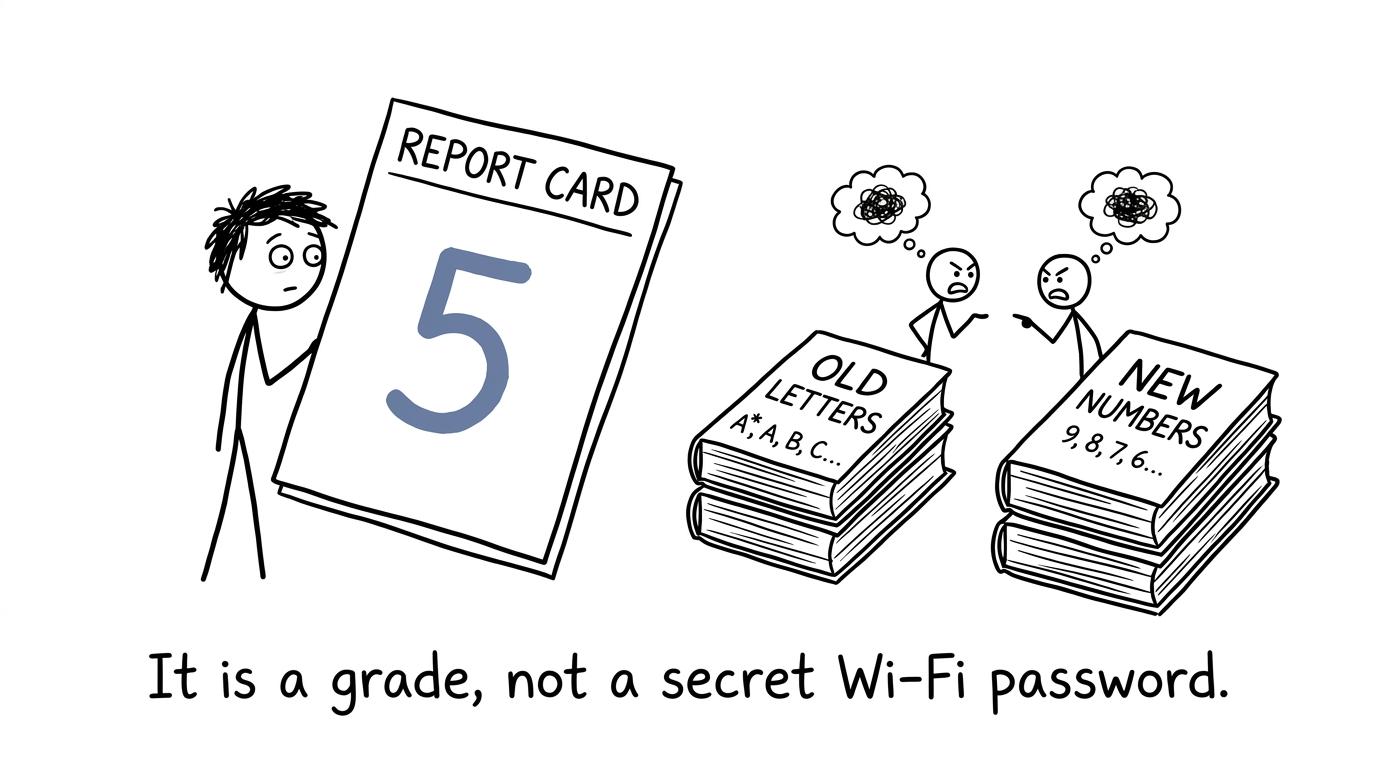 A student discovers that a GCSE grade is not a secret Wi-Fi password
What does a grade 5 actually represent in terms of ability?
A grade is evidence of performance across an entire assessment. It is not a certificate saying that every topic has been mastered equally.
On a relevant grades 9-1 digital or computing qualification, a grade 5 would usually suggest that the student can demonstrate a reasonably secure understanding of much of the assessed content. They can apply knowledge in familiar contexts, interpret information, communicate explanations and make sensible decisions in a range of questions or tasks. They may also succeed with some less familiar material.
The gaps tend to appear when several ideas must be connected, when an explanation needs precise technical detail, or when an unfamiliar scenario requires independent judgement. That is the difference between knowing isolated facts and controlling them under examination pressure.
The precise abilities depend on the specification. GCSE Computer Science may assess algorithms, programming, data representation, networks, cyber security and the effects of digital technology. A vocational digital qualification may place more emphasis on practical applications, project work or workplace contexts. Legacy GCSE ICT specifications had their own balance of theory and controlled assessment.
For that reason, grade 5 should be read as secure overall performance in the qualification actually taken, not as a universal list of computing skills.
Is grade 5 a strong pass in GCSE ICT?
Grade 5 is often called a “strong pass”, but the phrase needs context.
The Department for Education uses grade 5 or above as the strong-pass benchmark within headline school performance measures for GCSE English and maths. Grade 4 is the standard-pass benchmark. Students sometimes extend those labels to every GCSE because they provide a convenient way to understand the scale.
For an ICT-related subject, grade 5 is certainly a respectable result above grade 4. But “strong pass” is not a promise that every institution will treat it identically. A college might ask for a particular grade in maths, English or the subject you wish to continue. Another course may consider your overall GCSE profile.
Always read the exact entry requirement. If it says “five GCSEs at grade 4 or above”, grade 5 exceeds that stated threshold. If it asks for grade 6 in Computer Science or maths, grade 5 does not meet it. The course wording, not the informal label, decides.
How grade 5 compares with the old letter grades
The numbered and lettered scales do not match grade by grade. Ofqual established comparable points at selected boundaries:
| Grades 9-1 reference point | Old-scale comparison |
|---|---|
| Bottom of grade 7 | Comparable with the bottom of grade A |
| Bottom of grade 4 | Comparable with the bottom of grade C |
| Bottom of grade 1 | Comparable with the bottom of grade G |
Grades 4, 5 and 6 therefore divide the broad performance range previously associated with grades B and C more finely. Grade 5 was designed to sit around the upper section of the former C range and the lower section of the former B range.
So it is reasonable to describe grade 5 as between an old B and C, provided that description remains approximate. Calling it simply “a B” is too generous; calling it merely “a C” loses the extra distinction created by the numbered scale.
This comparison also explains why older relatives may interpret the result differently. They remember one letter covering a wider band of performance. The modern scale separates that band into more steps.
Why a current “GCSE ICT” result needs checking
In England, GCSE ICT was not reformed into the grades 9-1 system and was discontinued. GCSE Computer Science became the main GCSE qualification in this area, alongside vocational digital and information-technology courses.
Therefore, if your school, family or results discussion uses “ICT” as a general label, look at the formal details:
- the full qualification title;
- the exam board or awarding organisation;
- whether the result uses grades 9-1, letters or vocational labels;
- whether it is a GCSE or another Level 2 qualification;
- the specification or qualification code.
Edexcel, AQA and OCR offer or have offered computing-related qualifications, while Eduqas and WJEC arrangements can vary according to the nation and specification. Most GCSEs in Wales continue to use letter grades, although some centres may offer qualifications graded 9-1. Northern Ireland also has different qualification arrangements from England.
This is not administrative trivia. A grade only makes sense inside its qualification. If the certificate says Computer Science, use that specification and its published grade boundaries. If it names a vocational course, read the awarding organisation's own grading guidance rather than forcing the result into a GCSE comparison.
Why grade 5 is not a fixed percentage
A common assumption is that every grade 5 represents one universal percentage. It does not.
Grade boundaries are set for each examination series using assessment evidence, statistical information and expert examiner judgement. If a paper proves more demanding, the boundary may be lower. If it proves less demanding, the boundary may be higher. Boundaries can also differ between subjects, specifications and exam boards.
This means a raw mark only becomes meaningful when matched with:
- the correct qualification;
- the correct exam board;
- the correct examination series;
- the correct tier, if the subject is tiered;
- the official overall qualification boundary.
Component boundaries may sometimes be described as notional. The overall subject grade is what appears on the certificate. Do not combine boundaries from different years or use one board's figures to judge another board's paper.
The same principle matters in maths. MathsGenie's guide to Edexcel and OCR GCSE maths grade boundaries explains why a raw mark must be interpreted in the right board and paper context.
What grade 5 means for your next step
For many general entry requirements, grade 5 is useful because it is above the grade 4 benchmark. Yet the decision belongs to the school, college, employer or apprenticeship provider. Requirements can vary by course and may focus particularly on English and maths.
If you want to take A Level Computer Science, check the provider's published criteria. Some providers may expect a higher grade in Computer Science, maths or both. Where a school did not offer GCSE Computer Science, it may use a maths requirement instead. Never assume that one national rule applies everywhere.
For students preparing for maths exams, the useful lesson is that a grade is a diagnosis, not an identity. A grade 5 says something about performance on one assessed course at one point in time. It does not set a ceiling on what comes next.
Start by opening the GCSE maths revision hub, selecting the correct board and matching your practice to your tier. MathsGenie supports Edexcel, AQA, OCR, Eduqas, WJEC and CCEA with free revision resources.
Turning a grade 5 into a stronger maths result
Moving beyond a mid-range grade rarely comes from doing more random questions. Improvement becomes easier when each revision session has a job.
Use this cycle:
- complete a short diagnostic set or past-paper section;
- mark it with the official mark scheme;
- separate knowledge gaps from accuracy and exam-technique errors;
- revise one weak topic using a lesson or video solution;
- complete targeted practice questions;
- return to the skill later without notes.
If you feel stuck around the pass range, MathsGenie's grade-focused revision advice shows how to turn questions you cannot start into a manageable topic list.
Past papers become particularly valuable once they are used as feedback rather than as repeated tests of confidence. Read when to begin GCSE past papers and, if you take Pearson Edexcel, follow the guide to using Edexcel past papers properly.
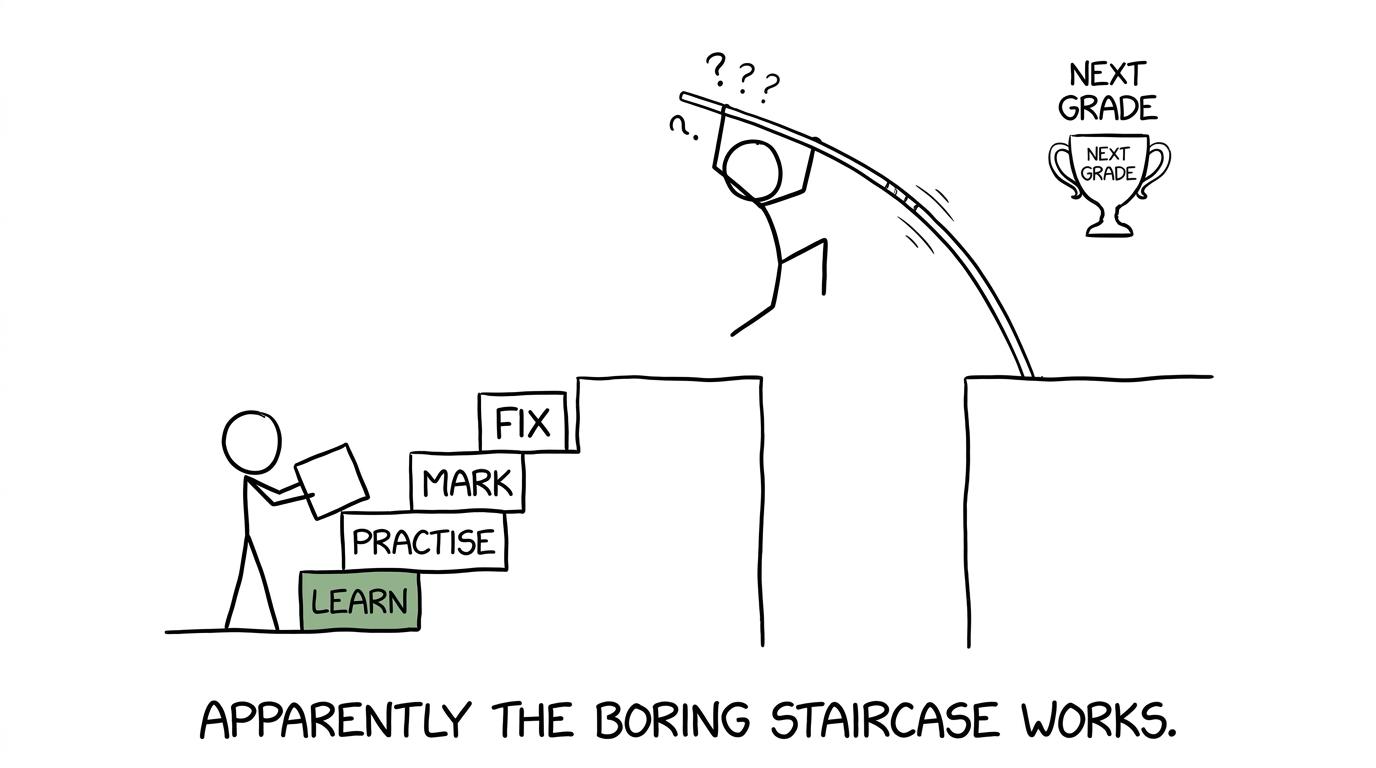 A student chooses the reliable revision staircase instead of trying to leap directly to the next grade
Common mistakes when interpreting grade 5
Treating grade 5 as an exact old grade B
The scales overlap rather than matching perfectly. Grade 5 is best understood as spanning part of the old B/C region.
Assuming “ICT” and Computer Science are interchangeable
They are not. Confirm the formal qualification title before comparing grades, content or entry requirements.
Believing every grade 5 requires the same percentage
Boundaries change by series, subject and specification. Use the official overall boundary for the result concerned.
Assuming a pass guarantees progression
A grade can be a valid pass without meeting a particular course's entry rule. Check the provider's current requirements directly.
Revising only by completing full papers
Papers reveal weaknesses, but focused practice repairs them. If an examination is close, the GCSE one-week revision plan provides a structured route from diagnosis to timed practice.
Make the grade useful
A grade 5 in a grades 9-1 ICT-related qualification represents secure, respectable attainment above grade 4 and roughly within the territory once shared by old grades B and C. It is neither a weak result nor proof that every skill is secure. Its exact meaning depends on the qualification, specification, assessment series and your next destination.
First, check what you actually took. Then check the requirements for where you want to go. Finally, turn the result into action.
MathsGenie gives you a free place to do that for GCSE maths: clear revision lessons, practice questions, mini tests, past papers, predicted papers, mark schemes and video solutions. If a previous result has created uncertainty, use the GCSE maths resit and results-day plan to build a focused route forward. Choose one weak topic, practise it, mark it carefully and fix what went wrong. Grades improve when feedback stops being a verdict and starts becoming a plan.