GCSE ICT Christmas Holiday Revision: A Fair Plan
GCSE ICT Christmas holiday revision made manageable: set a sensible limit, use short focused sessions and protect enough time to enjoy your break.
Christmas revision can expand to fill every available day. A few unfinished notes become a colour-coded timetable, the timetable becomes a source of guilt, and suddenly even watching a film feels like falling behind.
It does not need to work like that. A reasonable amount of GCSE ICT Christmas holiday revision is usually around 222-444 focused hours across the break, divided into short sessions. That might mean 444-666 sessions lasting 303030-454545 minutes. If you have mocks immediately after Christmas, unfinished coursework or significant gaps, you may need more, but the aim is still focused improvement, not sacrificing the entire holiday.
One important detail comes first. Some schools still use “ICT” informally, while the qualification may officially be GCSE Computer Science, Digital Technology or a vocational digital qualification. Check your exact course title, exam board and specification before choosing what to revise. AQA, OCR, Edexcel and Eduqas or WJEC do not necessarily organise or assess digital subjects in the same way.
A reasonable Christmas revision checklist
Before opening a textbook, make five decisions:
- Confirm the exact qualification and exam board.
- Identify no more than 333 weak areas.
- Schedule 444-666 short sessions across the holiday.
- Include retrieval, questions and marking in every session.
- Keep several days completely free from revision.
This is a minimum effective plan, not a universal rule. Your teacher may set specific homework, coursework or mock preparation, and that should take priority. But if you are planning independently, a small number of deliberate sessions is usually more useful than vague daily promises.
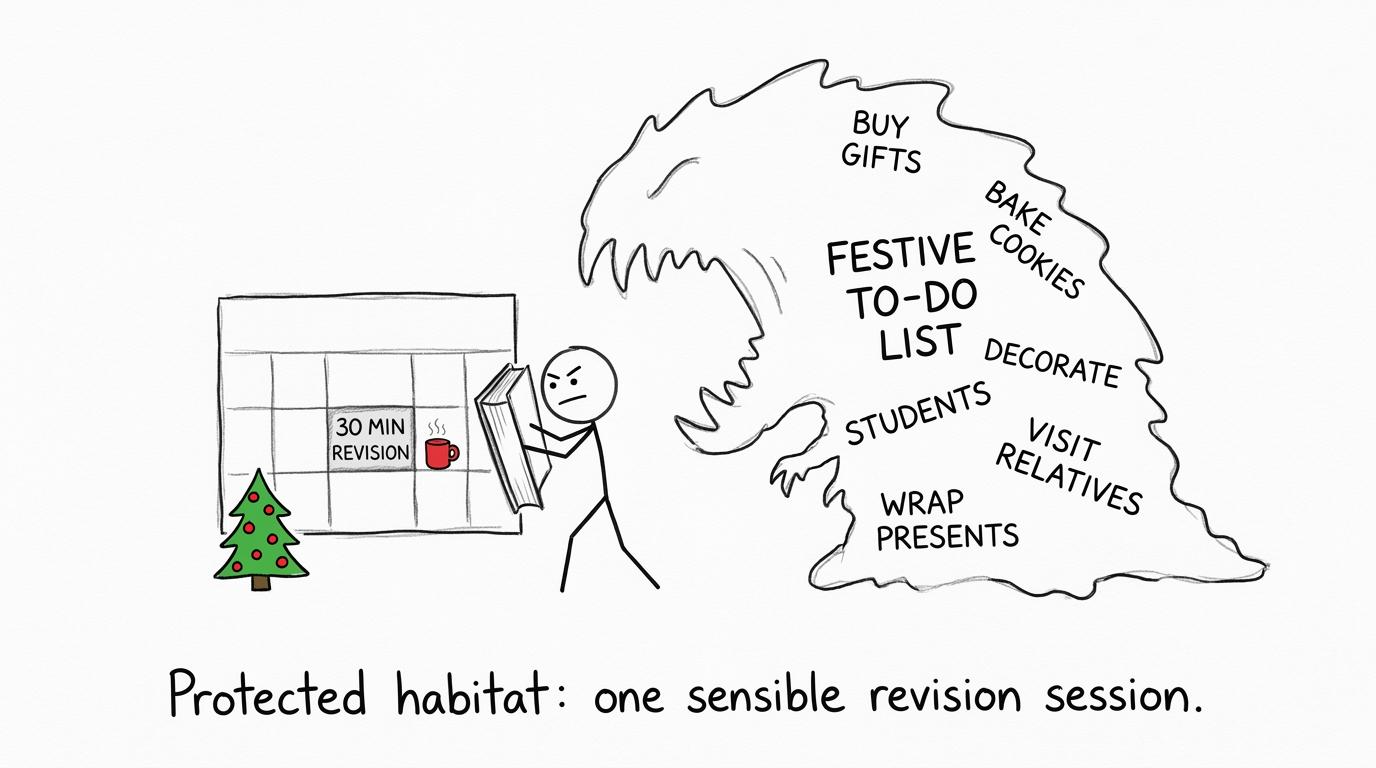 A student protecting one sensible revision session from a gigantic festive to-do list
How much GCSE ICT revision should you do at Christmas?
Start with your needs rather than somebody else’s timetable. The right amount depends on three things: how soon your next assessment is, how secure your knowledge is and how many other GCSE subjects need attention.
If you are broadly on track
Plan approximately 222 hours in total. Four sessions of around 303030 minutes are enough to refresh core knowledge, test recall and identify what needs attention in January.
Your goal is maintenance. You are stopping familiar ideas from becoming unfamiliar over the break.
If you have mocks soon after Christmas
Aim for roughly 333-444 hours, perhaps as 666 sessions of 303030-404040 minutes. Spend the early sessions diagnosing gaps and the later ones answering exam-style questions.
Do not automatically attempt full papers. Short sections can reveal misconceptions without using an entire afternoon. The same principle works in maths, where MathsGenie’s GCSE revision hub provides topic questions, mini tests and shorter practice formats alongside complete papers.
If you are significantly behind
You may need 555-777 hours across the break, especially if work is incomplete. Speak to your teacher if possible, because “catch up on ICT” is too broad to become a useful plan.
Turn it into named tasks: review network security, practise tracing an algorithm, revise database concepts or complete a particular assignment. A precise task has an endpoint. A whole subject does not.
Build a holiday budget before a revision timetable
A timetable begins with empty boxes and invites you to fill them. A budget begins with a limit.
Choose your total revision allowance first. You can express it as:
time per subject=total revision time availablenumber of priority subjects.\text{time per subject}=\frac{\text{total revision time available}}{\text{number of priority subjects}}.time per subject=number of priority subjectstotal revision time available.This does not mean every subject deserves exactly the same time. Maths may need more attention if it is a priority or if your mock exposed several weak topics. The calculation simply stops one subject quietly consuming the whole break.
Next, place rest days on the calendar before revision sessions. Protect family plans, celebrations and days when you know revision will be unrealistic. Then add short sessions to the quieter spaces.
A simple pattern might be:
- early holiday: one diagnostic session;
- middle of the break: two or three focused repair sessions;
- final few days: one recall session and one short assessment.
Avoid beginning with a punishing schedule on the first morning. Christmas revision works best as a bridge between terms, not a rehearsal for exam leave.
What should each ICT revision session contain?
A useful session should produce evidence. By the end, you should know something without prompts, have answered something or have corrected something.
Start with retrieval
Close the notes and spend 555-101010 minutes recalling key terms, processes or stages. You might use flashcards, a blank-page summary or verbal explanations.
This is harder than rereading because it reveals what is missing. That discomfort is useful information.
Repair one narrow gap
Use your specification, class materials and teacher guidance to review one precise area. Keep the scope small enough to explain clearly by the end of the session.
For Computer Science, possible areas might include algorithms, programming constructs, data representation, networks, cyber security or databases. Your actual list must come from your current specification. This matters particularly when specifications change between cohorts.
Answer and mark questions
Finish with exam-style questions or a short test. Mark the work immediately where a mark scheme is available, then write one sentence explaining the correction.
The loop is simple:
recall→practise→mark→fix→retest.\text{recall}\rightarrow\text{practise}\rightarrow\text{mark}\rightarrow\text{fix}\rightarrow\text{retest}.recall→practise→mark→fix→retest.It is also an effective pattern for maths. The MathsGenie 202020-minute maths revision routine shows how to make progress when time is limited, while the guide to finding your weakest GCSE topics helps turn lost marks into specific next actions.
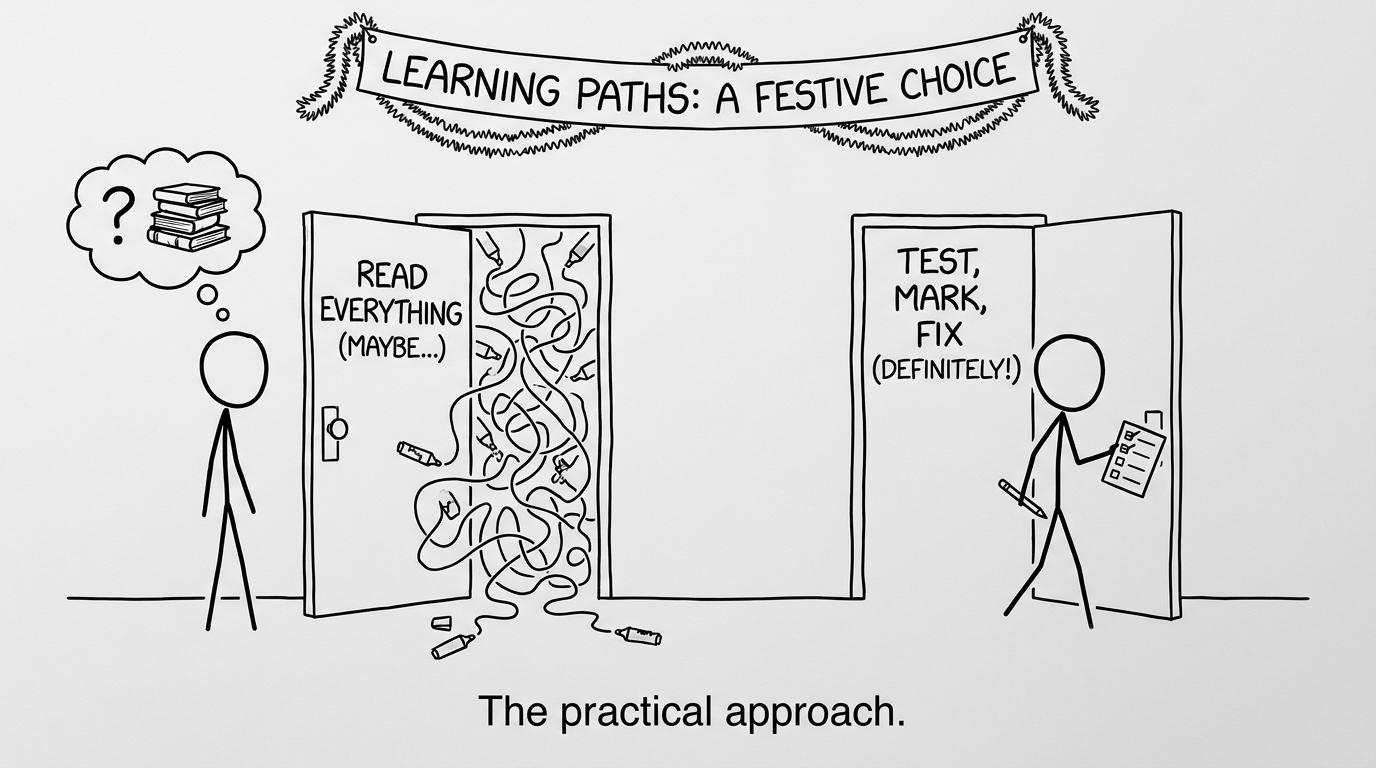 A student choosing test, mark and fix instead of entering an endless maze of highlighters
How to balance ICT with GCSE maths revision
ICT should not be planned in isolation. Most Year 111111 students have several subjects competing for the same finite holiday.
Give each subject a priority rating based on evidence:
- High priority: an early mock, unfinished required work or repeated knowledge gaps.
- Medium priority: generally secure, but containing two or three weak areas.
- Low priority: currently secure with no immediate assessment.
For maths, begin with the correct exam board and tier. Foundation and higher students should not practise random material merely because it looks impressive. MathsGenie includes board-specific pathways, including OCR GCSE Maths revision, plus resources for Edexcel, AQA, Eduqas, WJEC and CCEA.
Christmas is also early enough to diagnose gaps without making every session a full timed paper. The guide to when you should start GCSE past papers explains how to progress from mini tests and paper sections to full exam practice. If you need a wider structure for January, use the GCSE one-month maths revision plan.
Students taking GCSE Statistics can keep that work separate through the Edexcel GCSE Statistics revision area. Separating subjects and tasks reduces the temptation to call several hours at a desk “revision” when little has been completed.
Protect the holiday without abandoning revision
Rest is not evidence that you are uncommitted. The Christmas break should still contain sleep, movement, family time and ordinary days that are not measured in completed worksheets.
Set a clear stopping rule. When the planned 303030 or 404040 minutes are finished, record the next task and stop. Do not extend every session because one question went badly.
It also helps to make starting easy:
- choose the topic the night before;
- leave the required materials together;
- put your phone outside reach;
- use a visible timer;
- finish by writing the next action.
A revision planner should remove decisions, not cover every hour. MathsGenie’s free revision structure supports this approach: select a lesson, complete practice questions, check the mark scheme and return later with a mini test. When you need a manageable maths assessment, GCSE 454545-minute tests offer a shorter alternative to a full paper.
 A student finishing revision and returning to the Christmas holiday while a phone sulks in a drawer
Common Christmas revision mistakes
Planning every day
A plan with no space for changing arrangements is fragile. Schedule fewer sessions than the calendar could theoretically hold and leave room to move one.
Rereading without testing yourself
Notes can feel familiar while the knowledge remains difficult to retrieve. Close the book regularly and answer questions without prompts.
Revising the wrong qualification
Do not assume that a resource labelled ICT matches your course. Confirm the qualification title, exam board, specification and assessment format with your teacher or school documents.
Treating hours as the measure of success
A focused 303030-minute session that identifies and repairs one misconception can be more valuable than an unfocused afternoon. Measure outputs: questions marked, errors corrected and topics retested.
Ignoring other subjects
Over-revising ICT can simply transfer anxiety to maths, English or science. Allocate time according to assessments and evidence of weakness, then protect the limits you set.
Saving marking until later
Unmarked work gives you activity without feedback. Build marking into the planned session, even if that means answering fewer questions.
A calm plan is more likely to survive
Reasonable GCSE ICT Christmas holiday revision is not about doing nothing, nor is it about recreating the school week at home. For many students, 222-444 focused hours across several short sessions will be enough to maintain knowledge, repair a few gaps and return to school with a clear January plan.
Confirm your exact digital qualification. Choose three priorities. Test yourself. Mark what you complete. Then stop and enjoy the break.
For maths, make MathsGenie’s free GCSE Maths revision hub your starting point. Use revision lessons and practice questions to repair weak skills, mini tests to check recall, and past papers, predicted papers, mark schemes and video solutions as the exams approach. The goal is not to lose Christmas to revision. It is to return having made the next step easier.