GCSE ICT 5 to 8: The Changes That Raise Grades
GCSE ICT 5 to 8: learn the revision, practical and exam-technique changes that turn secure knowledge into precise, higher-grade answers in GCSE exams.

Moving from a grade 555 to a grade 888 rarely comes from simply spending three more hours rereading the same notes. A grade 555 often shows sound knowledge. A grade 888 usually requires something more demanding: applying that knowledge accurately, adapting it to unfamiliar situations and giving the examiner precisely what the question requests.
That is the central lesson of any GCSE ICT 5 to 8 revision plan. You need to turn general familiarity into reliable exam performance. This means diagnosing lost marks, practising practical skills without prompts, improving extended answers and revisiting weaknesses until they stay fixed.
One important clarification comes first. Legacy GCSE ICT was withdrawn in England, with final examinations taking place in 201920192019. Students using the name today may be taking GCSE Computer Science, an International GCSE in ICT, or a digital technology qualification. The content and assessment methods are not interchangeable, so check the exact qualification title, exam board and specification used by your school.
Your grade 555 to grade 888 checklist
A strong improvement plan should include:
- the specification for your exact qualification and examination series;
- one diagnostic paper or substantial timed section;
- an error log recording why each mark was lost;
- closed-book recall for theory and technical vocabulary;
- regular practical work if your course includes practical assessment;
- mark-scheme analysis for short and extended responses;
- spaced retesting rather than one-off revision;
- accurate handling of percentages, data, graphs and other numerical content;
- full timed papers during the final stage of preparation.
The difference is not a secret resource. It is the quality of the feedback loop.
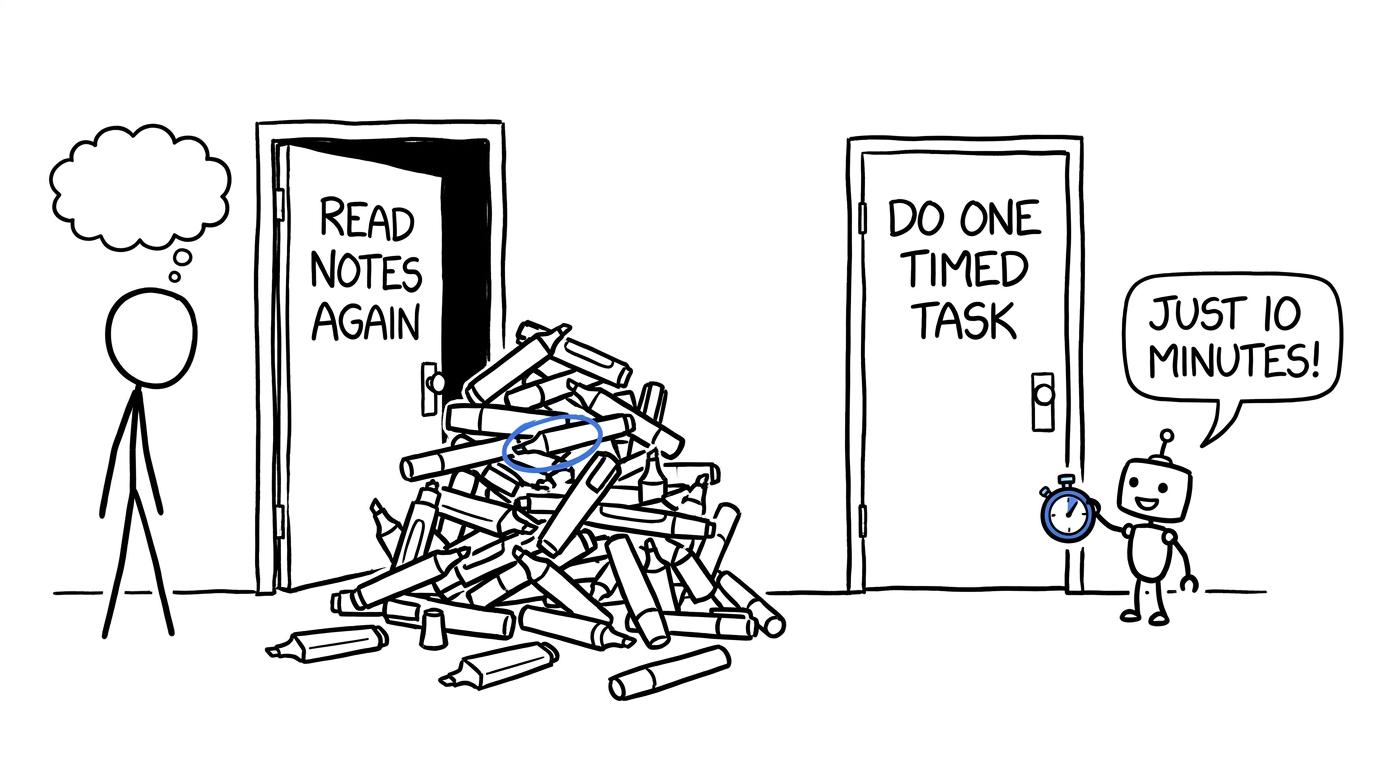 A student chooses between rereading notes and completing a timed revision task
What separates a grade 555 from a grade 888 in GCSE ICT?
There is no single universal mark that separates the grades. Grade boundaries are set after papers have been marked and can change between years and exam boards. Historical boundaries are useful as context, not as a promise about the next examination. If your course is Computer Science, MathsGenie's guide to GCSE Computer Science grade boundary history explains this movement clearly.
In practical terms, the distinction often appears in five areas.
Knowledge becomes precise
A grade 555 student may recognise ideas such as validation, encryption, networks or data protection. A grade 888 student is more likely to distinguish between related terms, select the correct one and explain it in the context given.
That final part matters. A memorised definition can earn a mark, but higher-tariff questions often ask you to apply, analyse, compare, justify or evaluate. The answer must travel beyond what something is and explain why it matters in that particular situation.
Application replaces generic statements
Suppose a question describes a school, retailer or healthcare provider. Generic claims such as “it is faster” or “it is more secure” are usually too thin on their own. A stronger answer identifies what becomes faster, who benefits, how the technology causes that change and what limitation might remain.
The habit to build is simple:
- make a relevant point;
- explain the mechanism;
- connect it to the scenario;
- state the resulting consequence.
For an evaluation, consider more than one side before reaching a justified conclusion. The conclusion should depend on the priorities in the question, not on a rehearsed opinion.
Practical skills become independent
For specifications with practical papers or assessed digital tasks, knowing where a software command sits is not enough. Higher performance comes from choosing suitable tools independently, working efficiently and checking the finished product against the brief.
Depending on your specification, this could include spreadsheets, databases, document production, presentations or web authoring. International GCSE ICT specifications may assess formulae, functions, relative and absolute references, validation, data searches, charts and document formatting. Computer Science courses instead place greater emphasis on algorithms, programming, data representation and computational thinking.
Do not revise one course using another course's topic list. Your specification is the contract.
Answers follow command words
Students often lose marks while writing something factually correct because it answers the wrong kind of question.
- State needs a concise fact.
- Describe needs relevant features or what happens.
- Explain needs linked reasoning.
- Compare needs connected similarities or differences.
- Justify needs a supported choice.
- Evaluate needs analysis, limitations and a reasoned judgement.
Circle the command word and note the number of marks before writing. This small pause prevents an impressive answer to a question that was never asked.
Performance survives time pressure
At grade 555, knowledge can depend on helpful cues: a familiar worksheet, an open textbook or a teacher's prompt. Grade 888 performance must survive an unfamiliar context and a ticking clock.
This is why timed practice matters. It is not merely rehearsal for writing quickly. It reveals whether your knowledge can be retrieved and used when the question does not resemble your notes.
Diagnose the marks between you and your target
Complete a recent paper or realistic sample assessment for your exact specification. If a full paper feels too large, use a substantial timed section. Then mark it strictly.
Do not record only the total. Classify every lost mark:
- knowledge gap: you did not know the required fact or process;
- application gap: you knew the topic but could not use it in context;
- command-word error: your response did not match the instruction;
- practical error: you selected or operated a tool incorrectly;
- verification error: you failed to test, proofread or check plausibility;
- timing error: you rushed, omitted or never reached the question.
MathsGenie's guide to finding your weakest GCSE topics shows how to turn paper evidence into a focused revision list. The same diagnostic method works well for ICT: attempt, mark, classify, repair and retest.
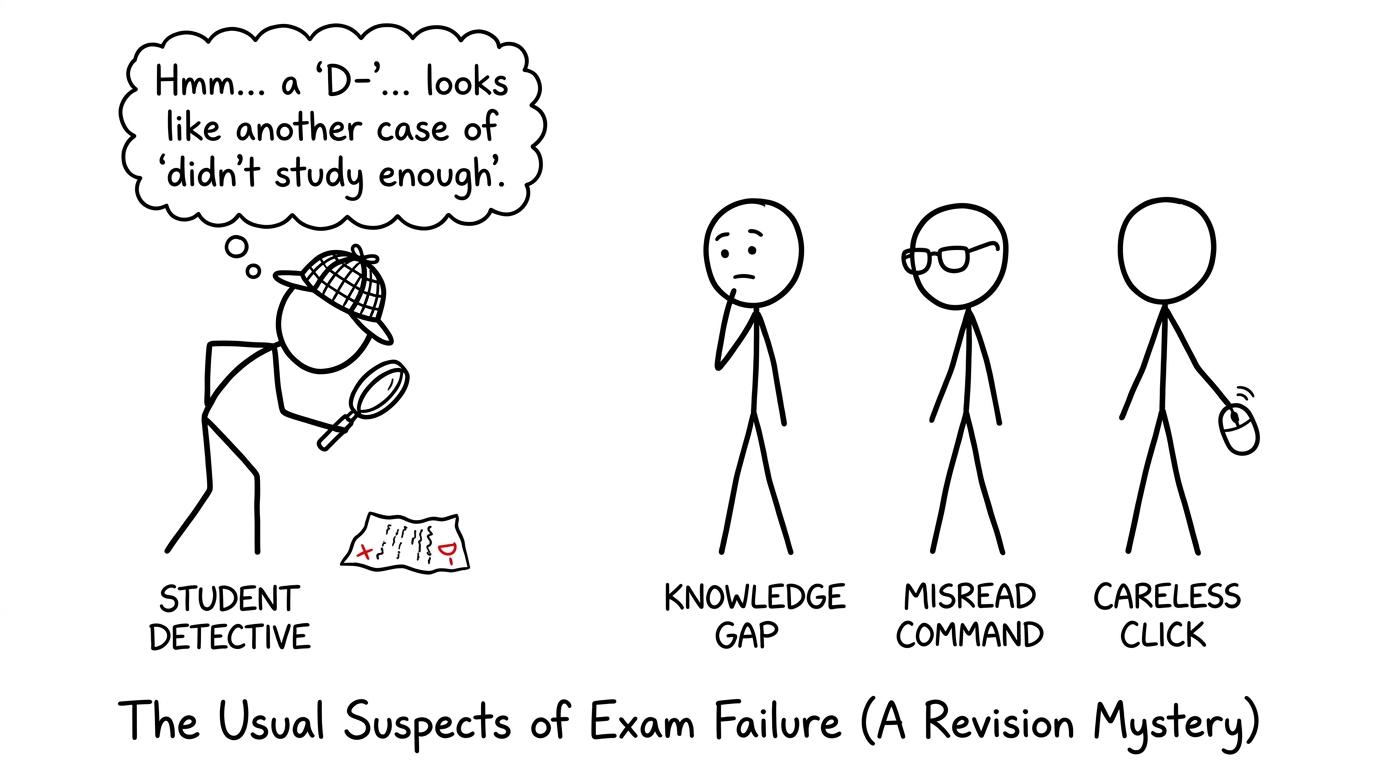 A student detective investigates three different causes of lost marks
Make the changes that move students up a grade band
Replace rereading with retrieval
Reading creates recognition, which can feel like knowledge. Examinations require retrieval.
Close your notes and produce what you know about one narrow topic. You might list the stages of a process, compare two technologies, define technical terms or sketch the structure of an extended response. Only then should you check the specification and notes.
Keep each topic narrow. “Cyber security” is too broad for one session; “how authentication reduces unauthorised access” is manageable. MathsGenie's revision planner can help you schedule these small returns rather than leaving the whole subject until one long weekend.
Practise practical tasks from a brief
If practical work forms part of your qualification, divide practice into three stages:
- accuracy: can you perform the required operation correctly?
- selection: can you decide which operation the brief requires?
- independence: can you complete and verify the task without prompts?
After finishing, inspect the output as an examiner would. Check that data is complete, calculations are plausible, formatting supports the purpose and every requirement has been addressed. A technically impressive product can still lose marks if it ignores the intended audience or task.
Train extended answers deliberately
Do not wait for full papers to practise longer responses. Select one command word and one topic, plan the answer briefly, then compare it with the mark scheme.
Look for missing reasoning rather than memorising whole paragraphs. Mark schemes show the kinds of valid ideas that earn credit, but future scenarios will change. Your goal is to learn the structure of strong reasoning, not to reproduce yesterday's wording.
Strengthen the numerical skills around ICT
Digital qualifications often include numerical demands: percentages, storage calculations, data interpretation, logic, charts or spreadsheet models. The exact content depends on your specification, but weak arithmetic can quietly remove marks from otherwise secure technical knowledge.
For example, percentage change is represented by:
percentage change=new value−original valueoriginal value×100\text{percentage change}=\frac{\text{new value}-\text{original value}}{\text{original value}}\times 100percentage change=original valuenew value−original value×100You should also be comfortable interpreting tables and checking whether a calculated result is reasonable. MathsGenie's free probability revision lesson supports data-based reasoning, while the wider GCSE maths revision resources can repair gaps in percentages, graphs, ratio and calculation skills.
Use a weekly revision cycle that creates evidence
A sustainable week could contain four different sessions:
- Theory retrieval: recall one topic without notes, check it and correct omissions.
- Practical or technical practice: complete a focused task independently.
- Exam application: answer timed questions, including one extended response.
- Repair and retest: revisit errors from earlier in the week using fresh questions.
Short, repeatable sessions are often easier to maintain than occasional marathons. The GCSE twenty-minute revision routine offers a useful structure: recall, practise, mark and choose the next micro-topic.
As the examination approaches, move towards complete papers. Use official past papers first, then other realistic material where appropriate. MathsGenie's guide to using GCSE past papers properly explains why the learning happens after the paper, when each error is corrected and retested.
For your maths preparation alongside ICT, GCSE predicted papers and Edexcel GCSE maths mini tests provide fresh timed practice, mark schemes and focused checks. Predicted papers should be treated as dress rehearsals, not forecasts of exact questions.
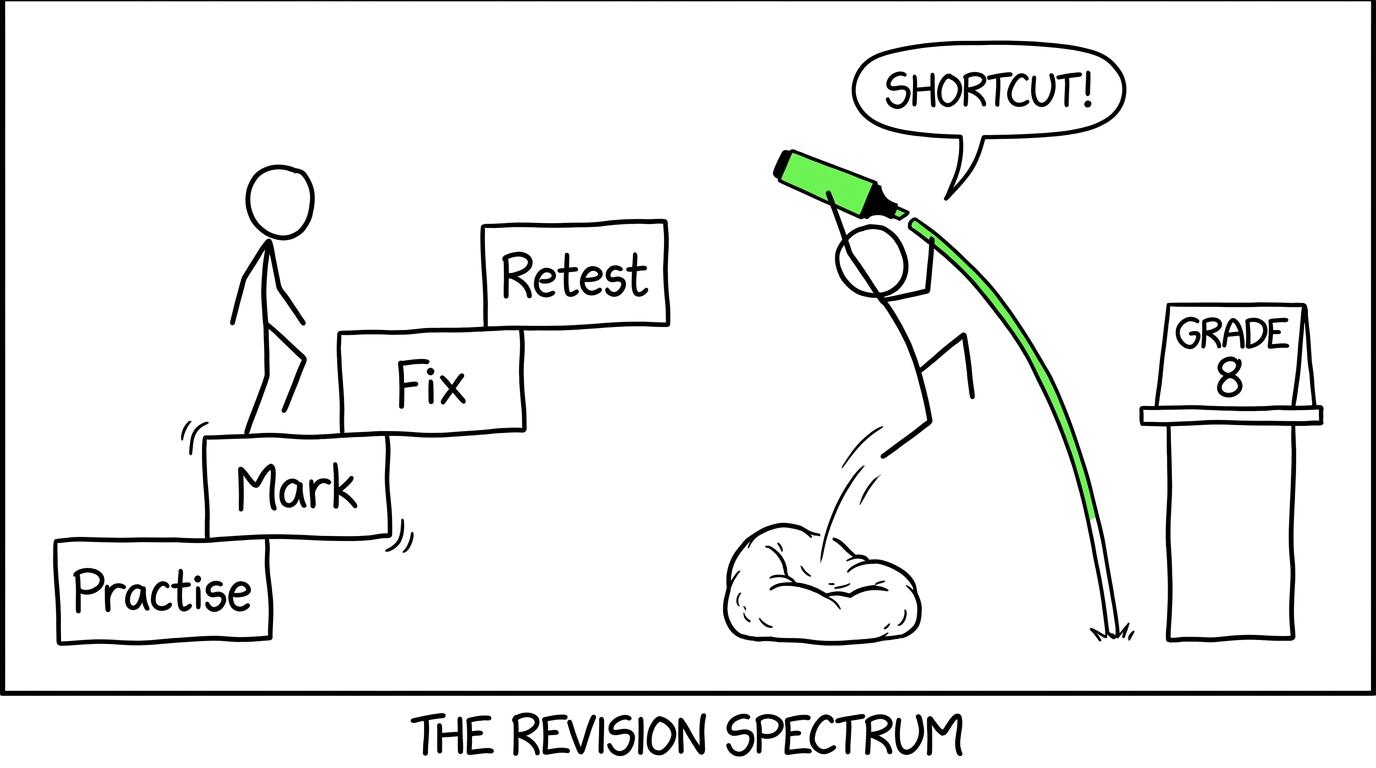 One student climbs the practise-mark-fix-retest staircase while another tries to jump straight to grade eight
Common mistakes that keep students at grade 555
Revising the wrong qualification
“GCSE ICT” is often used as an informal umbrella term. Confirm whether you take Computer Science, International GCSE ICT, Digital Technology or another qualification. Download the correct specification and use papers from the correct board and series.
Treating highlighting as completed revision
Highlighted notes may look organised without proving recall. Follow reading with a closed-book task, examination question or practical brief.
Giving generic advantages and disadvantages
An advantage only becomes convincing when it is explained in context. Identify who benefits, what changes and why that consequence matters.
Ignoring practical verification
Students frequently finish when the product appears complete. Higher-quality work checks formulae, data types, queries, links, spelling, layout, audience and compliance with the brief, where relevant to the specification.
Counting papers instead of correcting them
Completing five papers while repeating the same errors is less valuable than completing two papers and repairing every recurring weakness. Track changes in the error log, not just totals.
Chasing a guessed grade boundary
Boundaries vary. Build a safety margin by pursuing every accessible mark and using historical boundaries only to understand previous outcomes.
Make grade 888 a process, not a hope
The journey from grade 555 to grade 888 is not one dramatic leap. It is a series of smaller upgrades: vague knowledge becomes precise; prompted skills become independent; generic answers become contextual; mistakes become revision tasks; and practice begins to resemble the real assessment.
Start by confirming your qualification and completing one diagnostic section. Record the causes of lost marks, choose the two most important weaknesses and schedule their retests. Then repeat the cycle.
MathsGenie can support the numerical and revision side of that journey for free. Use the revision lessons and practice questions to rebuild weak maths skills, mini tests to check them quickly, and past papers, predicted papers, mark schemes and video solutions to develop reliable exam performance. Open the revision planner today and give your next session one clear purpose.