

GCSE ICT 4 to 6: A Practical Grade Guide
GCSE ICT 4 to 6: discover what separates the grades, how to improve application and evaluation, and how to build an effective revision plan.
A grade can look like a single number, but it is usually the result of dozens of small decisions: whether you applied a definition to the scenario, justified a recommendation, checked a spreadsheet or explained both sides of an issue.
That is the practical answer to moving GCSE ICT 4 to 6. You do not simply need more facts. You need to turn accurate knowledge into contextual, reasoned answers while making your practical work systematic and well evidenced.
One important detail comes first. GCSE ICT is not currently a reformed GCSE offered by the main exam boards in England in the same way as GCSE Maths. Depending on your school and location, “ICT” may mean WJEC GCSE Digital Technology in Wales, an Eduqas Level 1/2 Vocational Award in ICT, an international qualification or another digital technology course. These qualifications have different grading systems and assessment structures. Confirm the exact title, board and specification code with your teacher before using any grade advice.
Your grade 4 to grade 6 checklist
The precise boundary changes between examination series, so there is no permanent number of marks that guarantees a grade. Instead, focus on these controllable improvements:
- Learn the precise ICT vocabulary required by your specification.
- Apply each point to the organisation, user or situation in the question.
- Develop explanations using causes, consequences and relevant evidence.
- Make justified recommendations rather than listing generic advantages.
- Practise extended answers under timed conditions.
- Test practical products systematically and record meaningful evidence.
- Improve your confidence with percentages, charts, averages and spreadsheet logic.
- Mark answers carefully and revisit the exact skills that lost marks.
The difference is rarely one spectacular answer. It is usually fewer vague answers across the whole assessment.
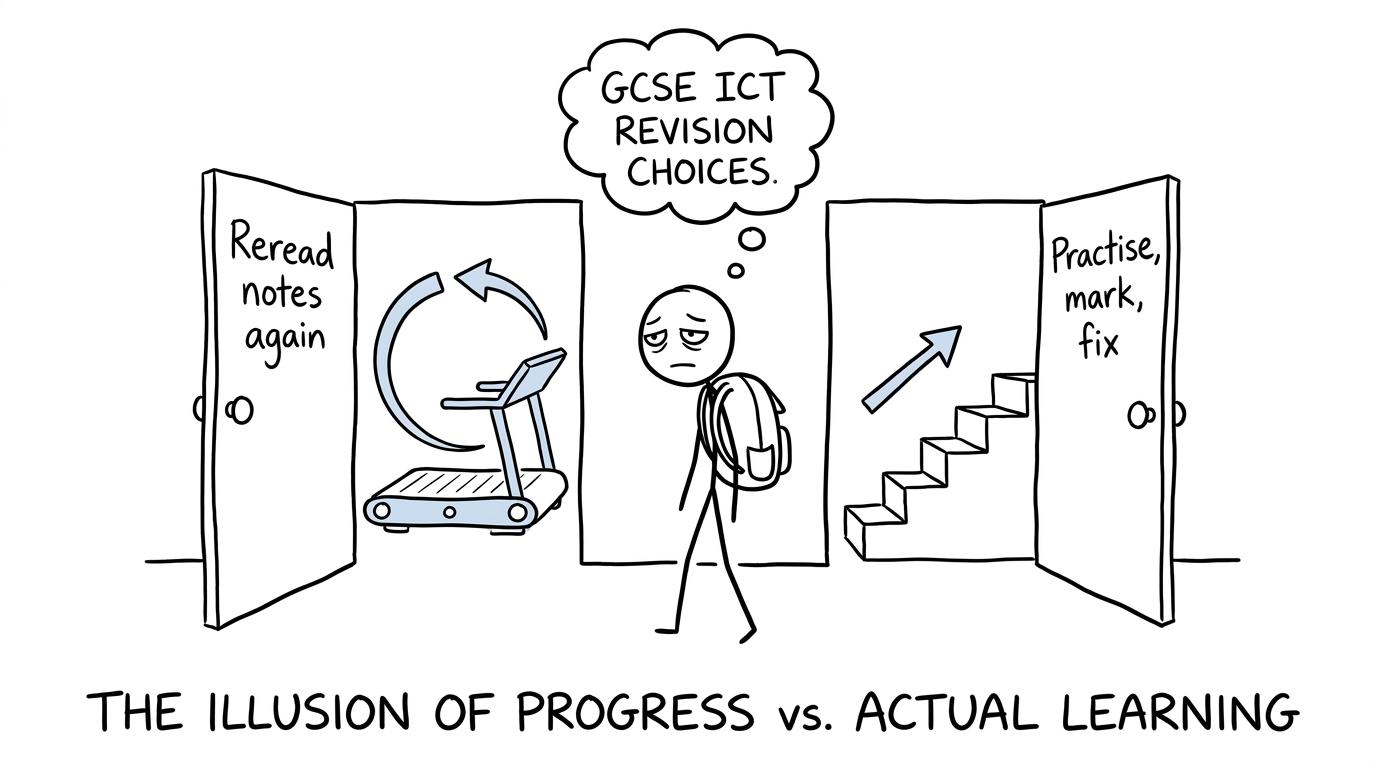 A student chooses between rereading notes and a practise-mark-fix staircase
What separates a grade 4 from a grade 6 in GCSE ICT?
A grade 4 performance generally shows secure knowledge of many core ideas and some ability to use them in familiar contexts. A student may identify suitable hardware, describe a security threat or state an advantage of cloud storage. However, explanations can remain general, and longer answers may lack balance or a supported conclusion.
A grade 6 performance is normally more consistent. The student selects relevant knowledge, connects it to the scenario and follows the effect through. Practical decisions are linked to audience or client requirements. Evaluation considers competing factors before reaching a reasoned judgement.
Because specifications differ, these are not official universal grade descriptors. They are useful performance patterns based on the assessment skills commonly found in ICT and digital technology qualifications: knowledge, application, analysis, practical development, testing and evaluation.
| A grade 4 response often… | A grade 6 response more often… |
|---|---|
| States an accurate fact | Selects an accurate fact that matters in the given context |
| Gives a generic advantage or disadvantage | Explains who is affected, how and why |
| Makes a recommendation | Justifies the recommendation against realistic alternatives |
| Describes what a digital product does | Connects design choices to audience and purpose |
| Carries out basic testing | Uses planned tests, appropriate data and recorded outcomes |
| Spots an issue | Analyses its consequence and proposes a suitable response |
| Uses technical vocabulary occasionally | Uses precise terminology consistently |
The movement from grade 4 to grade 6 is therefore a movement from recognition towards reasoning.
Start with your actual specification
Revision becomes wasteful when the course in your folder is not the course in your examination. Write down:
- the complete qualification title;
- the exam board;
- the specification code;
- the grading scale;
- the examined and non-examined components;
- the assessment objectives;
- the permitted software and equipment.
Do not assume that Edexcel, AQA, OCR and Eduqas offer interchangeable “GCSE ICT” papers. They do not. In Wales, digital qualifications may also use an A∗A^*A∗ to GGG scale rather than England’s grades 999 to 111. Vocational ICT qualifications can report outcomes such as Level 1 or Level 2 awards instead.
If your qualification is not graded 999 to 111, ask your teacher what your school means by a grade 4 or grade 6 target. It may be a reporting conversion rather than the final qualification grade.
Grade boundaries are set after assessments have been completed and can change because paper difficulty changes. Track raw marks to measure progress, but do not treat one previous boundary as a promise.
Replace topic revision with mark-producing revision
Knowing that networks, databases or cybersecurity are weak areas is a start. It is not yet a revision plan. Each weakness should become an action you can complete and check.
A useful cycle is:
- retrieve the key facts without notes;
- answer a short set of questions;
- mark the responses against the available mark scheme;
- identify whether the problem was knowledge, application, reasoning or timing;
- correct the answer;
- attempt a fresh question after a short gap.
MathsGenie’s guide to finding your weakest GCSE topics explains how to turn lost marks into a focused error log. You can also organise sessions with the free revision planner, particularly when ICT must fit alongside maths and other GCSE subjects.
Build precise knowledge
Definitions matter, but copying them repeatedly creates an illusion of progress. Use retrieval instead. Close the book and explain terms such as validation, verification, encryption, phishing, primary key, accessibility and data protection from memory.
Then add the question that grade 6 answers need: why does this matter here?
For every concept, be ready to identify:
- its purpose;
- an appropriate context;
- a limitation or risk;
- the people affected;
- a sensible alternative or safeguard.
This turns isolated vocabulary into usable knowledge.
Apply every answer to the scenario
ICT questions are often built around a school, business, charity, employee or customer. Details in the scenario are not decoration. They tell you which consequences matter.
A generic response might say that a system is faster. A stronger response explains what becomes faster, whose work changes and what practical benefit follows. If the scenario mentions remote staff, sensitive records, a limited budget or inexperienced users, use that information explicitly.
Before writing, underline the decision-maker, the users, the purpose and any constraint. This small habit makes answers less interchangeable and more relevant.
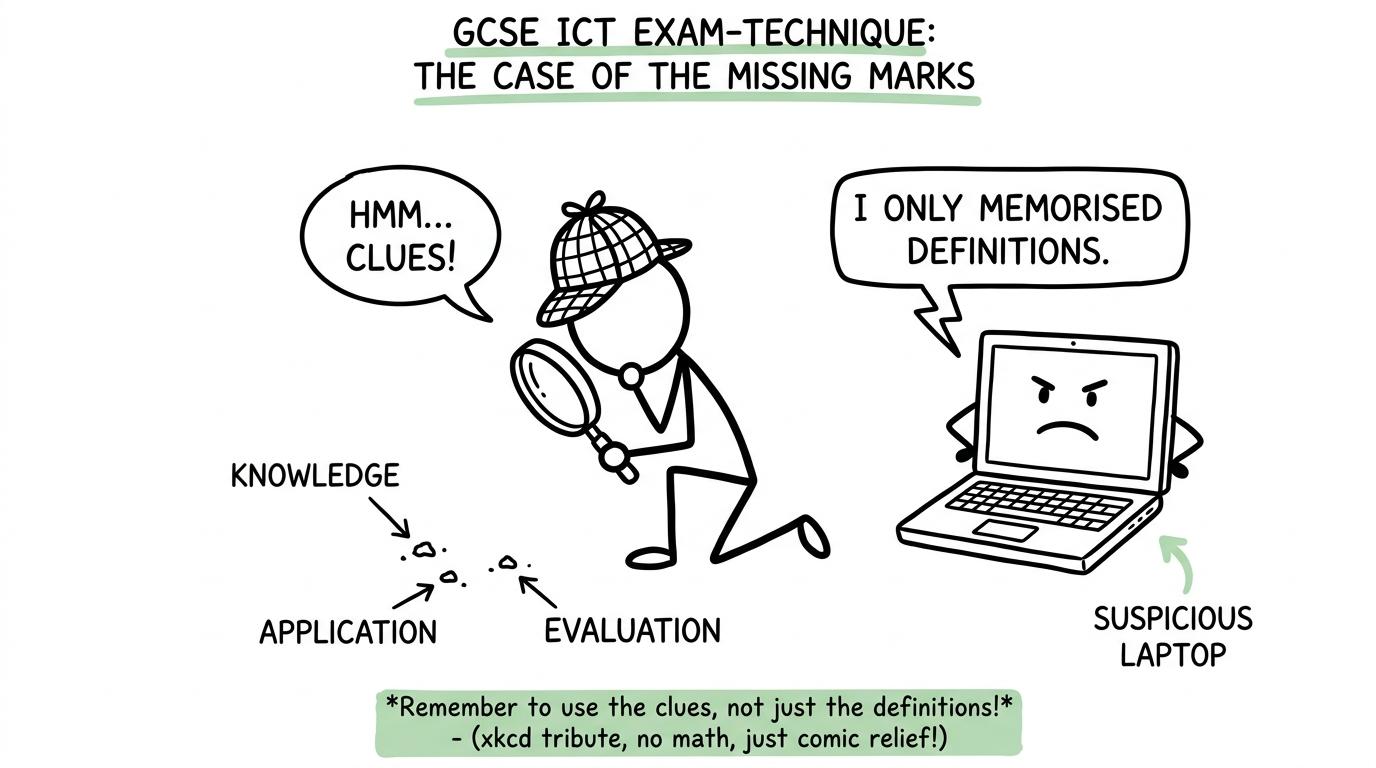 A student detective investigates knowledge, application and evaluation
Analyse before you evaluate
Students often jump from one advantage to “therefore this is best”. Evaluation needs a chain of reasoning.
A dependable structure is:
- make a relevant point;
- explain the consequence in context;
- consider a limitation or competing factor;
- compare the importance of those factors;
- reach a judgement supported by the scenario.
The final judgement should answer the question, not merely repeat an earlier sentence. Words such as “however” and “therefore” can help organise an answer, but connective words do not create analysis by themselves. The reasoning between them earns the value.
Improve the maths inside ICT
ICT assessments can involve data handling, charts, storage calculations, percentages, averages and spreadsheet models. These marks are often recoverable because the underlying methods can be practised directly.
You should be comfortable with relationships such as:
percentage=partwhole×100\text{percentage} = \frac{\text{part}}{\text{whole}} \times 100percentage=wholepart×100and:
mean=sum of the valuesnumber of values\text{mean} = \frac{\text{sum of the values}}{\text{number of values}}mean=number of valuessum of the valuesYou may also need to select an appropriate chart, interpret a trend, compare data sets or decide whether a result is reasonable. MathsGenie’s GCSE Statistics revision hub supports these data skills, while the Edexcel GCSE Maths revision area includes lessons and practice questions on percentages, averages, graphs and related topics.
Spreadsheet competence is broader than entering a formula. Check that you can:
- use cell references appropriately;
- distinguish relative and absolute references;
- select suitable functions;
- sort, filter and validate data;
- create readable charts;
- test boundary, valid and invalid inputs;
- explain how the output supports a decision.
A technically working product is not automatically a high-level product. It must also suit its audience and purpose.
Make practical work systematic
Where your qualification includes non-exam assessment or controlled practical work, follow your teacher’s instructions and the current assessment rules. Do not bring unauthorised assistance into controlled tasks.
Higher-quality practical evidence usually comes from deliberate decisions. Requirements should influence the design; testing should check those requirements; evaluation should use the test evidence.
Before considering a product complete, ask:
- Does it meet every stated requirement?
- Is it suitable for the intended audience?
- Have I used realistic test data?
- Have I included invalid and boundary tests where relevant?
- Did I record expected and actual outcomes?
- Did I correct faults and test again?
- Does my evaluation identify specific improvements?
“Everything worked” is rarely a useful evaluation. A stronger evaluation identifies what was tested, what the evidence showed and what would improve the product.
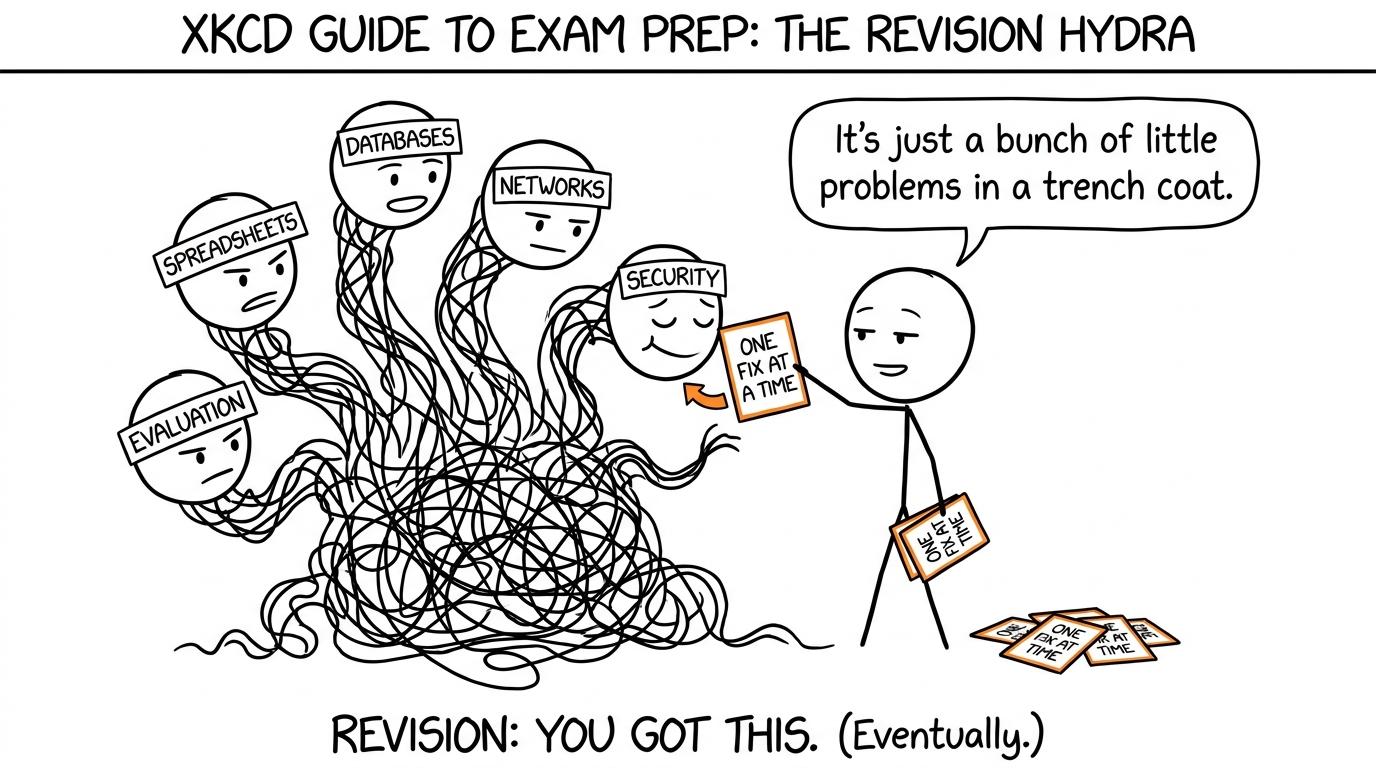 A student tames the many-headed ICT revision monster one fix at a time
Use timed practice to make improvement visible
Once individual topics are secure, complete assessment sections under the correct conditions for your qualification. Mark them using official materials supplied by your board or school.
Keep an error log with four headings:
| Question | Why marks were lost | Corrective action | Retest date |
|---|---|---|---|
| Record the exact item | Knowledge, application, reasoning, accuracy or timing | Name one specific task | Schedule a fresh attempt |
The score tells you where you are. The error log tells you what to do next.
For the wider revision routine, MathsGenie’s one-month GCSE revision plan shows how to combine retrieval, focused practice and timed assessment. Its advice on when to start GCSE past papers is also useful across subjects: begin while there is still enough time to repair what the papers reveal.
Keep ICT papers specific to your qualification. For your maths preparation, use MathsGenie’s free GCSE predicted papers alongside practice questions, mark schemes and video solutions.
Common mistakes that keep students near grade 4
Rereading instead of retrieving
Familiar notes feel easy because the answer is visible. Close the notes and produce the knowledge yourself. Revision should expose uncertainty, not hide it.
Listing without explaining
Several undeveloped points may earn less than fewer, carefully developed ones. Follow each relevant point through to its consequence for the named user or organisation.
Ignoring command words
“Identify”, “describe”, “explain”, “analyse” and “evaluate” demand different depths. Match the length and structure of your response to the command and available marks.
Giving universal recommendations
No technology is always best. Cost, security, accessibility, reliability, training, scale and user needs can change the sensible choice.
Treating testing as proof that something opens
Good testing checks requirements using planned inputs and records expected outcomes, actual outcomes and subsequent corrections.
Chasing a remembered grade boundary
A boundary from an earlier series is historical information, not a guaranteed target. Concentrate on improving raw marks and response quality across the whole assessment.
From grade 4 knowledge to grade 6 control
The route from grade 4 to grade 6 is not about making revision louder or longer. It is about gaining control: control of terminology, context, reasoning, practical evidence and time.
Confirm your qualification first. Diagnose your lost marks. Practise one weak skill at a time, check it against the mark scheme and return to it until the improvement survives without notes.
MathsGenie can support the numerical and revision side of that journey for free. Use its revision lessons and practice questions to strengthen data skills, the revision planner to organise your week, and its mini tests, past papers, predicted papers, mark schemes and video solutions to prepare for GCSE Maths alongside ICT. Start with one weakness today; then turn it into the next mark you no longer lose.











