

Is a GCSE History Revision Timetable Worth It?
GCSE history revision timetable worth it? Learn when a written plan helps, when flexible revision works, and how to balance history revision with maths.
A revision timetable can feel productive before any revision has happened. The colours are chosen, every evening has a neat label, and the week appears to be under control. Then Tuesday changes, one session is missed, and the whole plan begins to look like evidence of failure.
So, is a GCSE history revision timetable worth it? Usually, yes, but only if it is short, flexible and connected to specific tasks. Writing a timetable does not improve your grade by itself. Its value comes from helping you spread revision over time, choose what to do next and notice whether your approach is working.
Flexible revision can work just as well. The essential ingredients are not boxes on paper, but repeated retrieval, exam practice, feedback and sensible decisions about your weakest areas. This matters especially when History must share the week with GCSE Maths and several other subjects.
The quick answer: when a timetable is worth making
A written plan is useful when it helps you:
- cover every History unit on your specification;
- revisit material rather than cramming it once;
- balance knowledge recall with sources, interpretations and extended answers;
- protect regular time for maths practice;
- decide on a manageable task before a session begins;
- review your progress and change the plan when necessary.
It is not useful when you spend longer designing it than following it, fill every free hour, or treat missed sessions as debts that must be repaid.
The best timetable is therefore not a perfect calendar. It is a decision-making tool.
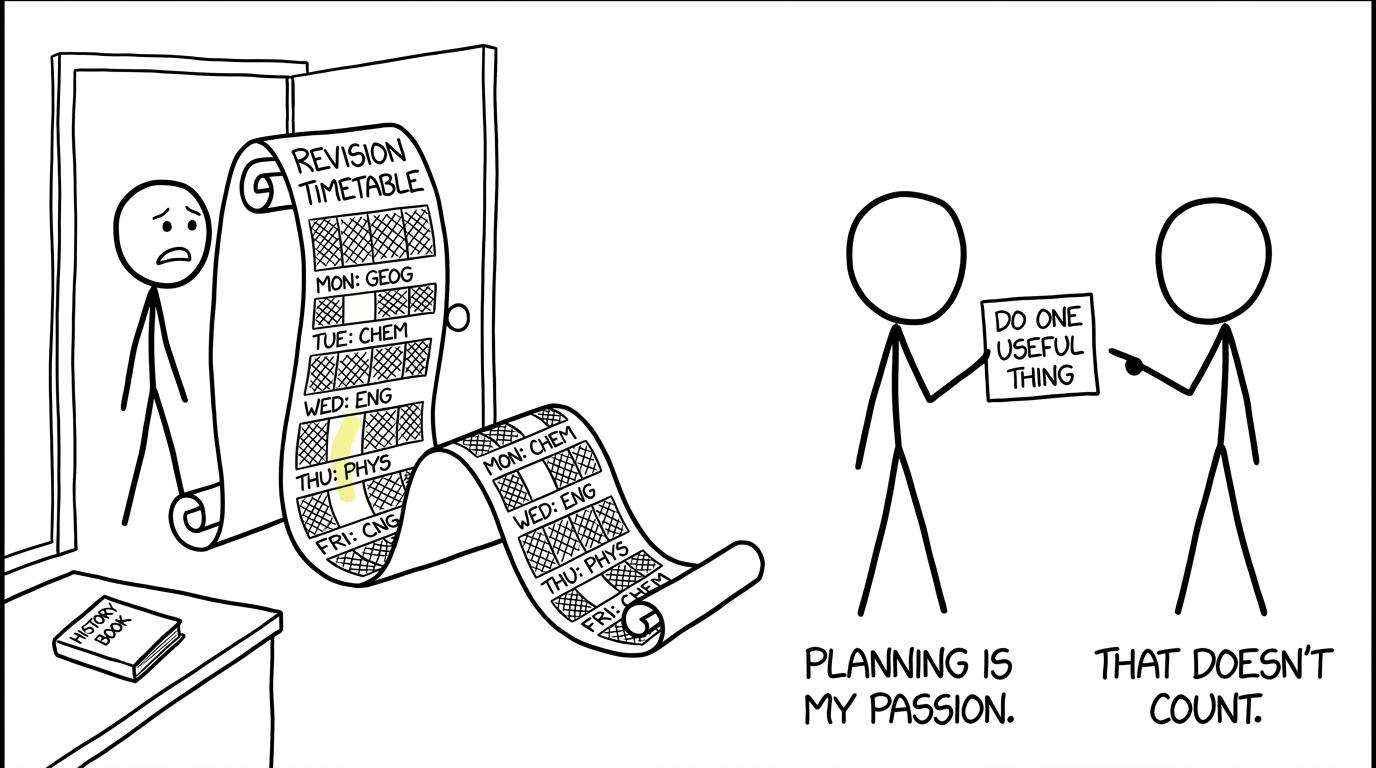 A student discovers that making an enormous colour-coded timetable is not the same as revising
What a written timetable can actually change
Educational evidence supports teaching students to plan, monitor and evaluate their learning. That does not prove that every handwritten revision calendar raises exam results. It does suggest that planning becomes valuable when it is part of a wider self-regulated cycle:
- Plan: choose a precise goal and an appropriate revision method.
- Monitor: test whether you can recall or apply the material.
- Evaluate: use the result to decide what needs another attempt.
A timetable mainly supports the first step. To influence outcomes, it must lead into the other two.
For example, “History revision” is too vague to guide a useful session. “Recall the causes of an event, then answer and mark one causation question” identifies both the content and the evidence that will show whether you understand it. For maths, “do algebra” is equally weak. A better task would identify the exact skill, practice questions and checking method.
MathsGenie’s GCSE Maths revision hub makes those decisions easier by organising board-specific lessons, questions, papers and revision tools. Your timetable only needs to name the resource and the intended outcome.
Why GCSE History needs more than a topic list
GCSE History is not simply a memory test. Across the regulated specifications, students are assessed on knowledge and understanding, explanation using second-order concepts, analysis of contemporary sources, and evaluation of historical interpretations. The precise papers and options vary between AQA, Pearson Edexcel, OCR and Eduqas.
That means a useful History plan should rotate between different kinds of work:
- retrieving dates, people, events and developments;
- explaining causation, consequence, change, continuity or significance;
- analysing and evaluating sources;
- comparing or evaluating interpretations;
- planning and writing responses under time pressure;
- checking work against the relevant mark scheme.
Always build the content list from the specification and options taught by your school. This is particularly important for Pearson Edexcel students because content and assessment changes apply from the summer 202620262026 series. Use the current specification and advice from your teacher rather than copying an older online timetable.
Unlike GCSE Maths, GCSE History is not divided into foundation and higher tiers. Your maths sessions, however, must match the tier and exam board for which you have been entered. If you take OCR Maths, for example, use the OCR GCSE Maths revision resources rather than filling your plan with unidentified “maths papers”.
Flexible revision versus a fixed timetable
A rigid timetable assigns an exact subject and task to every period. A flexible system keeps a prioritised list and chooses the best task when a revision window opens. Neither format is automatically superior.
A fixed plan may suit you if
- you regularly postpone difficult subjects;
- you have predictable evenings and weekends;
- you need to see whether every unit has been covered;
- firm start times reduce the number of decisions you make.
A flexible plan may suit you if
- homework, clubs or family commitments change frequently;
- missing one scheduled task makes you abandon the whole plan;
- your practice results regularly reveal new priorities;
- you can begin work without needing a precise calendar entry.
The strongest option for many students is a hybrid. Give each subject a few protected weekly windows, but choose the exact task from a live priority list. You might reserve one window for History retrieval, another for a timed History response and several for maths. After marking work, update what happens inside the next window.
This preserves structure without pretending that you can predict every weakness weeks in advance. Maths students can use the same approach described in MathsGenie’s guide to finding weak GCSE topics quickly: gather evidence, label the problem, practise narrowly and re-test.
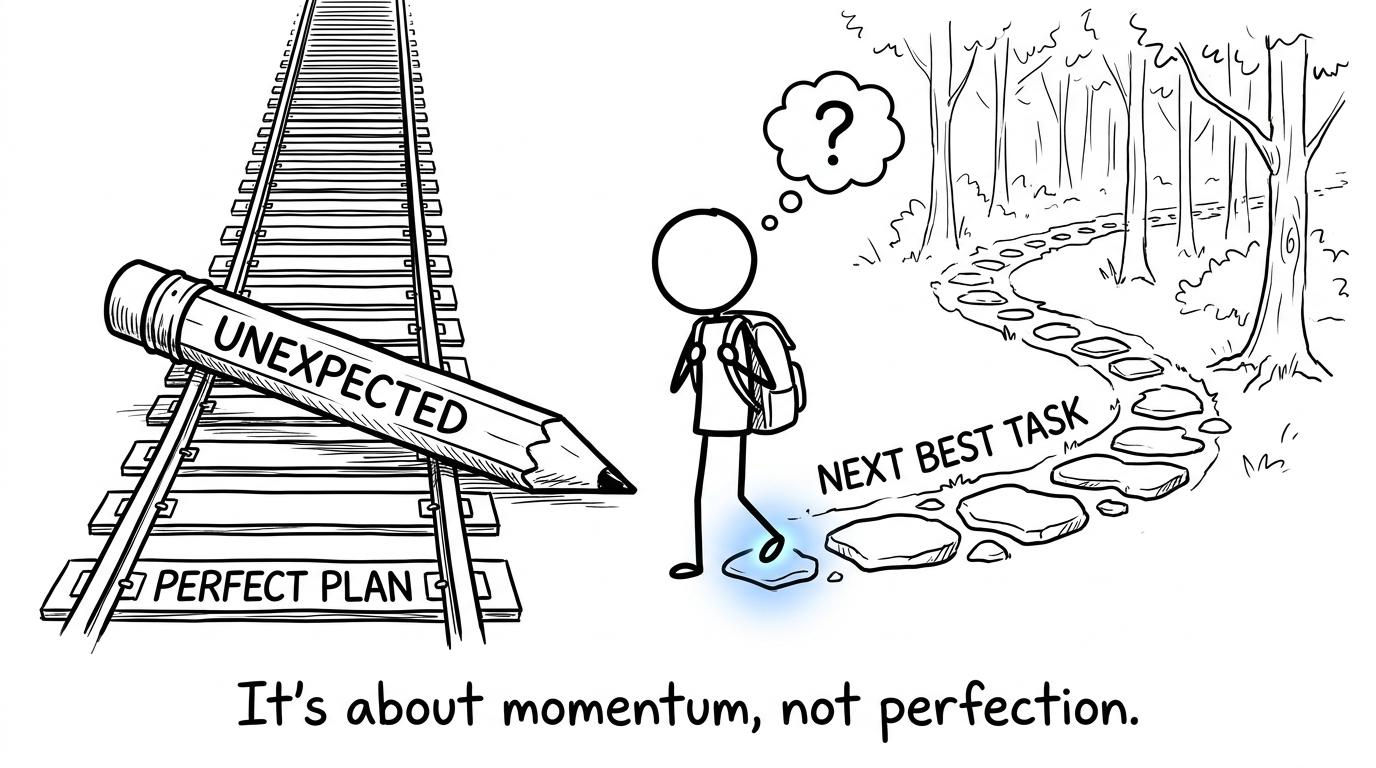 A flexible revision path continues around a fallen pencil while the perfect plan is blocked
How to build a timetable that survives real life
Start with constraints, not ambition
Mark lessons, travel, meals, sleep, activities and genuine rest first. Revision belongs in the remaining time. A plan that requires you to ignore ordinary life is not ambitious; it is inaccurate.
Keep some space unallocated. This gives you somewhere to move an important task when plans change, without pushing every later session backwards.
Plan outputs rather than hours
Each session should produce something you can inspect: completed recall questions, an essay plan, a marked source response, a finished mini test or a corrected set of maths problems.
A session described only by its duration can be filled with rereading. An output makes passive drift harder.
Schedule returning, not just covering
Seeing a topic once creates familiarity, but familiarity is not the same as being able to retrieve it in an exam. Bring important material back on later days and weeks. Start by attempting to recall it without notes, then check what was missing.
The calendar is useful here because it prevents “finished” topics from disappearing permanently. MathsGenie’s guide to stopping forgotten OCR Maths content explains how spaced recall, mixed practice and re-testing can form a repeatable system.
Separate learning from performance practice
Early sessions can rebuild knowledge or methods. Later sessions should increasingly require independent, timed application.
For maths, move from revision lessons and topic questions towards mini tests and papers. The Edexcel GCSE Maths mini tests are useful when a full paper will not fit into the available window. When you are ready for longer exam practice, use Edexcel GCSE Maths past papers with the accompanying mark schemes and solutions.
History needs a comparable progression: retrieve the content, apply it to the correct question type, mark the response and revisit what was weak.
Review the plan every week
Ask three questions:
- What did I complete?
- What did marked work reveal?
- What should receive more or less time next week?
Do not judge the week by the proportion of boxes ticked. Judge it by whether your knowledge, accuracy and exam decisions improved.
Balance History with GCSE Maths
History can encourage long sessions because there is always another chapter to read. Maths can create the opposite temptation: avoiding it because questions expose mistakes immediately. A fair timetable corrects both tendencies.
Keep maths frequent and active. Short, repeated sessions involving questions and feedback are generally more useful than saving everything for one exhausting weekend block. A sensible session moves through a simple loop: refresh the method if necessary, attempt questions independently, mark them, record the cause of each lost mark and re-test later.
Past papers should inform your plan rather than merely occupy it. The MathsGenie guide on when to start GCSE past papers explains how topic work, timed sections and complete papers can be introduced progressively. If the exams are close, the one-week GCSE Maths revision plan provides a more concentrated structure.
Remember that a plan should reflect urgency without allowing one subject to consume every evening. The aim is not equal time for every subject. It is purposeful time based on exam dates, current understanding and the marks available to improve.
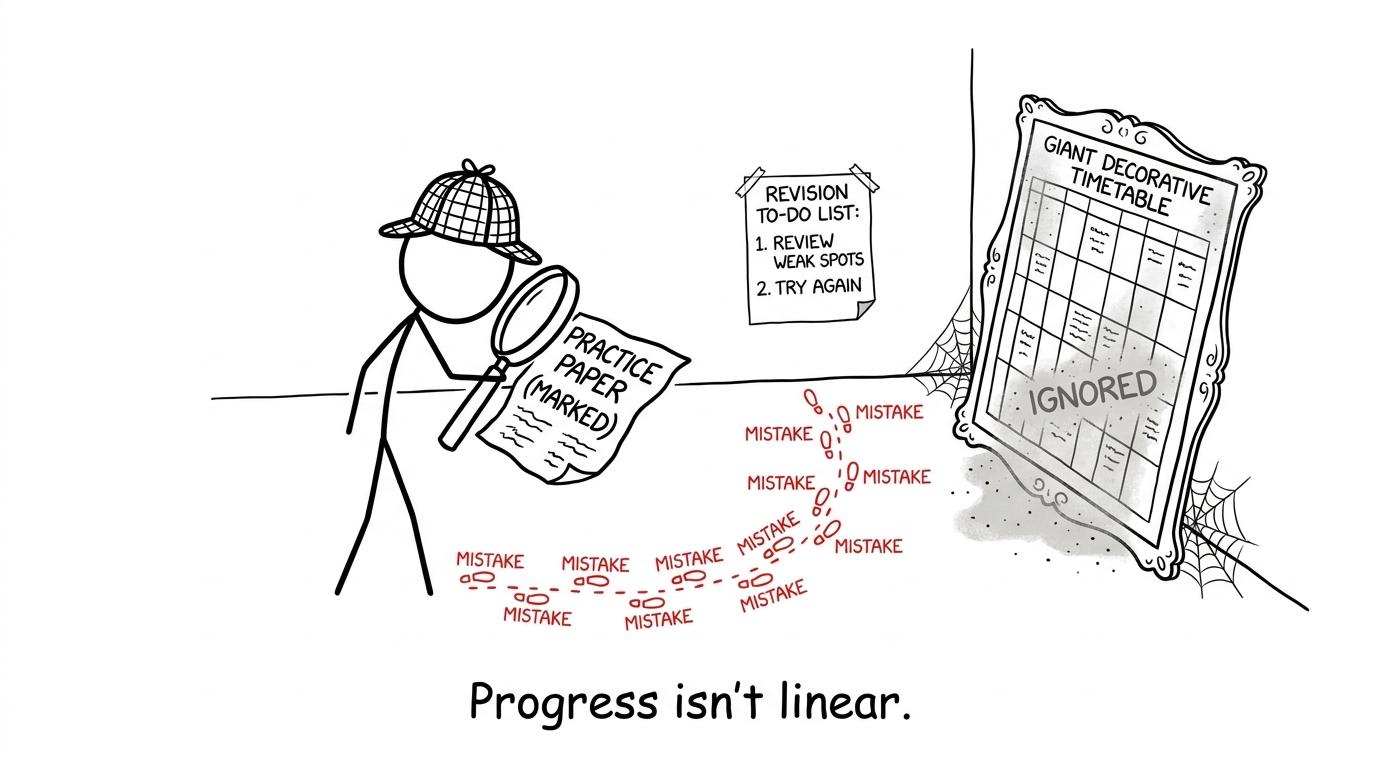 A student detective follows mistakes from a marked paper towards a useful revision list
Common revision timetable mistakes
Making the timetable too detailed
Planning every few minutes creates fragile precision. Use clear revision blocks with one main outcome and a little flexibility.
Confusing organisation with learning
Colour coding may make a plan readable, but it cannot replace recall, questions or feedback. Stop formatting when the next action is clear.
Scheduling only favourite tasks
Comfortable tasks make a timetable easier to follow while leaving the largest gaps untouched. Use marked work to identify priorities rather than choosing by mood alone.
Writing broad subject labels
“History” or “maths” does not tell you how to begin. Name the unit, skill, question type and checking resource.
Filling every available space
An overloaded timetable assumes perfect energy and perfect circumstances. Include rest and spare capacity so one difficult day does not destroy the week.
Never changing the plan
A timetable written before you complete practice papers is based partly on guesswork. Update it when mark schemes, teacher feedback or mini tests reveal something more important.
The timetable is a tool, not the work
A GCSE History revision timetable is worth making when it reduces indecision, spreads practice and adapts to evidence. It is not necessary to account for every hour, and flexible revision can be equally effective when you maintain a clear priority list and regularly review your progress.
Keep the plan small enough to use. Let completed questions and marked responses decide what comes next. Above all, leave room for the maths practice that turns familiar methods into reliable exam performance.
Make MathsGenie your free maths revision base: begin with revision lessons and practice questions, check your work using mark schemes and video solutions, then build towards mini tests, past papers and predicted papers. Your timetable provides the appointment. The work you do with it is what gives that appointment value.











