GCSE History Handwriting Speed: Does It Matter?
GCSE history handwriting speed can affect how much you finish, but speed earns no marks itself. Learn to write clearly, pace answers and seek support early.
There is a particular kind of frustration in knowing the answer but not getting it onto the page before time is called. For students worried about GCSE history handwriting speed, the short answer is this: writing slowly does not directly lose marks, because examiners assess the quality of your response rather than how many words you produce per minute. But it can cost marks indirectly if you leave answers unfinished, omit supporting knowledge or write so quickly that your meaning becomes unclear.
The goal is not beautiful handwriting or frantic speed. It is readable, efficient writing that lets you demonstrate what you know within the available time. That lesson matters in History, and it transfers surprisingly well to GCSE maths: sensible pacing, clear working and timed practice all help knowledge become marks.
The quick handwriting checklist
Before changing your handwriting, identify the actual problem:
- Can a teacher read your writing without repeatedly guessing words?
- Do you complete timed History papers or regularly leave questions unfinished?
- Are you spending too long planning, remembering facts or perfecting introductions?
- Does your hand become painful or unusually tired?
- Is your writing much slower than your thinking across several subjects?
- Have you practised under the timing of your own exam board?
If your writing is readable and you usually finish, your handwriting speed is probably adequate. If you know the content but repeatedly fail to record it, investigate further rather than assuming that you simply need to write faster.
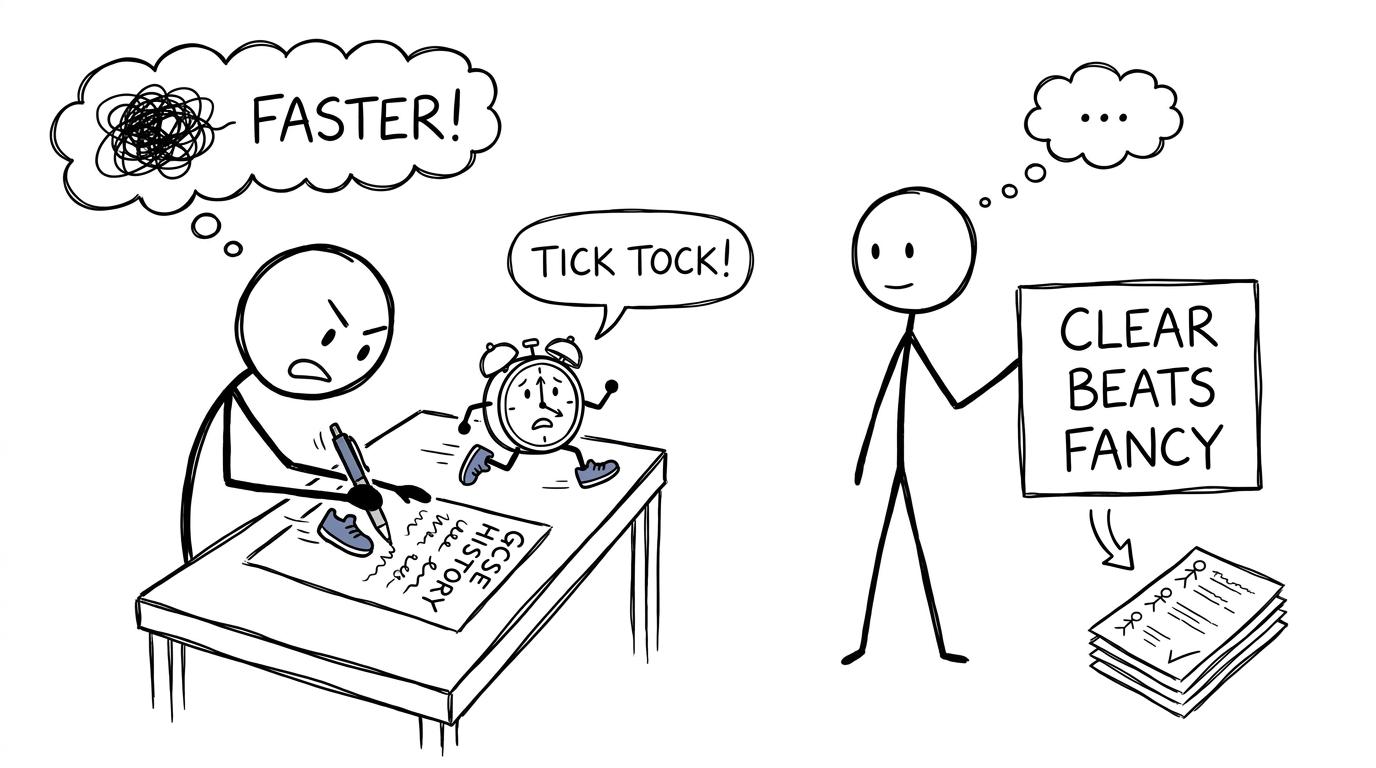 A student's pen races an exam clock while an examiner values clarity
Does slow handwriting genuinely cost marks in GCSE History?
GCSE History mark schemes from Edexcel, AQA, OCR and Eduqas award marks for historical knowledge, explanation, analysis, source or interpretation skills, and judgement where required. Handwriting speed is not itself an assessment objective.
That distinction matters. An examiner does not count your words per minute and reward the fastest script. Nor does a long answer automatically deserve more marks than a concise one. A focused paragraph that answers the question can be more valuable than a page of loosely connected facts.
However, examinations have fixed time limits. Slow writing can therefore become a practical barrier. It may prevent you from:
- completing the final question;
- developing an explanation far enough to reach a higher level;
- including precise supporting knowledge;
- comparing interpretations fully;
- reaching and supporting a judgement;
- checking whether you answered the exact question.
Ofqual research into time limits notes that GCSEs and A Levels are intended to assess knowledge, skills and understanding, not speed for its own sake. It also recognises that handwriting can limit how much some candidates record in a paper-based examination. So speed is not what the exam is meant to test, but it can affect your opportunity to show what is being tested.
Legibility matters more than neatness
Examiners are accustomed to reading many different handwriting styles. Your script does not need to resemble calligraphy. It needs to communicate your meaning.
A useful standard is functional legibility:
- letters are distinguishable;
- words have enough spacing;
- corrections are clear;
- sentences can be followed;
- names, dates and specialist terms can be identified.
If an examiner can read your answer, untidy handwriting does not usually reduce the historical mark. If the writing is genuinely indecipherable, however, the examiner cannot award credit for knowledge they cannot identify.
Some GCSE History specifications also assess spelling, punctuation and grammar in particular questions. The exact arrangement depends on the exam board and specification, so check the current guidance provided by your school. This is not a reward for decorative handwriting. It is another reason why meaning must remain clear when writing under pressure.
Find out where the time is actually going
Students often call themselves slow writers when the pen is not the main delay. A timed paper contains several different processes:
- reading the question;
- deciding what it requires;
- retrieving relevant knowledge;
- planning a response;
- physically writing it;
- pausing to rethink or edit.
Ask a teacher to observe a timed answer, or record your own timings during a mock. Notice whether long pauses happen before writing, between paragraphs or while trying to remember evidence. If planning consumes too much time, faster letter formation will not solve the central problem.
The same diagnosis helps in maths. A student may appear slow because arithmetic is insecure, because they repeatedly restart methods or because they spend too long on one difficult question. The MathsGenie GCSE revision homepage helps separate those issues through revision lessons, topic questions and exam practice.
Build a realistic timing plan
Use the structure and mark allocations of your own History paper rather than following a generic internet timetable. Edexcel, AQA, OCR and Eduqas papers differ, and question types can demand different amounts of reading, planning and writing.
A starting budget can be expressed as:
t=TM×mt = \frac{T}{M} \times mt=MT×mHere, TTT is the total working time, MMM is the total number of marks and mmm is the mark value of a question. The result, ttt, is only a starting estimate. Source reading, checking time and the demands of individual questions may require you to adjust it.
Write a small set of checkpoint times before beginning. If a planned checkpoint arrives, make a conscious decision: finish the current sentence, add the most important missing point and move on. An unfinished high-mark answer can be expensive, but so can sacrificing several later questions to perfect it.
This is why full timed practice matters. Maths students can build the same discipline by learning when to start GCSE past papers and using shorter tests before progressing to complete papers.
How to improve GCSE History handwriting speed safely
Practise the complete exam skill
Copying text quickly tests transcription, but a History examination also requires retrieval, selection and argument. Practise actual exam-style questions under gradually tighter conditions. Afterwards, ask your teacher to judge three separate things: historical quality, completion and legibility.
Keep a simple record of how much you completed and where you paused. The purpose is not to chase an arbitrary words-per-minute target. Research methods and writing tasks vary, so there is no universal speed that guarantees success in every GCSE History paper.
Plan briefly and selectively
A plan should reduce hesitation, not become a hidden first draft. Record only the key argument, evidence and order of ideas. Then begin writing.
Use direct opening sentences that address the question. Avoid memorised introductions that consume time without adding analysis. For each paragraph, prioritise a relevant claim, precise historical support and an explanation of why that evidence matters.
Choose fluency over presentation
Use the handwriting style that is most natural and readable for you. Printing is not automatically too slow, and joined writing is not automatically fast. Avoid forcing an unfamiliar style shortly before the examination.
A comfortable pen, sensible grip and relaxed pressure can reduce fatigue. Practise with equipment permitted by your school and exam regulations. If writing causes persistent pain, tell a teacher, parent or carer rather than attempting to train through it.
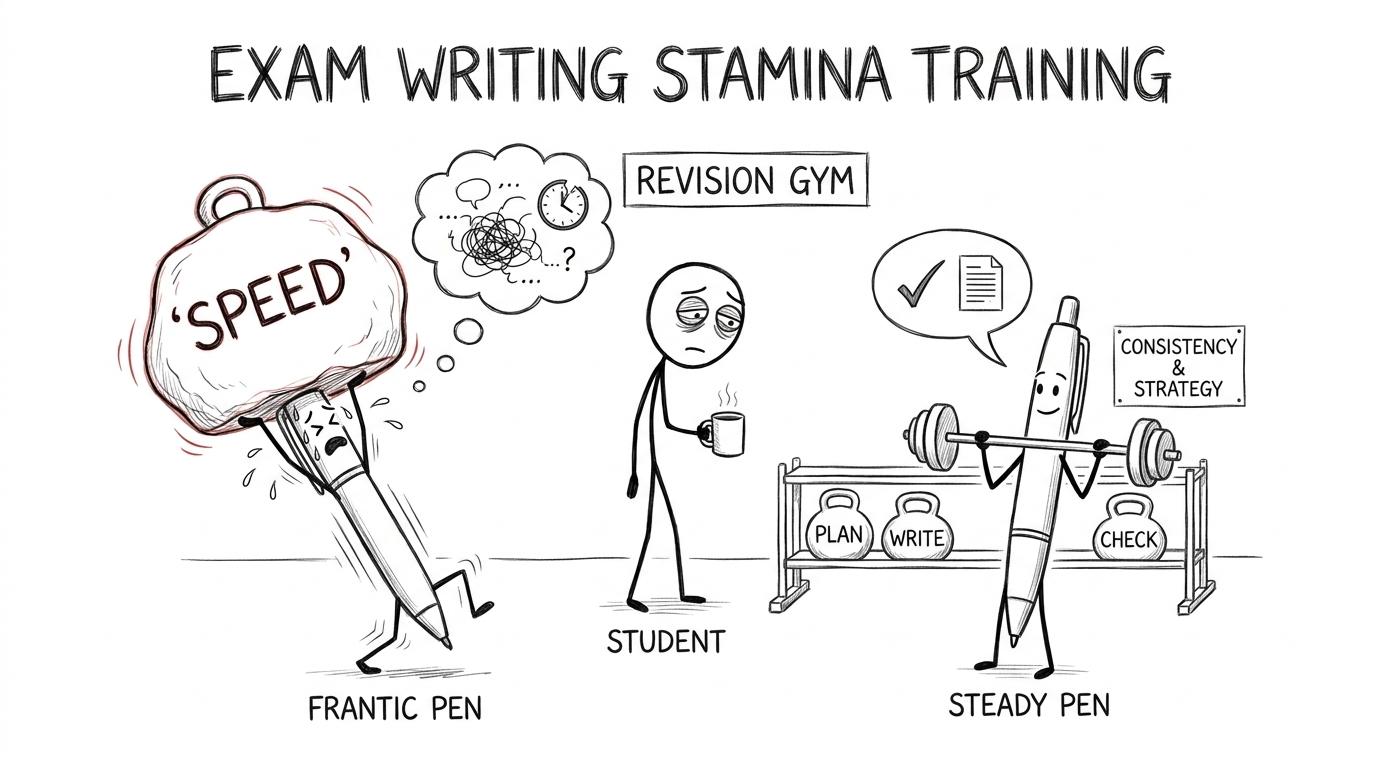 Pens train planning, writing and checking instead of chasing speed alone
Review what you omit
After each timed response, highlight the knowledge or analysis that remained in your head. This reveals whether the missing marks came from handwriting, weak recall, poor selection or an unrealistic plan.
MathsGenie uses a similar improvement loop: complete a task, check the mark scheme, identify the exact gap and return to focused practice. The GCSE one-month maths revision plan shows how mini tests, timed questions and review can fit into a manageable routine. For a longer structure, use the GCSE maths revision timetable.
When to ask about access arrangements
If slow or painful handwriting creates a persistent and substantial barrier, speak to your subject teacher and school SENCo as early as possible. Do not wait until the examination week.
Under current Joint Council for Qualifications guidance, access arrangements are intended to remove barriers without changing what an examination assesses. Depending on an individual student's needs and normal way of working, arrangements may include a word processor, extra time, supervised rest breaks or, in specific circumstances, a scribe.
These arrangements are not granted merely because a student prefers typing or feels that extra time would be useful. Schools must follow JCQ requirements, establish need and, where required, provide assessment evidence. For a word processor, the arrangement should normally reflect how the student works in school; examination machines generally have spelling, grammar and predictive-text facilities disabled unless a separate permission applies.
A handwriting-speed measure may contribute to evidence for extra time when a student writes by hand, but it is not the only consideration. Your SENCo or qualified assessor must determine what evidence and arrangement are appropriate. A teacher's records from timed classwork and mock examinations can help show whether the difficulty is consistent.
Common mistakes when trying to write faster
Making handwriting unreadable
Speed is useless if letters merge, key names become ambiguous or sentence boundaries disappear. Increase pace gradually while asking someone else to check legibility.
Writing everything you remember
History rewards relevant selection, not a knowledge dump. More writing can consume time without moving the answer into a higher mark level.
Perfecting the opening paragraph
An elegant introduction cannot compensate for missing later analysis or an absent conclusion. Give each section a job and move forward when that job is complete.
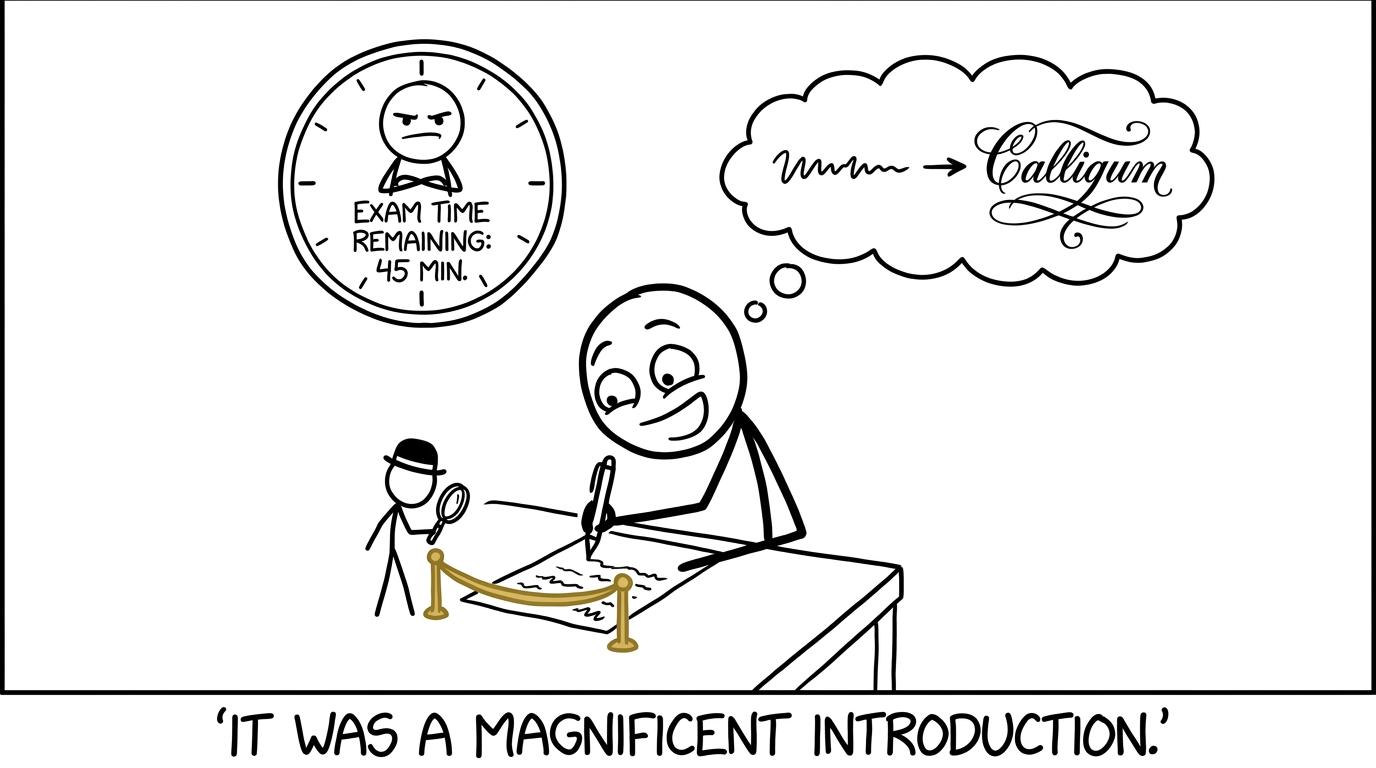 A museum curator admires an introduction while the exam clock waits
Practising only when untimed
Untimed revision builds knowledge, but it does not reveal whether your plan survives examination pressure. Combine topic learning with short timed answers and full papers.
Assuming the problem is handwriting
Slow recall, overplanning, anxiety and weak question selection can all look like slow writing. Diagnose before trying to fix.
Leaving support until the last minute
Access arrangements must be considered and organised through the school. Raise persistent difficulties early enough for teachers and the SENCo to observe your normal way of working.
Turn timing into a revision skill
Good exam technique is rarely dramatic. It is a collection of small decisions made early enough: move on now, choose the relevant fact, show the essential working, return later if time remains.
That is as true in GCSE maths as it is in History. Use MathsGenie's guide to how many GCSE past papers to complete to balance timed papers with careful review. Near the examination, Edexcel GCSE Maths predicted papers can provide realistic practice with mark schemes and worked solutions. The GCSE maths night-before plan can also help you avoid replacing preparation with panic.
Slow handwriting does not automatically cost marks in GCSE History. Unfinished, irrelevant or unreadable answers can. Build a timing plan, practise authentic questions and ask for support if handwriting remains a genuine barrier.
Then apply the same calm process to maths. Start with MathsGenie's free revision lessons, strengthen weak topics through practice questions and mini tests, and test your progress using past papers, predicted papers, mark schemes and video solutions. The aim is not to rush. It is to make sure the knowledge you have worked for reaches the page clearly, while there is still time for it to count.