GCSE History Cram Guide: A 1-Week Plan
GCSE history cram guide 1 week: follow a focused seven-day plan using recall, timelines, source practice and past-paper review before exam day.
There is a particular kind of panic that arrives when the History exam is seven days away and the textbook still looks almost new. The temptation is to read everything, highlight everything and sleep very little. Resist it. This gcse history cram guide 1 week plan gives you a better route: confirm your assessed topics, retrieve the essential knowledge, practise your exam board's question types and repair the gaps revealed by marking.
A week is not enough to relearn an entire course perfectly. It is enough to become more selective, more accurate and much better prepared than you are today.
Your one-week History revision checklist
Before starting, collect:
- your exam board and exact specification;
- the topics taught by your school;
- your examination dates and paper order;
- past papers, official mark schemes and examiner guidance;
- class notes or one trusted revision guide;
- blank paper for timelines and recall;
- a simple mistake log.
GCSE History courses differ across AQA, Edexcel, OCR and Eduqas. Even students taking the same board may study different options. Do not revise a topic merely because it appears in somebody else's online checklist. Confirm your route using your school information and the current specification on your exam board's website.
Your daily method will be simple: recall, check, correct, practise and revisit. Spend less time creating resources and more time testing whether you can produce useful knowledge without seeing it first.
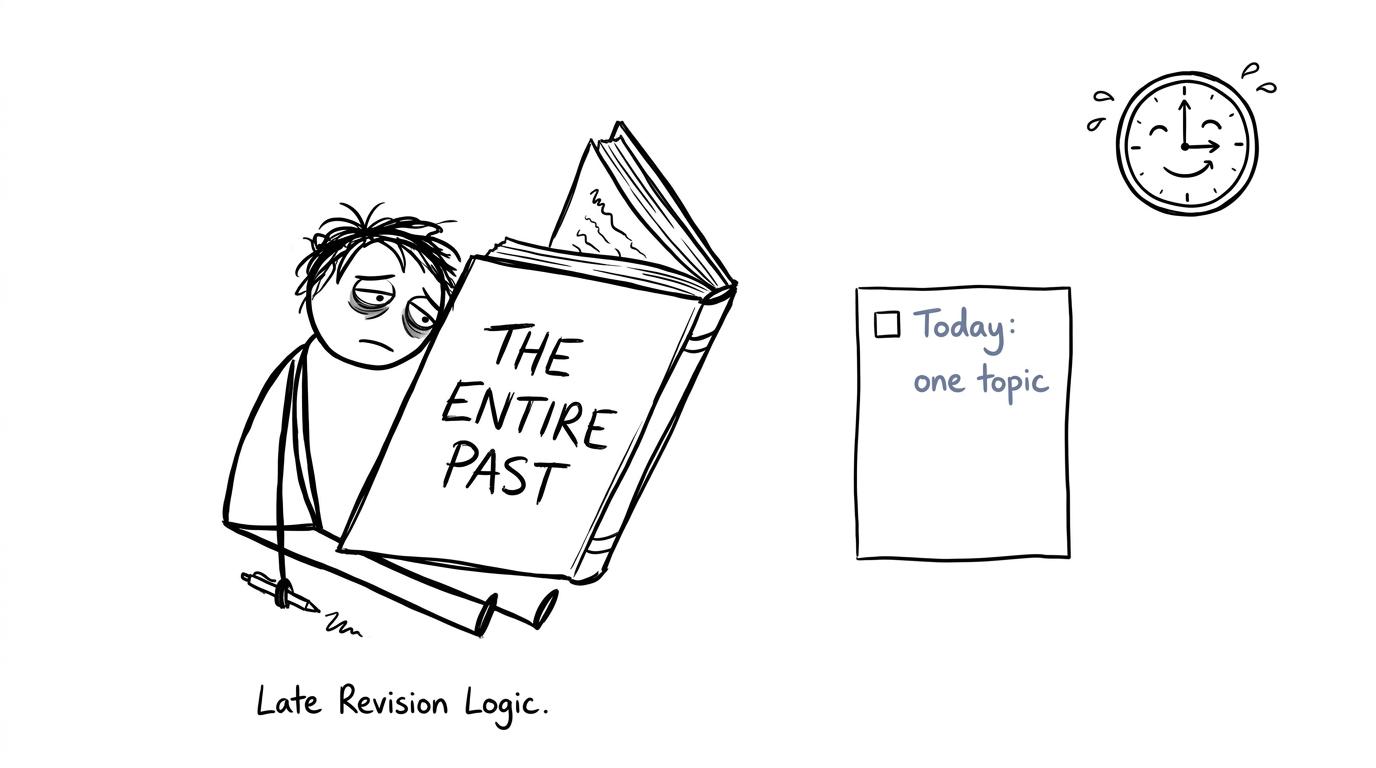 A student discovers that revising one History topic is more manageable than revising the entire past
How to organise each revision day
Use two or three focused sessions rather than an exhausting marathon. A practical session has four parts:
- Closed-book recall: write what you know about one event, person, development or period.
- Correction: use your notes to add missing dates, causes, consequences and evidence in another colour.
- Question practice: answer or plan an exam-board-specific question.
- Review: record the knowledge gap or technique problem that needs another attempt.
The distinction between recognition and recall matters. A familiar-looking page can make knowledge feel secure. The exam asks you to produce and apply that knowledge without the page. That is why rereading should support retrieval, not replace it.
If History is only one of several urgent subjects, protect separate blocks for maths rather than allowing one subject to consume the week. The GCSE Maths Revision hub brings together board-specific lessons, questions and papers, while the guide to learning GCSE maths topics in a sensible order can help you choose priorities quickly.
Day one: map the course and diagnose the gaps
Today is about choosing, not cramming.
Write down every History paper and topic you will actually sit. Under each topic, list its main enquiries or specification headings. Then label each area:
- Secure: you can explain it accurately without notes.
- Shaky: you recognise it but cannot produce enough precise evidence.
- Missing: you cannot yet explain the main story.
Test these labels with short closed-book brain dumps. Do not rely on confidence alone. A topic is not secure because it feels familiar; it is secure when you can retrieve accurate material and use it in an answer.
Finish by choosing the most important weak areas for the next four days. Give priority to broad gaps that would prevent you from attempting a question. Tiny facts can wait.
Day two: rebuild chronology and the main story
History becomes difficult when facts float around without order. Build a simple timeline for each priority topic, including only the developments needed to understand change, continuity, causes and consequences.
For every major event, ask:
- What happened?
- Why did it happen then?
- What changed afterwards?
- What stayed the same?
- Which precise evidence could support an argument?
Keep the timeline lean. Its job is to show the story, not become a handwritten copy of the textbook. When it is complete, cover it and reconstruct it from memory. Check immediately, correct mistakes and repeat later in the day.
Day three: causes, consequences and connections
Knowing isolated dates is useful; understanding relationships is what makes those dates work in an answer.
Choose several major developments from your weakest topics. For each one, create a cause-and-consequence chain. Separate long-term conditions from short-term triggers, and distinguish immediate results from longer-term effects. Then rank the causes or consequences according to the wording of a possible question.
Your aim is not to memorise one fixed judgement. It is to build a bank of defensible connections. A strong explanation identifies a factor, supports it with precise knowledge and shows why that evidence answers the question.
End the day by revisiting yesterday's timelines from a blank page. This delayed second attempt is more valuable than admiring the original version.
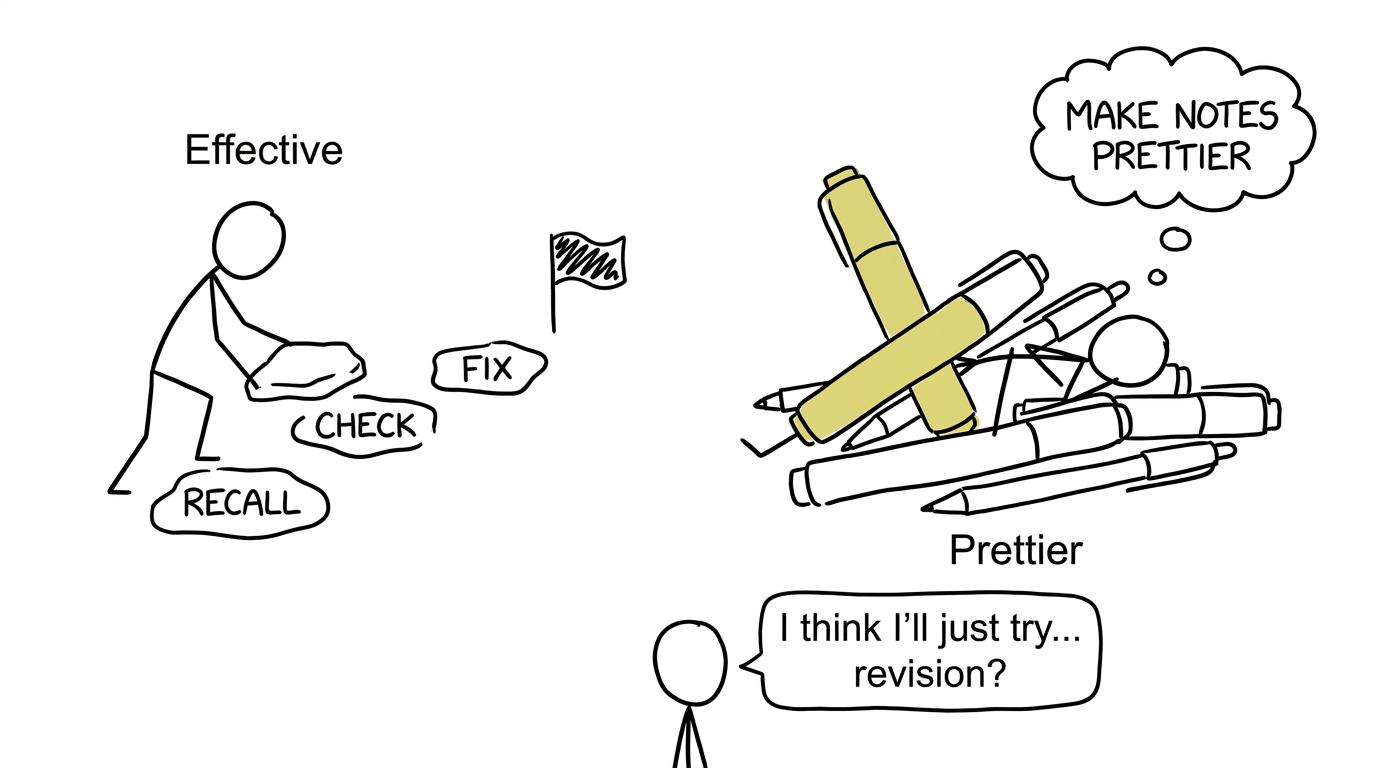 One student uses a recall path while another disappears beneath decorative highlighters
Day four: sources and interpretations
Today, focus on the question types that use sources or interpretations in your papers. Check the exact wording and requirements in your board's materials because these tasks are not interchangeable across specifications.
When considering a source, separate three questions:
- What does its content suggest?
- How does your contextual knowledge support or challenge that suggestion?
- Why might its origin, purpose, audience or context affect its usefulness for this particular enquiry?
Avoid declaring that a source is useless simply because it is biased. A partial or persuasive source can still provide valuable evidence about an attitude, purpose or audience. Use provenance only when you can explain its effect on usefulness.
For interpretations, identify the actual difference between the views before explaining it. Relevant contextual knowledge may help you understand why historians could emphasise different evidence, but do not invent motives for an author.
Practise planning and writing the question types on your own paper. Compare your response with the official mark scheme and any teacher feedback.
Day five: practise arguments under time pressure
Move from knowledge collection to exam performance. Select questions covering different topics and command words from your specification.
Before writing, create a brief plan containing:
- your answer to the exact question;
- the main factor or argument in each paragraph;
- precise supporting knowledge;
- a link explaining why the evidence matters;
- the basis of your final judgement, where required.
Complete at least one substantial response under controlled conditions. Use the timing suggested by your teacher or exam board rather than copying another board's routine. Afterwards, mark it honestly. Look for unanswered wording, vague evidence, unsupported assertions and paragraphs that describe events without explaining their significance.
Maths revision benefits from the same paper-to-correction cycle. If you are balancing both subjects, read when to begin using GCSE past papers and use Edexcel GCSE Maths mini tests when a full maths paper would take too much of today's History time.
Day six: run a paper, then repair it
Use a past paper or a carefully selected set of questions that reflects the paper you are about to sit. Work without notes and keep to realistic conditions as far as possible.
The marking matters more than the score. For every lost mark, classify the cause:
- missing factual knowledge;
- inaccurate or vague evidence;
- misunderstanding the command word;
- weak explanation;
- poor source or interpretation analysis;
- unfinished work or ineffective timing.
Now repair the most costly patterns. If chronology failed, rebuild one timeline. If evidence was vague, retrieve a small set of precise facts. If paragraphs drifted, plan answers that repeatedly connect evidence to the question.
Do not immediately complete another whole paper to escape the discomfort of correction. A paper is useful because it exposes what to fix.
For your parallel maths preparation, this is also the moment to use the Edexcel GCSE Maths revision collection or follow the MathsGenie method for using past papers properly: attempt, mark, diagnose, repair and retest.
Day seven: retrieve, polish and stop
The final day is for consolidation, not expansion.
Recreate your key timelines, retrieve evidence for major themes and plan a small selection of likely question forms. Reattempt the weakest task from day six. Check the answer against your mark scheme and correction notes.
Then prepare for the exam. Confirm the time and location, organise permitted equipment and decide when revision will finish. Avoid opening an entirely new resource late at night. One more exhausted chapter is unlikely to help as much as arriving able to read questions carefully and sustain an argument.
If you also have a maths paper approaching, use the GCSE maths night-before plan to keep that preparation short and controlled.
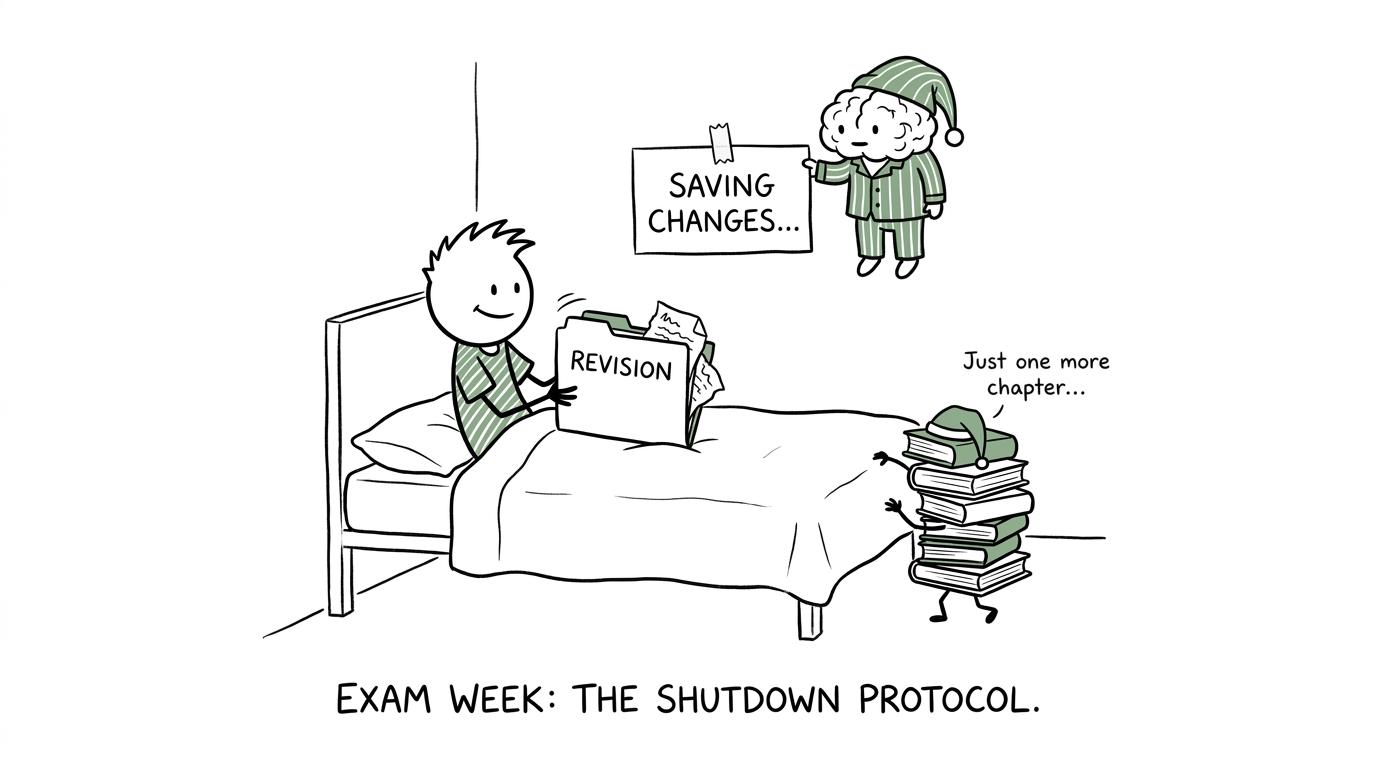 A cartoon brain saves the day's revision while a pile of books tries to sneak past bedtime
Common mistakes in a one-week History cram plan
Trying to cover every detail equally
Not all gaps are equally damaging. Secure the broad chronology, central developments and usable evidence before chasing obscure details.
Rewriting notes instead of retrieving
Neat notes can absorb hours without proving that you remember anything. Begin with a closed-book attempt, check it and then correct only what was missing.
Ignoring your exact exam route
Boards and optional studies differ. Use the specification, school guidance and papers matching your own course rather than a generic topic list.
Memorising model answers word for word
A rehearsed response may not fit the wording in front of you. Learn flexible knowledge, argument structures and question-specific planning instead.
Treating a past paper as the final task
The score is a diagnosis. The learning happens when you inspect the mark scheme, identify recurring weaknesses and reattempt the difficult material.
Sacrificing sleep for one more session
Late revision often becomes passive and error-prone. Set a stopping point, prepare your equipment and give yourself the best chance of thinking clearly.
Make the next seven days count
Starting late limits your options, but it does not remove them. The useful question is no longer, "What should I have done last month?" It is, "Which action will make tomorrow's answer stronger?"
For History, follow the sequence: map the course, rebuild chronology, connect causes and consequences, practise sources and interpretations, write arguments, mark a paper and consolidate. For maths, let MathsGenie reduce the number of decisions you need to make. Use its free revision lessons, practice questions, mini tests, past papers, predicted papers, mark schemes and video solutions to identify a weakness and work on it directly.
Open the MathsGenie GCSE Maths hub, choose your exam board and protect a focused maths block alongside this History plan. Seven calm, deliberate days will serve you better than seven days spent trying to revise everything at once.