

GCSE History Command Words: What They Really Mean
GCSE history command words explained clearly. Learn what describe, explain, compare and evaluate require, and avoid misreading questions under pressure.
A familiar fact can suddenly feel useless when an exam question asks for it in an unfamiliar way. You know the event. You remember the date. Yet the first word says evaluate, and your mind offers a description instead.
That is why GCSE history command words matter. They tell you what kind of thinking the examiner wants to see: recall, description, explanation, comparison, source evaluation or a supported judgement. The quickest way to improve is to identify the command word, underline the exact focus and shape every paragraph around both.
This guide explains the most common instructions used by Edexcel, AQA, OCR and Eduqas. Exact question formats and mark tariffs vary, so always check the specification, sample papers and guidance for your own course. The meanings below, however, capture the distinctions that repeatedly matter under pressure.
Your command-word checklist
Before writing, pause long enough to answer five questions:
- What is the command word or question stem?
- What precise event, period, factor or issue is the question about?
- Does it ask for knowledge, explanation, comparison or judgement?
- Must I use a source, an interpretation, contextual knowledge or all three?
- Have I answered the stated question rather than displaying everything I know?
That final distinction is important. Revision fills your memory with material. Exam technique decides which material earns marks.
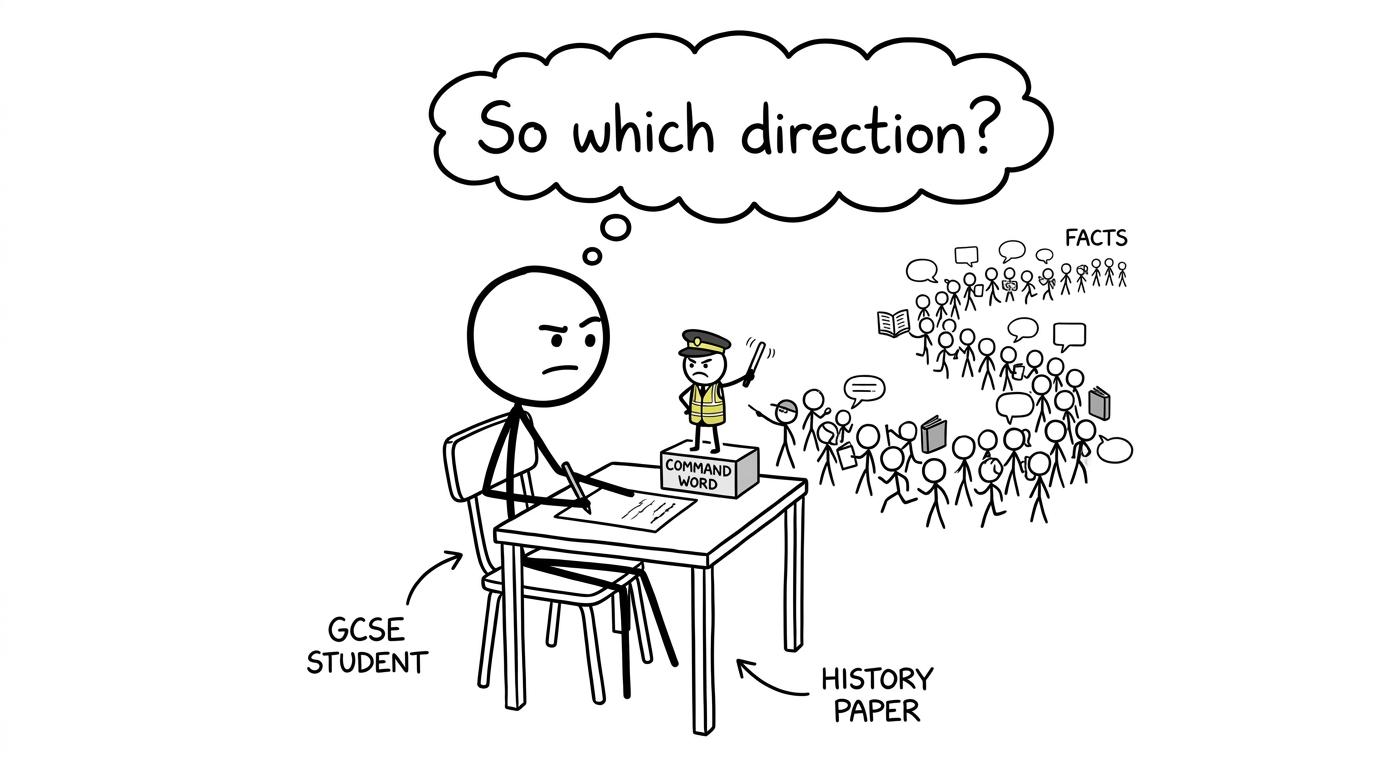 A tiny command word directs a parade of historical facts
What the main GCSE history command words require
Official guidance describes command words as the words or phrases that tell candidates how to respond. They are not decorative openings. Changing describe to explain, for example, changes the intellectual task.
| Command word or stem | What it is really asking you to do |
|---|---|
| Identify, name, give or state | Select the relevant fact, feature or piece of information concisely. |
| Describe or outline | Set out relevant characteristics or main features with accurate supporting detail. |
| Explain | Show how or why something happened, mattered or produced an outcome. |
| Compare | Make direct connections by identifying relevant similarities and/or differences. |
| Write an account | Produce an organised analytical narrative showing how developments connect. |
| How useful? | Evaluate a source for a specific enquiry using its content, provenance and contextual knowledge where required. |
| How convincing? | Test an interpretation's claims against accurate contextual knowledge. |
| Assess or evaluate | Weigh relevant evidence and reach an informed, supported judgement. |
| How far do you agree? | Analyse evidence supporting and challenging a statement, then judge its extent or validity. |
The whole question matters as much as the first verb. Explain why, explain the significance and explain two ways do not produce identical answers. Read beyond the command word to find the concept being tested.
Identify, give, name and state
These instructions usually demand selection rather than extended explanation. The examiner wants the requested information clearly and precisely.
If the question asks for two things, make sure two distinct things are visible. Adding a long background paragraph can waste time and sometimes makes the intended answers harder to locate.
Think of these as controlled recall tasks. Your job is not to prove how much you revised. It is to retrieve exactly what was requested.
Describe and outline
A description sets out characteristics. An outline gives the main features in a concise form. Neither word normally asks you to build a causal argument or weigh competing views unless another part of the question explicitly requires that.
Strong description is still specific. Names, policies, events and relevant details can establish secure knowledge. The trap is moving too quickly into explanation and spending time answering a harder question that was never asked.
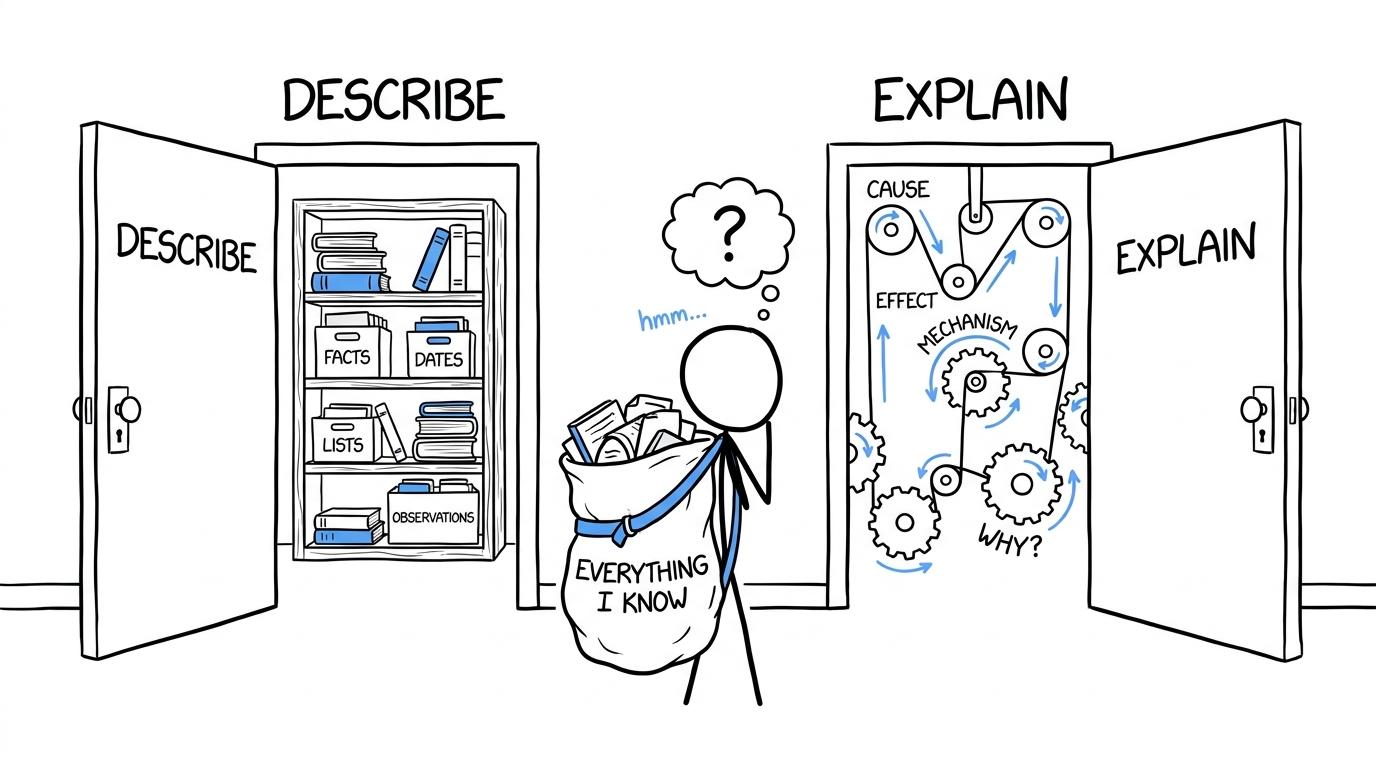 A student chooses between the describe and explain doors
Explain means show the connection
Official exam-board definitions commonly express explain as setting out reasons, purposes or causes. In history, it often tests second-order concepts such as causation, consequence, significance, change or continuity.
A factual point is therefore only the beginning. Your answer must make the relationship visible:
- identify a relevant reason, consequence or development;
- support it with precise knowledge;
- explain how that knowledge answers the focus;
- link the reasoning back to the question.
Using the word because can prompt reasoning, but it is not a magic mark-producing formula. The logic after it must be historically accurate and developed. A list of causes remains a list until you show how each cause contributed to the outcome.
Compare requires direct links
A comparison should place two periods, events, people or developments in relation to one another. Writing everything you know about the first and then everything about the second leaves the examiner to make the comparison for you.
Use direct comparative language such as similarly, whereas, in both cases and unlike. Check whether the question wants similarities, differences or both. Some exam-board questions specify one of these explicitly, so do not rely on a memorised generic structure.
The comparison must also match the named focus. Two events may be similar in many ways, but only the similarities relevant to the question can help answer it.
Write an account is more than telling the story
A chronological answer can still be analytical. When asked to write an account, organise relevant developments in a logical sequence and show the connections between them.
The examiner is not simply asking, “What happened next?” The stronger question is, “How did one development shape, intensify or lead towards another?” Accurate sequence matters, but connected sequence is what turns a timeline into historical reasoning.
This resembles good revision in any subject. Facts become useful when relationships are understood. Maths students can apply the same principle through the MathsGenie 20-minute revision routine: retrieve, practise, mark and identify the connection you missed.
How useful are sources?
Usefulness is always usefulness for the stated enquiry. A source is not simply useful or useless in isolation.
Consider three connected elements:
- Content: What relevant information or impression does the source provide?
- Context: How does your knowledge support, qualify or challenge what it shows?
- Provenance: Who produced it, when, for whom and for what purpose, and why does that affect its value for this enquiry?
Do not dismiss a source merely because it is biased. A partisan speech may be limited as a neutral account while remaining valuable evidence of the speaker's aims, language or intended audience. Provenance needs to be applied, not labelled.
Requirements differ between papers. AQA guidance, for example, distinguishes source utility from interpretation questions, while Edexcel uses recurring stems for particular paper sections. Learn the precise source routine attached to your exam board rather than assuming every question rewards the same checklist.
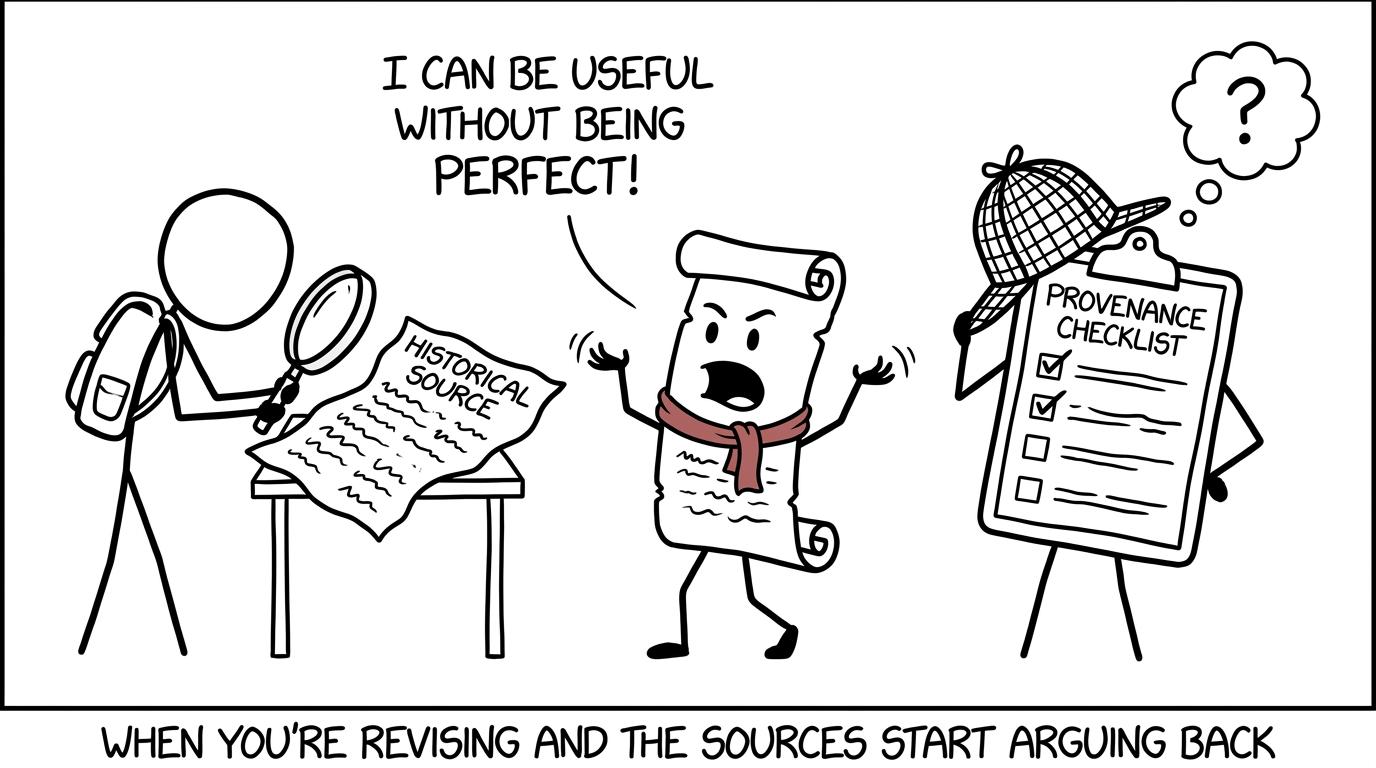 A historical source insists that imperfect evidence can still be useful
What interpretation questions are testing
An interpretation is a later view or representation of the past, not simply a contemporary source. Questions may ask how interpretations differ, why they differ, how convincing one is or how far you agree with one.
For how convincing, focus on the interpretation's claims and test them using relevant knowledge. Do not automatically evaluate provenance as if it were a source-utility question. Some specifications explicitly assess these tasks differently.
If asked why interpretations differ, consider factors such as their chosen evidence, emphasis, scope or approach. Avoid the empty claim that one historian “did more research” unless the provided material gives a defensible basis for saying so.
How far do you agree, assess and evaluate
These are judgement questions. They ask you to weigh evidence rather than deliver an unsupported opinion.
A strong response usually needs:
- a clear line of argument;
- evidence that supports the proposition;
- relevant evidence that challenges or qualifies it;
- explanation of the importance of each factor;
- a conclusion answering how far, not merely repeating earlier points.
Balance does not mean giving every side the same number of sentences. It means considering credible alternatives before reaching a reasoned judgement. Your conclusion should state the basis of comparison: a factor may be more important because it had a wider impact, lasted longer, acted as a trigger or made other factors effective.
A revision method that makes command words automatic
Command words become easier through deliberate practice, not repeated reading. Create a page for each question type containing the command word, the required thinking, the evidence permitted and the features rewarded by the mark scheme.
Then use this cycle:
- complete one question under a realistic time limit;
- underline where your answer performs the command;
- compare it carefully with the mark scheme;
- record whether the problem was knowledge, question reading, structure or judgement;
- practise the same command with different content.
This is the same feedback loop that makes maths revision effective. MathsGenie's guide to using GCSE past papers properly explains how to turn marking into a repair plan. You can also use the weak-topic diagnostic method to separate content gaps from exam-technique errors.
For maths practice, start with short Edexcel GCSE Maths mini tests, then progress to the GCSE predicted papers. The subject changes, but the habit remains valuable: read the instruction, produce the requested evidence and mark the response honestly.
Common mistakes with GCSE history command words
Answering the topic instead of the question
A student recognises the period and begins writing everything remembered. The knowledge may be accurate but irrelevant to the named factor, date range or enquiry. Underline all three before planning.
Describing when the question says explain
Facts establish knowledge; explanation shows why those facts matter. After each factual detail, ask, “What connection does this prove?”
Treating every source as unreliable
Bias, purpose and limited perspective do not automatically remove usefulness. Explain how a particular feature changes the source's value for the specific enquiry.
Evaluating interpretations like contemporary sources
Source utility and interpretation validity are related but distinct tasks. Follow your board's question wording and assessment guidance rather than applying one universal provenance paragraph.
Reaching a judgement only in the final line
Evaluative answers need reasoning throughout. Compare importance, extent or validity as the argument develops, then make the conclusion the natural result of that reasoning.
Using one memorised structure for every board
Edexcel, AQA, OCR and Eduqas do not use identical papers or mark tariffs. A paragraph formula can support organisation, but it cannot replace reading the exact question and current mark scheme.
Turn instructions into marks
The command word is a small part of the question, but it controls the shape of the answer. Learn to distinguish recall from description, description from explanation, and explanation from evaluation. Then practise until that choice feels routine.
The same discipline will strengthen your maths exams. Use MathsGenie's free GCSE maths revision for revision lessons, practice questions, mark schemes and video solutions. Build timing with mini tests, learn from past papers and use predicted papers as a final rehearsal. Before exam week, work through the calm GCSE maths exam checklist.
Revision gives you knowledge. Careful reading tells you what to do with it.










