GCSE German Tier Decision Timing: When Schools Decide
GCSE German tier decision timing explained: when schools choose Foundation or Higher, who decides, when changes are possible, and what students should ask.
The unsettling part of a tier decision is often not knowing when it becomes real. One week, Higher and Foundation feel like classroom labels. The next, someone says the entries have been submitted.
The practical answer on GCSE German tier decision timing is that there is no single date used by every school. Most schools form a provisional view during Year 10 or early Year 11, review it after autumn and winter assessments, and make their operational decision before submitting summer exam entries, commonly around February. A school's internal deadline may be earlier, while later amendments may sometimes be possible.
Students usually have a voice, but not an automatic right to select their own tier. The final entry is normally made by the school, drawing on teacher judgement, assessment evidence, target grades and conversations with the student and their family.
The short checklist
If you are uncertain about your German tier, establish these facts now:
- Which exam board and specification are you following?
- What is your school's internal tier deadline?
- Are you currently entered for Foundation or Higher?
- Which assessments will influence the final decision?
- What evidence would support a move to Higher?
- When will students and families be told?
- Until what date would the school consider an amendment?
Do not rely on a friend's deadline. Different centres have different timetables, even when they use the same exam board.
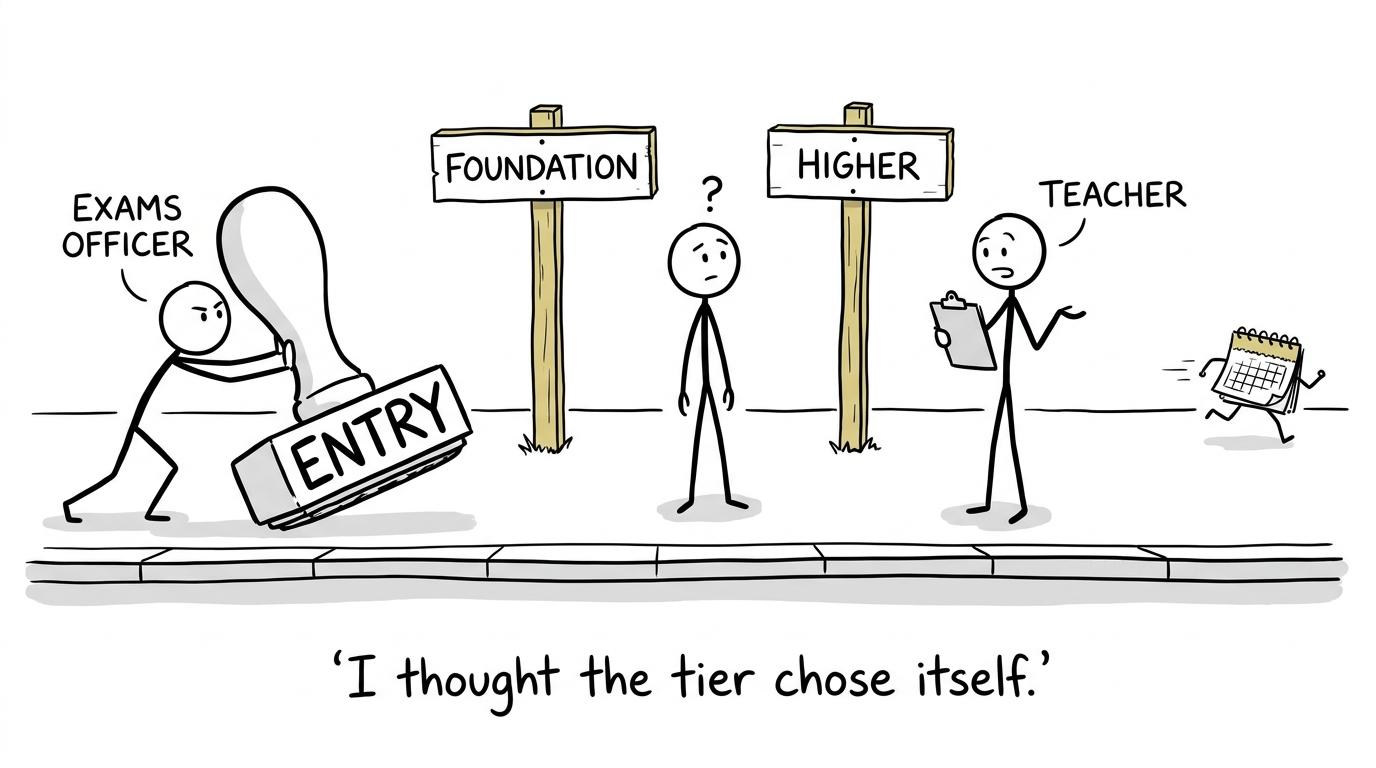 A student waits between Foundation and Higher while an exam-entry calendar escapes
When do schools normally choose the German tier?
The decision tends to happen in stages rather than at one dramatic meeting.
The provisional stage
Teachers may begin discussing likely tiers during Year 10. This helps departments choose suitable teaching materials and establish whether a student is secure with vocabulary, grammar, listening, reading, speaking and writing at the required level.
This is not necessarily the final entry. Performance can change, and a sensible department will consider a pattern of evidence rather than treating an early classroom test as permanent.
The evidence-gathering stage
Autumn and winter assessments in Year 11 often carry more weight. Teachers may consider:
- performance across all four language skills;
- mock examination results;
- consistency across several assessments;
- whether answers meet Higher-tier demands;
- attendance and completion of assessed work;
- the student's target grade and realistic grade range;
- confidence under timed conditions.
One result can start a conversation, but it should not automatically settle everything. German is assessed across different skills, so a student who writes confidently but struggles in listening needs a more careful judgement than one overall percentage can provide.
The entry stage
For a summer examination series, schools generally submit final candidate entries during the spring term, commonly around February under the annual exam-entry timetable. The exams officer may therefore set an earlier internal deadline so departments have time to check candidate details, tiers and access arrangements.
That internal deadline is the date students are most likely to experience as the moment the choice is “locked”. It may not be the last date on which an exam board system can technically accept an amendment.
Entry arrangements and fee dates can change between examination series. Your exams officer or head of German can confirm the timetable that applies to your centre and year.
Is the decision genuinely final after February?
Sometimes yes in practice, but not always in theory.
Exam boards can permit entry amendments after the ordinary entry deadline, subject to their current procedures and possible fees. A school may nevertheless decline a late change because it creates administrative risk or because the available evidence does not justify it.
German also has practical scheduling considerations. Speaking assessments take place within an appointed period and require organisation by the school. Tier decisions must be consistent with the relevant specification and the papers for which the candidate is entered. On the main GCSE German specifications, students do not simply select Higher for a preferred skill and Foundation for another.
This means a late change is not something to assume will happen. If you want your tier reviewed, ask early, ideally before your school's internal entry deadline, not shortly before the examinations.
What do Foundation and Higher allow?
For GCSE German specifications using England's grades 999-111, Foundation tier is generally aimed at grades 111 to 555, while Higher is aimed at grades 444 to 999. Some specifications provide a narrowly defined grade 333 safety net for Higher candidates who fall just below grade 444, but students should check the rules for their own board and examination series.
The important strategic point is simple:
- Foundation offers access to grade 555 but not grades above it.
- Higher makes grades 666 to 999 available, but the papers contain greater linguistic demand.
- Higher is not automatically the better choice if it makes demonstrating secure knowledge substantially harder.
- Foundation is not a “failure” tier. It is a route to the grade range it assesses.
Specifications introduced for first assessment from 2026 have changed aspects of GCSE modern languages, so older advice, past papers and online discussions may refer to a previous course. Confirm whether your school uses AQA, Pearson Edexcel, OCR or Eduqas, then ask which specification applies to your cohort.
How much say does a student usually get?
Students usually get influence rather than sole control.
The school is responsible for making and checking the examination entry. In practice, the subject teacher or head of department recommends a tier and the exams officer submits it. Schools may consult students and parents, but consultation does not mean that the candidate has a unilateral choice.
A good conversation should still be two-way. You can ask:
- What evidence is the recommendation based on?
- Is my performance secure across every assessed skill?
- Which grade range does the department currently consider realistic?
- What would I need to demonstrate before the deadline?
- Will there be another assessment or review?
- What are the risks of each option in my particular case?
The strongest case is specific. “I want Higher” expresses a preference. “My last three assessments show secure performance at the department's Higher threshold, and I have improved my listening results” gives the teacher evidence to discuss.
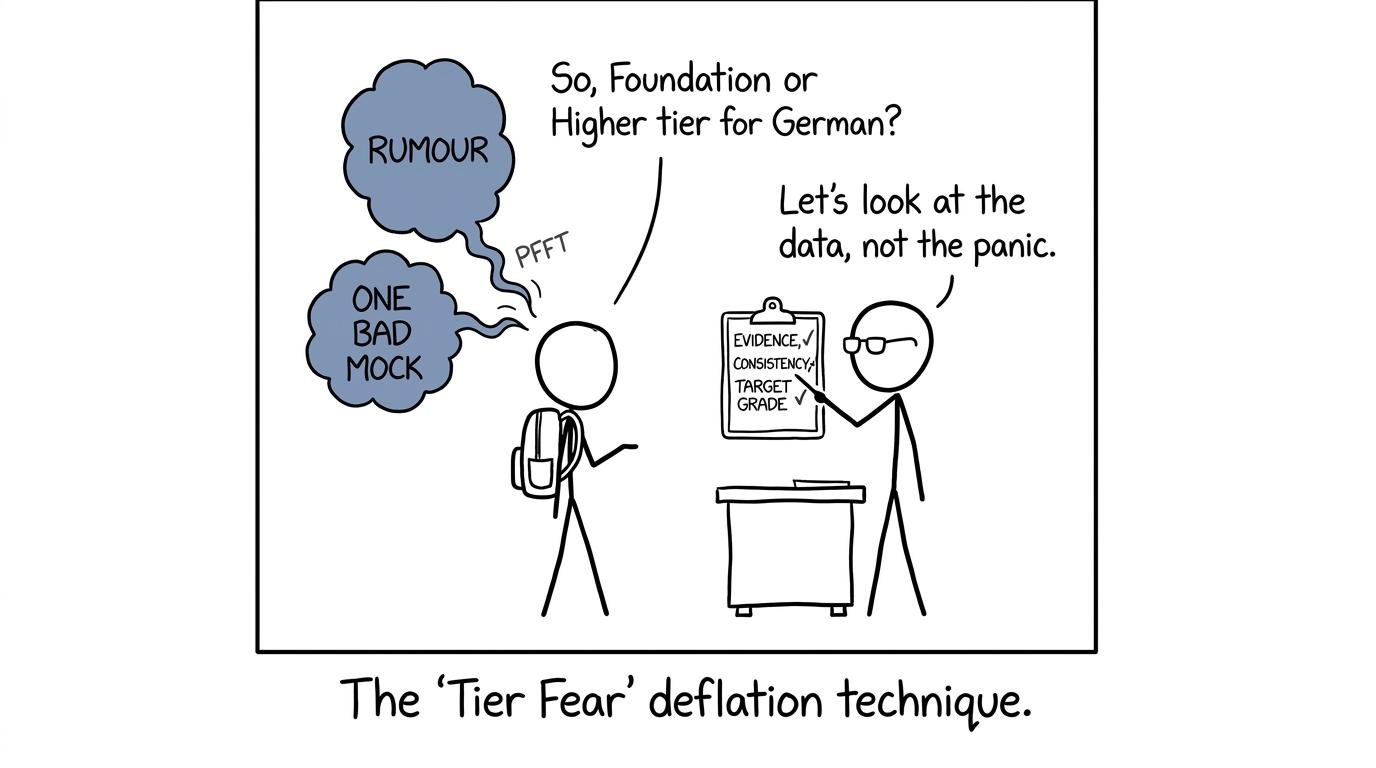 A calm tier conversation deflates the monsters of rumours and one bad mock
What schools consider beyond one mock grade
A mock can be useful without being perfect evidence. Its difficulty, grade boundaries and coverage may differ from the live examination. Teachers also know whether the assessment tested a balanced selection of skills and whether students had completed the course.
Departments therefore tend to look for consistency. A borderline student might be suitable for Higher if their underlying language knowledge is secure and recent evidence is improving. Another student with the same total mark might be better served by Foundation if large parts of the Higher paper are inaccessible.
The tier should protect realistic opportunity, not reward confidence or punish nerves. A useful decision balances two questions:
- What is the highest grade the student may realistically need?
- On which tier can the student best demonstrate what they know?
Neither question should be considered alone.
How to request a tier review constructively
Begin with the teacher rather than rumours from classmates. Ask for a short meeting and bring your latest assessment information. If appropriate, a parent or carer can contact the head of department for clarification.
Keep the request calm and practical:
- confirm your current or proposed entry;
- ask for the school's internal deadline;
- identify the evidence behind the recommendation;
- agree what improvement would trigger reconsideration;
- ask when the decision will next be reviewed;
- request written confirmation after the final choice.
If you are disappointed, avoid turning the meeting into a debate about intelligence. Tiering is an examination-entry judgement at a particular moment. It is not a complete description of your ability.
Protecting your maths revision while German is unresolved
An uncertain tier in one subject can consume attention needed elsewhere. The solution is not to ignore it, but to turn uncertainty into a short list of actions: ask, record the deadline, gather evidence and continue revising.
For maths, make the same clarity work in your favour. First confirm your own maths board and tier using the GCSE maths topics by exam board and tier guide. Edexcel students can then use the Edexcel GCSE Maths revision hub for lessons and exam-style questions.
A productive weekly cycle is:
- revisit one weak topic through a revision lesson;
- complete focused practice questions;
- mark the work and name the exact error;
- test the skill later in a mixed paper;
- keep one short action for German rather than worrying about it daily.
When you are ready for timed practice, use Edexcel GCSE Maths past papers or read how to use past papers properly. The guide to when GCSE students should start past papers can help you place full papers at the right stage of revision.
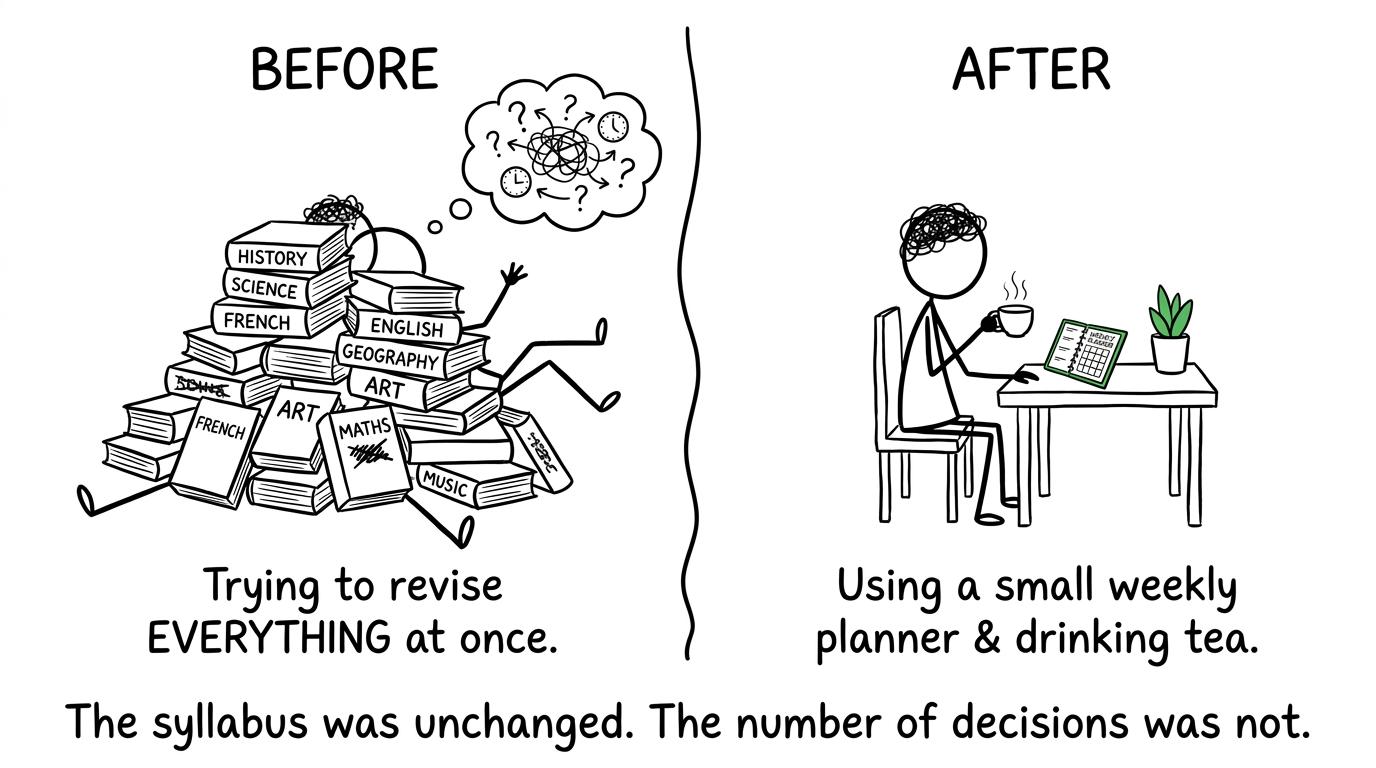 A mountain of revision books becomes manageable when a student uses a weekly planner
Common mistakes around GCSE German tier decisions
Assuming every school decides on the same date
Exam boards publish entry arrangements, but schools create their own earlier internal deadlines. Ask for your centre's date directly.
Treating an autumn decision as permanently fixed
It may be provisional. Equally, do not assume it will automatically be reviewed. Ask when the next formal review happens.
Waiting until the speaking assessment period
By then, entries and practical arrangements may already be established. Raise concerns as soon as you have them.
Focusing only on the maximum available grade
Higher opens the upper grades, but accessibility matters. The right question is not simply “Which tier goes higher?” but “Which tier gives me the best realistic opportunity?”
Using old specification advice
Current cohorts may be following reformed GCSE German specifications first assessed in 2026. Check the board, specification and current tier rules before acting on an old video or forum post.
Letting one decision derail every subject
Once you have asked the relevant questions, return to your revision plan. For maths, GCSE predicted-topic guidance explains how to revise recurring skills without guessing the paper, while the MathsGenie GCSE and A Level revision site keeps topic support and paper practice in one place.
Make the decision visible, then move forward
GCSE German tier decisions are usually developed over time, tested against Year 11 evidence and operationally settled before the school submits its exam entries. Students generally get a meaningful opportunity to ask questions and present evidence, but the centre normally makes the final entry.
Find out your current tier, internal deadline and review criteria this week. Then give the issue a boundary. A clear question asked early is far more useful than months of quiet uncertainty.
For the maths exams competing for the same revision time, let MathsGenie provide the structure. Use free revision lessons and practice questions to repair individual gaps, mini tests to check progress, and past papers, predicted papers, mark schemes and video solutions to build exam confidence. Start with one weak topic today, then make your next decision from evidence rather than anxiety.