GCSE German Revision Timetable Clash: A Realistic Plan
GCSE German revision timetable clash? Build a realistic six-subject plan that protects maths, targets language skills and leaves room for rest each week.

There is a particular kind of revision stress that appears when every subject seems to need attention at once. German vocabulary is fading, a speaking assessment is approaching, and maths still demands regular question practice. If a GCSE German revision timetable clash is making six subjects feel impossible to manage, the answer is not to create a stricter timetable. It is to build a smaller, flexible system based on exam dates, weak areas and the type of practice each subject requires.
German needs frequent contact with the language. Maths needs active problem-solving. Neither benefits much from being ignored for a week and then attacked in one exhausting evening. A realistic plan therefore gives both subjects short recurring sessions, while reserving longer blocks for timed papers and urgent assessments.
Your six-subject revision checklist
Before drawing boxes on a timetable, make these decisions:
- Write down the exact exams and assessments you are preparing for.
- Check your exam board, tier and specification for every subject.
- Rank subjects by urgency and current weakness.
- Give German several short contacts across the week.
- Protect at least two active maths sessions.
- Plan tasks, not vague subject labels.
- Keep one block unallocated for catching up.
- Review the plan every weekend rather than rebuilding it every day.
The aim is not equal time. It is sensible time.
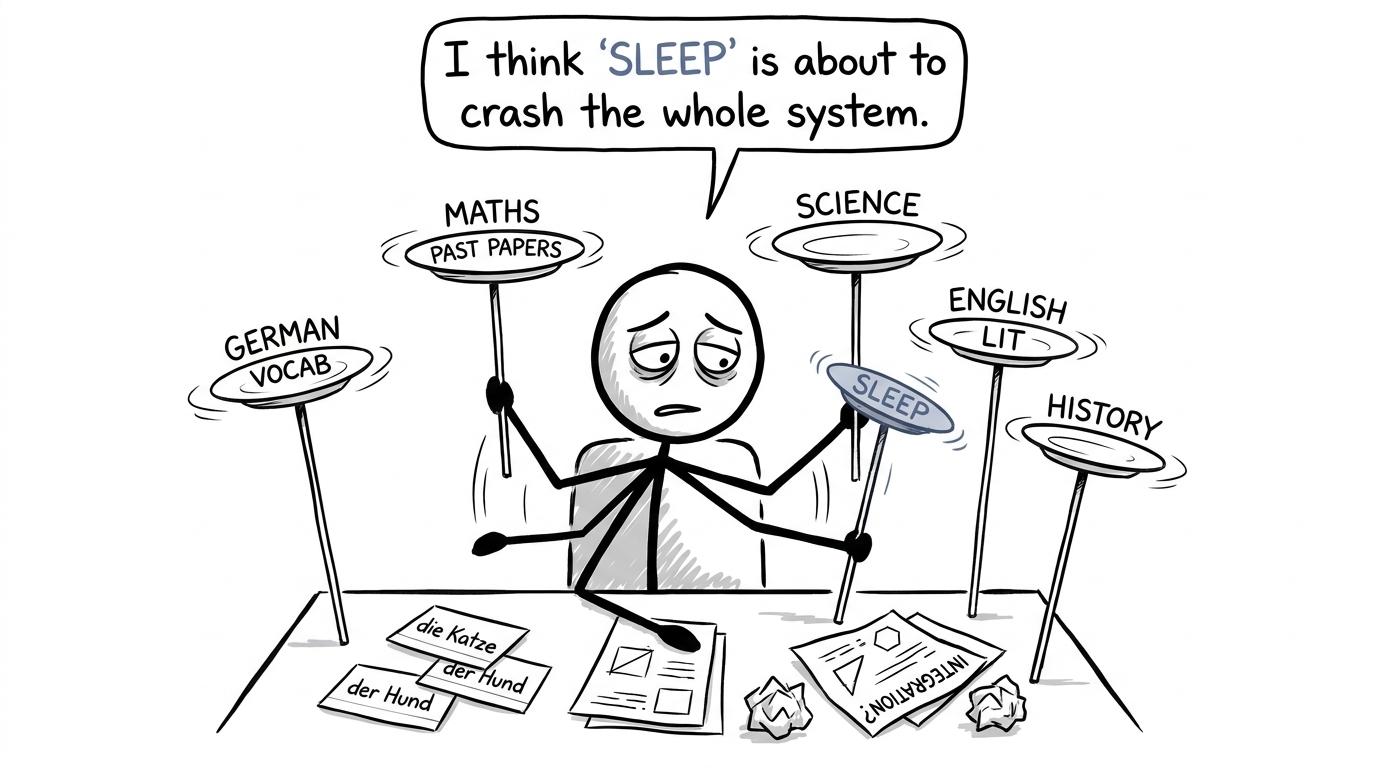 A student juggling German, maths and the surprisingly fragile plate called sleep
Why German and maths compete for time
German revision can look deceptively small. Learning vocabulary for 151515 minutes does not appear demanding, so it is easy to postpone. Yet language knowledge weakens when contact becomes irregular. Speaking also needs rehearsal aloud; listening requires audio practice; writing needs accurate vocabulary and grammar under pressure.
Current AQA and Eduqas GCSE German specifications assess listening, speaking, reading and writing as separate components, with each contributing 25%25\%25% of the qualification. Exact task formats vary between exam boards and specifications, so check the information supplied by your school rather than using a generic online checklist.
Maths creates the opposite problem. It is easy to spend an entire evening on one difficult topic without knowing whether the session improved your exam performance. The GCSE Maths revision hub reduces that decision-making by organising free lessons, questions and papers by exam board.
The conflict is therefore not simply about hours. It is about giving each subject the right kind of attention.
Build the timetable from evidence, not guilt
A timetable often fails because it reflects how worried you feel, not what your exams require. One bad German lesson can lead to three German evenings. One disappointing maths mock can produce a weekend of random algebra.
Start with three pieces of evidence instead:
- Urgency: Which assessment comes first?
- Weakness: Where are you currently losing marks?
- Maintenance: Which subjects will slip if you stop practising them?
You can use MathsGenie's guide to finding your weakest GCSE topics to diagnose maths gaps from actual questions. Apply the same principle to German: separate vocabulary, grammar, listening, reading, speaking and writing rather than labelling the whole subject “weak”.
A subject with an imminent assessment and a clear weakness gets more time. A confident subject without a nearby paper receives maintenance time. This is more useful than dividing the week into six equal shares.
Plan around the real exam sequence
Put confirmed school assessments and official exam dates into your calendar first. Speaking assessments may occur before the main written papers, depending on your board and your school's arrangements. That can temporarily make German the priority even when maths usually receives more weekly time.
If two official examinations genuinely appear to overlap, speak to your school's exams officer immediately. Exam arrangements are managed by the centre; they should not be solved by changing your personal revision timetable.
Use two sizes of revision session
Trying to give every subject a full hour is how a six-subject plan becomes unliveable. Use two session sizes instead.
Short maintenance blocks
A block of 151515 to 252525 minutes suits tasks such as:
- retrieving German vocabulary without notes;
- practising one speaking response aloud;
- completing a short listening or translation task;
- recalling maths formulae and methods;
- answering a small set of targeted questions;
- correcting mistakes from an earlier session.
MathsGenie's 20-minute maths revision routine is useful on crowded school days because it moves quickly from recall to questions and marking.
Longer performance blocks
Use blocks of 454545 to 909090 minutes for activities that need continuity:
- a German writing task followed by correction;
- a full speaking rehearsal;
- a timed reading or listening paper;
- a maths mini test or paper section;
- a complete past paper under exam conditions.
Long blocks should be purposeful and relatively rare. They are not the default unit for every subject.
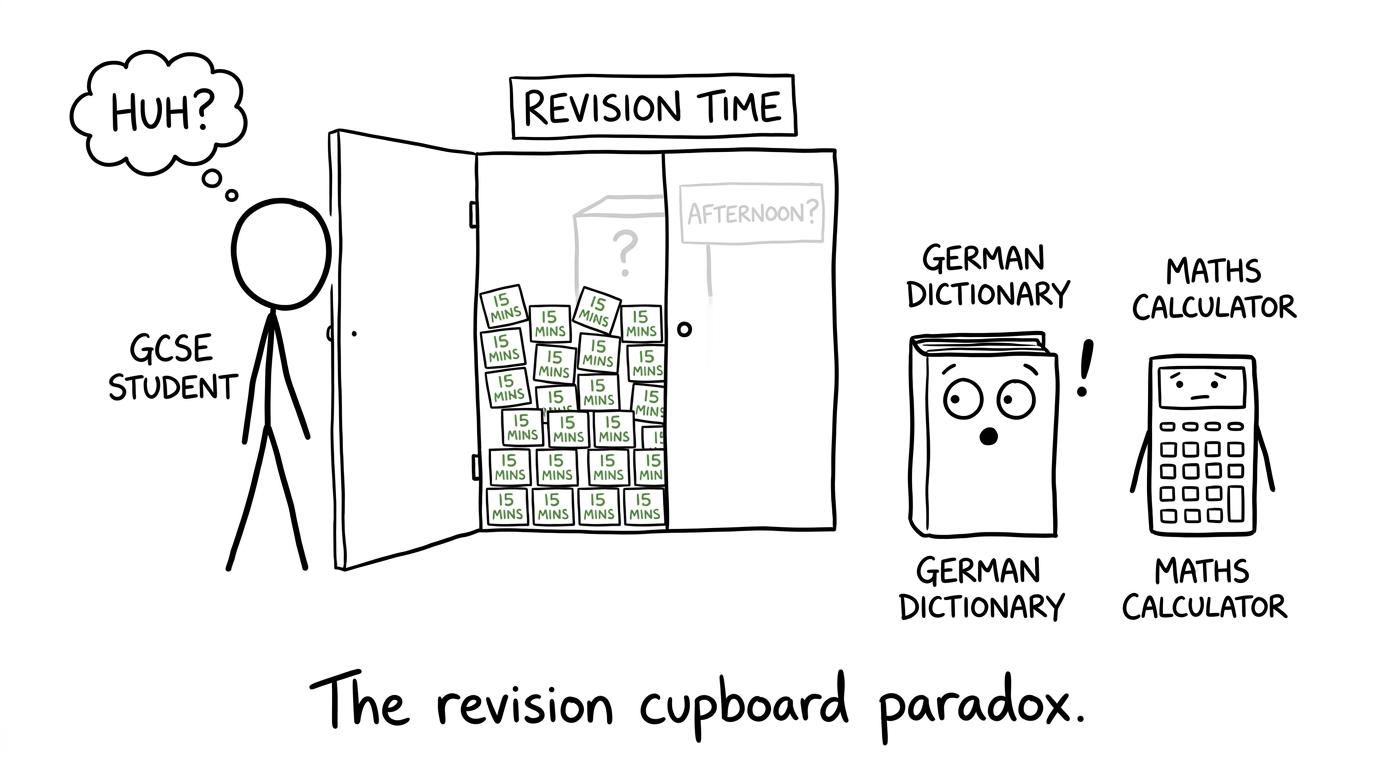 A cupboard full of small revision-time boxes instead of one mythical free afternoon
A realistic weekly structure for six subjects
The following pattern is a framework, not a promise that every week will look identical. It assumes five other subjects alongside German, with maths protected as one of the core priorities.
| Day | Main block | Short block |
|---|---|---|
| Monday | Maths topic practice for 454545 minutes | German vocabulary for 202020 minutes |
| Tuesday | Subject three for 454545 minutes | German speaking for 202020 minutes |
| Wednesday | Subject four for 454545 minutes | Maths corrections for 202020 minutes |
| Thursday | German writing or listening for 454545 minutes | Subject five recall for 202020 minutes |
| Friday | Rest or catch-up | Optional vocabulary review for 151515 minutes |
| Saturday | Maths timed practice for 606060 minutes | Subject six for 454545 minutes |
| Sunday | Nearest-exam priority for 606060 minutes | Plan the next week for 151515 minutes |
This provides German with several encounters rather than one large weekly block. It also protects maths question practice without allowing maths to consume every available evening.
If your German speaking assessment is close, replace one other main block with speaking practice for that week. Once speaking is complete, return the time to the next urgent paper. A timetable should move with the exam season.
For a broader structure, compare this plan with the GCSE maths revision timetable guide. The important feature is not the exact day assigned to each subject. It is the repeatable rhythm of learning, practising, marking and revisiting.
Make each German session specific
“Revise German” is not an actionable instruction. It creates a decision at the moment when your energy is already low.
Replace it with tasks such as:
- retrieve vocabulary from one specification theme;
- record and review two speaking answers;
- complete one short listening section;
- write one response using targeted tenses;
- correct a previous translation;
- test noun genders or verb forms from memory.
Rotate through the four assessed skills, but adjust the balance according to evidence. If listening is secure and speaking is hesitant, equal time would be inefficient.
Retrieval matters here. Looking over a vocabulary list can feel fluent because the answers are visible. Covering the German, recalling it and then checking gives you much better information about what is actually available from memory. Spacing these attempts over different days is generally more useful for retention than placing the same amount of review into one sitting.
Protect maths without letting it expand
Maths revision becomes efficient when every session has a boundary. Choose one weak topic, complete questions, mark them and record the exact error. Stop when the planned task is complete.
On a busy evening, an Edexcel GCSE Maths mini test can provide focused timed practice without requiring a full paper. Students using AQA, OCR or Eduqas should select board-appropriate resources through the main revision hub.
At weekends or during less crowded weeks, use Edexcel GCSE Maths past papers or the corresponding collection for your board and tier. A paper only becomes useful revision when you mark it, identify lost marks and repair the underlying topics. The guide to using GCSE past papers properly explains that full cycle.
Predicted papers can be valuable additional practice near the exams, but they do not predict every question. Use them as unseen exam-style rehearsal, not as a replacement for complete specification coverage.
What to do when the week goes wrong
A missed Tuesday should not destroy Wednesday. Avoid pushing every unfinished task forward, because that creates a growing queue of revision debt.
Use this recovery rule:
- Keep the next urgent deadline.
- Keep one German maintenance block.
- Keep one active maths block.
- Move only the most important missed task into the catch-up slot.
- Delete or shorten the rest.
This is why Friday or Sunday needs some unallocated space. Flexibility is not evidence of a weak plan. It is what allows the plan to survive homework, tiredness and changing school deadlines.
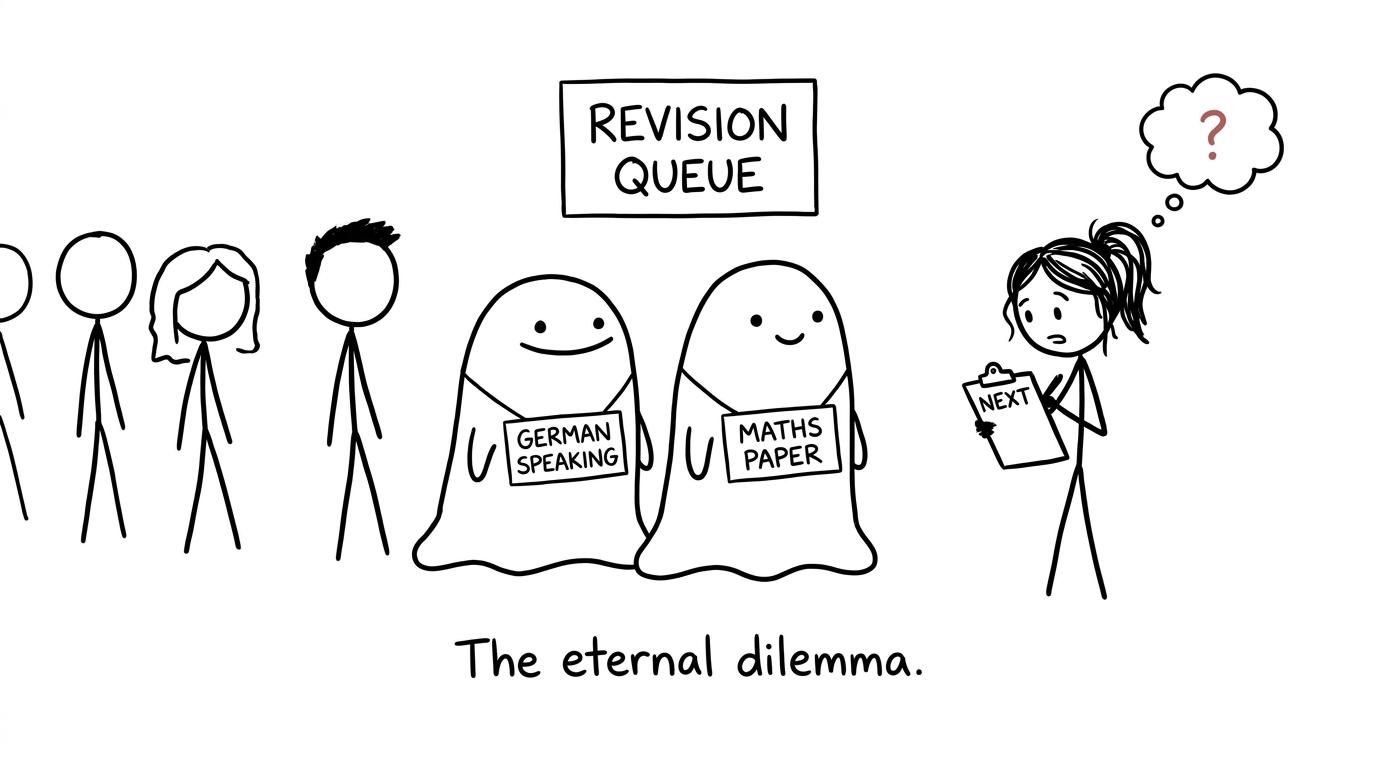 German speaking and a maths paper waiting politely in the revision priority queue
Common mistakes when balancing German and five other subjects
Giving every subject equal time
Subjects have different exam dates, weaknesses and maintenance needs. Review allocations weekly instead of forcing equality.
Revising only the most comfortable German skill
Reading familiar vocabulary can feel productive while speaking or listening remains exposed. Rotate skills and use errors to decide what returns next.
Filling every evening
A timetable without rest or catch-up space breaks after one disruption. Leave at least one light period in the week.
Writing subjects instead of tasks
“Maths” and “German” are categories. “Complete one ratio mini test” and “retrieve travel vocabulary” are instructions.
Counting time instead of checking outcomes
A long session can produce little. Finish by asking what you can now recall, answer or correct that you could not do before.
Using the wrong paper or specification
Check the exam board, qualification specification and, where relevant, foundation or higher tier. For maths, grades 999 to 111, calculator rules and paper content must match your actual entry.
Make the timetable smaller and start
The best response to a GCSE German revision timetable clash is not a beautiful colour-coded calendar. It is a week you can repeat: brief German contact, protected maths practice, longer sessions for the nearest assessments and enough empty space to recover when life intervenes.
Choose your first German micro-task. Then open the MathsGenie GCSE Maths revision area and select one topic that is currently costing you marks. Use the free revision lessons and practice questions to rebuild it, mini tests to check it, and past papers, predicted papers, mark schemes and video solutions to prepare under exam conditions.
Six subjects will still be six subjects. But once each session has a clear job, they stop arriving in your head all at once.