GCSE German No Background Knowledge: Can You Start?
GCSE German no background knowledge? See if a late start is realistic, what your school must approve, and how to build a focused catch-up plan quickly.
Starting a language late can feel like joining a conversation halfway through. Everyone else appears to know the vocabulary, the grammar and when to nod. You are still looking for the door.
The reassuring answer to GCSE German no background knowledge worries is that a late start can be realistic. Current AQA and Pearson Edexcel specifications do not set formal prior-learning requirements. But that does not automatically give you a place on the course: your school decides its entry policy, timetable and whether it can support you. If it agrees, you will need a deliberate catch-up plan covering pronunciation, core vocabulary, grammar, listening, speaking, reading and writing.
Possible does not mean effortless. It means the barrier is practical rather than official.
The short answer and your starting checklist
Before committing, establish five things:
- Ask which exam board and specification your school uses. Do not assume that materials for AQA, Pearson Edexcel or Eduqas are interchangeable.
- Confirm that the school will enter you. Course-entry decisions remain with schools and colleges.
- Find out your likely tier. Foundation and higher tier have different demands and grade ranges.
- Ask how speaking practice and assessment will be arranged. This cannot be left until the final weeks.
- Request the vocabulary, grammar and topic lists already covered. Your first task is to identify the gap, not to revise randomly.
A useful conversation with your head of languages should be specific: when would you join, what has the class completed, how many lessons remain, and what evidence would the school need before approving the move?
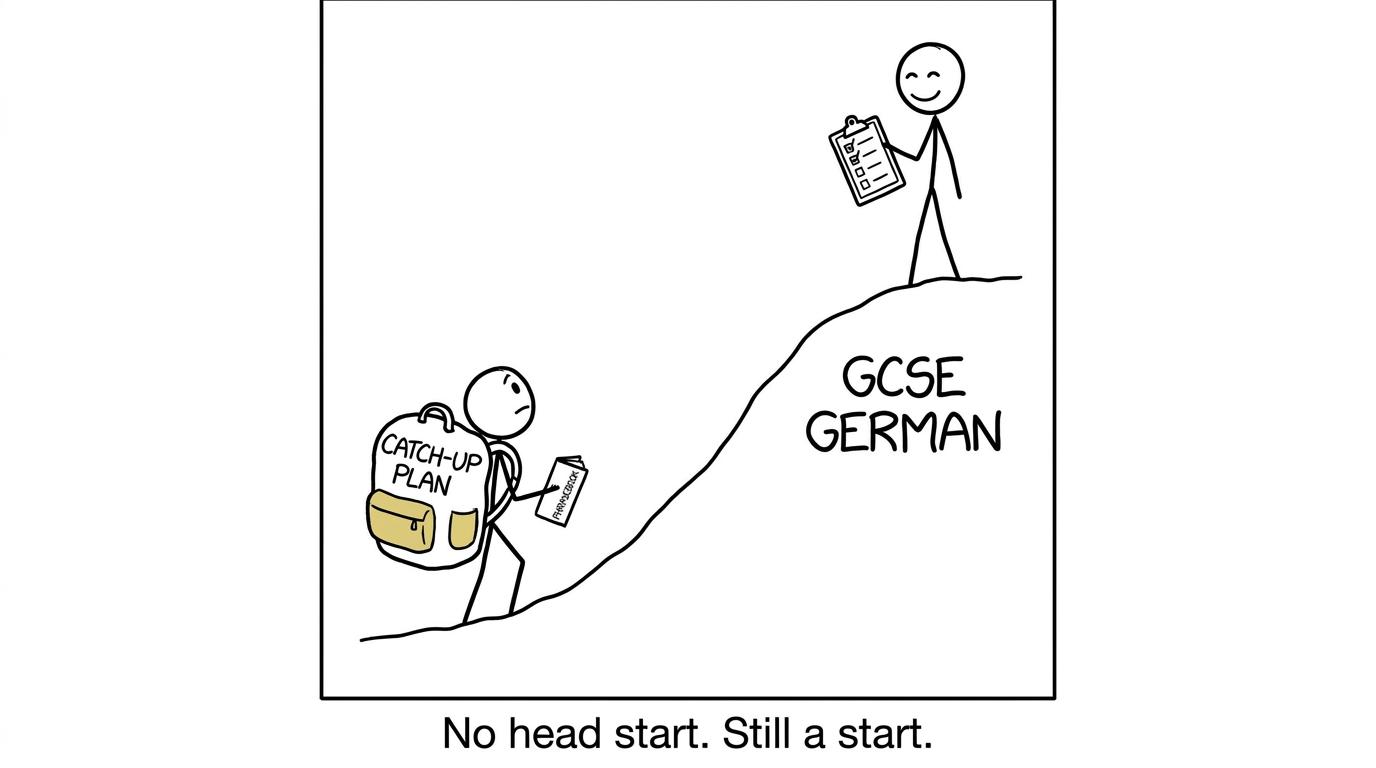 A student beginning the climb towards GCSE German with a catch-up plan
Is GCSE German with no prior knowledge officially allowed?
For the current AQA GCSE German specification, there are no previous-learning requirements. AQA also states that individual schools and colleges may set their own course-entry requirements. Pearson Edexcel similarly states that its current GCSE German qualification has no prior-learning requirement.
That distinction matters. An exam board may allow beginners, while a school may reasonably decide that joining its particular class late is not workable. Timetable space, teacher capacity, safeguarding arrangements for speaking assessments and the amount of missed teaching can all affect the decision.
The reformed AQA and Pearson Edexcel courses were introduced for first teaching from September 2024, with first assessment in summer 2026. They assess listening, speaking, reading and writing. On these specifications, each component represents one quarter of the qualification, and students take one tier across the assessment.
AQA identifies Foundation tier as covering grades 111 to 555 and Higher tier as covering grades 444 to 999. Always check the specification used by your centre because arrangements and task details can change between boards and qualification versions.
If you are considering private entry, contact a prospective exam centre before paying for tuition or resources. A speaking assessment requires suitable centre arrangements, and accepting private candidates is not the same as accepting them for every qualification component.
What background knowledge are you actually missing?
Students often imagine that they have missed one large object called “German”. In reality, they have missed several smaller systems.
Sound and spelling patterns
You need to connect written German with spoken German. This matters because current assessments include listening, dictation, clear pronunciation and reading aloud. Learning vocabulary only by looking at English-German word pairs leaves a serious gap: you may recognise a word on a card but fail to recognise it when spoken.
Begin with common sound-spelling relationships and practise saying new words aloud. Listen, pause, repeat and record yourself. Accuracy grows through frequent correction, not through waiting until you feel confident enough to speak.
High-frequency vocabulary
Defined vocabulary is central to the current specifications. However, a long alphabetical list is not a sensible learning order.
Start with language that unlocks sentences: common verbs, question words, pronouns, time expressions, connectives, opinions, negatives and everyday nouns. Organise vocabulary by usefulness and context. A word becomes more retrievable when you have heard it, said it, read it and written it.
Core grammar
German grammar is structured, which can be encouraging for students who like rules. You will need foundations such as verb position, present-tense forms, gender and articles, cases, word order, negatives, modal verbs and ways to refer to past and future events.
Do not attempt every grammar point at once. Learn one pattern, retrieve it without notes, use it in short sentences and revisit it later. The principle is familiar from maths: recognising a method is not the same as being able to produce it independently.
Exam-specific communication
Knowing German and earning GCSE marks overlap, but they are not identical. You must also understand the task formats: responding to spoken and written material, dictation, translation, role-play, reading aloud, visual prompts and extended writing.
Use materials for the correct specification. Legacy papers can still provide language practice, but they may not reproduce the current assessment structure.
How to catch up quickly without pretending it is easy
The fastest sustainable approach is a repeated loop: identify, learn, retrieve, apply and check. MathsGenie uses the same logic across effective maths revision. You can see it in the guide to finding your weakest GCSE topics, where evidence leads to focused practice rather than vague revision.
Build a precise gap list
Ask your teacher for the scheme of work, vocabulary list and grammar checklist. Sort the missing content into three groups:
- essential foundations that block everything else;
- current class content needed immediately;
- lower-priority material that can wait.
Your plan must do two jobs at once: repair the foundation and help you follow present lessons. Spending months “getting ready” before touching current work usually causes the class to move even further away.
Use short daily contact
Languages respond well to regular exposure. A short session can include retrieval of old vocabulary, one grammar focus, listening and a brief spoken response. The precise length matters less than returning consistently and testing yourself.
Maths students can adapt the structure in the twenty-minute GCSE revision routine: choose a small target, attempt something without support, check it and record the next action. Use German resources supplied or approved by your teacher for the language content itself.
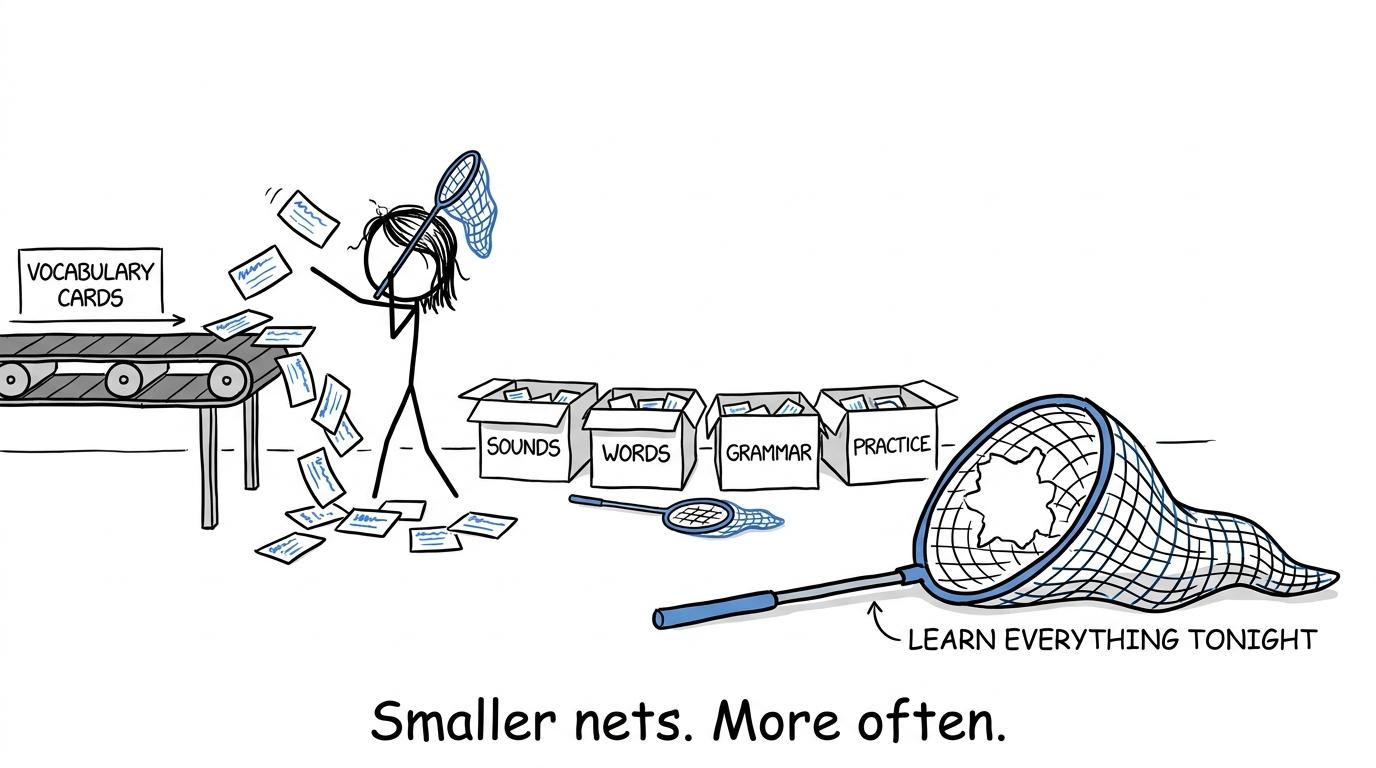 A calm vocabulary system succeeds where learning everything at once fails
Train all four skills from the beginning
It is tempting to postpone speaking because it feels exposed, or listening because progress is difficult to measure. That creates an unbalanced learner.
Every week should contain:
- listening with the transcript hidden first;
- reading for meaning rather than translating every word;
- speaking aloud, including unrehearsed answers;
- writing that receives accurate correction;
- vocabulary and grammar retrieval without notes.
Speaking becomes less intimidating when it is ordinary. Ten imperfect spoken sentences across several days are more useful than one polished paragraph silently memorised.
Keep an error log
After a task, record the type of error: vocabulary recall, verb form, word order, article, spelling, misunderstood sound or incomplete response. Then turn the label into a small action.
The same habit strengthens maths revision. After using Edexcel GCSE Maths mini tests, for example, the valuable step is not merely seeing a mark. It is locating the exact skill that leaked marks and repairing it.
Ask for feedback early
A beginner cannot reliably detect every pronunciation or grammatical error alone. Arrange regular feedback from your teacher and ask narrow questions. “Is the verb in the right position?” is easier to answer and act upon than “Is this good?”
Early correction prevents repeated mistakes from becoming familiar. Familiarity can feel like fluency even when the underlying pattern is wrong.
Can you balance German catch-up with GCSE maths?
This question matters because the cost of a new subject is time taken from existing ones. Enthusiasm is useful, but a timetable is more honest.
Protect fixed maths sessions rather than revising whichever subject feels most urgent that evening. MathsGenie brings free GCSE maths revision resources together so you can move from a lesson to practice questions without wasting time searching. For Edexcel students, GCSE maths past papers with mark schemes provide realistic evidence of what still needs attention.
A balanced week might use frequent short German sessions alongside fewer, longer maths blocks. Near maths exams, switch some maths work to timed papers, mini tests and targeted repairs. The GCSE predicted papers can support final rehearsal, but predictions should complement specification-wide revision rather than replace it.
If adding German causes your maths practice, sleep or attendance to collapse, the plan is not ambitious. It is overloaded. Review the decision with your teachers before the consequences become difficult to reverse.
Common mistakes when starting GCSE German late
Waiting for permission before doing any preparation
You should not buy a course or assume entry, but you can begin learning basic pronunciation and high-frequency language while the school considers your request. Ask the department which materials match its specification.
Learning vocabulary only from English to German
Recognition is easier than recall. Test both directions, listen to the words and use them in context. Otherwise, reading may improve while speaking and writing remain stuck.
Avoiding speaking until you are “ready”
Readiness often arrives after repeated speaking, not before it. Begin privately, then move towards teacher feedback and short unrehearsed responses.
Treating hours completed as proof of progress
Time records effort, not learning. A better test is whether you can retrieve yesterday’s vocabulary, understand a fresh recording or produce a correct structure without notes.
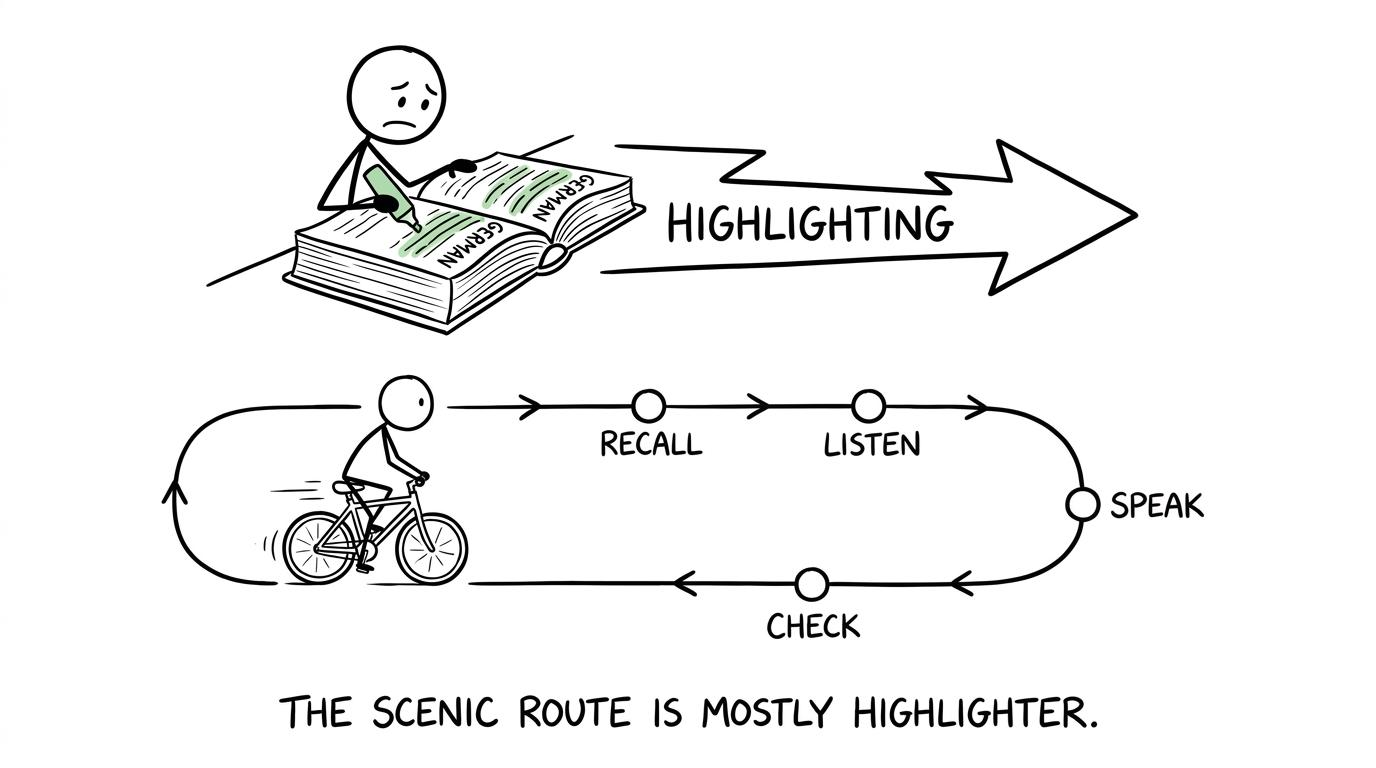 Two revision routes show why active practice beats endless highlighting
Neglecting your other GCSEs
A late German start should fit inside a wider revision plan. Use a weekly planner and review actual evidence from each subject. If maths is a concern, the guide to stopping forgotten GCSE maths content explains how retrieval and spaced practice can make limited time more productive.
Using papers without checking the specification
An old paper may test useful German while still giving a misleading picture of your current exam. Confirm the board, specification code, tier and assessment format with your school.
The decision is about support, time and consistency
Taking GCSE German without the usual background knowledge is possible in principle, and current AQA and Pearson Edexcel specifications do not demand earlier formal study. The decisive questions are whether your school permits it, whether speaking and assessment arrangements are available, how much teaching you have missed and whether you can practise consistently without damaging your other GCSE preparation.
Start with a meeting, not a mountain of flashcards. Get the exact specification and gap list. Build pronunciation, useful vocabulary and core grammar together. Train all four skills, seek early correction and measure progress through retrieval and fresh tasks.
Meanwhile, let MathsGenie keep the maths side of your timetable clear. Use free revision lessons and practice questions to repair individual topics, mini tests to check them, and past papers, predicted papers, mark schemes and video solutions to prepare for exam conditions. If time is short, the one-week GCSE maths revision plan offers a focused structure.
A late start is not the same as a hopeless start. But it needs a school-approved route and a plan you can still follow when the novelty has worn off.