

GCSE German Grade 8 Meaning: Ability & Old Grades
GCSE German grade 8 meaning explained: learn what ability it represents, how it compares with grades A and A*, and how to plan effective revision.
A result can look wonderfully simple. One digit. One line on a results sheet. Yet the meaning behind it is much larger.
If you are searching for the GCSE German grade 8 meaning, the direct answer is this: a grade 8 represents a very strong performance at Higher tier. It shows that you can understand and communicate detailed ideas in German, handle more complex language and use vocabulary and grammar mostly accurately. On the old letter scale, it sits within the territory previously covered by grades A and A*, although there is no exact one-to-one conversion.
It is the second-highest GCSE grade, below grade 9 and above grade 7. More importantly, it describes performance across several language skills rather than perfect fluency.
The grade 8 meaning at a glance
A student achieving grade 8 in GCSE German will typically have demonstrated that they can:
- understand detailed spoken and written German
- identify opinions, conclusions and implied meaning
- communicate clearly in speaking and writing
- develop and justify ideas rather than giving isolated answers
- use a broad range of vocabulary and grammatical structures
- respond when a task becomes less predictable
- work with more complex language at Higher tier
- perform strongly across the qualification as a whole
A grade 8 does not mean that every sentence was perfect or that the student speaks German like a native speaker. It means the overall examination evidence met the grade 8 standard set for that series.
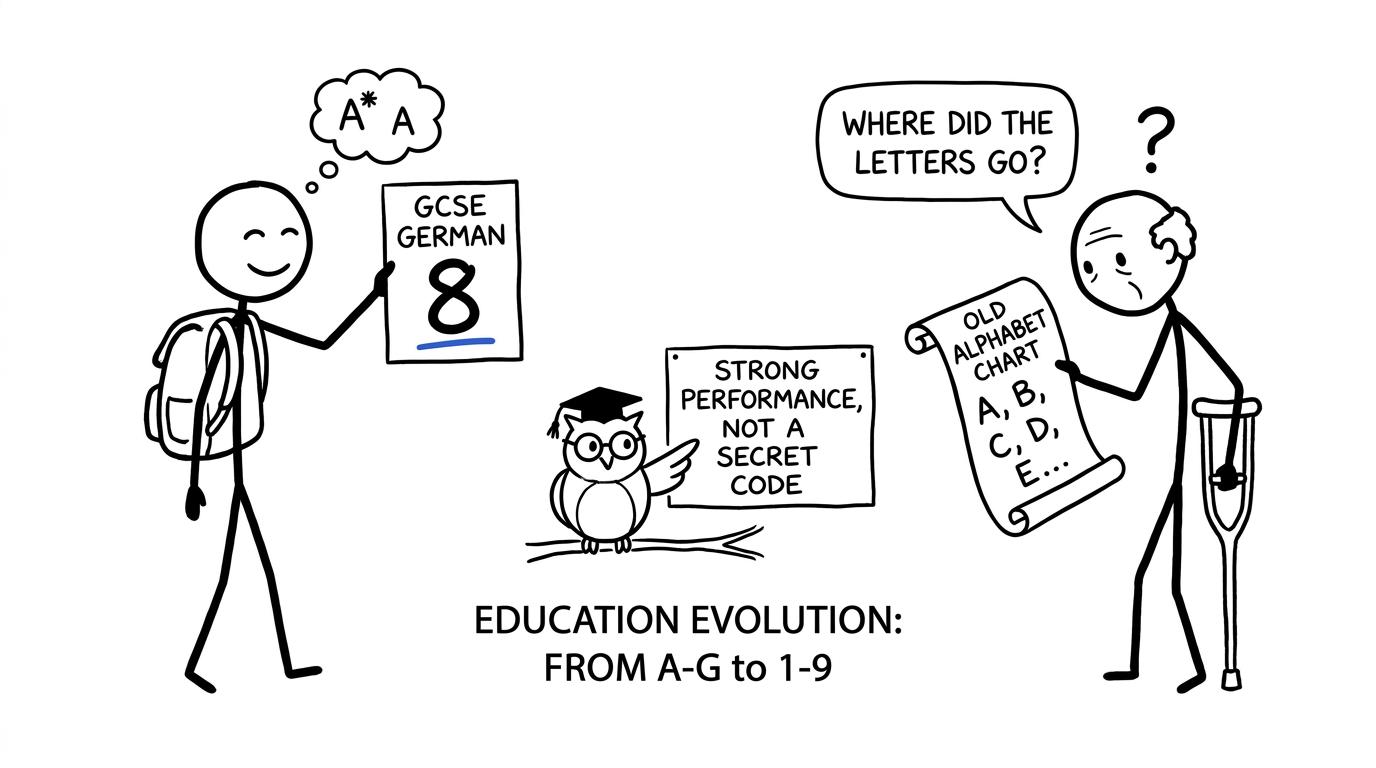 A student and an older relative decode the GCSE number scale
How does grade 8 compare with the old letter grades?
The numerical GCSE scale runs from grade 9, the highest result, to grade 1. It replaced the former A* to G scale in England.
The safest comparison is:
| Current grade | Broad comparison with the old scale |
|---|---|
| Grade 9 | The very highest performance within the old A* range |
| Grade 8 | Strong performance within the old A/A* range |
| Grade 7 | Comparable at its lower boundary to the old grade A |
| Grade 4 | Comparable at its lower boundary to the old grade C |
| Grade 1 | Comparable at its lower boundary to the old grade G |
Official guidance stresses that the two scales are not directly equivalent. The bottom of grade 7 was aligned with the bottom of the old grade A, while grades 7, 8 and 9 collectively provide greater differentiation across the territory formerly occupied by A and A*.
It is therefore reasonable to describe a grade 8 informally as being around a strong A or A*, but it is misleading to call it simply “the new A*”. Grade 9, grade 8 and grade 7 divide the old top-grade range more finely.
That distinction matters. The new system was designed to reveal more variation among high-performing students, not merely to replace every letter with one number.
What language ability does a grade 8 represent?
A grade is a summary of examination performance. To understand it properly, it helps to look beneath the number.
Official modern foreign language grade descriptors indicate that a typical grade 8 candidate can respond effectively to more complex and extended spoken and written passages. This includes extracting information, recognising opinions, drawing conclusions and sometimes inferring meaning rather than waiting for every answer to be stated explicitly.
Listening and reading
At this level, recognition alone is not enough. A student should generally be able to follow the overall message while also noticing important details, changes of opinion and linguistic clues.
An unfamiliar word does not automatically make the whole passage inaccessible. Strong candidates use context, grammar and known vocabulary to make a plausible interpretation.
In reading, this may involve distinguishing what someone says from what they actually believe. In listening, it may mean following a longer contribution without losing the thread when the speaker changes tense or introduces a contrasting view.
Speaking
Grade 8 performance in speaking is usually sustained rather than fragmentary. The student can develop answers, express and justify opinions and respond effectively when a question is not entirely predictable.
Pronunciation and intonation should be mostly accurate and comprehensible. A perfect accent is not required. Communication, control and the ability to manipulate language matter more than imitation.
Writing
Strong grade 8 writing is purposeful. It addresses the task, develops ideas and uses vocabulary and grammar with a high degree of accuracy.
There may still be mistakes. The important distinction is that errors do not regularly prevent communication, and the student can use some more complex language rather than relying exclusively on memorised short sentences.
Complexity should serve meaning. A carefully controlled subordinate clause is worth more than an ambitious construction that collapses before reaching the full stop.
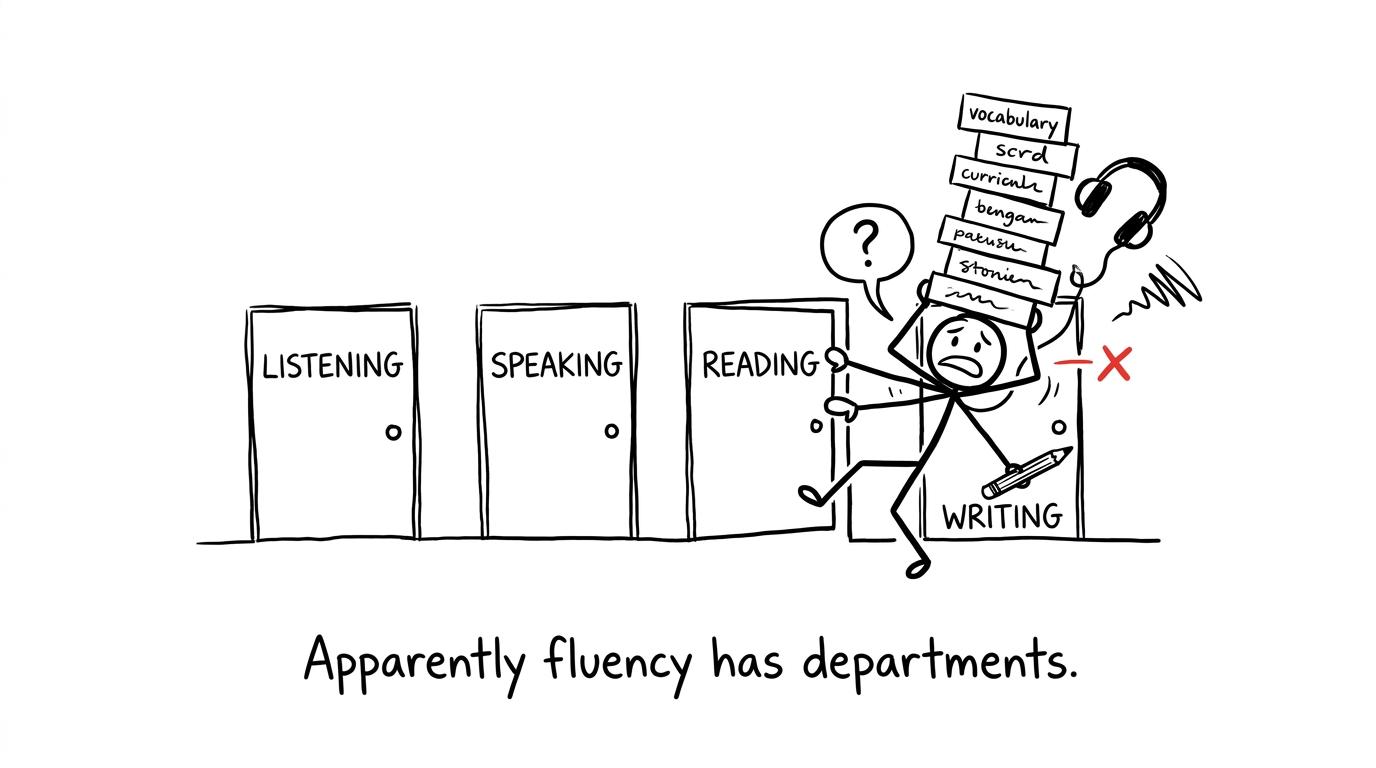 A GCSE student carries revision tools through four language-skill doors
Does grade 8 mean fluency in German?
Not in the everyday sense of effortless fluency.
A grade 8 student is a highly successful GCSE learner, but GCSE German is still a school qualification with defined vocabulary, grammar and assessment tasks. It does not certify that someone can understand every native speaker, study any subject in German or manage every real-life situation without support.
Ofqual research examining GCSE languages through the Common European Framework of Reference found grade 7 performance around the middle of A2 and grade 9 around the lower part of B1. That suggests grade 8 lies broadly between those reference points. However, this should be treated as context, not an official conversion.
The research concerned GCSE performance standards, while CEFR qualifications are designed and assessed differently. Revised French, German and Spanish GCSE specifications were introduced for first teaching in September 2024, with first examinations in summer 2026. Students should therefore avoid presenting a GCSE grade as if it were a formal CEFR certificate.
A grade 8 is best understood on its own terms: excellent performance in GCSE German.
How is a grade 8 awarded?
A grade 8 is based on a student’s overall qualification mark, not on a teacher deciding that their German “sounds like” grade 8.
Current GCSE German specifications assess listening, speaking, reading and writing. For specifications used from the summer 2026 examination series, AQA and Pearson Edexcel each give the four components equal weighting at 25%25\%25% of the qualification. Other boards follow the national subject requirements but may organise individual tasks differently, so students should always check the specification for their own board.
The broad assessment focus includes:
- understanding and responding to spoken language
- understanding and responding to written language
- communicating through speech and writing
- applying prescribed vocabulary and grammar accurately
- translating between German and English where required
The final grade is determined using grade boundaries set for that examination series. There is no universal percentage that always guarantees grade 8. Paper demand can vary between years, so boundaries are adjusted through the awarding process to maintain standards.
This is similar to the lesson maths students learn from grade boundaries: a target percentage may be useful for practice, but it is not a permanent law. MathsGenie’s guide to GCSE Maths grade boundaries across Edexcel and OCR explains why marks need context.
What separates grade 8 from grade 7 or grade 9?
Grades are boundaries on a continuous range of performance. There is no single trick that turns grade 7 German into grade 8 German.
Compared with a typical grade 7 performance, grade 8 work is likely to show greater consistency, more detailed understanding, stronger development of ideas and better control when language becomes complex or unfamiliar.
The difference between grades 8 and 9 may be smaller and more subtle. Grade 9 represents the highest level of GCSE performance, often involving exceptional consistency and control. Grade 8 remains an outstanding result. It should not be treated as a grade 9 that went wrong.
One weaker component does not automatically prevent grade 8 because the award is based on the overall result. Even so, depending entirely on one exceptional skill is risky. Strong revision aims to reduce large gaps between listening, speaking, reading and writing.
Turning the meaning of grade 8 into a revision plan
Knowing what the grade represents is useful only if it changes what you do next.
For German, divide revision by skill. Vocabulary recall supports every component, but listening must still be practised through listening, and spontaneous speaking must still be practised aloud. Use your exam board’s current specification, sample materials and mark schemes so that your preparation matches the exact tasks you will face.
The same principle applies when German sits beside maths on your timetable. A high target grade can make revision feel enormous, but the practical work remains small and specific.
Start at the GCSE Maths revision hub, select your exam board and identify one weak topic at a time. The GCSE Maths topics by exam board and tier guide can help you check that your practice matches Edexcel, AQA, OCR or Eduqas.
A useful revision loop is:
- identify one weakness
- review the relevant lesson or method
- complete focused practice questions
- mark the work carefully
- record why marks were lost
- return to the skill after a short gap
Once individual topics are more secure, move into timed paper practice. MathsGenie’s advice on when to start GCSE past papers helps you choose between short diagnostic sets and full papers. If you take Edexcel Maths, the guide to using Edexcel GCSE Maths past papers properly shows how marking and reattempting questions turns practice into progress.
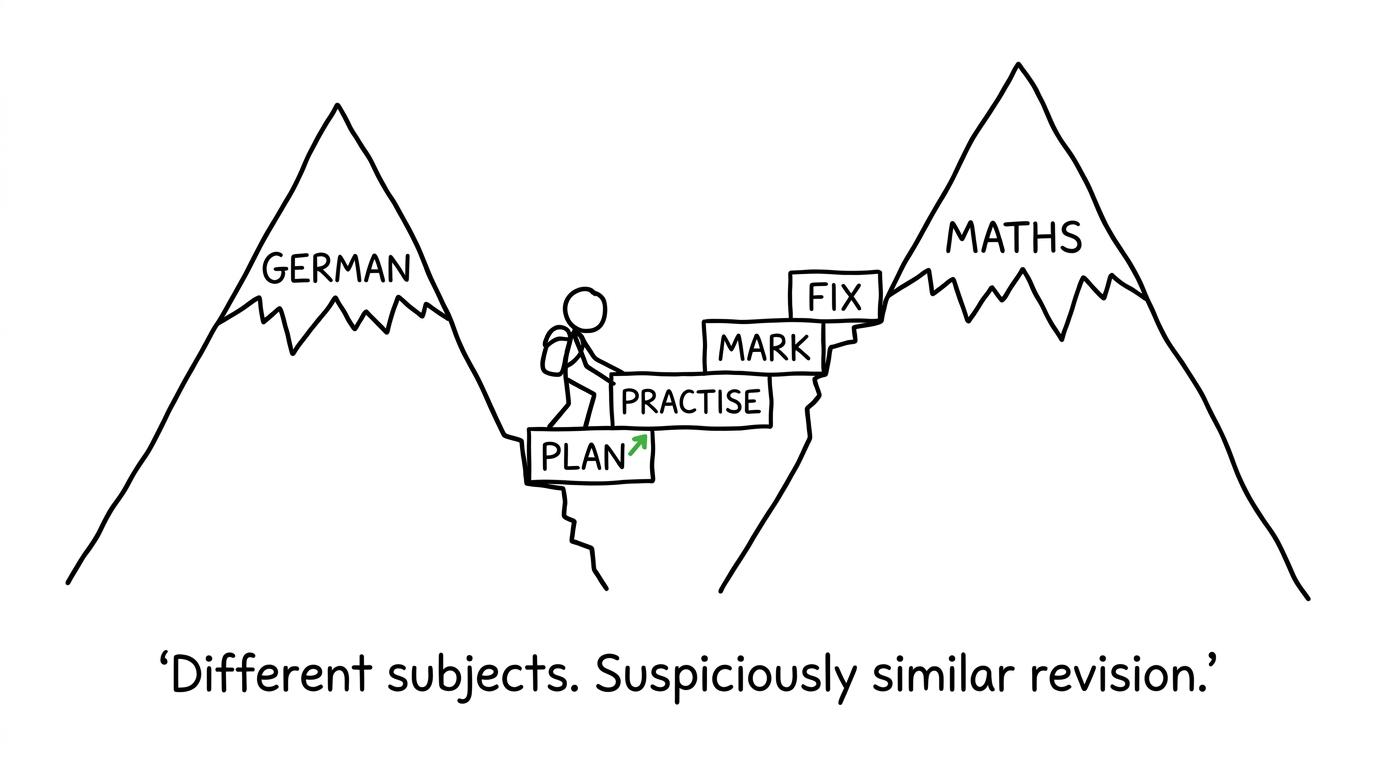 A student builds one revision staircase between German and maths
Common mistakes when interpreting a German grade 8
Calling grade 8 an exact A*
It is a useful rough comparison, but not an official one-to-one equivalence. Grades 7, 8 and 9 collectively cover the old A and A* range.
Assuming it means native-level fluency
A grade 8 demonstrates excellent GCSE performance. It does not certify unrestricted fluency or replace a dedicated language proficiency qualification.
Expecting a fixed mark every year
Grade boundaries vary by series and exam board. Use published boundaries to understand past papers, not to predict a guaranteed future threshold.
Revising vocabulary but neglecting skills
Vocabulary matters, but successful candidates must retrieve and apply it while listening, speaking, reading and writing. Recognition on a flashcard is not the same as using a word under pressure.
Treating a mock grade as a final verdict
A mock is evidence about current performance. Its best use is diagnostic: identify the skill, topic or exam habit that caused each lost mark, then practise it deliberately.
The same mistake appears in maths when a student records a score but never investigates it. The GCSE maths night-before revision plan offers a calmer approach built around short practice, careful marking and focused repairs.
A strong grade is evidence, not identity
The clearest GCSE German grade 8 meaning is that a student produced excellent work across a demanding language qualification. They understood detailed German, communicated developed ideas and applied vocabulary and grammar with considerable control.
It is an achievement, but it is not a personality test. A grade 8 does not make future success automatic, just as a lower mock grade does not make improvement impossible. Grades record evidence from a particular set of assessments. Revision changes the evidence you are capable of producing next.
For your maths exams, make that next step concrete. Open MathsGenie’s free GCSE Maths revision resources, choose your board and tier, and begin with one weakness. Use revision lessons and practice questions to learn, mini tests to check recall, past papers to develop timing, and mark schemes or video solutions to understand every lost mark. Nearer the examination, predicted papers can help you rehearse the complete process.
The number on results day arrives all at once. The ability behind it is built one well-chosen practice session at a time.










