

GCSE Geography Weekend Revision: A Two-Day Plan
GCSE geography weekend revision made simple: follow a focused two-day routine to recall case studies, practise exam skills and avoid last-minute cramming.
The final weekends before a GCSE Geography exam can feel strangely unhelpful. You have enough time to do something meaningful, but so much content that choosing where to begin becomes a task of its own. Case studies, fieldwork, maps, processes and extended answers all compete for attention.
A productive GCSE geography weekend revision routine is not a two-day reading marathon. It is a sequence: diagnose your gaps, retrieve essential knowledge, answer exam questions, mark them honestly and return to the weaknesses that matter most. Saturday should reveal and repair gaps. Sunday should test whether those repairs hold.
This plan is designed for students balancing Geography with GCSE Maths and other exams. It gives Geography serious attention without allowing one subject to consume the entire weekend.
Your weekend revision checklist
Before starting, check that you can answer each of these questions:
- Which exam board do you take: AQA, Edexcel, OCR or Eduqas?
- Which paper is coming next, and what content can it assess?
- Which named case studies and examples belong to that paper?
- What did your latest mock or assessment expose?
- Do you have specification-matched questions and mark schemes?
- When will you stop revising and rest?
Use your own exam board specification and information from your school to confirm the paper structure. Geography specifications differ, so a generic online checklist should never replace the exact content you have been taught.
The weekend itself can then follow this pattern:
| Time | Saturday | Sunday |
|---|---|---|
| Morning | Diagnose gaps and retrieve physical geography | Complete timed exam practice |
| Early afternoon | Retrieve human geography and case studies | Mark, analyse and repair mistakes |
| Late afternoon | Practise geographical and numerical skills | Review fieldwork and extended responses |
| Evening | Light recall and plan Sunday | Pack materials, stop early and rest |
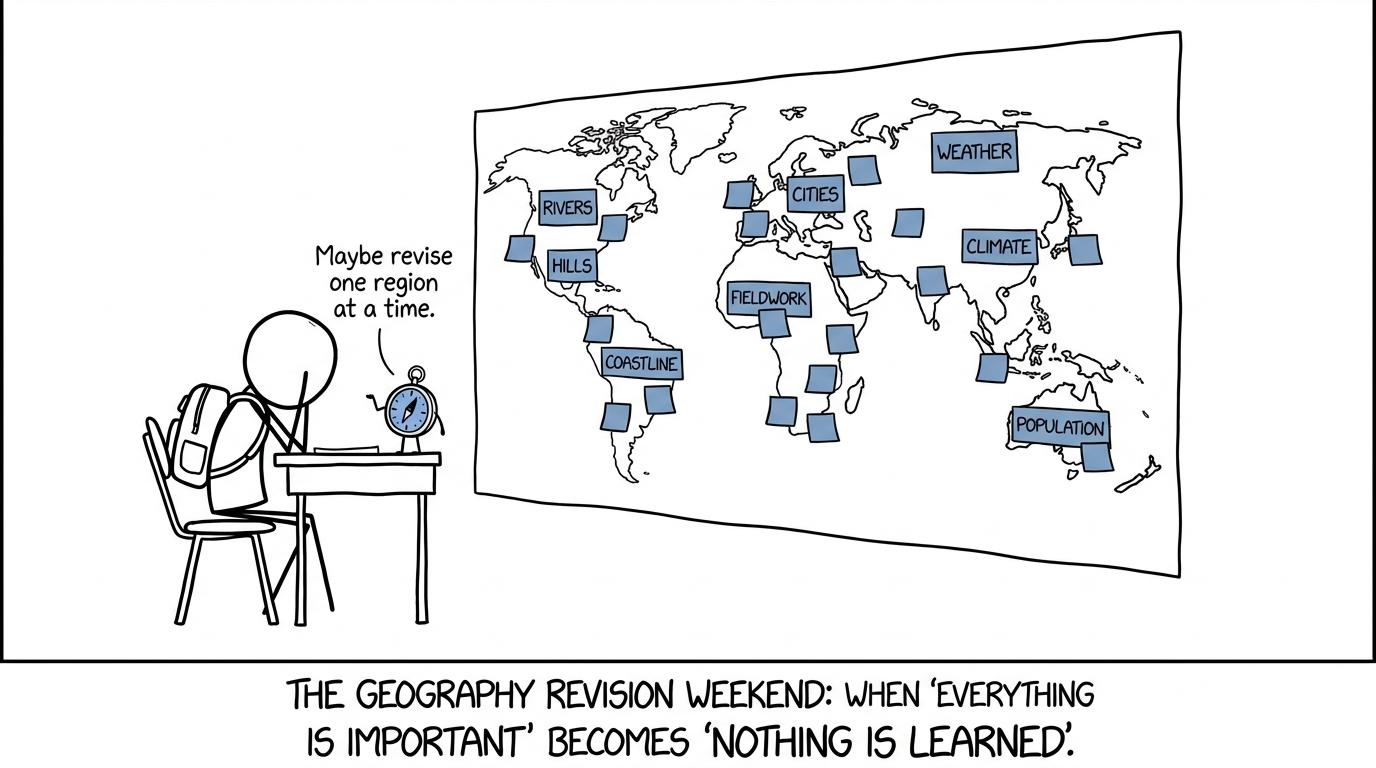 A student negotiates with an intimidating wall of geography notes
Prepare on Friday evening
Do not spend Saturday morning constructing a perfect timetable. Make the important decisions on Friday in about 202020 minutes.
First, write three priority areas. Choose them from evidence such as a mock paper, teacher feedback or questions you previously avoided. “Rivers” is too broad. “Explaining how a waterfall retreats” is specific enough to revise and test.
Next, collect your notes, specification, questions and mark schemes. Remove unrelated materials from the desk. If Maths is also approaching, keep the GCSE Maths revision hub ready for a separate, clearly timed session rather than switching subjects whenever Geography becomes uncomfortable.
Finally, decide when the day ends. A stopping time protects sleep and prevents a focused plan becoming an exhausting one.
Saturday morning: diagnose before you revise
Begin with closed-book retrieval. On blank paper, write what you remember about the topics on the next paper. Include processes, locations, key vocabulary, case-study evidence and links between human and physical factors.
Then compare your recall with your specification and class materials. Use three labels:
- Secure: accurate enough to use in an answer.
- Uncertain: partly remembered or lacking precise evidence.
- Missing: could not be recalled without notes.
This is more useful than beginning with your favourite topic. Comfortable revision can feel fluent while leaving the largest gaps untouched. The same principle underpins MathsGenie’s guide to finding your weakest GCSE topics: evidence should decide what you practise next.
Spend the rest of the morning on no more than two weak physical geography areas. Use a short cycle:
- retrieve the process without notes;
- check and correct it;
- draw or sequence it from memory;
- answer one relevant exam question;
- mark the response immediately.
Active retrieval is more demanding than rereading because it exposes what your memory can actually produce. Feedback matters too: an incorrect answer should be corrected before it becomes familiar.
Saturday afternoon: case studies with a purpose
Case studies are often revised as long blocks of facts. That creates a problem: the exam rarely asks for an undirected fact dump. It asks you to apply knowledge to a particular command word and argument.
For each required example, build a compact case-study frame:
- location and geographical context;
- causes or controlling factors;
- primary and secondary effects where relevant;
- responses, management or competing viewpoints;
- a small number of precise supporting details;
- one evaluative conclusion.
Then close your notes and reconstruct the frame. Avoid memorising invented precision. Use figures only when they come from trustworthy course materials and you can recall them accurately. A sound geographical explanation is more valuable than an uncertain statistic.
After physical geography, repeat the process for one or two human geography priorities. Ask how population, development, urban change, resource use or economic decisions interact with place. This moves revision beyond AO1 recall towards the understanding, application and judgement rewarded through AO2 and AO3.
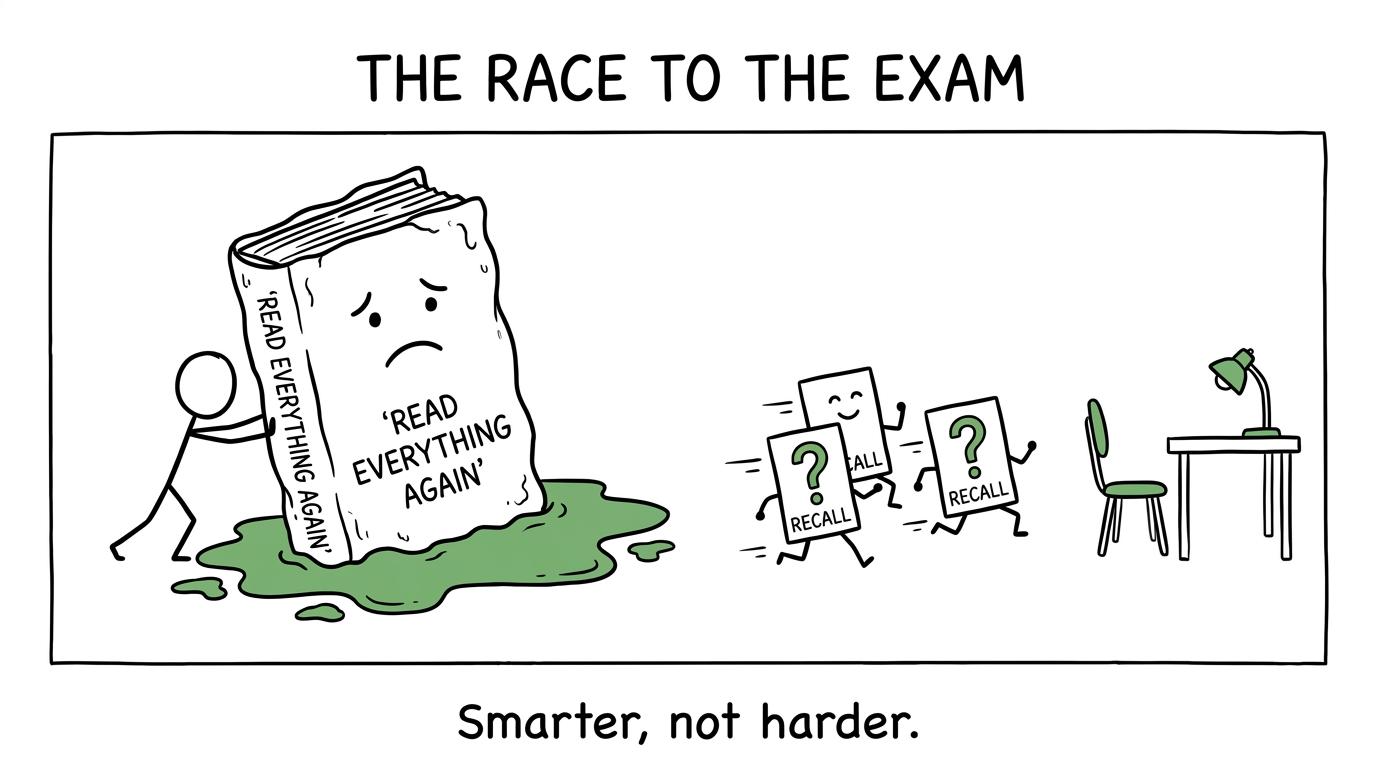 Active recall outruns an enormous rereading book
Saturday late afternoon: practise geographical maths
Do not treat numerical skills as an optional corner of Geography. Current GCSE Geography requirements in England allocate at least 10%10\%10% of subject marks to mathematical and statistical techniques. Depending on the question, you may need to interpret maps and graphs, work with scale, compare data or evaluate how information has been presented.
Your skills session should cover a selection of:
- ratio, proportion and map scale;
- percentage increase and decrease;
- mean, median, mode and range;
- quartiles and interquartile range;
- scatter graphs and lines of best fit;
- interpolation and extrapolation;
- area, distance and unit conversion;
- interpreting tables, choropleth maps and proportional symbols.
Keep essential relationships available for recall, including:
Percentage change=new value−original valueoriginal value×100\text{Percentage change}=\frac{\text{new value}-\text{original value}}{\text{original value}}\times 100Percentage change=original valuenew value−original value×100and
Mean=sum of the valuesnumber of values.\text{Mean}=\frac{\text{sum of the values}}{\text{number of values}}.Mean=number of valuessum of the values.Practise these inside geographical questions rather than as disconnected calculations. Always include appropriate units and use the data to support a geographical conclusion.
If the underlying maths is uncertain, use MathsGenie’s short GCSE revision routine or a focused Edexcel GCSE Maths mini test. These are Maths resources, not Geography papers, but they can strengthen the numerical fluency that Geography questions require.
Sunday morning: move into exam conditions
Sunday should contain less note-making and more performance. Choose a section from a past paper for your board and sit it under timed, closed-book conditions. If your exam is very close, prioritise the paper you will actually face rather than revising the whole course equally.
Before writing, notice the command word:
- Describe requires an accurate account of a pattern or feature.
- Explain requires linked reasons showing how or why.
- Assess requires a supported judgement.
- Evaluate requires consideration of strengths, limitations or competing evidence before reaching a conclusion.
For an extended response, spend a brief moment deciding your argument. Each paragraph should contribute evidence and reasoning rather than repeat the same point in different words. Where a resource is provided, use it explicitly alongside your own knowledge.
Do not check notes halfway through. The purpose is to discover what survives under pressure.
Sunday afternoon: mark, classify and repair
Mark the work while your decisions are still fresh. A mark scheme is not simply a scoreboard; it shows the difference between what you intended and what the examiner can credit.
Classify each lost mark:
- missing knowledge;
- weak geographical explanation;
- failure to use the resource;
- misread command word;
- vague case-study evidence;
- numerical or graphical error;
- poor timing.
Then repair the three most important losses. Rewrite only the weak paragraph, conclusion or calculation rather than copying the entire answer. Maths students can apply the same feedback habit through using GCSE mark schemes effectively.
If you also have a Maths exam approaching, reserve one contained block for it. Choose the page matching your course, such as AQA GCSE Maths past papers, Edexcel GCSE Maths past papers or the OCR GCSE Maths revision hub. Keeping the subjects in separate blocks reduces unplanned switching.
Review fieldwork without rewriting the trip
Fieldwork revision should follow the enquiry process, not the chronology of the day out. Be ready to recall:
- the enquiry question or hypothesis;
- relevant geographical theory;
- primary and secondary data;
- sampling and data-collection methods;
- presentation techniques;
- patterns, anomalies and conclusions;
- limitations and realistic improvements.
Evaluation must be specific. Saying a method was “unreliable” is rarely enough. Explain what caused the limitation, how it could affect the conclusion and what practical change would improve the investigation.
You may also face unfamiliar fieldwork material. Practise applying the enquiry process to a new setting rather than memorising only your own investigation.
Common GCSE geography weekend revision mistakes
Rereading for most of the weekend
Rereading can refresh knowledge, but it does not prove that you can retrieve or apply it. Close the book regularly and produce something: a sequence, annotated sketch, plan or exam response.
Revising every case study equally
Prioritise the next paper, your specification and your weakest required examples. Depth in relevant material is better than shallow contact with everything.
Writing answers without marking them
Unmarked practice preserves uncertainty. Mark questions promptly, identify why marks were lost and attempt the weak part again.
Ignoring maps, data and fieldwork
Geography assesses more than remembered content. Skills, mathematical techniques, fieldwork and judgement deserve protected time in the weekend plan.
Treating predicted content as guaranteed
Predictions can provide fresh practice, but no prediction removes the need to cover the specification. The same is true in Maths: GCSE Maths predicted papers should supplement official past papers, not replace them.
Revising late into Sunday night
The final hour of exhausted rereading often adds less than a calm stop, organised equipment and proper rest.
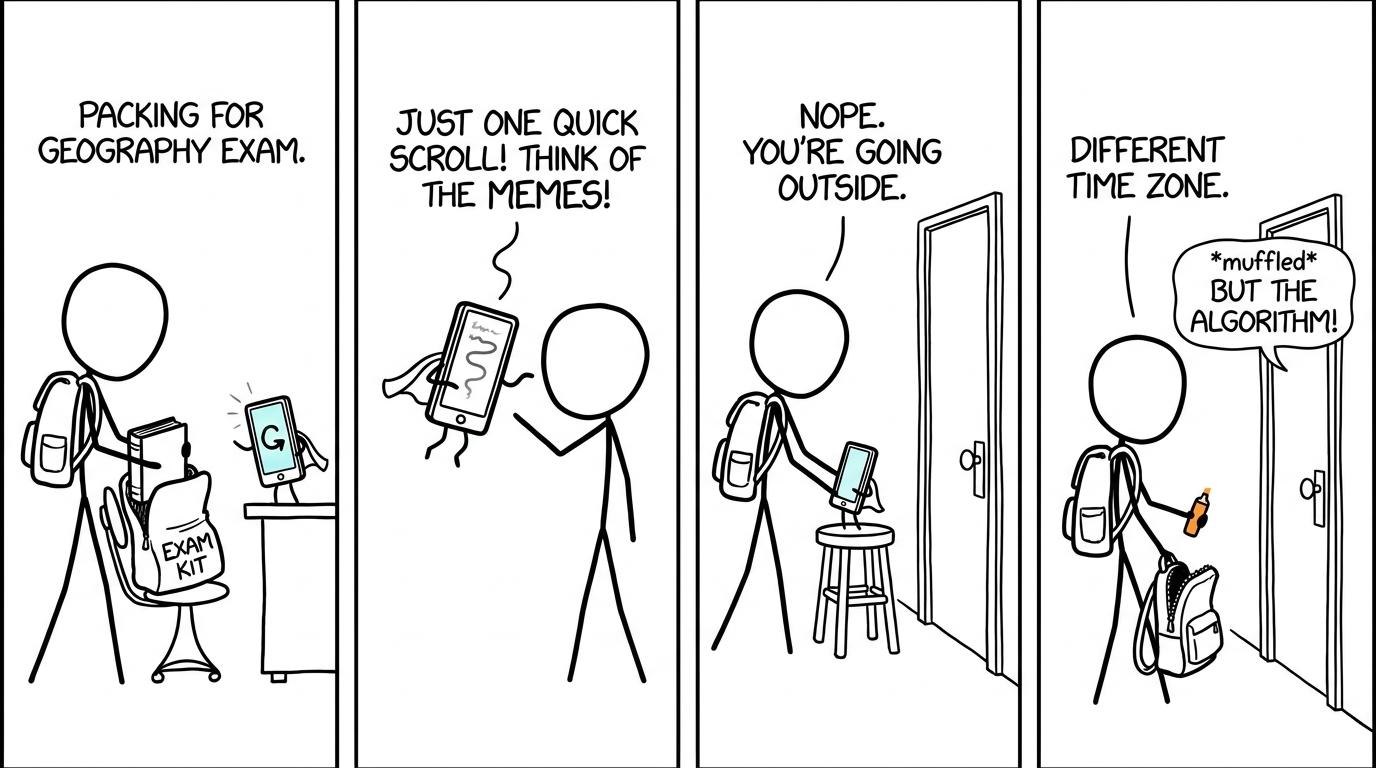 A student defeats a distracting phone by placing it in another time zone
Finish the weekend with a short handover
Before stopping on Sunday, write a small weekday list containing:
- three facts or processes to retrieve again;
- two questions to reattempt;
- one case study or fieldwork weakness to check.
This turns the weekend into part of a spaced revision plan rather than an isolated burst. The next session begins with evidence, not guesswork.
A strong GCSE Geography weekend is not measured by the number of hours spent at a desk. It is measured by what changed: a missing process became retrievable, a vague case study became usable, or an unsupported judgement became a structured answer.
For the Maths portion of your exam preparation, make MathsGenie’s free GCSE Maths revision hub your next stop for revision lessons, practice questions, mini tests, past papers, predicted papers, mark schemes and video solutions. Build the same dependable cycle in both subjects: retrieve, practise, mark, repair and return.











