Is GCSE Geography Useful Without A-level?
GCSE geography useful without A-level? Explore its transferable maths, data and fieldwork skills, college entry value and practical revision benefits.
Choosing a GCSE can feel like choosing a road you must follow for years. If Geography will not be one of your A-levels, it is reasonable to wonder whether the work still matters. So, is GCSE geography useful without A-level study? Yes. It gives you a recognised qualification alongside transferable skills in data, graphs, maps, evidence, extended writing and decision-making. It can also support your maths revision because the two subjects share skills including percentages, ratio, scale, averages and statistical interpretation.
That does not mean Geography is automatically the right option for everyone. Your interests, likely grades, workload and college plans matter. But a subject does not become useless simply because you stop studying it at age 161616. Often, the most valuable part of a GCSE is not the final topic you remember. It is the way you learn to think.
The short answer: what GCSE Geography gives you
If you are not planning to take Geography at A-level, the GCSE can still provide:
- a broad academic qualification covering human and physical geography;
- practice interpreting maps, graphs, photographs and unfamiliar information;
- numerical and statistical skills that overlap with GCSE maths;
- experience collecting, presenting and evaluating fieldwork data;
- stronger evidence-based writing and judgement;
- understanding of environmental change, hazards, cities, resources and global development;
- a humanities subject that can contribute towards the English Baccalaureate in England;
- another GCSE grade that may count towards a school or college's general entry requirements.
The important distinction is this: GCSE Geography is rarely a universal requirement for unrelated college courses. However, the grade may count towards your overall GCSE profile, and some sixth forms set specific Geography GCSE requirements if you later change your mind and apply for A-level Geography. Entry policies differ, so always read the current requirements published by the college you are considering.
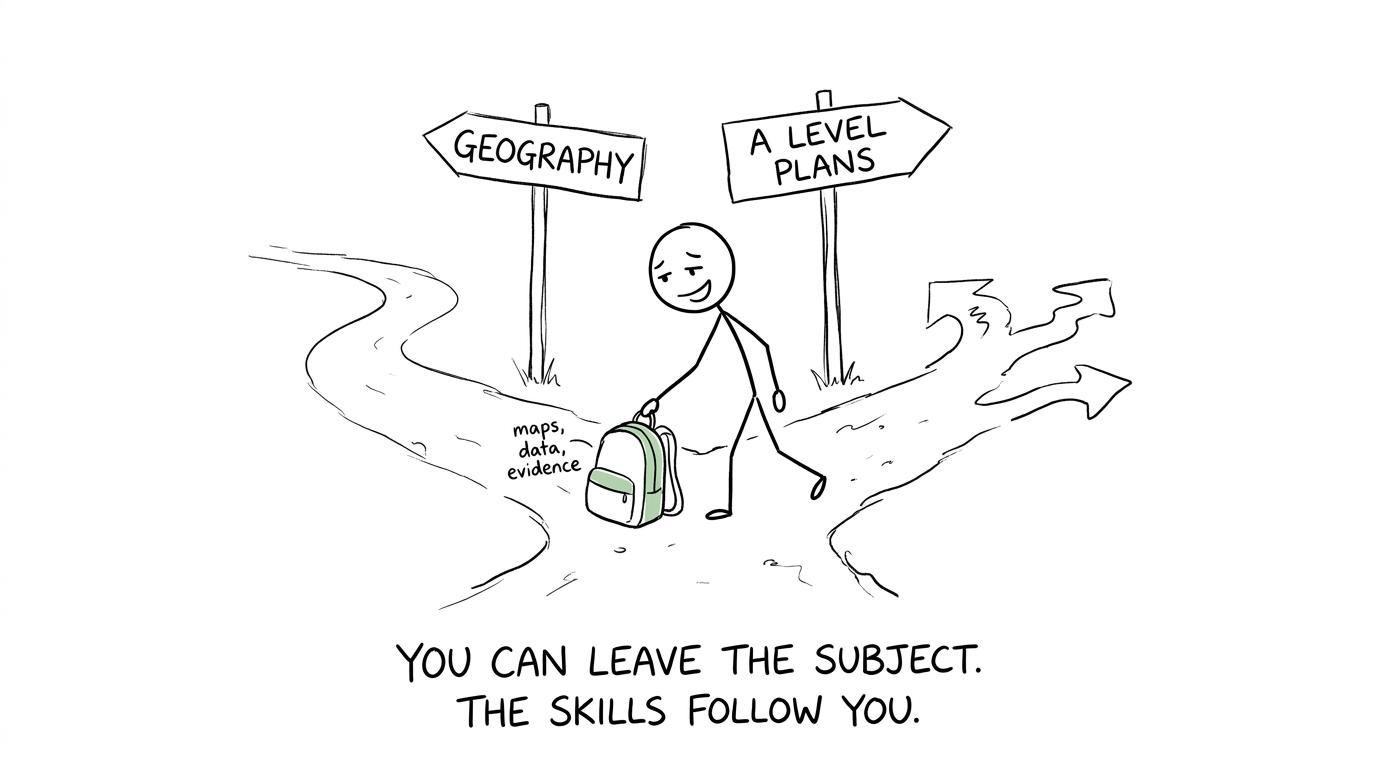 A student discovers that Geography skills follow them along a different path
Geography quietly strengthens your maths
GCSE Geography is not a substitute for maths revision. Yet it gives mathematical ideas a setting. A percentage is no longer only a calculation on a page; it might describe population change, land use or access to a resource. A scatter graph becomes a way to investigate whether two geographical variables appear related.
Ofqual's requirements for GCSE Geography in England state that at least 10%10\%10% of the subject marks must assess mathematical and statistical techniques. Specifications from exam boards such as AQA and OCR therefore include numerical, graphical, cartographic and statistical skills. Exact paper structures differ between boards and specifications, but quantitative work is a required part of the qualification rather than an optional extra.
Common areas of overlap include:
- fractions, decimals and percentages;
- percentage increase and decrease;
- ratio and proportion;
- map scales and unit conversions;
- mean, median, mode and range;
- quartiles and interquartile range;
- frequency tables and cumulative frequency;
- scatter graphs, correlation and lines of best fit;
- interpreting bar charts, line graphs and pie charts;
- sampling, reliability, accuracy and bias.
Maths teaches you how the techniques work. Geography asks what the results mean. That second question is valuable because an accurate calculation is only part of a strong answer. You must also consider units, context, limitations and whether the evidence really supports the conclusion.
You can develop this overlap through MathsGenie's GCSE Statistics revision resources, which include lessons, questions and past-paper support. The AQA Geography graphical skills guide is particularly helpful for choosing and interpreting charts, while the OCR Geography numerical and statistical skills guide explains scale, units, averages, percentages and data handling in a geographical setting.
What fieldwork teaches beyond Geography
Fieldwork is sometimes remembered as the day outside. Its deeper value is learning how evidence is produced.
You begin with a question. You decide what information to collect, choose locations or participants, record results and look for patterns. Then comes the part that matters most: deciding how much confidence to place in the findings.
Was the sample large enough? Were measurements taken consistently? Could time, location or the sampling method have influenced the outcome? Does the graph reveal a genuine pattern, or are you making too much of limited data?
These habits transfer naturally to science practical work, psychology, sociology, business and any future project involving research. They also strengthen the statistical reasoning assessed in maths. A calculated mean can be correct while the sample behind it is poor. Geography helps you see both truths at once.
Geography develops argument, not just memory
There is content to learn, including processes, places and case studies. But successful Geography answers do more than reproduce facts. Students must apply knowledge, analyse evidence, evaluate options and make supported judgements.
That pattern is useful far beyond the subject:
- identify the actual question;
- select relevant evidence;
- explain connections rather than list facts;
- consider more than one side;
- reach a conclusion supported by the evidence.
This resembles mathematical problem-solving more than it first appears. In a GCSE maths question, you identify the information, choose a method and interpret the result in context. In Geography, the information may be less tidy and more open to debate, but disciplined reasoning remains essential.
The habit of communicating clearly also matters. Labels, units, specialist vocabulary and logical explanations can all separate a promising answer from a complete one. Maths students often know a method but lose marks because their reasoning is difficult to follow. Geography gives you another place to practise making thought visible.
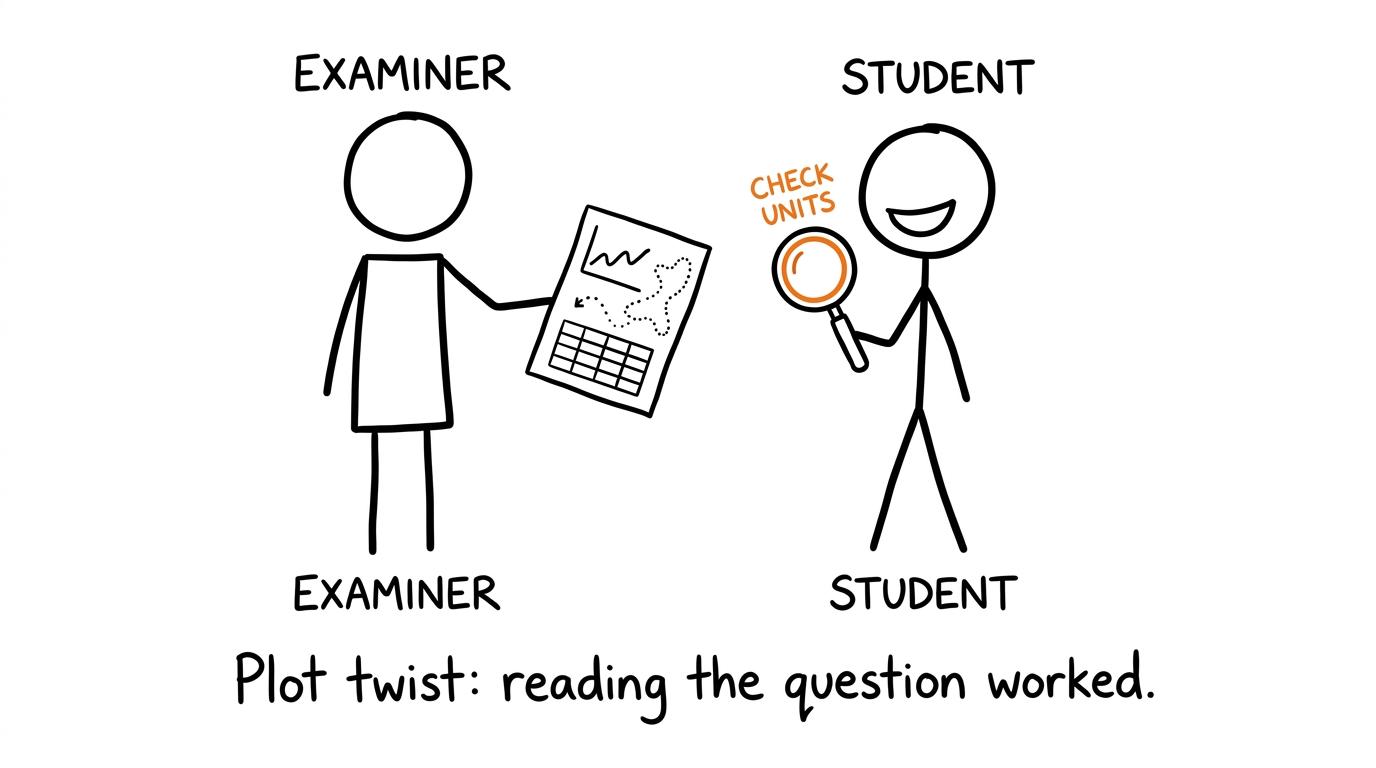 A student calmly investigates an examiner's mysterious graph and map
Does GCSE Geography help with college entry?
It can, but the answer depends on the institution and course.
Many sixth forms and colleges publish general entry requirements based on achieving a specified number of GCSEs at particular grades. English and maths commonly have their own minimum requirements, while individual A-levels may ask for a grade in a related GCSE. In that situation, Geography can contribute to the overall set of grades even if it is not directly required for your intended course.
If you wanted to take A-level Geography, some providers ask for a particular grade in GCSE Geography, sometimes alongside English or maths. Other providers may consider applicants differently. Requirements are local decisions and can change between admission years.
Before choosing or dropping a subject, check:
- the general entry requirements for each college;
- the requirements for your possible A-level or vocational courses;
- whether Geography GCSE is required, preferred or simply counted as one qualification;
- what happens if you later change your A-level choices;
- whether the published information applies to your intended year of entry.
Do not rely on a friend's recollection or assume every sixth form uses the same rules. Ask the admissions team if the wording is unclear.
In England, Geography is also one of the humanities that can contribute to the EBacc combination. The EBacc is a school performance measure rather than a separate qualification awarded to students, so it should not be confused with a college entry certificate.
When Geography may not be the best choice
A useful subject is not necessarily the best subject for you.
If you strongly dislike the content, find extended responses persistently difficult or have another option that aligns much more closely with your strengths, that deserves consideration. Workload matters too. Geography involves content recall, case-study knowledge, geographical skills and fieldwork preparation. It should not be treated as an effortless option simply because it includes familiar real-world topics.
A sensible decision balances four questions:
- Am I interested enough to revise it consistently?
- Am I likely to make progress with the available teaching and support?
- Does it keep open any route I may realistically want later?
- Can I manage it alongside compulsory subjects, especially maths and English?
You do not need to know your entire career at 141414 or 151515. You need a reasonable next decision, made with accurate information.
How to balance Geography with maths revision
The danger is not taking both subjects. It is revising whichever one feels easiest while repeatedly postponing the weaker one.
Start with your assessment evidence. Use Geography tests and maths papers to identify where marks are being lost. Then separate content gaps from skill gaps. If graph interpretation causes difficulty in both subjects, one focused session can support each course. If the issue is a Geography case study, it needs subject-specific retrieval rather than more calculations.
A practical weekly pattern is:
- revisit one weak skill using a short revision lesson;
- complete focused questions without notes;
- mark the work carefully;
- record the precise reason for each lost mark;
- return to the skill after a gap;
- test it later in a mixed or timed paper.
MathsGenie's guide to the best order for learning GCSE maths topics can help you sequence your revision. You can also use the GCSE maths topics by board and tier checklist to confirm what belongs on your Foundation or Higher tier course.
Closer to the exams, the one-month GCSE maths revision plan provides a manageable rhythm of lessons, targeted questions and timed practice. For Edexcel students, GCSE maths predicted papers can provide fresh exam-style practice, but predicted papers should support rather than replace official past papers.
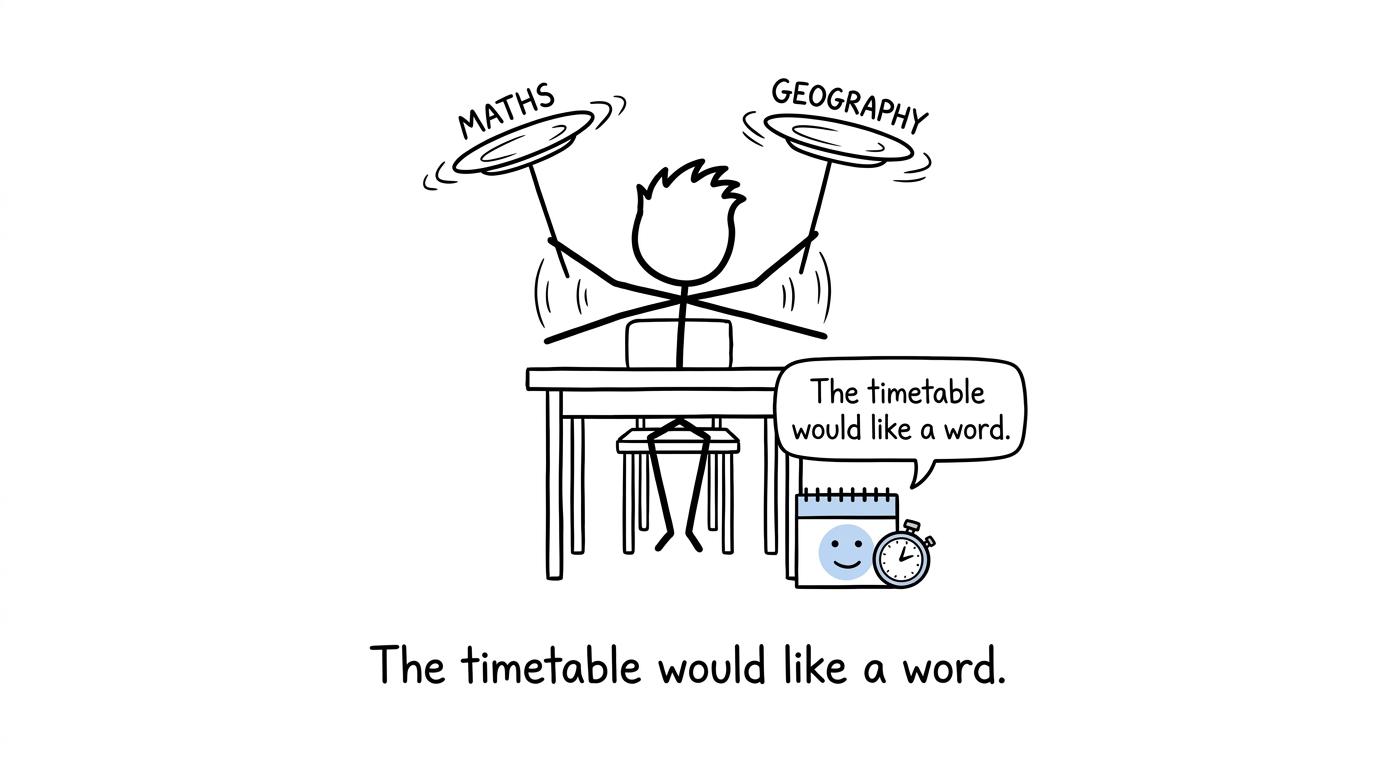 A student balances Geography and Maths while the timetable watches
Common mistakes when judging the value of Geography
Assuming every GCSE must lead to an A-level
GCSEs build a broad foundation. You can benefit from a subject's knowledge and methods without continuing it at Level 333.
Believing Geography contains no serious maths
Quantitative and statistical techniques are built into GCSE Geography assessment. Ignoring them can cost Geography marks as well as wasting a useful opportunity to reinforce maths.
Treating college requirements as universal
One sixth form may ask for a specific Geography grade for A-level Geography, while another may use different criteria. Check the current policy for each provider.
Choosing only because the subject seems easy
Geography requires knowledge, application, data interpretation, fieldwork understanding and extended writing. Choose it with a realistic view of the course.
Revising graphs without interpreting them
Plotting accurately is not enough. Read the axes, key, scale and units, then describe patterns using evidence. MathsGenie's Edexcel GCSE Statistics resources can help you practise data interpretation alongside statistical techniques.
A useful subject does not need to become your future
GCSE Geography can be worthwhile even when A-level Geography is not in your plan. It strengthens data handling, map reading, research, evaluation and evidence-based communication. It may contribute to general college entry requirements, keep A-level Geography open at providers that require the GCSE, and give mathematical skills a practical context.
Its value is not a promise that you must become a geographer. It is the collection of tools you carry into your next subjects.
Keep building those tools with MathsGenie. Use free revision lessons to understand each method, practice questions and mini tests to build accuracy, and past papers with mark schemes and video solutions to diagnose lost marks. When the exams approach, add predicted papers and a clear revision planner. Start with the skill that is costing you marks now; then practise it until it becomes one you can trust.